AI proactive engagement triggers: pilot guide for decision-makers
Discover how AI proactive engagement triggers can transform customer outreach by automating tailored communications for improved service.

AI proactive engagement triggers are event-driven decisions that automatically reach the right customer with the right channel, message, and timing, without waiting for the customer to act first. Gartner identifies event-driven and agentic technologies as among the most significant shifts in customer service through 2028, moving organisations from reactive support to anticipatory outreach. Platforms like Conversational AI are already operationalising this shift for regulated Australian enterprises across voice, SMS, email, and live chat.
Your first three actions before any pilot:
- Map three high-value trigger scenarios and the data events that drive each one (for example: account inactivity after day 14, a failed payment, or a completed onboarding step).
- Confirm the data infrastructure: event streams, a unified customer profile, and consent flags must exist before you write a single trigger rule.
- Design a small, measurable pilot with a holdout group so you can attribute lift to the trigger, not to background noise.
Before you proceed, note these immediate constraints:
- Privacy and consent: every outbound trigger requires a lawful basis and a clear opt-out path.
- Throttling: without per-customer cooldowns, even well-designed triggers create fatigue and opt-outs.
- Data quality: a trigger is only as reliable as the event data feeding it. Gaps in timestamps or identity resolution produce false positives.
Key takeaways
Event-driven AI triggers deliver measurable CX and revenue outcomes when they are built on clean data, governed by clear cooldown policies, and measured against a clean holdout group from day one.
| Point | Details |
|---|---|
| Start with three trigger scenarios | Map high-value events (inactivity, failed payment, onboarding drop-off) before building any infrastructure. |
| Data quality comes first | Consent flags, identity resolution, and timestamped event streams must be confirmed before any trigger goes live. |
| Measure with holdouts | A 10–20% holdout population, defined before launch, is the only reliable way to attribute lift to a trigger. |
| Cooldowns protect the channel | Per-customer cooldowns and opt-out propagation within 24 hours are non-negotiable guardrails. |
| Conversational AI for pilots | Conversational AI’s Australia-hosted platform covers multichannel delivery, CRM integration, and consent handling in a single governed environment. |
Table of Contents
- What are AI proactive engagement triggers and how do they work?
- How do event-driven triggers differ from scheduled campaigns?
- What infrastructure does an event-driven AI system need?
- High-impact use cases across the customer lifecycle
- How do you design trigger logic that scales without fatiguing customers?
- Managing frequency, signal noise, privacy, and ethics
- How do you measure whether triggers are actually working?
- A practical roadmap from pilot to production
- How Conversational AI maps to these requirements
- Conversational AI is production-ready for your first trigger pilot
- Sources
What are AI proactive engagement triggers and how do they work?
The industry term for this capability is event-driven engagement automation, though “AI proactive engagement triggers” captures the practitioner framing well. At its core, an event-driven trigger fires when a defined condition is met in real time, rather than on a fixed schedule. A customer abandons a cart, a sensor reports a service outage, a credit score crosses a threshold — the system detects the state change and dispatches a personalised response within seconds or minutes.
This is fundamentally different from passive messaging, where the customer must initiate contact. Proactive outreach intercepts the customer at the moment of highest relevance, which is why the role of AI in customer service has shifted so decisively toward anticipatory models.
The five main trigger types
- Time-based triggers: fire after a fixed interval (day 7 of no login, 30 days before contract renewal). Low complexity, easy to implement, but blind to context.
- Behaviour/event-based triggers: fire on a specific customer action or inaction (page visited, form abandoned, feature not used). Higher relevance than time-based alone.
- State-change triggers: fire when a record in a system of record changes (payment status, risk score, subscription tier). Require reliable event streaming from source systems.
- Predictive-score triggers: fire when an ML model scores a customer above a churn, upsell, or fraud threshold. Higher lift potential, but require training data and model governance.
- Agentic/AI-initiated triggers: the AI autonomously decides when and how to reach out based on a goal (retain this customer, resolve this complaint) rather than a fixed rule. Highest capability, highest governance requirement.
AI adds value at every layer: enriching raw signals with derived features, scoring propensity, routing to the optimal channel, generating personalised content, and optimising send timing. Simple rules handle the first two types adequately. Predictive and agentic triggers need ML infrastructure and clear human-in-the-loop gates.
| Trigger type | Latency need | Complexity | Typical ROI signal |
|---|---|---|---|
| Time-based | Minutes to hours | Low | Baseline engagement lift |
| Behaviour/event-based | Seconds to minutes | Medium | Conversion and completion rates |
| State-change | Seconds | Medium–high | Risk reduction, revenue recovery |
| Predictive-score | Near real-time | High | Retention lift, upsell conversion |
| Agentic/AI-initiated | Continuous | Very high | Net revenue retention, CSAT |
How do event-driven triggers differ from scheduled campaigns?
The distinction matters because the wrong tool for the job wastes budget and frustrates customers.
Event-driven AI triggers are the right choice when:
- The value of the message decays within minutes (fraud alert, service outage, failed payment).
- The trigger depends on individual customer state, not a segment.
- You need to personalise channel, content, and timing simultaneously.
- Recovery from a negative experience is the goal (cart abandonment, onboarding drop-off).
Scheduled campaigns remain sufficient when:
- The message is broadly relevant to a segment regardless of individual behaviour (monthly newsletter, seasonal promotion).
- Timing is driven by a calendar event, not a customer action.
- Data infrastructure for real-time event streaming does not yet exist.
Rules-based automation sits in between: it fires on events but applies fixed logic without ML scoring. It is faster to implement than predictive triggers and appropriate for high-volume, low-complexity scenarios like welcome sequences or appointment reminders.
| Use case | Latency need | Data complexity | Recommended approach |
|---|---|---|---|
| Service outage alert | Seconds | Low | Event-driven, rules-based |
| Churn prevention | Minutes to hours | High | Event-driven, predictive ML |
| Monthly newsletter | None | Low | Scheduled campaign |
| Upsell at renewal | Hours | Medium | Scheduled + predictive score |
| Fraud detection | Seconds | High | Event-driven, agentic |
| Onboarding nudge | Minutes | Medium | Event-driven, rules or ML |
What infrastructure does an event-driven AI system need?
Six architectural layers underpin a production-grade trigger system. IT teams should map each layer to their existing stack before committing to a vendor or build.
| Component | Purpose | Critical metric |
|---|---|---|
| Event ingestion/streaming | Captures and routes raw events in real time | End-to-end latency (target: under 500ms) |
| Identity/profile store | Resolves events to a single customer view | Match rate and merge accuracy |
| Feature store | Serves pre-computed and real-time features to models | Feature freshness (staleness threshold) |
| Inference/decisioning | Scores propensity, selects next-best action | Model latency and prediction accuracy |
| Orchestration layer | Manages channel routing, throttling, and sequencing | Trigger fire rate vs. delivery rate |
| Telemetry/observability | Monitors delivery, engagement, and model drift | Opt-out rate, engagement rate, drift alerts |
Data governance is not optional at any of these layers. You need a single customer view with consistent identifiers, a documented event taxonomy with reliable timestamps, and consent flags that propagate in real time to the orchestration layer. Forrester’s guidance on AI deployment foundations is direct: data quality and governance readiness are the most common failure point for AI customer initiatives, not the models themselves.
Monitoring checklist for operations teams:
- End-to-end trigger latency (from event to delivery confirmation)
- Delivery rate by channel (SMS, email, voice, push)
- Engagement rate per trigger type
- False-trigger rate (triggers fired on bad data)
- Model drift alerts (weekly minimum for predictive triggers)
- Opt-out rate per campaign and per channel
Pro Tip: Before you connect a feature store to a live model, instrument every event with a server-side timestamp at the point of capture. Client-side timestamps drift and create phantom latency that corrupts time-sensitive trigger logic.
For teams scaling agent configurations, configuring AI agent scalability settings covers the orchestration layer in practical detail.
High-impact use cases across the customer lifecycle
The highest-ROI trigger scenarios cluster around four lifecycle moments. Each one maps to a measurable KPI so you can build a business case before the pilot starts.
Onboarding and activation
A new customer completes registration but does not use the core feature within 48 hours. An event-driven nudge via SMS or in-app message, personalised to the feature they skipped, recovers a meaningful share of at-risk activations. KPI: day-7 activation rate.
Retention and re-engagement
Inactivity beyond a defined threshold triggers a personalised offer or a check-in message. The key is using a predictive churn score rather than a flat time rule — customers who are inactive but low-risk do not need a discount. KPI: 30-day retention lift in the triggered cohort versus holdout.
Risk, fraud, and outage notifications

State-change triggers on payment failure, unusual account activity, or a detected service outage are the clearest ROI case. The message is urgent, the customer expects it, and the cost of silence is high. KPI: resolution rate and complaint volume reduction.
Revenue: upsell, cross-sell, and collections
Next-best-action models score each customer for the most relevant offer at the moment of highest receptivity — after a successful transaction, at contract renewal, or when usage crosses a threshold. Payment reminder triggers on overdue accounts reduce days-sales-outstanding without requiring manual outreach. KPI: conversion lift per contact and cost per incremental conversion.
An ACM case study on ML-optimised push notifications reported measurable increases in orders and reductions in notifications per user after applying adaptive ML to more than 100 million daily push notifications on a food-delivery platform. The lesson: fewer, better-timed triggers outperform high-volume spray-and-pray approaches.
For practical examples of customer service automation triggers mapped to CRM events, the linked guide covers the taxonomy in detail.
How do you design trigger logic that scales without fatiguing customers?
Effective trigger design is a sequence of decisions, not a single configuration choice.
-
Select signals with care. Prioritise events with high fidelity (server-confirmed, timestamped), recency (within the last session or day), and demonstrated correlation with the outcome you want. Derived features — time since last purchase, rolling 7-day login frequency — often outperform raw events alone.
-
Choose the right model tier. Simple rules work for binary state changes (payment failed: yes/no). Predictive ML is appropriate when the trigger condition is probabilistic (churn risk above 70%). Agentic workflows, where the AI selects both the trigger condition and the response, suit complex multi-step recovery scenarios but require the most governance overhead.
-
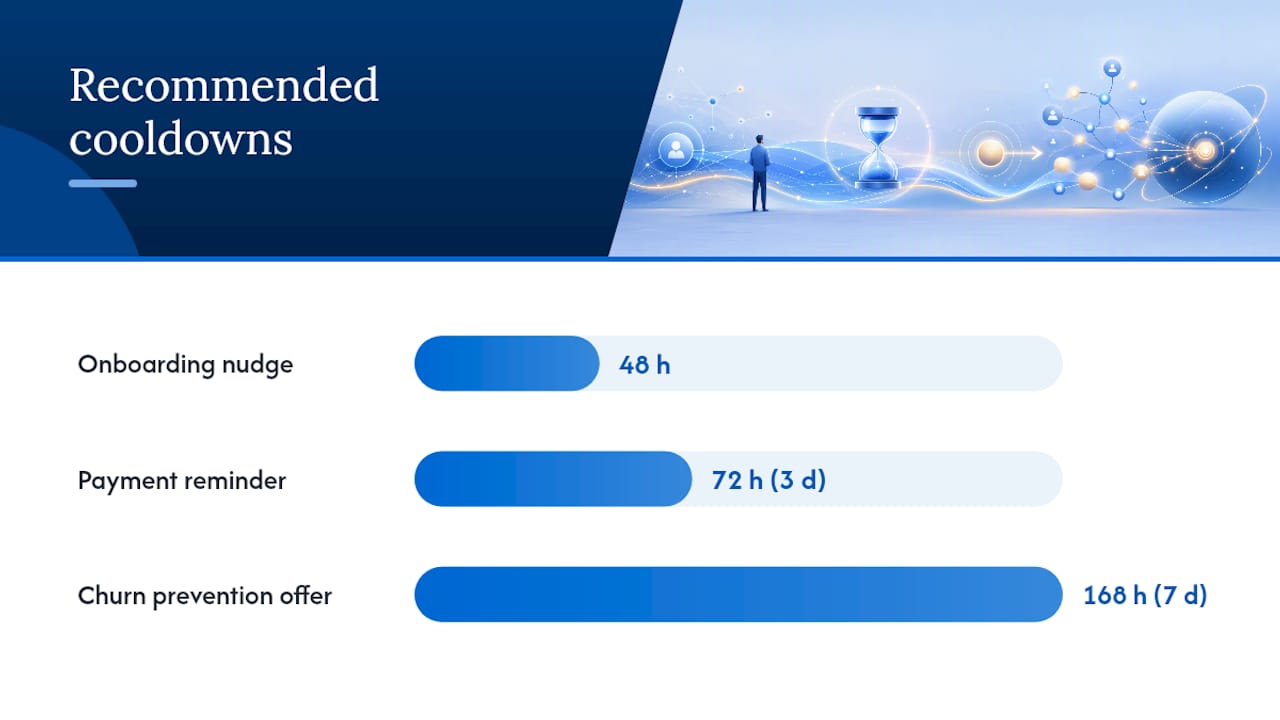
Set thresholds and cooldowns explicitly. A customer should not receive more than one proactive outreach per channel per day in most contexts, and no more than three per week across all channels. Define these as policy, not as model outputs.
| Trigger scenario | Recommended cooldown | Escalation rule |
|---|---|---|
| Onboarding nudge | 48 hours between messages | Escalate to human after 3 no-responses |
| Churn prevention offer | 7 days | One offer per 30-day window |
| Payment reminder | 3 days | Escalate to collections after 2 reminders |
| Fraud alert | No cooldown | Immediate escalation to human agent |
- Personalise at scale with variable stacking. A single message template with three to five variable slots (name, product, channel-specific CTA, preferred language) covers most personalisation needs without requiring bespoke content for every segment. Route to the customer’s preferred channel first; fall back to a secondary channel after a defined non-delivery window.
Pro Tip: For cold starts — when you have no historical engagement data for a new trigger — create three to five synthetic recipient archetypes based on CRM segment data and simulate expected engagement rates. Use these to set initial thresholds before live traffic calibrates the model. This approach is documented in ACM research on adaptive notification frameworks and avoids the common mistake of launching with thresholds that are either too aggressive or too conservative.
Voice and chat AI channel routing is worth reviewing when designing multi-channel fallback logic.
Managing frequency, signal noise, privacy, and ethics
Operational risks in proactive engagement are predictable. Most teams encounter the same four problems.
Notification fatigue is the most common. Customers who receive too many triggers opt out, and once they do, you lose the channel permanently. Implement user-level cooldowns (not just campaign-level), rotate message variants to avoid repetition, and monitor opt-out rate weekly. Practitioner resources consistently show that cooldowns, message rotation, and channel health signals are the standard toolkit for maintaining engagement without burning out the audience.
Signal noise and false positives damage trust fast. A fraud alert on a legitimate transaction, or a churn offer sent to a customer who just renewed, signals that your system does not know them. Validate event data at ingestion, build fallback rules for ambiguous signals, and gate high-stakes triggers (fraud, collections escalation) behind a human-in-the-loop review step.
Privacy and compliance requirements are non-negotiable. Every trigger must fire only for customers who have provided consent for that channel and communication type, with a functioning opt-out mechanism that propagates within 24 hours. Data minimisation applies: collect and process only the fields the trigger logic actually needs. For organisations operating under Australian Privacy Act obligations, data sovereignty — where customer data is stored and processed — is a material consideration when selecting infrastructure.
Ethics and transparency close the loop. Customers who receive an unexpected outreach and ask “how did you know that?” deserve a plain-language answer. Log every trigger decision with the signal that fired it, the model version, and the channel selected. These logs serve both audit and escalation purposes when a trigger fires incorrectly.
This conservative rollout catches misconfigured thresholds before they reach your full customer base.
How do you measure whether triggers are actually working?
Measurement discipline separates teams that improve from teams that iterate blindly.
Primary KPIs:
- Engagement rate per trigger type (opens, clicks, responses, call completions)
- Conversion lift in the triggered cohort versus a clean holdout group
- Retention lift at 30 and 90 days
- Lift per contact (incremental conversions divided by contacts sent)
- Cost per incremental conversion
Secondary KPIs:
- Delivery rate by channel (identifies infrastructure problems)
- End-to-end trigger latency (confirms real-time capability)
- False-trigger rate (measures signal quality)
- Opt-out rate per trigger type (early warning for fatigue)
Experiment design checklist:
- Define the holdout population before the trigger goes live. Never create a holdout retrospectively.
- Size the holdout to detect a meaningful lift with statistical confidence — for most engagement triggers, a 10–20% holdout is sufficient.
- Run the experiment for at least two full customer cycles (two weeks minimum for weekly-active products, two months for monthly).
- Control for contamination: customers in the holdout should not receive the trigger through any other channel.
- Check for streaking: if engagement spikes immediately after launch and decays, the trigger may be novelty-driven rather than value-driven.
| KPI | What it tells you | Action threshold |
|---|---|---|
| Engagement rate | Message relevance and timing | Below 10%: review signal and content |
| Conversion lift | Revenue attribution | Below 2%: reassess trigger condition |
| Opt-out rate | Fatigue and relevance | Above 2%: tighten cooldowns immediately |
| False-trigger rate | Data quality | Above 1%: audit event pipeline |
To build an ROI model, multiply lift per contact by the average revenue per conversion, subtract the cost of the trigger (infrastructure, content, agent escalation), and divide by total contacts sent. A trigger with reasonable conversion and average order value, and controlled cost per contact, can return a positive ROI — a clear case for scaling.
A practical roadmap from pilot to production
A 90-day pilot is the right scope for a first deployment. It is long enough to generate statistically meaningful data and short enough to maintain stakeholder momentum.
Phase 0: Discovery (weeks 1–2)
- Identify three trigger scenarios with clear business value and available event data.
- Audit data quality: confirm event streams, identity resolution, and consent flags are in place.
- Define success criteria and holdout design before any build begins.
Phase 1: MVP pilot (weeks 3–8)
- Implement the simplest trigger first — a rules-based state-change trigger with a single channel.
- Connect CRM sync, event stream, and delivery adapter. Connecting live chat AI to your CRM covers the integration steps in practical terms.
- Launch to 5% of eligible customers with a 20% holdout.
- Monitor daily: delivery rate, engagement rate, opt-out rate, and false-trigger rate.
Phase 2: Iterate and scale (weeks 9–12)
- Review pilot data against success criteria. Gate scale on: engagement rate above 10%, opt-out rate below 2%, false-trigger rate below 1%.
- Add a second trigger type (predictive-score or behaviour-based).
- Expand to full eligible population if gating criteria are met.
- Hand off monitoring to the operations team with documented SLAs.
Integration checklist:
- CRM sync: bidirectional, with event write-back for trigger outcomes
- Event stream: confirmed latency under 500ms end-to-end
- Identity resolution: match rate above 95% for target segments
- Delivery adapters: SMS, email, voice, and chat configured and tested
- Consent flag propagation: confirmed real-time across all channels
Change management essentials:
- Assign clear ownership: product (trigger logic), data engineering (pipeline), legal (consent review), and operations (monitoring).
- Brief customer-facing teams before launch so they can handle inbound queries about unexpected outreach.
- Document escalation paths for incorrect triggers from day one.
AI deployment project management guidance covers the organisational alignment steps in more detail.
Pro Tip: The most common pilot failure is launching without a documented fallback rule. If the model returns a null score or the event data is missing, the trigger should default to no-send rather than firing on incomplete information.
How Conversational AI maps to these requirements
Conversational AI’s Australia-hosted platform is built for exactly the architecture described above. Its multichannel agent layer covers voice, SMS, email, and live chat from a single orchestration surface, which removes the integration overhead of stitching together separate channel providers. CRM integration is bidirectional, supporting the event write-back that trigger measurement depends on. Contextual memory means the platform carries conversation state across sessions, so a follow-up trigger does not repeat information the customer already provided.
Platform capabilities mapped to core components:
- Event ingestion and orchestration: outbound campaign management with configurable trigger conditions and cooldown policies.
- Delivery layer: multichannel agents with channel preference routing and fallback sequencing.
- Personalisation: contextual memory and dynamic content variables across all channels.
- Observability: real-time analytics and agentic reporting for engagement and delivery metrics.
- Governance: Australia-hosted private cloud, consent handling, and data sovereignty compliance for regulated sectors including healthcare, finance, and professional services.
Pilot checklist for Conversational AI:
- Configure consent flags and opt-out handling before any trigger goes live.
- Set up CRM sync and confirm event write-back is active.
- Define cooldown policies at the platform level before enabling individual triggers.
- Start with a single outbound SMS or voice trigger on a rules-based condition.
- Enable real-time analytics from day one so the pilot generates usable data.
For teams considering enterprise-scale AI deployment, the platform’s modular structure means you can add trigger types and channels incrementally without re-architecting.
Pro Tip: For regulated sectors, confirm that your platform vendor can provide written confirmation of data residency and processing location before signing. Australia-hosted infrastructure is not a marketing claim — it is a compliance requirement for many healthcare and financial services organisations.
The pilot pitfalls that most enterprise teams learn the hard way
Over-automation is the most predictable mistake. Teams that activate five or six trigger types simultaneously in the first pilot cannot isolate which trigger drove which outcome, and they usually generate enough opt-outs to poison the data. One trigger, one channel, one holdout group — that discipline is what produces a result you can actually defend to a CFO.
Weak signals are the second failure mode. A trigger built on a derived feature that sounds plausible but has no validated correlation with the outcome will fire frequently and convert rarely. The temptation to launch on intuition rather than validated signal correlation is strong when the business is impatient. Resist it. Two weeks of signal validation before build is cheaper than six weeks of a pilot that produces no usable data.
The third pitfall is ignoring change management. Customer-facing teams who are not briefed on new proactive outreach will receive confused or angry customer calls and have no context to respond. That erodes confidence in the programme faster than any technical failure. Brief operations, document escalation paths, and make the trigger logic legible to non-technical staff from day one.
The underlying discipline is the same across all three: measure before you scale, and build the organisational muscle for it before you build the technology.
Conversational AI is production-ready for your first trigger pilot
Most enterprise teams spend months in vendor evaluation when the faster path is a contained 90-day pilot on a platform that already meets their governance requirements. Conversational AI gives regulated Australian organisations a private-cloud, Australia-hosted environment where trigger logic, consent handling, and multichannel delivery are configured from a single platform — no stitching together separate tools for SMS, voice, and CRM sync.
The practical starting point: pick one high-value trigger scenario from the use cases above, confirm your event data is clean, and run a pilot with a holdout group. Conversational AI’s team can support scoping, configuration, and measurement design from the first conversation. Contact Conversational AI to discuss a pilot that fits your infrastructure and compliance requirements.
Sources
- Gartner reveals three technologies that will transform customer service and support by 2028
Recommended
- AI model management: a guide for enterprise practitioners - Conversational AI
- Multichannel AI agent deployment guide for enterprises - Conversational AI
- Why audit AI system decisions: guide for Australian organisations - Conversational AI
- AI sentiment analysis for customer calls: CX manager’s guide - Conversational AI