The Role of AI in Customer Service: 2026 Guide
Discover the role of AI in customer service and how it enhances interactions, boosts efficiency, and resolves issues effectively.

AI in customer service is defined as the deployment of automated systems, including chatbots, virtual assistants, and intelligent routing tools, to handle customer inquiries, personalize interactions, and support human agents at scale. Platforms like Zendesk, Salesforce, and IBM have embedded AI directly into their service workflows, making automation a standard expectation rather than a competitive advantage. The role of AI in customer service has expanded well beyond answering simple FAQs. Today it covers complaint resolution, inbound call handling, queue management, upselling, and customer retention. The challenge for business leaders is not whether to adopt AI, but how to deploy it in a way that actually resolves customer problems rather than deflecting them.
How does AI improve customer service operations?
AI improves customer service by automating routine tasks, personalizing interactions, and giving human agents better information faster. The practical impact shows up across every channel: voice, SMS, email, and live chat. When AI handles the predictable volume, your team can focus on the cases that genuinely require human judgment.
Customer self-service AI, the industry term for AI-powered portals and virtual agents that let customers resolve issues without speaking to a person, is one of the highest-impact applications. AI-powered self-service accesses purchase history, subscription tiers, and previous interaction records to deliver relevant answers and dynamic content. That level of personalization reduces escalations and increases first-contact resolution rates.
The operational gains extend to back-end workflows as well. AI ticket routing reads the content of an incoming request and assigns it to the right team or agent automatically. AI response generation drafts replies for agents to review, cutting handle time without removing human oversight. For a deeper look at how these workflows connect across channels, multi-channel communication orchestration is worth understanding as a discipline in its own right.
Top AI customer service use cases in 2026:
- Chatbot triage for inbound call handling and live chat
- Automated ticket classification and routing
- AI-generated response drafts for agent review
- Sentiment analysis to flag at-risk customers for retention outreach
- Personalized upselling prompts based on purchase history
- Queue management and callback scheduling
- Post-interaction surveys and automated follow-up sequences
- Knowledge base search and dynamic FAQ delivery
How are human agent roles changing because of AI?
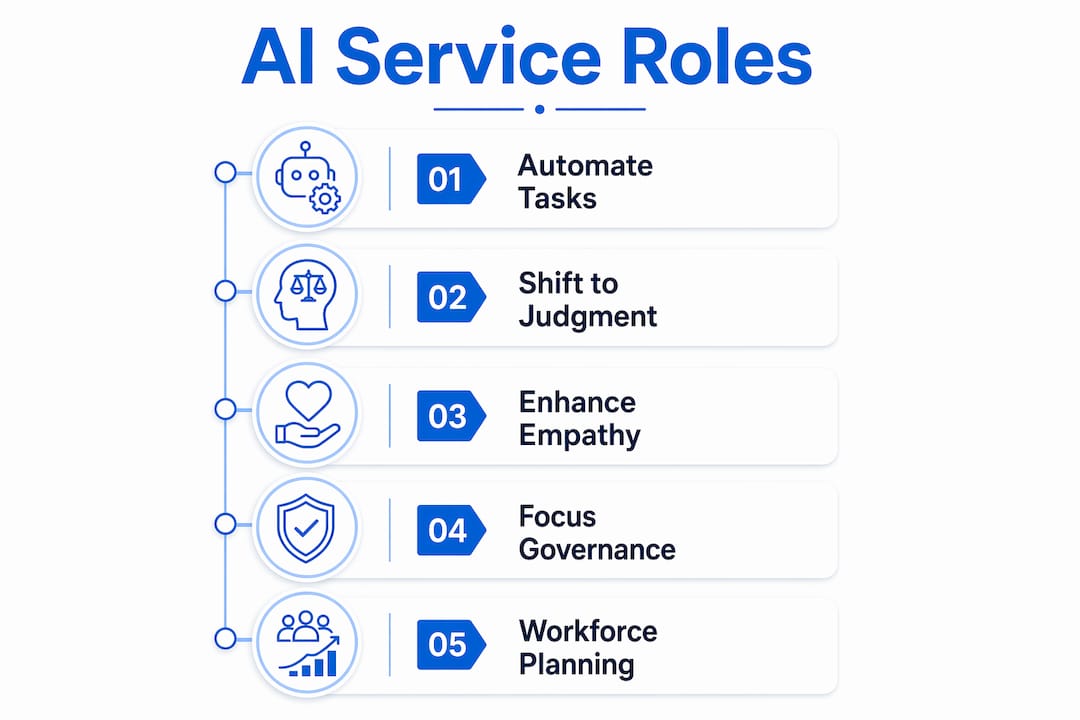
AI does not eliminate customer service jobs. It restructures them. Forrester predicts that by 2030, AI will automate 49% of current customer service roles, shifting human work toward overseeing and managing AI agents. That is a fundamental change in what the job requires, not just a reduction in headcount.

The roles that grow are those requiring judgment, empathy, and governance. Agents move from answering calls to managing AI agent performance, handling complex escalations, and specializing in policy interpretation. Quality assurance expands significantly because someone must review what the AI is doing and correct it when it drifts. New “light technology” roles are also emerging, where frontline staff configure AI agents using low-code tools rather than waiting on IT.
Organizations must anticipate this shift in workforce capability. The skills your team needs in 2026 are different from the skills they needed in 2022. Training programs need to cover AI agent configuration, escalation protocol design, and quality review of AI outputs. For enterprise teams already working through this transition, AI automation and team productivity examples from comparable organizations can accelerate the learning curve.
Pro Tip: Before deploying AI in your contact center, map every existing role against the tasks AI will handle. Identify which staff members are best suited for escalation management, AI quality assurance, or low-code configuration. Retraining is faster when you start with a clear picture of the gap.
What trust and design challenges does AI customer service create?
AI customer service introduces a category of risk that traditional service design does not account for: confident wrong answers. A human agent who does not know the answer will usually say so. An AI system may generate a plausible but incorrect response with no visible uncertainty signal. That failure mode erodes customer trust faster than a slow response time ever could.
The RRR framework, which stands for reliability, responsiveness, and relational quality, provides a structured approach to designing trustworthy AI service systems. Reliability means the system performs consistently and accurately. Responsiveness means customers feel heard and attended to, not just processed. Relational quality means the interaction preserves dignity and does not feel transactional or dismissive. Speed and automation alone are insufficient. Felt responsiveness and relational quality must guide AI service design.
A critical failure mode is the inability to detect when to stop and escalate. AI systems need explicit uncertainty thresholds and graceful failure protocols. When the AI cannot resolve an issue, it should acknowledge that clearly and hand off to a human without making the customer repeat themselves. The NIST AI Risk Management Framework recommends a GOVERN, MAP, MEASURE, MANAGE approach to evaluate validity, reliability, safety, fairness, and privacy across AI deployments. That framework gives customer service leaders a structured way to assess risk before it becomes a public complaint.
| Trust principle | Traditional service design | AI service design requirement |
|---|---|---|
| Reliability | Agent training and scripts | Accuracy thresholds and output monitoring |
| Responsiveness | Wait time and tone | Felt attentiveness and uncertainty acknowledgment |
| Relational quality | Agent empathy | Dignity-preserving escalation protocols |
| Failure recovery | Supervisor escalation | Graceful handoff with context transfer |
| Governance | HR policy and QA | NIST-aligned AI risk management |
Pro Tip: Set a defined confidence threshold for your AI system. Any response below that threshold should trigger an automatic offer to connect the customer with a human agent. This single rule prevents the majority of confident-but-wrong AI failures.
What are the best practices for implementing AI in customer service?
Success with AI depends not on the technology’s capabilities alone, but on how your organization defines and measures successful resolution. CNBC reports that many AI deployments still fail to truly resolve issues, deflecting rather than solving customer problems. Zendesk counts resolution only when the customer, the business, and the employee all agree the problem is solved. That three-way definition is the right standard.
Optimizing AI for deflection or call time reduction risks customer dissatisfaction when success metrics do not align with true resolution. Tom Eggemeier of Zendesk highlights the need for outcome-focused measurements across all three stakeholder perspectives. Deflection numbers look good on a dashboard. Customer satisfaction scores tell the real story.
Hybrid human-AI escalation paths are the operational structure that makes AI deployable at scale. AI handles routine tasks. Humans handle complex, emotional, and high-stakes issues where empathy is the deciding factor. CEOs at major service organizations emphasize AI as an aid, not a replacement, in complex cases. That framing should guide every implementation decision you make.
Implementation steps for AI in customer service:
- Audit your current contact volume and categorize inquiries by complexity and emotional stakes.
- Deploy AI on high-volume, low-complexity interactions first: FAQs, order status, appointment booking.
- Build explicit escalation triggers based on sentiment signals, topic complexity, and customer tier.
- Define resolution using a three-way confirmation model: customer, employee, and business.
- Measure containment rate, first-contact resolution, and customer satisfaction separately. Do not combine them into a single deflection metric.
- Review AI agent performance weekly in the first 90 days. Adjust confidence thresholds based on real outcomes.
- Expand AI scope only after each phase meets your resolution quality benchmark.
For teams managing IT service desks alongside customer-facing support, automating your IT helpdesk with AI follows the same phased logic and offers a practical parallel model.
Key takeaways
AI in customer service delivers real operational value only when organizations measure true resolution, not deflection, and pair automation with clear escalation protocols.
| Point | Details |
|---|---|
| Define resolution correctly | Use a three-way confirmation model: customer, employee, and business must all agree the issue is solved. |
| AI restructures jobs, not eliminates them | By 2030, Forrester predicts 49% of current roles will shift toward AI oversight, QA, and escalation management. |
| Trust requires design, not just accuracy | Apply the RRR framework and NIST guidelines to address confident wrong answers and graceful failure. |
| Start with low-complexity, high-volume tasks | Deploy AI on FAQs and order status first, then expand scope after each phase meets resolution benchmarks. |
| Hybrid escalation is non-negotiable | AI handles routine volume; humans handle emotional and complex cases where empathy determines the outcome. |
Where AI implementation gets harder than the demos suggest
The demos always look clean. The AI understands the question, retrieves the right answer, and the customer says thank you. Real deployments are messier. Customers phrase things in ways the training data did not anticipate. Edge cases pile up. And the most damaging failure is not the AI saying “I don’t know.” It is the AI saying the wrong thing with complete confidence.
What I have seen consistently is that organizations underinvest in the governance layer. They spend heavily on the AI platform and almost nothing on the protocols that govern when the AI should stop. The NIST framework exists precisely because this gap is predictable. The organizations that get AI customer service right treat the governance work as equal in importance to the technology selection.
The other thing worth saying plainly: AI is not a substitute for fixing a broken service process. If your returns process is confusing, an AI chatbot will confuse customers faster and at greater scale. AI amplifies what is already there. Fix the process first, then automate it. That sequence matters more than which platform you choose.
— Sowrabh
AI customer service solutions built for Australian businesses
Australian enterprises face a specific set of requirements that generic platforms often miss: data sovereignty, local compliance, and the expectation that customer data stays onshore.
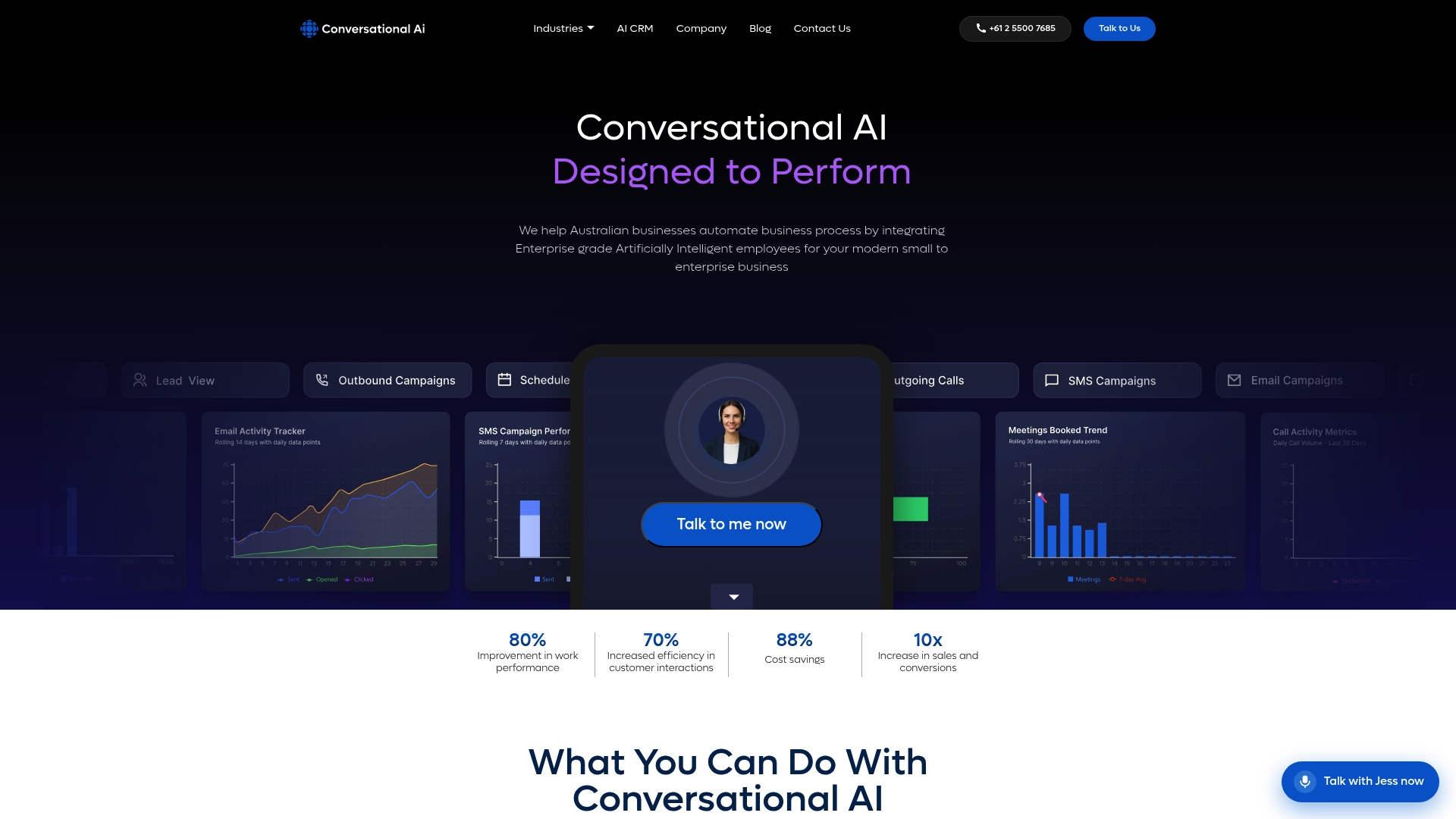
Conversational AI delivers multi-channel AI agents across voice, SMS, email, and live chat, all hosted within Australia and built to integrate with your existing CRM infrastructure. The platform covers the full service workflow, from automated triage and queue management to escalation routing and real-time analytics. If you are evaluating how to deploy AI agents for your business, Conversational AI is built specifically for the compliance and operational demands Australian organizations face. Contact the team to see how the platform fits your current service structure.
FAQ
What is the role of AI in customer service?
AI in customer service automates routine inquiries, personalizes interactions using customer data, and supports human agents with faster information and response drafts. Its core function is to handle predictable volume so human agents can focus on complex and emotionally sensitive cases.
What is customer self-service AI?
Customer self-service AI refers to AI-powered portals and virtual agents that let customers resolve issues without speaking to a person. These systems access purchase history and previous interactions to deliver personalized answers and reduce escalations.
How does AI affect customer service jobs?
Forrester predicts AI will automate 49% of current customer service roles by 2030, shifting human work toward AI agent oversight, quality assurance, and escalation management rather than eliminating positions outright.
What is the biggest risk of AI in customer service?
The biggest risk is AI generating confident but incorrect responses without signaling uncertainty. The RRR framework and NIST AI Risk Management guidelines both address this through reliability standards, escalation protocols, and ongoing human oversight.
How should businesses measure AI customer service success?
Businesses should measure success using a three-way resolution confirmation: the customer, the employee, and the business must all agree the issue is resolved. Deflection rate alone is not a valid success metric and often masks customer dissatisfaction.