Sovereign AI in Australia: the enterprise compliance guide
Discover how sovereign AI in Australia ensures compliance with privacy laws, safeguarding your data sovereignty for regulated enterprises.

For regulated Australian enterprises, a privately hosted, Australia-resident conversational AI control plane is the recommended approach to meet Privacy Act and APP obligations while preserving full data sovereignty.
Here is why that matters right now, and what to do next:
- Data residency and sovereignty are not the same thing. Residency is where data sits; sovereignty depends on who controls the system and which legal jurisdiction governs disclosure. An offshore-controlled provider with Australian servers can still be compelled to disclose your data under foreign law.
- APP 8 and APP 6 create real cross-border risk. The Privacy Act 1988 applies extraterritorially, and the OAIC’s guidance confirms that cloud hosting may disclose personal information outside Australia if the operating environment is not carefully scoped.
- Technical controls must sit at the inference boundary. Data loss prevention (DLP), role-based access control (RBAC), and policy enforcement need to operate where prompts and outputs are generated, not just at the network perimeter.
Immediate next step: Involve your privacy, procurement, and infrastructure leads in a joint session, then request a demo or pilot scoping call with your sovereign AI vendor. Thirty days of scoping now prevents months of remediation later.
Pro Tip: Before any vendor conversation, classify your data into tiers. Know which workloads carry personal information before you evaluate deployment models.
Key takeaways
Australia-hosted, privately controlled conversational AI is the only deployment model that gives regulated enterprises a clean answer to APP 8 cross-border disclosure risk and positions them for the ADM disclosure obligations arriving in December 2026.
| Point | Details |
|---|---|
| Residency ≠ sovereignty | On-shore hosting alone is insufficient if the provider is subject to foreign disclosure laws. |
| APP 8 requires documented steps | A signed DPA, named sub-processors, and audit rights are the minimum evidence for reasonable steps. |
| ADM disclosure from December 2026 | APPs 1.7–1.9 require privacy policy disclosure of automated decision-making from 10 December 2026. |
| Procurement gating stops shadow AI | A two-tier internal policy and do-not-use register prevent unapproved tools from reaching production. |
| Conversational AI fits this model | Australia-hosted, with private cloud and on-prem options, DPA-backed, and built for regulated sectors. |
This article is general information, not a substitute for advice from a qualified lawyer. Consult a qualified legal professional about your own circumstances before acting on anything here.
Table of Contents
- What Australian deployments teach you about compliance and architecture
- Your 90-day procurement and pilot checklist
- Conversational AI: Australia-hosted and built for this compliance environment
- Sources
What Australian deployments teach you about compliance and architecture
The gap between “we use an Australian data centre” and genuine sovereign AI in Australia is wider than most procurement teams expect. Here is what consistently surfaces in enterprise pilots.
Start with data classification. Map each data tier to the minimum acceptable deployment point on the spectrum: public SaaS, private cloud, on-premises, or air-gapped. Sensitive personal information and regulated health or financial data typically require private cloud or on-prem, where the full AI data path, including prompts, embeddings, and logs, stays in-jurisdiction.
APP 8 and OAIC guidance set the floor. The OAIC advises organisations to assess hosting location, access controls, and cross-border disclosure risk for every AI product they deploy. Reasonable steps under APP 8 mean a signed Data Processing Agreement (DPA) with explicit Australia data residency clauses, a named sub-processor list, and documented audit rights. A PIA is recommended for any high-privacy-risk AI activity, and the OAIC’s submission on safe and responsible AI reinforces that PIAs and higher organisational accountability are the expected standard.
ADM disclosure is coming. From 10 December 2026, APPs 1.7–1.9 will require organisations to disclose automated decision-making in their privacy policies. If your conversational AI routes, scores, or decides on customer outcomes, that disclosure obligation applies to you now, not after go-live.
Technical design checks that matter most:
- Enforce DLP and policy at the inference boundary, not just the API gateway
- Keep prompts, outputs, embeddings, and logs in-country at rest and during inference
- Implement RBAC with least-privilege access and immutable audit logs with defined retention periods
- Require encryption in transit and at rest, with key management under your control
Procurement gates prevent shadow AI. A compliance playbook approach recommends two internal tiers: a PII-cleared tier for tools that passed the APP 6/8 decision tree, and an internal-only tier for drafting. No tool reaches production without clearing procurement. A do-not-use register for consumer-grade AI tools closes the shadow AI gap that most pilots discover too late. Australia’s evolving regulatory environment means governance controls built now will absorb future compliance uplift with far less disruption.
Your 90-day procurement and pilot checklist
- Classify data (Days 1–10). Tier all data the AI will touch. Identify which tiers carry personal information and map each to its minimum deployment model. Owner: Privacy/Legal.
- Run the APP 6/8 decision tree (Days 10–20). For each use case, confirm cross-border disclosure risk and document reasonable steps. Owner: Privacy Officer.
- Require DPA and sub-processor list (Days 15–25). No vendor advances without a signed DPA naming Australian data residency, sub-processors, and audit rights. Owner: Procurement/Legal.
- Technical proof-of-concept with on-shore inference and DLP (Days 20–45). Validate that prompts, outputs, and logs stay in-jurisdiction. Confirm RBAC, encryption, and audit logging meet your standards. Owner: Infrastructure/IT.
- Run a Privacy Impact Assessment (Days 30–50). Mandatory for high-privacy-risk activities. Document findings and remediation actions. Owner: Privacy Officer.
- Obtain IRAP, SOC 2, ISO 27001 evidence and third-party pentest results (Days 40–60). Treat gaps as blockers, not conditions. Owner: IT Security.
- Staff training and rollout gating (Days 60–90). Train teams on the two-tier policy and do-not-use register before go-live. Gate production promotion on PIA sign-off and security evidence. Owner: Operations/HR.
Cost model expectations: Sovereign AI platforms in Australia commonly use a pricing model that includes a subscription licence, implementation fee, and optional professional services for integration and training, though specifics vary by vendor. Commercial variance is driven by data retention period, SLA tier, number of integrations (CRM, telephony, channels), and white-label requirements. Request itemised pricing across all three components before signing.
Conversational AI: Australia-hosted and built for this compliance environment
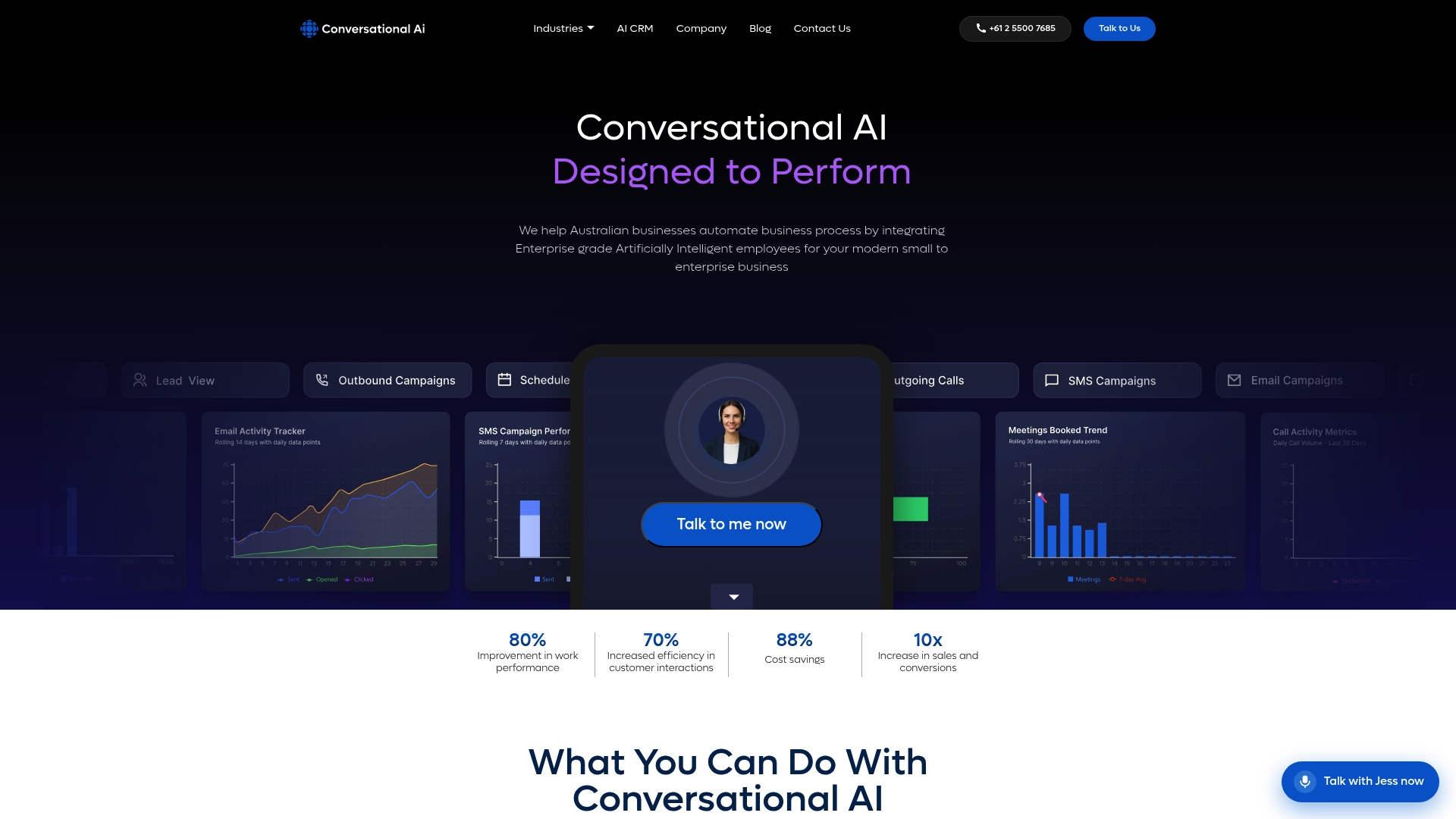
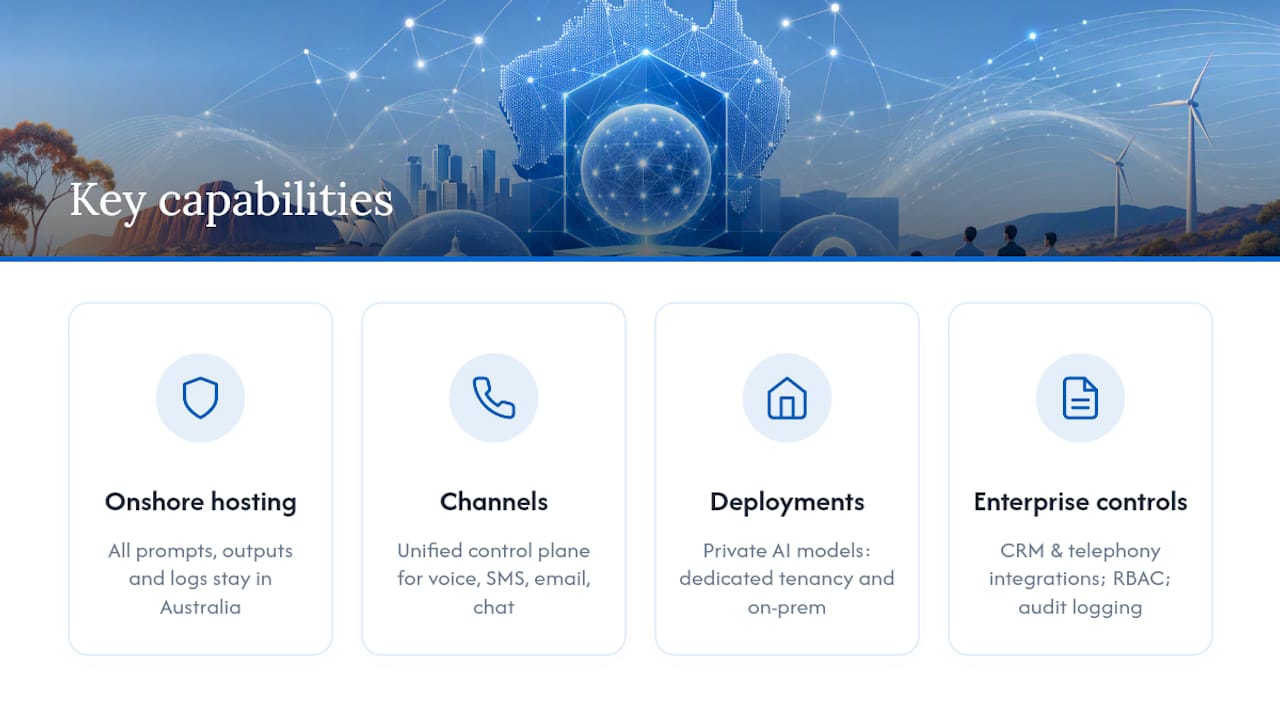
Conversational AI is an Australia-hosted enterprise platform built specifically for organisations that cannot afford to treat data sovereignty as an afterthought. Every prompt, output, embedding, and log stays on Australian soil, under Australian legal jurisdiction, with no offshore inference path. That is the concrete difference for teams running APP 8 and PIA assessments: the cross-border disclosure question has a clean answer from day one.
The platform covers voice, SMS, email, and live chat through a single control plane, with private AI deployment models that include dedicated tenancy and on-premises options for regulated sectors. CRM and telephony integrations, RBAC, immutable audit logging, and DPA-backed sub-processor transparency are standard, not add-ons.
Healthcare, finance, and professional services teams use it to automate customer service, appointment scheduling, lead qualification, and collections, without moving sensitive data outside their compliance boundary. To scope a pilot for your environment, request a demo with your privacy and infrastructure leads in the room.
Sources
- Guidance on privacy and the use of commercially available AI products | OAIC
- Privacy Act 1988 Compilation No. 95 Compilation date: 14/09/2023 Registered: 16/09/2023 (text / pdf)
- Automated decision‑making transparency: what APP entities need to know about the APP 1 amendments | Allens
- Australia in focus: data protection and AI in Australia | Reed Smith
- AI data sovereignty Australia: APP‑8 guide | Mamba Strategic
- Privacy Act 1988 + AI: 2026 Compliance Playbook (AU) | Aivy