AI system integration for Australian enterprises
Discover what is AI system integration for Australian enterprises. Unify your software, enhance compliance, and maximize efficiency seamlessly.

AI system integration is the engineering process of unifying disparate AI components and enterprise software into a coordinated whole. Think of it as the connective tissue between your CRM, communication channels, data pipelines, and AI models. For Australian enterprises, this means voice agents, SMS bots, live chat, and email automation all operating from a single governed platform, with data staying onshore and compliance baked in from day one.
Key components of a well-structured AI integration include:
- Middleware and APIs that handle data routing, format conversion, and protocol translation between systems
- Security and governance frameworks controlling access, data classification, and audit trails
- Multi-channel orchestration across voice, chat, SMS, and email
- Data sovereignty controls ensuring information stays within Australian borders, meeting Privacy Act and APRA obligations
Table of Contents
- Security, governance, and compliance you cannot afford to skip
- How multi-channel conversational AI handles data across channels
- Common challenges in AI integration and how to address them
- What the integration process looks like in practice
- How AI integration affects your existing IT infrastructure
- Conversational AI: secure multi-channel integration, built for Australia
- Key takeaways
Security, governance, and compliance you cannot afford to skip
Agentic AI introduces new security risks the moment it connects to live enterprise systems. Without proper data classification and Purview tuning, sensitive information can leak through seemingly routine queries. Governance cannot be retrofitted after deployment.

Australian enterprises face a specific compliance stack: APRA CPS 230 and CPS 234, the Privacy Act, the Essential Eight framework, and OAIC mandates all set binding standards for how AI handles enterprise data. Regulated sectors like banking and healthcare have zero tolerance for gaps.
Secure architectures typically rely on private cloud or air-gapped environments. Sovereign AI stacks built for government and high-compliance industries embed PII redaction and human-in-the-loop approval flows by design, not as optional add-ons. Addressing AI adoption risks early in your integration planning prevents costly remediation later.
Pro Tip: Map your data classification tiers before connecting any AI agent to a live system. Knowing which fields are sensitive determines your approval workflows and access controls from the start.
How multi-channel conversational AI handles data across channels
A properly integrated multi-channel AI deployment routes every customer interaction through a unified data layer. Here is how the technical flow works:
- Ingestion — customer inputs arrive via voice, SMS, email, or live chat and are normalised into a common format
- Model serving — the AI model processes each request via an exposed inference API, applying context from prior interactions
- Output routing — responses are directed back through the correct channel while CRM records update in real time
- Monitoring and feedback — logging at every integration boundary catches drift and flags anomalies before they affect customers
CRM synchronisation is the linchpin. Every channel interaction should write back to a single source of truth, giving your team a complete picture without manual data entry.
Common challenges in AI integration and how to address them
The biggest pitfall Australian enterprises hit is giving AI direct ownership of CRM data. When an AI agent can overwrite records without approval, data integrity erodes fast. The safer model: AI proposes updates, humans or policy engines confirm them.
Other challenges worth planning for:
- Legacy system compatibility — older ERP and SCADA systems often need specialised connectors before any AI layer can attach
- Architectural coupling — synchronous versus asynchronous data flows affect latency, throughput, and compliance risk differently
- Observability gaps — without logging and alerting at integration boundaries, failures go undetected until a customer complains
Pro Tip: Start with read-only AI access to your CRM. Build confidence in the data matching logic before enabling any write actions, even low-risk ones like attaching call summaries.
What the integration process looks like in practice
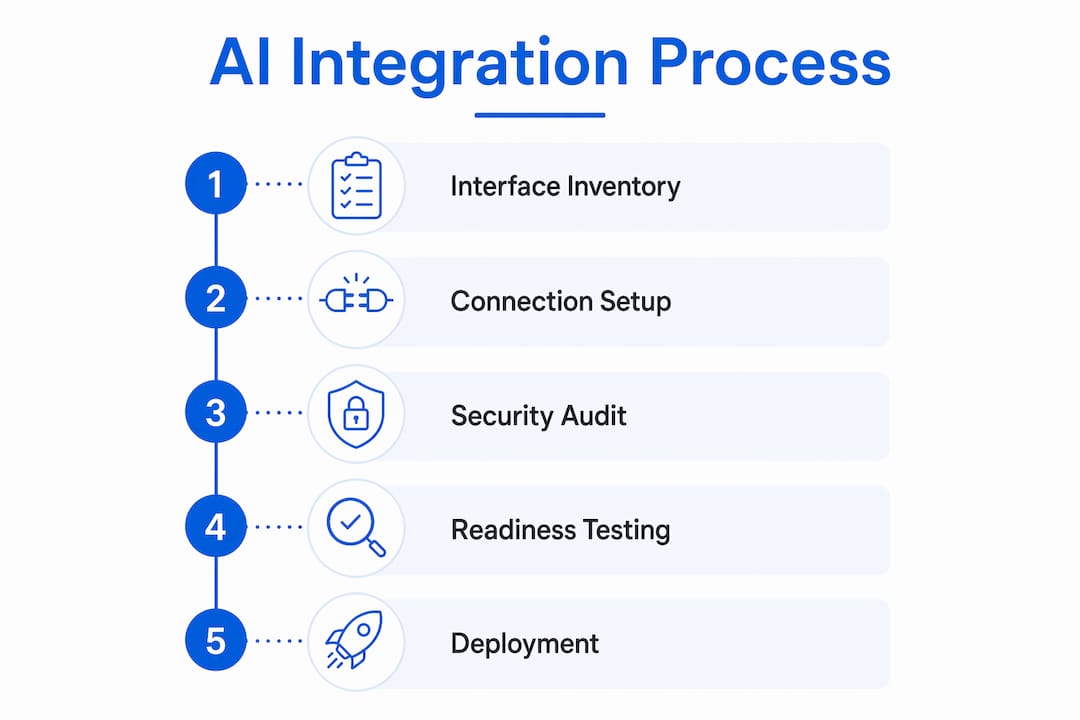
A phased approach reduces risk and keeps teams in control. Enterprise service buses and API gateways act as the integration layer, decoupling components so individual systems can be updated without breaking the whole.
| Phase | Activity |
|---|---|
| Interface inventory | Document every system, API, and data contract in scope |
| Connectivity architecture | Choose synchronous, asynchronous, or hybrid data flows |
| Data contract specification | Define field mappings, formats, and validation rules |
| Integration testing | Run incremental testing from bottom-up through end-to-end scenarios |
| Observability | Hook metrics, logging, and alerting at every boundary |
For healthcare, finance, and professional services, audit readiness is non-negotiable. Platforms built for private AI deployment on sovereign Australian infrastructure handle this by design.
How AI integration affects your existing IT infrastructure
Connecting AI to legacy infrastructure is rarely plug-and-play. ERP systems, telephony platforms, and document management tools each need validated connectors before data flows reliably. Network architecture also shifts: AI inference workloads add latency considerations that affect how you route traffic between on-premise and cloud environments.
Australian enterprises increasingly prefer sovereign cloud deployment for data residency and low-latency performance. Keeping data onshore satisfies Privacy Act obligations and removes the ambiguity that comes with offshore processing.
- Continuous integration pipelines catch interface defects before they reach production
- Security monitoring must extend to AI integration boundaries, not just the perimeter
- Operational workflows change when AI handles first-contact triage; staff need clear escalation protocols
Pro Tip: Treat your AI integration layer as a living system. Schedule quarterly observability reviews to catch model drift and data mapping errors before they compound.
Conversational AI: secure multi-channel integration, built for Australia
Australian enterprises that need private, compliant, multi-channel AI integration without building the stack from scratch have a direct option.
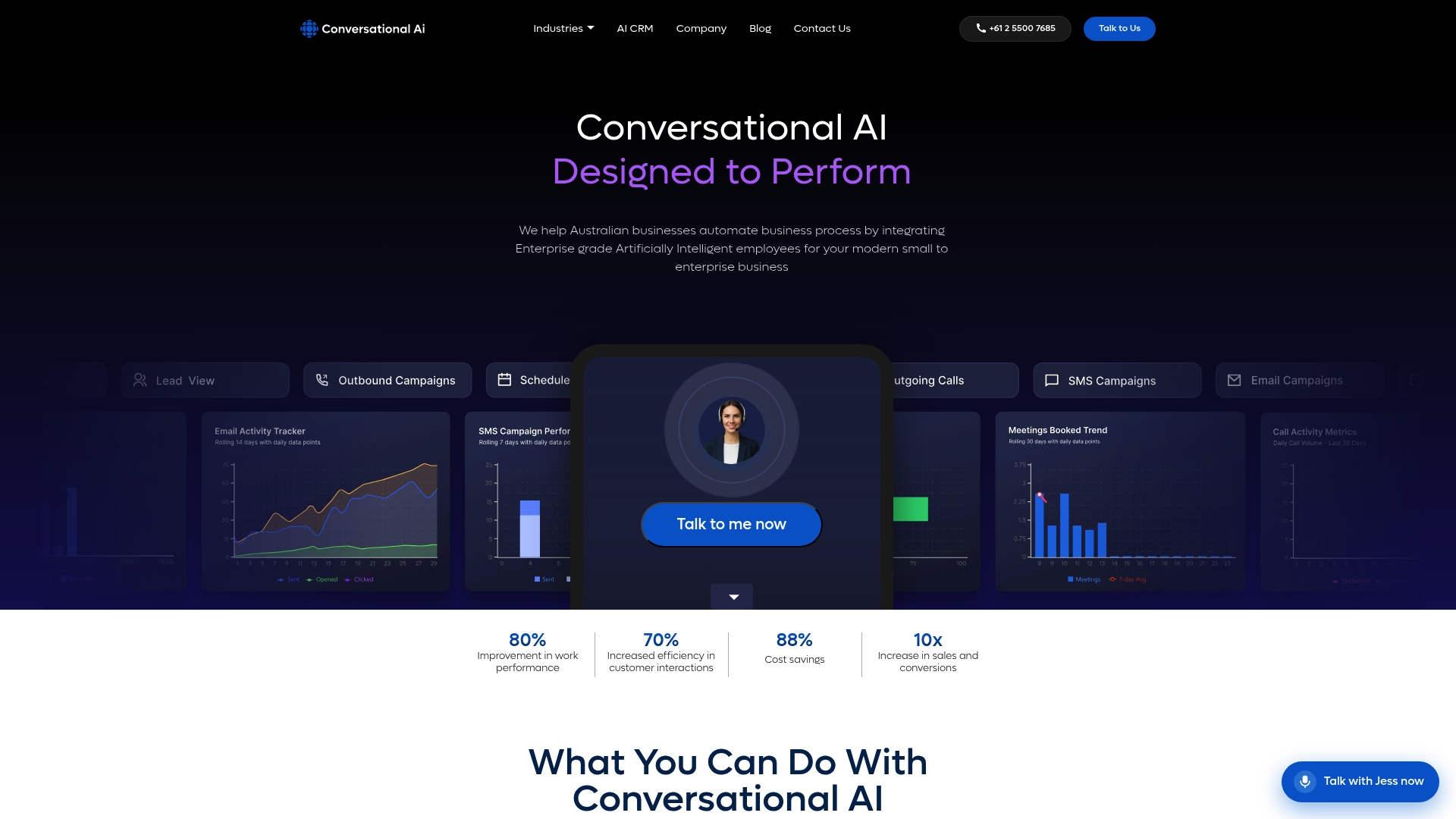
Conversational AI is an Australian-hosted enterprise platform purpose-built for organisations where data sovereignty is non-negotiable. Voice agents, SMS, email, and live chat all operate through a single governed platform, with CRM synchronisation handled natively. The platform meets APRA, Privacy Act, and Essential Eight requirements out of the box, with enterprise-grade access controls and full audit trails. Healthcare providers, financial services firms, and professional services organisations use it to automate customer interactions without compromising compliance. To see how it fits your infrastructure, contact the team for a consultation.
Key takeaways
AI system integration connects AI models, enterprise applications, and communication channels into a single governed platform, with security and data sovereignty built in from the start.
| Point | Details |
|---|---|
| Governance from day one | Embed data classification and approval workflows before connecting AI to live systems. |
| Australian compliance stack | APRA CPS 230/234, Privacy Act, and Essential Eight all apply to enterprise AI deployments. |
| Multi-channel data flow | Voice, SMS, email, and chat must sync to a single CRM source of truth in real time. |
| Phased integration testing | Incremental testing from interface inventory through observability reduces production risk. |
| Conversational AI | An Australian-hosted platform delivering private, compliant, multi-channel AI integration for enterprises. |