How AI integrates with legacy systems: Australian enterprise guide
Discover how AI integrates with legacy systems effectively. Learn about API middleware, data lakes, and embedded modules for streamlined enterprise solutions.

AI typically integrates with legacy systems by giving conversational models controlled, read-only access to verified data sources via a middleware or replication layer, while enforcing data access rules aligned to the Australian Privacy Principles. This approach protects production systems, preserves CRM integrity, and keeps regulated data onshore. Three patterns cover most enterprise scenarios:
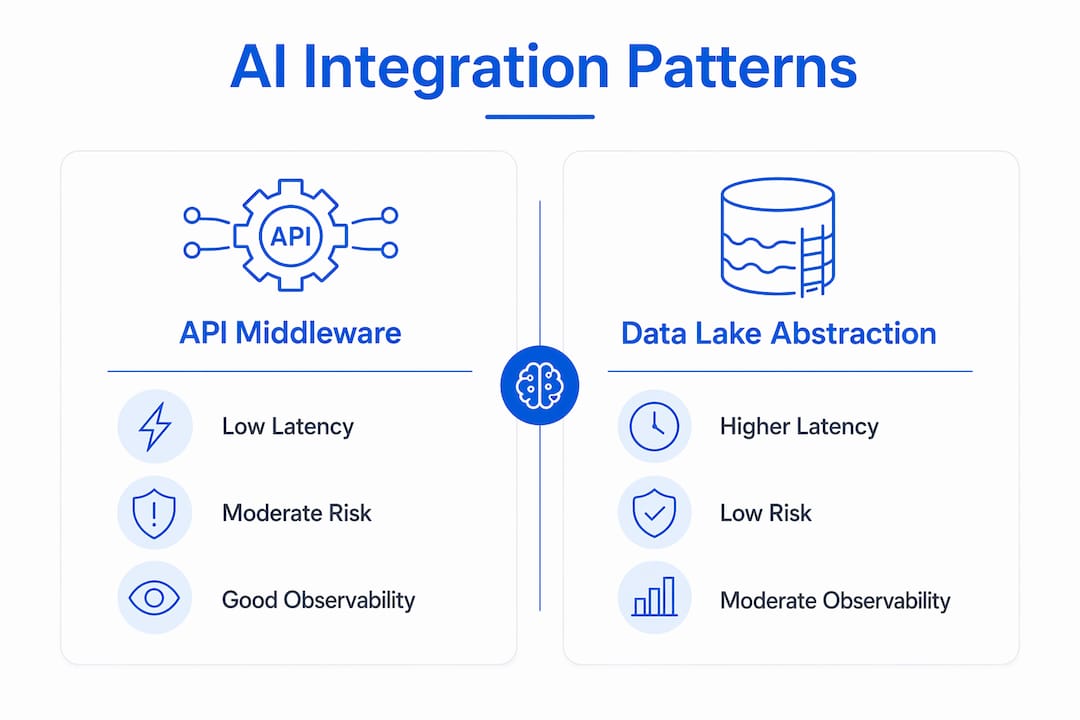
- API middleware (wrap): An adapter layer exposes selected CRM fields and endpoints to the AI without touching the legacy core. Best for near-real-time CRM sync and voice IVR.
- Data lake or read-only replica (replicate/abstract): A governed copy of production data feeds the AI. Best for analytics, retrieval-augmented generation, and batch enrichment where strong isolation matters.
- Embedded AI modules or sidecar (inline): The AI service runs alongside the core system, classifying or summarising outputs while the legacy platform stays the system of record. Highest capability, highest change risk.
Before choosing a pattern, map your truth sources, build a data access matrix, spin up a read-only replica or sandbox API, and run a shadow test against live traffic.
Table of Contents
- How AI integrates with legacy systems: architecture patterns compared
- How does conversational AI connect to CRMs and communication channels?
- Data governance, AI guardrails and Australian privacy requirements
- What security controls do Australian enterprises need for AI integration?
- What does a phased AI integration roadmap look like?
- Testing and monitoring conversational AI in production
- How should you evaluate vendors for conversational AI integration?
- Conversational AI.com.au: an Australian-first example
- Key takeaways
- The integration gap most enterprises ignore
- Ready to run a privacy-first AI integration in Australia?
- Useful sources and further reading
How AI integrates with legacy systems: architecture patterns compared
Three proven patterns connect AI to legacy infrastructure: API middleware/adapter, data lake abstraction, and embedded sidecar modules. Each trades off latency, coupling, and regulatory exposure differently.
| Pattern | Latency | Read/write risk | Observability | Typical use case |
|---|---|---|---|---|
| API middleware/adapter | Low (ms) | Low (read-only by default) | High | Real-time IVR, CRM sync |
| Data lake/replica | Medium (seconds) | Very low (isolated copy) | Very high | Analytics, RAG, batch enrichment |
| Embedded sidecar | Very low | Medium (writes possible) | Medium | Document classification, scoring |
Never connect an AI model directly to a production legacy database. Read-only replicas or a data lake abstraction protect transaction performance and isolate query load from inference spikes.
Cloud region selection matters as much as pattern selection. AWS Australia (Sydney and Melbourne), Microsoft Azure Australia (East and Southeast), and Google Cloud Australia (Sydney) all offer data residency within Australian borders. Choosing an Australian region for both inference endpoints and data storage removes the need for cross-border data transfer agreements under the Privacy Act 1988.
Architecture principle: The most valuable operational data often lives in the oldest systems. Adapter and replication patterns let AI access that context without forcing risky changes to the legacy core itself. Keep the transactional system stable; add intelligence at the edges.
For a deeper look at enterprise AI integration architectures, the patterns above map directly to regulated Australian deployment scenarios.
How does conversational AI connect to CRMs and communication channels?
Connector patterns for Salesforce and Microsoft Dynamics 365 follow the same principle: the AI reads, the CRM writes, and a single controlled service owns canonical updates.
- Webhook/API adapter: The AI agent calls a CRM REST or SOAP endpoint in real time. Suitable for Salesforce and Dynamics 365 when session context needs immediate record lookup.
- Incremental change-data-capture (CDC): A CDC stream feeds a replica, keeping the AI’s knowledge current without polling the production database.
- Event-driven message bus: Near-real-time sync via a message broker (such as Apache Kafka or Azure Service Bus) decouples the AI from CRM availability windows.
Channel integration follows a similar layered approach. Voice IVR connects via SIP gateway or a cloud telephony API. Webchat and live chat use plugin connectors or embedded JavaScript widgets. SMS and email route through gateway APIs with session identifiers that stitch context across channels. For detailed contact centre AI integration patterns, the session-stitching requirements for IVR deserve particular attention.
Keep ephemeral session state in a short-TTL context store (Redis or equivalent). Persist canonical facts to the CRM only when the interaction is complete and the write is authorised.

Pro Tip: Route all CRM writes through a single orchestration service. Multiple channels writing independently to Salesforce or Dynamics 365 create duplicate records and race conditions that are expensive to remediate.
Data governance, AI guardrails and Australian privacy requirements
Governance must start at discovery, not after the pilot. Map truth sources first: identify every CRM field, transactional record, and document store the AI will touch, then explicitly declare what it may and may not access.
A practical governance checklist for Australian enterprises:
- Data access matrix: List every data entity, the AI’s permitted operations (read/none), and the business justification.
- Role-based access control (RBAC): Scope model credentials to the minimum fields required.
- Field-level masking and redaction: Strip PHI and PII before data reaches the inference layer.
- Audit logging: Log every model query, input hash, and output for at least the retention period required under the Australian Privacy Principles.
- Residency controls: For regulated data (health records, financial data), prefer onshore hosting or a private cloud within Australia. When offshore inference is unavoidable, apply data minimisation and execute a data processing addendum with the vendor.
For private AI deployment decisions, onshore hosting removes the most common compliance objections from legal and privacy teams in one step.
Pro Tip: Embed policy enforcement at the middleware layer, not inside the model. A centralised policy enforcement point means access decisions are auditable and consistent across every channel.
What security controls do Australian enterprises need for AI integration?
Encryption in transit and at rest, mutual TLS for inference endpoints, short-lived credentials, and immutable decision logs are the baseline. No exceptions for regulated sectors.
| Control | What it protects | How to implement |
|---|---|---|
| Encryption in transit | Data between AI and legacy systems | TLS on all API calls |
| Encryption at rest | Stored replicas and context stores | AES encryption, managed keys |
| Mutual TLS (mTLS) | Inference endpoint authentication | Client cert rotation, periodic |
| Short-lived credentials | Lateral movement after compromise | IAM roles, token TTL ≤ 1 hour |
| Immutable audit logs | Model decision traceability | Write-once log store, tamper-evident |
| Network segmentation | Blast radius containment | VPC isolation, private endpoints |
Align controls to ISO 27001, SOC 2 Type II, and the ACSC Essential Eight maturity model. The Essential Eight’s application control and patching guidance applies directly to middleware and model-serving components.
Pro Tip: Request compliance certificates and audit-log samples from vendors before signing. A vendor who cannot produce a SOC 2 report or an ISO 27001 certificate during procurement will not produce one after go-live either.
What does a phased AI integration roadmap look like?
Follow five gated stages: assess, isolate, connect, validate, scale. Gate each on measurable KPIs before proceeding.
- Discovery and assessment (2–4 weeks): Inventory APIs, data flows, and technical debt. Unmanaged technical debt can divert 20–40% of IT development time, so surface it early.
- Sandbox and POC (2–6 weeks): Stand up a read-only replica or sandbox API. Run shadow traffic against the AI without touching production.
- Pilot (8–16 weeks): Deploy to a single channel or business unit. Define rollback criteria before launch, not after.
- Phased production rollout: Expand by domain or channel. Use canary releases to limit blast radius.
- Steady-state operations: Monitor drift, retrain on schedule, and review access matrices quarterly.
Key cost drivers that enterprises routinely underestimate:
- Data engineering and schema mapping (often the largest single item)
- Middleware development and ongoing maintenance
- Model hosting and inference compute
- Compliance and audit effort
- Retraining and model versioning overhead
Testing and monitoring conversational AI in production
Treat models like production software: version artifacts, run shadow traffic, and capture inputs and outputs (redacted as needed) for post-incident analysis.
Testing sequence: unit tests on connector logic, integration tests against the replica, shadow/parallel runs comparing AI outputs to human baselines, canary releases at 5–10% traffic, then synthetic load tests that stress both inference and upstream database behaviour simultaneously.
| Metric | Why it matters | Typical threshold |
|---|---|---|
| Low response latency | User experience and SLA compliance | Under 2 seconds for voice/chat |
| Error rate | Integration reliability | Under 1% in steady state |
| Accuracy vs. labelled baseline | Output quality assurance | Reviewed at each model version |
| Model drift indicators | Silent degradation detection | Alert on >5% deviation from baseline |
Operational principle: A model that performs well in the sandbox but degrades silently in production is more dangerous than one that fails loudly. Instrument drift detection before go-live, not as a post-incident response.
Redact sensitive inputs in logs. Maintain runbooks for escalation and rollback. Alert on drift before customers notice it.
How should you evaluate vendors for conversational AI integration?
Prioritise vendors who can demonstrate enterprise CRM integration experience (Salesforce, Dynamics 365), onshore Australian hosting, and documented governance controls. References matter more than feature lists.
Checklist for vendor evaluation:
- Integration patterns implemented and documented (adapter, sidecar, event-driven)
- References for live CRM and channel integrations in Australian regulated industries
- SLAs covering latency, availability, and incident response
- Data processing addenda aligned to the Australian Privacy Principles
- Model versioning, rollback support, and CI/CD pipeline documentation
Sample RFP questions to ask vendors:
- “Can you provide an architecture diagram showing how your platform connects to Salesforce or Dynamics 365 without writing to production?”
- “Where is inference compute hosted, and can you provide evidence of Australian data residency?”
- “Show us an example audit log from a production deployment.”
- “What is your canary release process, and how do you handle rollback?”
- “Which compliance certificates do you hold: ISO 27001, SOC 2 Type II, or equivalent?”
- “How do you handle model drift in production, and what alerting do you provide?”
For CRM AI synchronisation specifics, ask vendors to walk through their change-data-capture approach and how they prevent duplicate writes across channels.
Conversational AI.com.au: an Australian-first example
Conversational AI provides multi-channel AI agents with onshore hosting and CRM connectors suited to regulated Australian industries including healthcare, finance, and professional services.
Platform proof points: Onshore Australian hosting for data sovereignty; multi-channel agents across voice, SMS, email, and live chat; native CRM connectors for Salesforce and Dynamics 365; contextual memory and real-time analytics; enterprise-grade access controls and audit logging aligned to the Australian Privacy Principles.
This directly satisfies the governance and security checklist covered earlier: onshore residency removes cross-border transfer risk, CRM connectors implement the adapter pattern with controlled writes, and audit logging supports ISO 27001 and SOC 2 compliance reviews. The platform’s AI system integration approach reflects the privacy-first architecture this guide recommends.
Key takeaways
Controlled access via middleware or read-only replicas is the safest default for enterprise conversational AI integration in Australia, and governance must start at discovery, not after the pilot.
| Point | Details |
|---|---|
| Start with truth-source mapping | Identify every data entity the AI will touch and declare access rules before writing any integration code. |
| Prefer read-only replicas | Never connect AI directly to a production database; replicas protect transaction performance and isolate query load. |
| Onshore hosting for regulated data | Australian data residency removes cross-border transfer obligations under the Privacy Act 1988. |
| Gate each rollout stage | Discovery, sandbox, pilot, and phased production each need measurable KPIs and a rollback plan before proceeding. |
| Conversational AI for Australian deployments | Conversational AI provides onshore-hosted, multi-channel agents with CRM connectors and audit logging suited to regulated Australian enterprises. |
The integration gap most enterprises ignore
The technical patterns in this guide are well-documented. What is less discussed is the governance timing problem: most teams treat data access rules as a post-pilot clean-up task, and that is where regulated Australian enterprises get into trouble.
Privacy obligations under the Australian Privacy Principles do not pause during a proof of concept. A shadow test that routes real customer queries through an AI model, even in a sandbox, can constitute personal information handling under the Privacy Act 1988 if the inputs are not properly redacted. That is not a theoretical risk. It is the kind of finding that surfaces in a privacy impact assessment and delays production rollout by months.
The practical fix is straightforward: build the data access matrix in week one of discovery, not week one of the pilot. Treat it as a prerequisite for any live data access, including shadow testing. Vendors who push back on this requirement during procurement are signalling something important about how they will behave post-contract.
The other underestimated factor is data engineering cost. Architecture decisions get the attention; schema mapping and data quality remediation consume the budget. In legacy estates with years of inconsistent records, the work of making data reliable enough for AI to use often exceeds the cost of the integration layer itself. Budget for it explicitly, or the pilot will stall before it reaches production.
Ready to run a privacy-first AI integration in Australia?
Australian enterprises in healthcare, finance, and professional services need more than a capable AI platform. They need one that keeps data onshore, connects to existing CRMs without rewriting the core, and produces the audit trail their compliance teams can actually use.
Conversational AI delivers exactly that: enterprise-grade, onshore conversational AI agents with native connectors for Salesforce and Dynamics 365, multi-channel coverage across voice, SMS, email, and live chat, and governance controls aligned to the Australian Privacy Principles. No offshore data transfer, no compliance guesswork, no ripping out the systems your business already depends on.
Book a technical discovery session to map your integration architecture, review your data access requirements, and scope a sandbox POC. The team runs structured discovery workshops specifically for Australian regulated industries. Reach out at conversationalai.com.au to get started.
Useful sources and further reading
These references support technical design, compliance reviews, and procurement decisions for Australian enterprise AI integration projects.
- Integrating AI with legacy systems: a practical enterprise guide (AliceLabs) — Primary reference for architecture patterns and integration barriers. Most useful for solution architects selecting between adapter, replica, and sidecar approaches.
- Integrating AI into an existing application (Appsvolt) — Governance-first framing with truth-source mapping guidance. Most useful for product owners and privacy teams setting up data access matrices.
- IT admin playbook: integrating AI tools into legacy systems (Promptly) — Discovery, dependency mapping, and compatibility testing steps. Most useful for IT administrators planning the assessment phase.
- How gen-AI is rewriting legacy tech modernisation rules (BCG) — Agentic discovery and technical debt prioritisation. Most useful for enterprise architects managing large legacy estates.
- 5 ways to use AI to modernise legacy systems (ZDNet) — Technical debt quantification and AI-assisted remediation. Most useful for CIOs building the business case for modernisation investment.
- AI integration for legacy systems: 2026 enterprise guide (Coderio) — Detailed pattern descriptions and production readiness criteria. Most useful for engineering leads scoping integration architecture.
- ACSC Essential Eight (Australian Cyber Security Centre) — Australian government security baseline. Most useful for security teams aligning AI integration controls to national guidance.
- Safety and compliance documentation (Ask Hayley) — Procedural safeguards and compliance artefacts reference. Most useful for legal and compliance teams preparing integration governance documentation.