AI sentiment analysis for customer calls: CX manager's guide
Discover how AI sentiment analysis for customer calls enhances coaching, churn detection, and compliance for Australian contact centres.

AI sentiment analysis can read customer calls and produce operationally useful signals for coaching, churn detection, and real-time intervention. The key condition: your pipeline needs clean audio, accurate transcripts, and aspect-based sentiment analysis rather than a single call-level polarity score. When those three elements are in place, sentiment signals correlate meaningfully with CSAT and NPS, and flag churn risk before a customer hangs up for the last time.

For Australian contact centres, there is one additional requirement that often gets overlooked at the scoping stage: data sovereignty. The Australian Privacy Principles (administered by the OAIC) impose obligations on how customer call recordings are stored and processed. Hosting your sentiment pipeline within Australia is not optional for regulated sectors; it is a compliance baseline.
Here is what a contact centre manager should do next:
- Confirm your call recording infrastructure supports audio export or real-time streaming to an AI pipeline.
- Define two or three specific KPIs (CSAT correlation, QA coverage rate, time to escalation) before selecting any tool.
- Scope a pilot of several weeks on a single channel or queue, not your entire operation.
- Verify that any vendor you evaluate hosts data within Australia and can document OAIC compliance.
- Assign a named owner for every insight category the pilot produces.
Pro Tip: Start with your highest-complaint queue. Negative sentiment is easier to label, easier to validate against CSAT, and produces the fastest visible ROI for stakeholders.
Table of Contents
- What does AI sentiment analysis for customer calls actually produce?
- How does the end-to-end pipeline work for voice calls?
- What business outcomes can contact centres realistically expect?
- A practical 5-step framework from pilot to scale
- What are the accuracy limits and compliance risks you need to manage?
- How do you measure success and what does a pilot cost?
- How Conversational AI supports Australian contact centres with sentiment analysis
- Key takeaways
- The gap between sentiment dashboards and actual change
- Ready to run a sentiment analysis pilot within Australia?
- Useful sources and further reading
What does AI sentiment analysis for customer calls actually produce?
Sentiment analysis for voice calls is the process of converting audio into text, then applying natural language understanding (NLU) models to classify the emotional tone, urgency, and topic-level sentiment of each utterance. The industry term for the most useful variant is aspect-based sentiment analysis (ABSA), which goes well beyond a simple positive/negative/neutral label for the whole call.
The outputs a contact centre can expect from a well-configured pipeline include:
- Per-utterance polarity scores: positive, negative, or neutral labels at the sentence or speech-segment level, with a confidence score and timestamp.
- Aspect tags: topic-level sentiment linked to specific themes such as pricing, billing, wait times, product quality, or agent behaviour.
- Emotion labels: frustration, satisfaction, confusion, or urgency detected from both linguistic content and, where prosody analysis is included, tone of voice.
- Escalation flags: high-urgency tags triggered when negative polarity and frustration signals co-occur above a set threshold.
A practical example: a customer says, “I’ve been waiting three weeks for a refund and nobody can tell me where it is.” A call-level score might return “negative.” An aspect-based model returns negative sentiment tagged to billing, high urgency, and a frustration emotion label. That combination automatically creates an SLA escalation ticket in your CRM, routed to a senior agent within minutes. The difference between those two outputs is the difference between a report and an action.

How does the end-to-end pipeline work for voice calls?
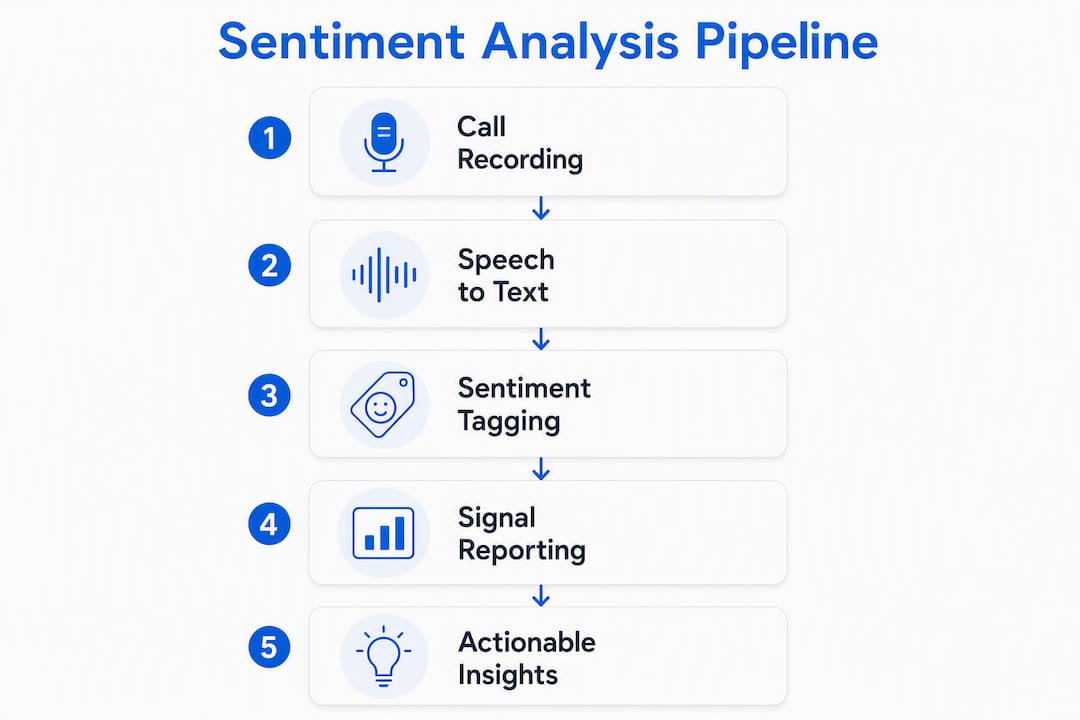
Understanding the stages helps you map the solution to your existing telephony, recording, and CRM systems before you commit to a vendor or architecture.
The four core stages
- Audio capture and storage: Calls are recorded via your telephony platform (SIP trunk, cloud PBX, or contact centre platform) and stored securely. For Australian contact centres, this storage must sit within Australian borders to satisfy data sovereignty requirements.
- Speech-to-text transcription: Audio is converted to a text transcript using an automatic speech recognition (ASR) engine. Transcript quality is the single biggest variable in model accuracy. Background noise, strong regional accents, domain-specific vocabulary, and overlapping speech all degrade quality.
- NLU classification and aspect extraction: The transcript passes through an NLU model that applies polarity classification, aspect tagging, emotion labelling, and confidence scoring. Prosody analysis (pitch, pace, volume changes) can run in parallel on the audio stream to add tone signals that text alone cannot capture.
- Action and integration: Tagged outputs are pushed via webhook or API to your CRM, QA platform, or agent desktop. Real-time pipelines can surface alerts mid-call; batch pipelines process recordings post-call for QA review and coaching.
Integration checklist for operations and engineering teams
- Confirm your telephony platform supports call recording export or real-time audio streaming.
- Validate that your ASR engine handles Australian English accents and your domain vocabulary (financial terms, medical terminology, product names).
- Define real-time versus batch processing requirements before architecture decisions are made.
- Map CRM integration points for alert routing, case creation, and agent notifications.
- Document data flow from capture to storage to processing, and confirm each node sits within Australia.
- Set minimum call volume thresholds for the pilot to ensure statistically meaningful baseline comparisons.
What business outcomes can contact centres realistically expect?
Automated sentiment analysis processes every call consistently, removing the sampling bias that comes with manual QA reviews covering only a fraction of volume. That consistency is where the operational value concentrates.
The priority use cases, and the metrics each one moves, are:
- QA automation and prioritised call review: Instead of random sampling, QA teams review calls flagged as high-risk by sentiment scores. QA coverage increases without adding headcount.
- Agent coaching: Sentiment trends by agent identify specific behaviours (escalating frustration, missed de-escalation moments) that coaching can target. Coaching becomes evidence-based rather than anecdotal.
- Churn and risk detection: Calls with sustained negative sentiment on billing or cancellation topics trigger CRM flags for proactive outreach. Retention teams can act within hours, not weeks.
- Real-time escalation alerts: High-urgency tags mid-call route to a supervisor or trigger an agent prompt, reducing the number of calls that end in a complaint or churn event.
- Product and service defect detection: Sentiment spikes on specific aspect tags (e.g., a sudden rise in negative billing sentiment) surface product or process issues days before they appear in quarterly CSAT reports.
- Post-call follow-up automation: Negative sentiment calls trigger automated follow-up sequences via SMS or email, closing the loop with customers who had a poor experience.
Map each use case to a single KPI and a named owner. Without that discipline, you end up with a dashboard full of sentiment scores and no one accountable for acting on them.
A practical 5-step framework from pilot to scale
This framework gives you a project brief you can hand to stakeholders today. It draws on best-practice guidance that emphasises regular analysis cycles over sporadic reporting, and ties every insight to an owner.
-
Scope and objective. Define the channel (inbound voice, outbound collections, complaints queue), the call cohort, and three measurable success metrics. Obtain legal clearance for call recording use in AI processing. Document the OAIC obligations that apply to your sector.
-
Data and privacy. Collect a representative sample of calls covering your full range of topics, agents, and customer types. Automate PII redaction from transcripts before any data touches the sentiment model. Confirm Australian hosting for all storage and processing nodes. Document your data flow for audit purposes.
-
Baseline and model selection. Manually tag a holdout sample (200–400 calls) to establish a ground-truth baseline. Select an aspect-based model and set confidence thresholds above which tags trigger automated actions. Run initial lab tests against the holdout set and calculate F1 scores before going live.
-
Pilot execution (4–8 weeks). Run live sentiment scoring on your scoped queue. Route high-urgency alerts to CRM. Sample QA reviews weekly and measure sentiment score correlation against CSAT and NPS for the same cohort. Track false positive rates from week one.
-
Operationalise and scale. Embed sentiment alerts into agent desktop workflows and automate reporting. Set a governance cadence for model retraining (quarterly is a practical starting point). Expand to additional channels only after the pilot queue shows stable accuracy and measurable KPI movement.
Responsibility matrix: CX lead owns scoping and KPI sign-off. Data engineer owns pipeline architecture and PII redaction. QA lead owns holdout tagging and weekly accuracy reviews. Legal/compliance owns OAIC documentation and audit trail.
Pro Tip: Assign a “sentiment champion” in the QA team whose sole job during the pilot is to review flagged calls daily and log disagreements with the model. That log becomes your retraining dataset.
What are the accuracy limits and compliance risks you need to manage?
Sentiment models are not infallible, and deploying one without understanding its failure modes is how projects lose stakeholder trust quickly.
Common accuracy pitfalls
- Transcript quality: Noisy call centre environments, headset audio artefacts, and strong regional accents (including Australian regional dialects) all increase word error rates in ASR, which cascades into sentiment misclassification.
- Short utterances: Single-sentence responses give the model very little signal. “Fine” can be satisfied or sarcastic; without prosody context, classification is unreliable.
- Sarcasm and indirect language: “Oh, that’s just great” reads as positive to a polarity model without contextual understanding.
- Multi-topic calls: A call that covers billing, a product question, and a complaint will flatten to a single sentiment if aspect tagging is not configured correctly.
- Unbalanced datasets: Research published in PubMed found that established, fine-tuned NLP classifiers such as VADER and LIWC outperformed general-purpose large language models on classification tasks with unbalanced sentiment datasets. General LLMs are not always the right tool for contact centre classification.
Validation steps
- Run holdout tests on labelled calls before go-live.
- Review confusion matrices to identify which sentiment classes the model misclassifies most often.
- Monitor F1 scores and false positive/negative rates weekly during the pilot.
- Keep a human-in-the-loop review process for high-urgency escalation tags throughout the pilot phase.
Australian privacy checklist
Data sovereignty is not a feature; it is a compliance requirement. Australian contact centres handling customer call recordings must redact PII from transcripts before processing, host all data within Australia, document their obligations under the Australian Privacy Principles (OAIC), and maintain audit trails for model decisions. In healthcare and finance, these requirements are non-negotiable. Verify your vendor’s hosting architecture before signing any contract.
For practical guidance on AI deployment and privacy obligations in the Australian context, review the OAIC’s guidance on automated decision-making alongside your legal team’s assessment of your specific sector obligations.
How do you measure success and what does a pilot cost?
Clear KPIs set before the pilot starts are what separate a project that earns budget for scale from one that gets quietly shelved.
Primary KPIs to track
- CSAT correlation: Do calls scored as negative by the model produce lower CSAT survey responses? A strong correlation validates the model’s signal.
- NPS movement: Track NPS for cohorts where sentiment-triggered follow-ups occurred versus those where no action was taken.
- QA coverage rate: What percentage of calls are now reviewed (via automated flagging) compared to the pre-pilot manual sampling rate?
- Time to remediation: How quickly does a high-urgency tag result in a customer contact or case resolution?
- False positive rate: What proportion of escalation alerts turn out to be incorrectly flagged? Keep this below a threshold your QA team defines as operationally acceptable.
- Model confidence trend: Is average confidence score improving as the model is calibrated to your domain vocabulary?
Measurement approaches compared
| Measurement type | Approach | What it tells you |
|---|---|---|
| Operational | Automated tagging rate, QA coverage %, time to escalation | Whether the pipeline is functioning and being used |
| Quality | F1 score, false positive rate, human-label agreement | Whether the model is accurate enough to trust |
| Business outcome | CSAT correlation, NPS movement, churn signal rate | Whether sentiment insights are producing commercial value |
Pilot cost drivers
Pilot costs vary by integration complexity, call volume, and vendor model. The main cost buckets are: integration engineering effort (connecting telephony, ASR, and CRM systems), hosting and compute (private cloud within Australia), and licensing or API fees for the sentiment model. A 4–8 week pilot on a single queue with a dedicated data engineer and CX analyst is a realistic resourcing baseline. Expect the integration effort to dominate early costs; ongoing operational costs drop significantly once the pipeline is stable.
How Conversational AI supports Australian contact centres with sentiment analysis
Conversational AI’s Australia-hosted platform is built to satisfy each step of the framework above without requiring you to stitch together separate vendors for hosting, transcription, sentiment, and CRM routing.
The platform’s relevant capabilities for contact centre sentiment programmes include:
- Private cloud hosting within Australia: All call data, transcripts, and model outputs remain on Australian soil, satisfying OAIC obligations and sector-specific compliance requirements for healthcare, finance, and professional services.
- Multichannel agent coverage: Voice, SMS, email, and live chat are handled within a single platform, so sentiment signals from inbound calls can be correlated with post-call SMS follow-up responses and email interactions.
- CRM connectors and webhook actions: Sentiment tags and urgency flags route directly to your CRM, creating cases, updating contact records, and triggering agent notifications without manual intervention. See how AI system integration works across enterprise environments.
- Real-time analytics and agentic reporting: Dashboards surface sentiment trends by queue, agent, topic, and time period, giving QA leads and CX managers the visibility they need to act on findings rather than just observe them.
- Built-in PII redaction options: Transcript processing includes configurable PII redaction before data enters the sentiment pipeline, reducing compliance risk at the point of processing.
- Dynamic agent training: Sentiment-flagged calls feed directly into coaching workflows, so training is grounded in real call evidence rather than generic scripts.
Pro Tip: When scoping your pilot with Conversational AI, ask for a baseline analytics report from your first two weeks of live scoring before any workflow changes are made. That baseline is your before-and-after comparison point and the evidence your stakeholders will want to see.
Key takeaways
AI sentiment analysis for customer calls produces reliable, operationally useful signals when the pipeline combines accurate transcription, aspect-based classification, and CRM-integrated alert routing within an Australian-hosted, privacy-compliant architecture.
| Point | Details |
|---|---|
| Scope the pilot tightly | Start with one queue, three KPIs, and a 4–8 week timeline before expanding to other channels. |
| Preserve data sovereignty | Host all call data and processing within Australia to meet OAIC obligations, particularly in healthcare and finance. |
| Measure CSAT correlation | Validate model accuracy by comparing sentiment scores against CSAT survey results for the same call cohort. |
| Embed alerts in CRM workflows | Sentiment insights only drive change when high-urgency tags automatically create cases or agent notifications in your CRM. |
| Conversational AI for Australian contact centres | Conversational AI’s Australia-hosted platform covers private cloud hosting, PII redaction, CRM connectors, and real-time analytics in a single deployment. |
The gap between sentiment dashboards and actual change
There is a pattern that shows up repeatedly in sentiment analysis deployments: the pilot produces genuinely interesting data, stakeholders nod approvingly at the dashboard, and then nothing changes. Six months later, the programme is quietly de-prioritised because it “didn’t deliver ROI.”
The problem is almost never the model. It is ownership. Sentiment analysis without a named human accountable for acting on each signal category is just an expensive reporting exercise. The organisations that get real value from these programmes are the ones that treat sentiment tags as operational triggers, not analytical outputs. A high-urgency billing tag should create a CRM case automatically. A frustration spike on a specific agent should generate a coaching session within 48 hours. A product defect signal should land in the product team’s issue tracker the same day.
The other thing that gets underestimated is the transcript quality problem. Teams spend weeks evaluating sentiment models and almost no time auditing their ASR accuracy. If your speech-to-text engine misses one word in eight on calls with background noise or regional accents, your sentiment model is classifying corrupted input. Fix the transcript first; the sentiment accuracy follows.
Finally, resist the temptation to deploy across every channel simultaneously. The contact centres that scale successfully start with their highest-complaint queue, get the pipeline stable, prove the CSAT correlation, and then expand. That sequencing gives you a replicable playbook and a stakeholder story built on real evidence.
Ready to run a sentiment analysis pilot within Australia?
Contact centres that have spent months evaluating offshore platforms often find the same sticking point: data sovereignty. Conversational AI is built specifically for Australian enterprises where that is not a negotiable trade-off.
The platform delivers private cloud hosting within Australia, built-in PII redaction, aspect-based sentiment modules, and direct CRM integration, covering every step of the 5-step framework in this guide. A pilot engagement typically includes baseline analytics from your first live scoring period, integration support for your existing telephony and CRM systems, and governance documentation to satisfy your legal and compliance team.
If your contact centre is ready to move from manual QA sampling to continuous, automated sentiment detection across voice and digital channels, contact Conversational AI to scope a pilot tailored to your queue, your compliance requirements, and your KPIs.
Useful sources and further reading
These sources back the claims in this guide and give you the next layer of detail for implementation, validation, and privacy compliance.
- Customer Feedback Analysis: The Ultimate Guide | Rightpoint — covers the full feedback analysis lifecycle, including how AI and machine learning enable personalisation at scale; useful for scoping your programme objectives.
- Post-call analytics for your contact centre with Amazon language AI services | AWS — practical architecture guidance for post-call analytics pipelines, including transcript processing and sentiment extraction; useful for engineering teams designing the pipeline.
- Automated sentiment analysis | Determ — explains how automated sentiment analysis integrates with CDPs and product teams; useful for understanding cross-channel signal triangulation.
- Thematic insights on automated sentiment analysis — detailed explanation of aspect-based sentiment and why topic-level signals outperform call-level polarity scores; useful for model selection decisions.
- Customer feedback analysis | Resonate CX — covers the link between sentiment signals and CSAT/NPS, and the importance of assigning owners to every insight; useful for pilot design and governance.
- PubMed: Evaluating automated sentiment analysis methods — 2025 research comparing NLP classifiers on unbalanced datasets; useful for model selection and understanding when fine-tuned classifiers outperform general LLMs.
- AWS sample GenAI PCA: PII and data handling — practical reference for PII redaction in post-call analytics pipelines; useful for engineering teams building compliant transcript processing.
- Customer feedback analysis steps and templates | Airtable — practical tooling and templates for centralising feedback, routing insights to owners, and tracking remediation; useful for operationalising the pilot.