Why audit AI system decisions: guide for Australian organisations
Discover why audit AI system decisions is essential for Australian organisations. Ensure accountability, legal compliance, and fairness in AI. Learn how!

Auditing AI system decisions is how organisations demonstrate accountability, manage legal and reputational risk, and keep automated decision-making fair, reproducible, and defensible. The single first action to take is to create an inventory of every AI system that influences a material decision, then map each decision point to the people, data, and processes behind it. Without that map, you cannot scope an audit, assign evidence ownership, or respond to a regulator with confidence.
The core reasons to audit AI decisions are:
- Accountability: establish who is responsible when an AI decision affects a person’s rights, finances, employment, or health.
- Legal compliance: meet obligations under the Privacy Act 1988, the Australian Privacy Principles (APPs), and sector-specific rules in financial services, health, and telecommunications.
- Fairness: detect and correct bias in training data, model outputs, and decision thresholds before harm reaches customers or staff.
- Safety and reliability: identify model drift, data quality failures, and performance regressions before they cause operational or reputational damage.
- Procurement trust: satisfy government and enterprise procurement panels that require evidence of responsible AI governance before awarding contracts.
- Reputational risk management: protect the organisation from public and media scrutiny when an AI decision is challenged.
Table of Contents
- Why auditing AI decisions matters for your organisation
- Australian regulatory and legal drivers for auditing AI decisions
- What an AI decision audit examines: core components and evidence types
- Common challenges and realistic expectations when auditing AI decisions
- How often to audit AI decisions and the role of continuous monitoring
- A practical 6-step checklist to start auditing AI decision-making
- Standards, tools and frameworks to adopt for auditing AI decisions
- How an Australia-hosted conversational AI platform supports auditability
- Key takeaways
- The part most organisations get wrong
- Conversational AI makes audit evidence collection practical
- Useful sources and further reading
Why auditing AI decisions matters for your organisation
Accountability is the foundation. When an AI system decides who receives a loan, which job applicant advances, or how a health triage is prioritised, a human organisation remains legally and ethically responsible for that outcome. Audits create the documented chain of accountability that regulators, courts, and affected individuals can inspect. Without it, “the model decided” is not a defensible answer.
Regulatory and compliance pressure is accelerating. The Australian Government’s AI Ethics Framework sets eight principles, including accountability and transparency, that government agencies and their suppliers are expected to apply. The Office of the Australian Information Commissioner (OAIC) has made clear that automated decision-making involving personal information must be consistent with the APPs, particularly APP 1 (open and transparent management) and APP 3 (collection of solicited personal information). Sector regulators in financial services (ASIC, APRA) and health (AHPRA, the Therapeutic Goods Administration) are increasingly scrutinising AI-assisted decisions. Organisations that cannot produce audit evidence face enforcement action, civil liability, and disqualification from government contracts.
Operational resilience is the less-discussed driver. AI models degrade. Training data becomes stale, real-world distributions shift, and model performance drifts in ways that are invisible without monitoring. Regular audits build trust and confidence in AI and, critically, catch these regressions before they compound into systemic failures. A single point-in-time certificate is no longer enough for high-risk systems.
“Auditing AI systems is not a compliance checkbox. It is the mechanism by which organisations convert opaque algorithmic processes into accountable, governable ones — and the only credible way to demonstrate that an AI system is doing what it claims to do.” — Synthesised from Auditing of AI: Legal, ethical and technical approaches
Commercial value follows governance maturity. Insurers pricing cyber and technology risk, enterprise procurement panels, and institutional investors are all beginning to ask for evidence of AI governance. Organisations with a functioning audit programme can answer those questions with documentation rather than assurances.
Australian regulatory and legal drivers for auditing AI decisions
Australia does not yet have a single AI-specific statute, but the regulatory obligations are real and distributed across several frameworks.
Office of the Australian Information Commissioner (OAIC) and the Privacy Act
The OAIC enforces the Privacy Act 1988 and the APPs. Where an AI system processes personal information to make or inform a decision, the APPs apply directly. APP 1 requires organisations to have a clearly expressed and up-to-date privacy policy covering how personal information is used in decision-making. APP 12 gives individuals the right to access information held about them, which extends to the inputs used in an automated decision. The OAIC has published guidance on privacy and AI that explicitly addresses automated decision-making, profiling, and the need for transparency. Organisations that cannot explain how an AI system used personal information to reach a decision are exposed to formal investigations and determinations.
Australian Government AI Ethics Framework
The framework’s eight principles — including human, societal and environmental wellbeing; human-centred values; fairness; privacy protection and security; reliability and safety; transparency and explainability; contestability; and accountability — are not legally binding for private organisations, but they are the standard against which government agencies and their suppliers are assessed. Procurement panels for federal and state government contracts increasingly require suppliers to demonstrate alignment with these principles, and an audit programme is the primary mechanism for doing so.
Sector regulators
- ASIC and APRA expect financial services firms to apply responsible lending and credit decision standards to AI-assisted processes, including explainability and fairness testing.
- The Therapeutic Goods Administration (TGA) regulates AI-based medical devices and software as a medical device (SaMD), requiring documented performance evidence.
- The Australian Communications and Media Authority (ACMA) and the telecommunications code apply where AI systems make decisions about service access or complaints handling.
The pattern across sectors is consistent: regulators expect documented evidence of how AI systems make decisions, what safeguards exist, and how errors are detected and corrected.
International standards referenced in Australia
ISO/IEC 42001 is a certifiable AI management system standard with surveillance audit cycles, directly analogous to ISO 9001 for quality. Australian organisations are adopting it as a baseline for demonstrating governance maturity to regulators and procurement panels. The NIST AI Risk Management Framework organises AI governance into four functions: Govern, Map, Measure, and Manage. It is widely used in Australia as a practical operating model for audit programmes, particularly in organisations with US business relationships or technology partnerships.
Consequences of non-compliance
- Regulatory enforcement: OAIC investigations, determinations, and civil penalty orders under the Privacy Act (up to AU$50 million for serious or repeated interferences with privacy for organisations).
- Civil liability: individuals affected by unfair or unlawful AI decisions can seek compensation through courts or the Australian Human Rights Commission.
- Procurement disqualification: failure to demonstrate responsible AI governance can result in exclusion from government and enterprise tender processes.
- Reputational damage: public disclosure of an AI failure without documented governance evidence amplifies the harm significantly.
What an AI decision audit examines: core components and evidence types
Research consistently identifies four audit layers that auditors must examine to assess lawfulness, technical robustness, and ethical compliance across the AI lifecycle: data, model, deployment, and governance.
| Audit component | What the auditor looks for | Example artefacts | Evidence owner |
|---|---|---|---|
| Data | Provenance, quality, representativeness, bias indicators, consent and lawful basis for use | Data lineage records, data quality reports, consent logs, bias testing results | Data engineering / privacy team |
| Model | Architecture, training process, version control, fairness metrics, performance benchmarks, explainability outputs | Model card, training logs, test results, fairness reports, SHAP/LIME outputs | ML engineering / data science |
| Deployment (runtime) | Integration points, input validation, output handling, monitoring configuration, incident records | Deployment manifests, API logs, monitoring dashboards, incident register | Platform / DevOps / IT operations |
| Governance / process | Policies, risk assessments, human review workflows, escalation protocols, training records | AI risk register, human review logs, policy documents, staff training records | Risk, compliance, and product owners |
Each layer produces specific artefacts that form the evidence base for an audit. The data layer is where bias and privacy risks most often originate, so auditors look for documented data lineage that traces every dataset from source to training pipeline. The model layer requires a model card, a structured document that records the model’s intended use, performance characteristics, known limitations, and fairness evaluation results.
At the deployment layer, auditors focus on runtime behaviour: how inputs are validated, how outputs are handled, and whether monitoring is configured to detect anomalies. Decision-level artefacts are particularly important here. These include audit trails that record each decision episode, model versioning records that identify exactly which checkpoint produced a given output, confidence or uncertainty metrics attached to each decision, and human review records showing when and how a person reviewed or overrode an automated decision.
The governance layer ties the technical evidence to organisational accountability. Auditors look for a current AI risk register, documented escalation protocols, and evidence that staff who operate or review AI systems have received appropriate training.
Pro Tip: Map your evidence owners before you scope the audit. The most common gap is not missing data — it is nobody knowing who owns the model card or the human review logs. Assign ownership in a RACI matrix at the start of the programme.
Common challenges and realistic expectations when auditing AI decisions
Auditing AI systems is harder than auditing financial statements, and organisations that approach it with the same methodology often hit walls quickly.
Explainability and reproducibility limits
Many production AI systems, particularly large language models and deep neural networks, do not produce human-readable explanations of their reasoning. Techniques like SHAP (SHapley Additive exPlanations) and LIME (Local Interpretable Model-agnostic Explanations) provide approximations, but they are not the same as a causal explanation. For stochastic training processes or continuously learning systems, exact reproducibility of a past decision may be technically impossible without a pinned checkpoint and a frozen input snapshot.
Institutional and standards immaturity
There is no single, universally accepted performance benchmark for AI fairness or robustness. Different fairness metrics (demographic parity, equalised odds, calibration) can produce conflicting results on the same model, and choosing which metric to apply is a normative decision, not a technical one. Qualified AI auditors are in short supply globally, and Australia is no exception.
Data access and third-party model limits
Where an organisation uses a third-party model accessed via API, it may have limited visibility into the model’s training data, architecture, or versioning. This restricts audit depth significantly. Contractual provisions requiring audit access, model cards, and incident disclosure are increasingly standard in enterprise AI procurement, but many existing contracts predate these requirements.
Pro Tip: Design your audit around what you can actually evidence, not what an ideal audit would examine. Document the scope limitations explicitly — a well-scoped audit with clear limitations is far more credible than an audit that claims to cover everything but cannot produce evidence for half of it. Regulators understand constraints; they do not accept silence.
How often to audit AI decisions and the role of continuous monitoring
Audit frequency should match the risk profile of the system, not an arbitrary calendar. Experts call for ongoing surveillance rather than a single, point-in-time certificate, and the distinction between continuous monitoring and periodic audits is important.
Continuous monitoring (Tier 1 systems)
High-risk systems require real-time or near-real-time monitoring of:
- Model drift: statistical shifts in input distributions or output distributions that indicate the model is operating outside its validated range.
- Performance metrics: accuracy, precision, recall, and fairness metrics tracked against baseline thresholds.
- Incident reports: automated alerts for anomalous outputs, high-volume override rates, or customer complaints linked to AI decisions.
- Data quality signals: upstream data pipeline failures, schema changes, or unexpected null rates.
Monitoring outputs feed directly into audit readiness. Every alert, threshold breach, and incident report becomes evidence in the next scheduled audit.
Scheduled audits (Tier 2 and Tier 3 systems)
- Tier 2 systems: quarterly monitoring reviews, with a full governance and technical audit every two years or at major update milestones.
- Tier 3 systems: annual spot checks covering governance documentation and a sample of decision records.
Triggers for unscheduled audits
Any of the following should trigger an immediate audit regardless of the scheduled cycle: a regulatory inquiry or complaint, a significant model update or retraining event, a material change in the data inputs or business context, or a public incident involving the system’s outputs.
Monitoring and audit readiness are two sides of the same coin. Organisations that maintain continuous monitoring logs, version-controlled model registries, and current governance documentation can respond to a regulator’s request for evidence within days rather than weeks.
A practical 6-step checklist to start auditing AI decision-making
This checklist is designed for a 30–90 day implementation window. It gives teams a concrete starting point without requiring a full governance programme to be in place first.
-
Inventory AI systems and map decision points. List every AI system in production that influences a material decision. For each system, document the decision type, the data inputs, the outputs, the affected parties, and the human review process. A spreadsheet is sufficient at this stage.
-
Classify risk using the tier framework. Apply the Tier 1/2/3 criteria from the risk-based prioritisation section above. Assign each system a tier and record the rationale. This determines audit frequency and depth for each system.
-
Map evidence owners and identify gaps. For each audit layer (data, model, deployment, governance), identify who owns the evidence and whether it currently exists. Document gaps explicitly. Common gaps include missing model cards, undocumented data lineage, and absent human review logs.
-
Run baseline tests for fairness and robustness. For Tier 1 systems, run at least one fairness evaluation (e.g., demographic parity or equalised odds across protected attributes) and one robustness test (e.g., performance on out-of-distribution inputs). Record the results and the methodology used.
-
Implement audit trails and model versioning. Pin model checkpoints, enable immutable logging for decision episodes, and capture input snapshots. Tools like MLflow support model registry and versioning out of the box. For enterprise AI integration architectures, the logging configuration will depend on where inference occurs in the stack.
-
Schedule audits and establish reporting. Set audit dates for each tier, assign an audit lead, and define the reporting format. For Tier 1 systems, establish a monitoring dashboard and a monthly review cadence. For Tier 2 and 3, schedule annual governance reviews.
Pro Tip: The fastest way to get audit-ready evidence is to pin your model checkpoints today and start capturing input snapshots with every inference call. These two actions alone give you the foundation of a proof bundle for every decision made from this point forward. Everything else can be built around them.
Standards, tools and frameworks to adopt for auditing AI decisions
Aligning your audit programme to recognised standards gives it credibility with regulators, procurement panels, and insurers. The good news is that the major frameworks are complementary, not competing.
NIST AI Risk Management Framework
The NIST AI RMF organises AI governance into four functions: Govern (establish policies and accountability), Map (identify and classify AI risks), Measure (analyse and assess risks), and Manage (prioritise and treat risks). It is the most practical operating model for building an audit programme from scratch, because it maps directly to the evidence types and team roles described in this guide. Australian organisations with US technology partnerships or government contracts will find it the most immediately applicable framework.
ISO/IEC 42001
ISO/IEC 42001 is a certifiable AI management system standard with surveillance audit cycles. It is the ISO equivalent of ISO 9001 for quality or ISO 27001 for information security. Certification demonstrates governance maturity to regulators and procurement panels in a format they already understand. For organisations in regulated sectors, ISO/IEC 42001 certification is increasingly a procurement requirement.
OAIC guidance and the Australian Government AI Ethics Framework
OAIC guidance on privacy and AI sets the baseline for any system processing personal information. The Australian Government AI Ethics Framework provides the eight principles against which government-facing AI systems are assessed. Both should be treated as mandatory reading for any Australian organisation building an audit programme.
Mapping a single audit programme to multiple frameworks
The practical approach is to use NIST AI RMF as the operating backbone, map your evidence artefacts to ISO/IEC 42001 management system requirements, and check each audit component against OAIC guidance and the AI Ethics Framework principles. This single-programme approach avoids duplicating effort across frameworks and produces evidence that satisfies multiple audiences simultaneously.
Recommended first tools for auditability
- MLflow: — model registry, versioning, and experiment tracking; provides the model identity and checkpoint records needed for a proof bundle.
- Fairness testing libraries: — Fairlearn or IBM AI Fairness 360 for baseline fairness evaluations.
For teams assessing AI automation for Australian businesses, understanding which tools produce audit-ready artefacts is a key part of platform selection.
How an Australia-hosted conversational AI platform supports auditability
For organisations running conversational AI systems across voice, SMS, email, and live chat channels, the platform architecture directly determines how much audit evidence you can produce and how quickly. Private AI deployment within Australia’s borders simplifies the compliance picture considerably.
Platform capabilities that improve audit readiness
- Decision audit trails: — multi-channel logging across voice, SMS, email, and live chat creates a complete record of every customer interaction and decision episode, with timestamps and channel identifiers.
Compliance advantages of Australia hosting
OAIC investigations and regulatory inquiries require evidence to be produced promptly and in a format the regulator can inspect. Evidence held in Australian data centres under Australian jurisdiction is accessible without cross-border legal complexity. For sector regulators in financial services and health, in-country hosting also satisfies data residency requirements that offshore platforms cannot meet.
Pro Tip: When assembling a proof bundle from a conversational AI platform, start with the interaction log for the specific session, pull the model version record for that session’s timestamp, and attach the CRM record for the customer. Those three artefacts, combined with the escalation log if applicable, give you the core of a defensible proof bundle in under ten minutes.
Key takeaways
Auditing AI system decisions is not optional for Australian organisations operating in regulated sectors: it is the mechanism that converts accountability commitments into defensible evidence.
| Point | Details |
|---|---|
| Audit AI decisions to manage real risk | Accountability, legal compliance, fairness, safety, and procurement trust all depend on documented audit evidence. |
| Build a proof bundle for every decision | Capture input snapshot, model version, confidence score, human review record, and immutable timestamps for each decision episode. |
| Prioritise by risk tier | Tier 1 systems (automated, high-stakes, regulated) need continuous monitoring and annual full audits; lower-risk systems need less. |
| Staff audits with cross-disciplinary teams | ML engineers, data scientists, legal specialists, domain experts, and IT auditors must all contribute for a credible result. |
| Conversational AI supports audit readiness | Australia-hosted deployment, model versioning, multi-channel decision logs, and CRM integration give teams the artefacts auditors need. |
The part most organisations get wrong
The most common mistake in AI audit programmes is treating the audit as a one-time event rather than a continuous posture. Organisations invest in a governance review, produce a report, and then file it. Twelve months later, the model has been retrained twice, the data pipeline has changed, and the report is describing a system that no longer exists.
The second oversight is underestimating the governance layer. Technical teams can produce model cards and fairness reports relatively quickly once they know what is needed. What takes longer, and what regulators actually scrutinise, is the governance layer: the policies, the human review workflows, the escalation protocols, and the training records. These are the artefacts that demonstrate an organisation is managing its AI systems, not just running them.
The practical lesson from Australian enterprise deployments is that audit readiness is cheapest when it is built into the development and deployment process from the start. Retrofitting logging, versioning, and governance documentation onto a system that has been in production for two years is expensive and often incomplete. The organisations that handle regulatory inquiries most confidently are the ones that never stopped collecting evidence.
Conversational AI makes audit evidence collection practical
Collecting the evidence an AI audit requires is significantly easier when your platform is designed for it from the ground up. Conversational AI is built specifically for Australian enterprises that need private, in-country AI automation with the audit trails, model versioning, and human review logs that regulators and procurement panels expect.
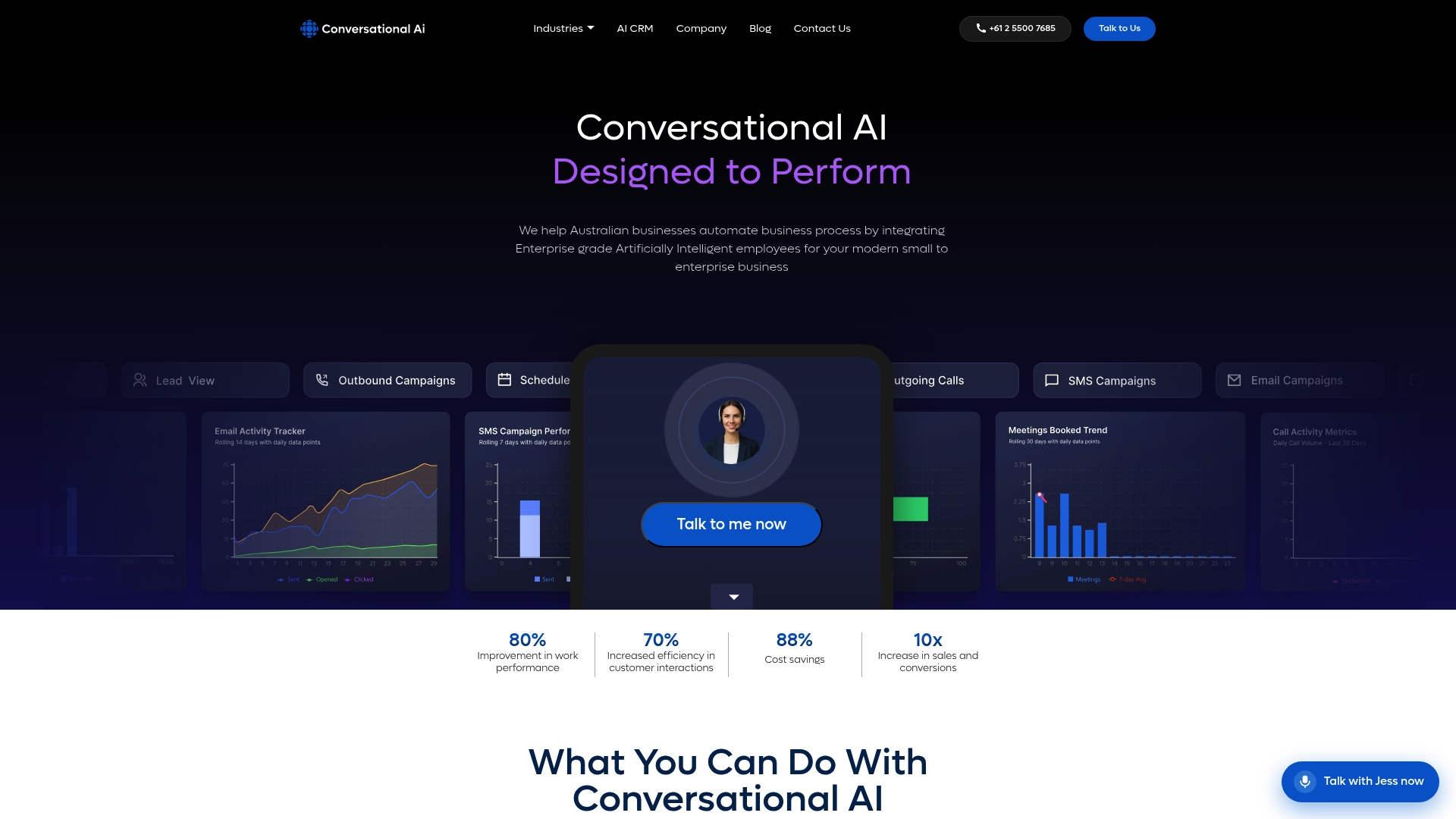
The platform’s Australia-hosted architecture keeps all decision records, interaction logs, and CRM-linked data within Australian jurisdiction, satisfying OAIC and APP requirements without cross-border complexity. Multi-channel logging across voice, SMS, email, and live chat means every decision episode is captured with the artefacts needed for a proof bundle. Model versioning and real-time analytics give your audit team the baseline evidence they need for Tier 1 compliance, without building custom logging infrastructure from scratch.
For organisations in healthcare, financial services, or professional services that need to demonstrate responsible AI governance to regulators, insurers, or procurement panels, Conversational AI provides the technical foundation that makes audit readiness achievable. Request a demo to see how the platform’s audit trail and compliance features work in practice.
Useful sources and further reading
These sources are the most authoritative references for Australian organisations building or reviewing an AI audit programme.
-
NIST AI Risk Management Framework: — the most practical operating model for structuring an AI governance and audit programme; maps directly to evidence types and team roles. Essential for organisations with US technology partnerships or government contracts.
-
OAIC — Privacy and AI guidance: the primary source for understanding how the Privacy Act 1988 and the APPs apply to automated decision-making and AI systems processing personal information.
-
Auditing of AI: Legal, ethical and technical approaches — Springer: — scholarly review of audit methodologies, functional definitions, and the need for structured, transparent procedures with predefined baselines.
-
Artificial intelligence auditability and auditor readiness — ScienceDirect: — systematic research on the four audit layers and the cross-disciplinary competencies auditors need; directly informs team composition and evidence requirements.
-
AI Decision Audit Trails: Regulator Rules — Velt.dev: — practical guidance on structuring tamper-evident decision logs and the specific fields regulators expect in an audit trail.
-
Advancing AI Audits for Enhanced AI Governance — IFI, University of Tokyo: — policy recommendations on risk-based audit prioritisation, institutional challenges, and the case for integrating audits through design and operation phases.
-
Regular audits would build trust, confidence in AI — Cornell News: — expert commentary on why ongoing surveillance audits are more effective than point-in-time certificates for managing drift and maintaining trust.