AI deployment at enterprise scale: a 2026 guide
Discover the key strategies for successful AI deployment at enterprise scale. Learn how to transition from pilot programs to impactful production systems.

AI deployment at enterprise scale is the structured integration of AI systems across complex organisational workflows to drive measurable efficiency, automation, and business value. For Australian enterprises, this means moving well beyond proof-of-concept projects into production systems that operate reliably across multiple business units, channels, and compliance environments. The stakes are real. Only 5% of enterprise AI initiatives successfully move from pilot to scaled production, with costs ranging from $250K to $5M depending on scope and compliance requirements. That figure signals a structural problem, not a technology one. Getting enterprise AI implementation right requires a disciplined approach to data foundations, governance, change management, and infrastructure, all aligned to measurable business outcomes.
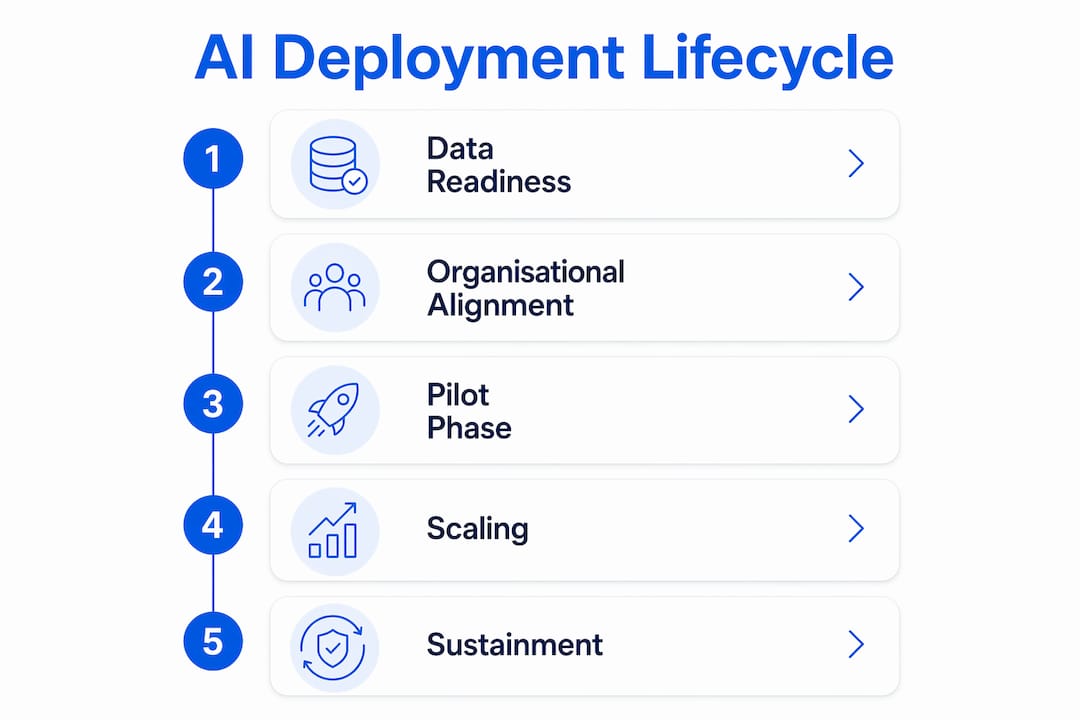
What are the critical phases in the AI deployment lifecycle for enterprises?
Enterprise AI implementation follows a defined sequence. Skipping phases does not accelerate delivery. It creates technical debt and organisational resistance that stalls production later.
-
Strategy definition. Align AI objectives to specific business outcomes before selecting any technology. Define what success looks like in measurable terms: cost per transaction, resolution rate, or processing time. Without this anchor, projects drift.
-
Use case prioritisation. Rank candidate use cases by ROI potential, data availability, and implementation complexity. Start with use cases where data is clean and the business process is well-understood.
-
Data foundation. Build data pipelines, governance policies, and quality controls before modelling begins. Teams that skip data readiness phases consistently fail deployment. This is the phase most enterprises underestimate.
-
Pilot testing. Deploy in a controlled environment with a defined user group. Measure against the success criteria set in phase one. Focused use cases can reach production in 60–90 days when data and organisational alignment are already in place.
-
Phased production deployment. Roll out incrementally across business units rather than launching organisation-wide simultaneously. This limits risk and allows teams to absorb change.
-
Governance and continuous monitoring. Establish model performance monitoring, drift detection, and escalation protocols from day one of production. Governance is not a post-deployment activity.
The average timeline for measurable ROI sits at 12–18 months. That timeline can compress when the data foundation and organisational alignment phases are completed thoroughly before modelling begins.
Pro Tip: Never treat data readiness and organisational alignment as optional pre-work. They are the two phases most likely to determine whether your deployment reaches production or stalls at pilot.
What specific challenges do Australian enterprises face when scaling AI deployment?
Scaling AI in Australian enterprises is harder than most technology roadmaps suggest. The barriers are predominantly organisational, not technical.
-
Skills and change management. Successful enterprise AI requires 70% of investment in people, process, and change management rather than technology development alone. Technical deployments without organisational adoption consistently fail to deliver ROI.
-
Regulatory compliance. Finance and healthcare sectors face strict obligations under Australian Privacy Act requirements and sector-specific regulators. Governance frameworks are necessary preconditions for AI deployment in regulated sectors. Attempting to deploy without them creates compliance exposure that can shut down a project mid-flight.
-
Calendar misalignment. This is the challenge that catches most IT managers off guard. AI deployment delays frequently occur due to collisions with business calendars such as audit cycles and peak seasonal activities, not technical complexity. A deployment scheduled during end-of-financial-year reporting or a retail peak period will stall because the business simply cannot absorb change at that moment.
-
Legacy system integration. Most Australian enterprises carry significant legacy infrastructure. Connecting AI systems to older CRM platforms, ERP systems, and data warehouses requires careful API design and data mapping work that adds weeks to timelines.
-
Organisational buy-in. Middle management resistance is a consistent blocker. Teams that have not been involved in use case selection often treat AI deployment as a threat rather than a tool.
Enterprises in regulated industries often get caught in a ‘fear of messing up’ loop. Without clear governance frameworks in place, the risk of AI errors feels unacceptable, so scaling never begins. Governance readiness is not a compliance checkbox. It is the precondition that makes scaling psychologically and operationally possible.
Pro Tip: Overlay your AI deployment roadmap with the business calendar as a first-class planning layer. Mark out audit periods, financial year-end, and peak trading windows before setting any milestone dates.
How can enterprises architect AI infrastructure to support scale and reliability?
Infrastructure architecture determines whether an AI system can grow with the business or becomes a bottleneck. The right architecture treats AI as enterprise infrastructure, not an isolated feature bolted onto existing systems.

Full-stack AI architecture includes compute, orchestration, trust, control, and governance layers. Each layer plays a distinct role in enabling reliable, accountable execution at scale.
| Infrastructure component | Role in enterprise AI |
|---|---|
| Compute layer | Provides processing capacity for model inference and training workloads |
| Orchestration layer | Manages workflow routing, task sequencing, and multi-agent coordination |
| Trust and governance layer | Enforces policy controls, audit logging, and compliance guardrails |
| Data pipeline layer | Handles ingestion, transformation, and quality validation of inputs |
| MLOps pipeline | Monitors model drift, manages versioning, and automates retraining cycles |
| Security architecture | Controls access to data inputs, model outputs, and API endpoints |
Hybrid cloud and multi-region deployment give enterprises failover capability and the ability to meet Australian data sovereignty requirements. Hosting AI workloads within Australian data centres is not optional for sectors like healthcare and finance. It is a regulatory expectation.
MLOps pipelines are the operational backbone of any production AI system. Without automated drift detection and retraining triggers, model accuracy degrades silently over time. By the time the business notices, the damage to trust in the system is already done.
Leading organisations treat AI as infrastructure integral to daily workflows and KPIs, not as a standalone project. Focusing on outcomes rather than individual models is what separates enterprises that scale successfully from those that accumulate a portfolio of disconnected pilots.
Pro Tip: Build your MLOps monitoring dashboard before go-live, not after. Waiting until a model drifts to set up monitoring means you are always reacting rather than managing.
What practical steps move AI from pilot to sustainable production?
The gap between a successful pilot and a production system that delivers ongoing value is where most enterprise AI programmes break down. Closing that gap requires deliberate execution across five areas.
-
Define the ROI equation mathematically before deployment. Construct a pre-deployment ROI equation using cost per transaction, volume, and improvement rate. Without this, budget reviews become subjective and projects lose funding before they reach full scale. Refer to an AI deployment pipeline guide for a practical framework on structuring this calculation.
-
Use incremental rollouts, not big-bang launches. Deploy to one business unit or channel first. Measure, adjust, and then expand. A phased approach limits the blast radius of any issues and builds internal confidence in the system.
-
Adopt hybrid deployment models. Hybrid deployment models combining vendor support with internal capability building provide practical pathways from pilot to ownership. Embedding specialist partners alongside internal teams accelerates complex integrations while transferring knowledge to your people.
-
Build internal AI ownership over time. Vendor dependency is a risk. Structure contracts and delivery models to include knowledge transfer milestones. Your internal team should be able to manage model updates and governance processes independently within 12 months of production launch.
-
Establish long-term model lifecycle governance. Set review cycles for model performance, data quality, and compliance alignment. Assign clear ownership for each governance function. Without this, production systems drift and accountability gaps emerge. Review enterprise chatbot implementation practices for practical governance frameworks that apply across AI agent deployments.
The transition from pilot to production is fundamentally an organisational change programme that happens to involve technology. Treat it that way and your chances of success improve substantially.
Key takeaways
Successful AI deployment at enterprise scale requires governance, data readiness, and organisational change management to be treated as primary workstreams, not secondary considerations.
| Point | Details |
|---|---|
| Data foundation first | Build data pipelines and quality controls before any modelling begins to avoid deployment failure. |
| Governance as a precondition | Regulated sectors must establish governance frameworks before scaling, not after. |
| Calendar-aware planning | Overlay business calendars onto AI roadmaps to prevent milestone collisions with audits and peak periods. |
| 70% people investment | Allocate the majority of deployment resources to change management and process, not technology alone. |
| Incremental production rollout | Phase deployment by business unit to limit risk and build internal confidence progressively. |
What I’ve learned from watching Australian enterprises attempt to scale AI
The most common mistake I see is treating AI deployment as a technology project with a change management component. It is the other way around. The technology is the easier part. Getting a finance team to trust an AI-generated credit recommendation, or a healthcare administrator to rely on an automated triage output, requires sustained organisational work that no amount of model accuracy can shortcut.
Calendar awareness is the insight that surprises most IT managers when I raise it. Delivery delays almost never come from a failed API call or a model that needs retraining. They come from a deployment scheduled during a period when the business is already at capacity. Audit season, end-of-financial-year, and peak trading periods are dead zones for change absorption. Build your roadmap around the business calendar first, then fit the technical milestones in.
Governance readiness is the other factor that separates organisations that scale from those that stay stuck in pilot loops. In regulated sectors like finance and healthcare, the fear of a compliance failure is real and legitimate. The answer is not to slow down. The answer is to build governance infrastructure early so that scaling feels safe. Partnering with AI providers who understand Australian regulatory requirements, and who host data within Australian borders, removes a significant portion of that risk.
The enterprises I have seen succeed at scale share one mindset: they stopped asking “what can AI do?” and started asking “what outcomes do we need, and how do we build the system that delivers them?” That shift in framing changes everything about how a programme is planned, resourced, and governed.
— Sowrabh
How Conversational AI supports enterprise-scale AI deployment in Australia
Australian enterprises ready to move beyond pilots need a partner who understands both the technical and regulatory realities of deploying AI at scale locally.
Conversational AI builds enterprise-grade AI agents for Australian businesses across voice, SMS, email, and live chat channels, all hosted within Australia to meet data sovereignty requirements. The platform integrates with existing CRM and infrastructure systems, supports natural language understanding and contextual memory, and provides real-time analytics to measure performance against defined business outcomes. For IT managers and decision-makers in finance, healthcare, and professional services, Conversational AI offers a compliant, production-ready path from use case selection through to full-scale deployment and ongoing governance.
FAQ
What does AI deployment at enterprise scale actually mean?
AI deployment at enterprise scale is the integration of AI systems across multiple business units and workflows to deliver measurable operational outcomes. It goes beyond isolated pilots to production systems embedded in daily operations.
Why do so few enterprise AI pilots reach production?
Only 5% of enterprise AI initiatives successfully scale from pilot to production. The primary barriers are skills gaps and change management failures, not technical limitations.
How long does enterprise AI deployment typically take to show ROI?
The average timeline for measurable ROI from enterprise AI implementation is 12–18 months. Focused use cases with strong data foundations can reach production in 60–90 days, but organisation-wide value takes longer to materialise.
What governance requirements apply to AI deployment in Australian regulated sectors?
Finance and healthcare organisations must establish governance frameworks covering audit logging, compliance controls, and escalation protocols before scaling AI. The Australian Privacy Act and sector-specific regulators set baseline requirements that apply from day one of production.
What is a hybrid AI deployment model?
A hybrid deployment model combines specialist vendor support with internal team capability building. It allows complex integrations to proceed quickly while transferring knowledge to internal staff, reducing long-term vendor dependency.