Enterprise chatbot implementation best practices: 2026 guide
Discover essential enterprise chatbot implementation best practices for achieving measurable business success. Enhance your AI strategy today!

Enterprise chatbot implementation best practices define a strategic framework for deploying AI-powered agents that deliver measurable business outcomes, not just automated responses. For business leaders and IT decision-makers in medium to large enterprises, getting this framework right from day one determines whether your chatbot becomes a genuine asset or an expensive liability. The difference lies in how well you plan, govern, and continuously improve your deployment. This guide covers the critical success factors, chatbot deployment strategies, technical architecture decisions, and KPI frameworks that separate successful enterprise chatbot programmes from those that stall after launch.
1. What are the critical success factors for enterprise chatbot implementation?
Enterprise chatbot success starts with clear, measurable business objectives tied to real outcomes. Vague goals like “improve customer experience” produce vague results. Define specific targets: reduce inbound support tickets by a set percentage, cut average handling time, or increase lead qualification throughput. These targets become your north star for every design and technology decision that follows.
User journey mapping is the second non-negotiable. Design conversations around what users actually need to accomplish, not around how your internal systems are structured. A chatbot that mirrors your org chart rather than your customer’s intent will frustrate people and drive escalations. Map the top five to ten user goals before writing a single dialogue flow.

Integration readiness determines whether your chatbot can deliver on its promises. A chatbot disconnected from your CRM, ERP, or HRIS can only answer static questions. Connecting it to live data lets it resolve issues, update records, and personalise responses. Audit your existing platforms and confirm API availability before committing to a deployment timeline.
Enterprise chatbot programmes must be treated as continuous product lifecycles with multi-year roadmaps, not one-off projects. A foundational use case sets the architectural layers that support successive expansions without requiring a full rebuild. Plan for growth from the start.
Pro Tip: Map your integration dependencies on a whiteboard before selecting a platform. Discovering a missing API connector after contract signing costs far more than the time spent upfront.
- Define KPIs tied to business outcomes, not session counts
- Map user journeys before designing dialogue flows
- Confirm API connectivity to CRM, ERP, and HRIS systems
- Build for maintainability and future expansion from day one
- Assign a product owner who is accountable for chatbot performance
2. Which chatbot rollout strategies deliver the most effective enterprise adoption?
The most effective enterprise chatbot rollout strategy starts narrow. Pick one focused use case, such as IT password resets, appointment booking, or order status enquiries, and build it properly. This approach establishes your architectural foundation and lets your team learn without the risk of a broad, chaotic launch.
A phased approach with a pilot, iterative improvement, and monitored rollout achieves 2–3x faster value realisation compared to big-bang deployments. That speed advantage compounds over time because each iteration produces cleaner data and more refined responses.
- Define the pilot scope. Select a controlled group of users and a single, well-documented use case. Limit data access to what the chatbot genuinely needs.
- Wire the human escalation path before go-live. Agents must be able to receive context-rich handovers from the chatbot. A broken escalation path destroys user trust faster than any other failure.
- Run weekly review cycles. Extract the top unanswered queries each week and revise the knowledge base. Weekly review cycles combined with regression testing against 50–100 baseline questions can achieve up to 80% deflection rates within a quarter.
- Regression test every update. Each knowledge base change must be tested against your baseline question set to prevent new answers from breaking existing ones.
- Ramp traffic gradually. Once your pilot metrics hit target, increase the user base in stages. Monitor escalation rates and resolution quality at each stage before proceeding.
Pro Tip: Treat your knowledge base like a living document. Deduplicate entries weekly and archive outdated content. A cluttered knowledge base is the single most common cause of chatbot drift in enterprise deployments.
3. How should enterprises manage governance, monitoring, and continuous improvement?
Governance is what separates enterprise chatbots that improve over time from those that quietly degrade. Cross-functional involvement including business, IT, security, compliance, and operations is required for successful enterprise chatbot adoption. Teams that integrate stakeholders early manage governance, risk, and change management far more effectively than those who treat it as an IT-only project.
A formal governance structure needs assigned ownership. Assign a named programme owner who is accountable for performance, compliance, and roadmap decisions. Without clear ownership, chatbot quality drifts as teams assume someone else is monitoring it.
Confidence scoring is a technical governance control that every production chatbot needs. When retrieval context is poor, confidence scoring disables answers and routes queries to human agents. This reduces hallucinations and maintains user trust in high-stakes enterprise environments.
Key governance practices to implement from day one:
- Assign a named programme owner with cross-functional authority
- Implement confidence scoring with automatic escalation for low-quality responses
- Schedule monthly knowledge base audits and quarterly full reviews
- Conduct bias assessments and regulatory compliance checks at each major update
- Track resolution quality, cost per resolved interaction, and user satisfaction, not session counts
- Log all escalations and analyse patterns to identify knowledge gaps
Continuous monitoring with regular audits and knowledge base refresh cycles prevents performance degradation and compliance failures. Build these cycles into your programme calendar, not as ad hoc tasks.
4. What technical architecture considerations ensure long-term chatbot performance?
Production-grade enterprise chatbots require a hybrid retrieval architecture. Hybrid retrieval combining vector search with BM25 keyword matching handles diverse query types that a single retrieval method cannot. Around 20–30% of queries perform better with keyword matching than with vector search alone. A hybrid approach covers both.
Conversation logging with outcome tracking is the foundation of your analytics and regression testing capability. Every conversation should be logged with its resolution status, escalation flag, and user satisfaction signal. This data drives your weekly review cycles and informs knowledge base updates.
SSO integration and role-based authentication allow personalised and secure chatbot interactions that respect user permissions and data access boundaries. Identity management prevents data leakage and enables contextual responses based on the user’s role, location, or account status.
Architecture evaluation criteria
| Capability | What to assess |
|---|---|
| Retrieval method | Does the platform support hybrid vector and keyword search? |
| Conversation logging | Are outcomes, escalations, and satisfaction signals captured? |
| Identity management | Does SSO and role-based access control come standard? |
| Version control | Can you roll back model or knowledge base updates safely? |
| Observability | Are real-time dashboards and alerting available out of the box? |
Version control and observability frameworks are not optional extras. You need the ability to roll back a bad knowledge base update without downtime, and you need real-time alerts when resolution rates drop unexpectedly.
5. Which KPI frameworks best demonstrate enterprise chatbot ROI?
Move beyond session counts. Outcome-focused metrics better reflect chatbot impact than totals of conversations or page views. The KPIs that matter to your board and your operations team are the ones tied to cost, quality, and customer experience.
The most useful KPIs for enterprise chatbot programmes fall into three categories. Efficiency metrics include ticket deflection rate, conversation completion rate, and cost per resolved interaction. Quality metrics include escalation rate, first-contact resolution, and accuracy against your regression test suite. Experience metrics include customer satisfaction score and time to resolution.
| KPI | What it measures | Why it matters |
|---|---|---|
| Ticket deflection rate | Percentage of queries resolved without human agent | Direct cost saving indicator |
| Escalation rate | Percentage of conversations handed to a human | Signals knowledge gaps or confidence failures |
| Cost per resolved interaction | Total programme cost divided by resolved queries | Proves financial ROI to leadership |
| CSAT score | User satisfaction rating post-conversation | Measures experience quality |
| Lead qualification rate | Percentage of leads qualified through chatbot | Demonstrates revenue contribution |
Build an analytics dashboard that surfaces these metrics daily. Use your regression test suite to monitor accuracy after every knowledge base update. When ticket deflection drops, your dashboard should tell you which query category caused it before your operations team notices the spike in agent volume.
Key takeaways
Successful enterprise chatbot implementation requires continuous governance, outcome-focused KPIs, and a phased rollout strategy built on a single, well-defined use case.
| Point | Details |
|---|---|
| Start with one use case | A narrow initial scope builds the architectural foundation for future expansion without rewrites. |
| Wire escalation before launch | Human handover paths must be tested and confirmed before any user-facing deployment. |
| Govern with named ownership | Assign a cross-functional programme owner accountable for performance, compliance, and roadmap. |
| Measure outcomes, not activity | Track ticket deflection, cost per resolution, and CSAT rather than session counts. |
| Review and test weekly | Weekly knowledge base updates with regression testing drive deflection rates toward 80% within a quarter. |
What I’ve learned about enterprise chatbot programmes that most guides won’t tell you
Most enterprise chatbot projects fail quietly. They launch, get decent initial numbers, and then slowly degrade as the knowledge base goes stale and no one is formally accountable for keeping it current. I’ve seen this pattern repeat across industries. The technology was never the problem. The governance was.
The organisations that get lasting value from their chatbots treat them exactly like they treat a core software product. There is a roadmap, a product owner, a release cycle, and a review cadence. The chatbot is never “done.” It has a backlog, a sprint cycle, and a retrospective. That mindset shift is the single biggest predictor of long-term success.
The other thing most guides understate is the importance of the escalation path. A chatbot that handles 70% of queries brilliantly but drops the remaining 30% into a dead end destroys more trust than it builds. The human handover experience is part of your chatbot’s product quality. Design it with the same care you give the automated flows.
Automation works best when it complements your human agents, not when it tries to replace them entirely. The best deployments I’ve seen use chatbots to handle high-volume, low-complexity queries so that human agents can focus on the conversations that genuinely need empathy and judgement. That division of labour is where the real AI in customer service value lives.
— Sowrabh
How Conversational AI supports enterprise chatbot deployment in Australia
Australian enterprises face specific requirements around data sovereignty, privacy regulation, and integration with local infrastructure. Conversational AI is built to address exactly those requirements.
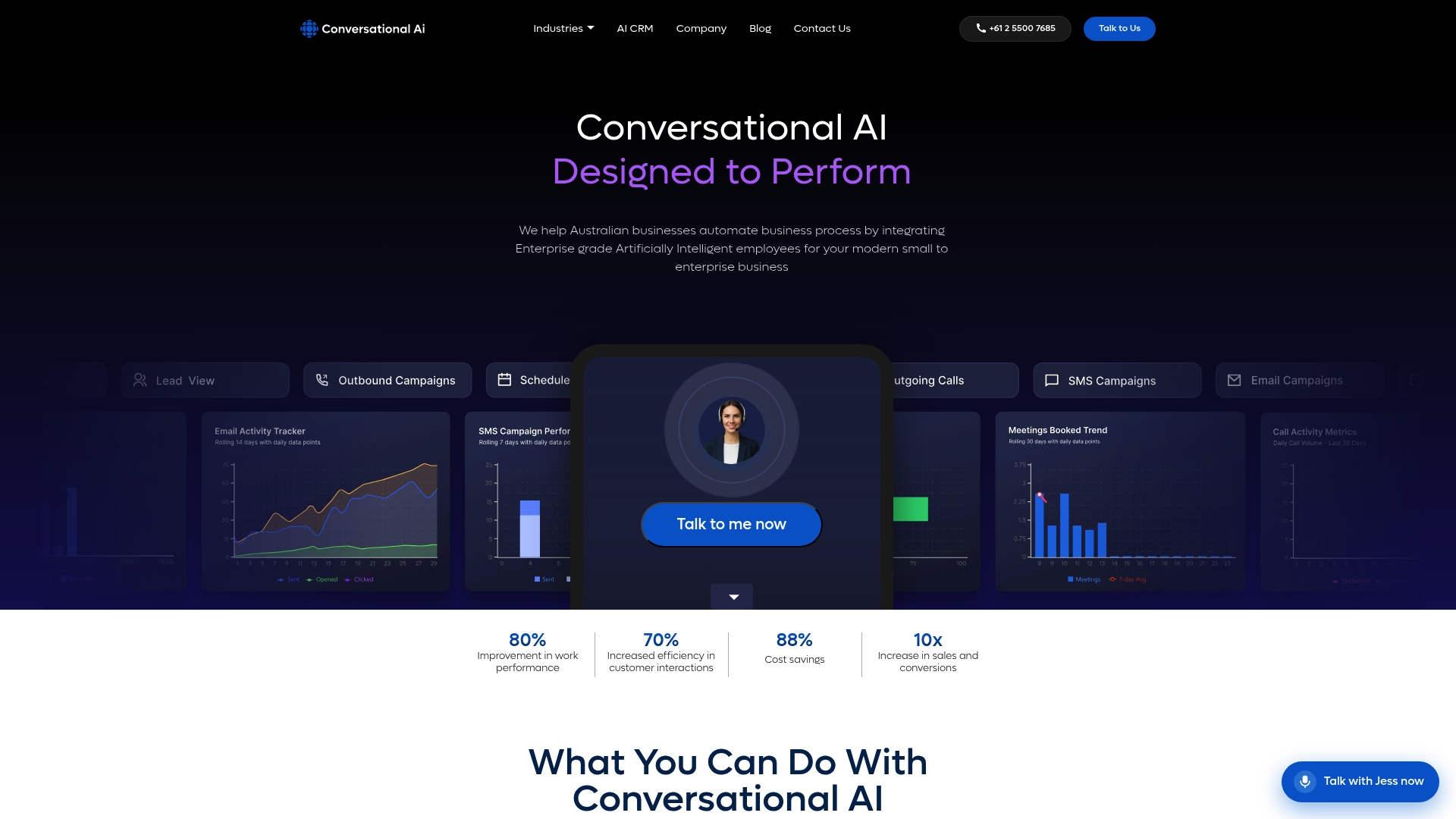
Conversational AI provides enterprise AI agents designed for Australian medium to large businesses, with multi-channel deployment across voice, SMS, email, and live chat. The platform hosts entirely within Australia, giving your team full data control and compliance confidence. Its agents connect to existing CRM and ERP systems, support SSO and role-based access, and include real-time analytics dashboards so you can track the KPIs that matter. If you are planning an enterprise chatbot rollout and want a platform built for Australian compliance and scale, contact the Conversational AI team to discuss your requirements.
FAQ
What is the first step in enterprise chatbot implementation?
Define a single, measurable use case with clear KPIs before selecting any technology. Starting narrow reduces risk and establishes the architectural foundation for future expansion.
How long does it take to see ROI from an enterprise chatbot?
Teams following a phased rollout with weekly knowledge base reviews and regression testing can achieve up to 80% deflection rates within a quarter. ROI timeline depends on use case complexity and governance discipline.
What KPIs should enterprises track for chatbot performance?
Track ticket deflection rate, escalation rate, cost per resolved interaction, CSAT score, and lead qualification rate. Session counts and conversation totals do not reflect business impact.
How do you prevent enterprise chatbot performance from degrading over time?
Assign a named programme owner, run monthly knowledge base audits, implement confidence scoring with automatic escalation, and conduct regression testing after every update.
What is confidence scoring in enterprise chatbots?
Confidence scoring is a mechanism that disables chatbot responses when retrieval quality is poor and routes the query to a human agent. It reduces hallucinations and maintains trust in production environments.