What is an AI deployment pipeline? A 2026 guide
Discover what an AI deployment pipeline is and how it automates workflows, enhancing machine learning from data to deployment and monitoring.

An AI deployment pipeline is an automated, repeatable workflow that manages the full lifecycle of a machine learning model, from data ingestion through to production deployment, monitoring, and retraining. In the industry, this practice sits under the broader discipline of MLOps, which combines machine learning with DevOps principles to make AI delivery reliable and repeatable. For IT professionals and project managers in large organisations, understanding what is an AI deployment pipeline is the difference between a proof-of-concept that never ships and an AI system that delivers measurable business value. The pipeline replaces manual, error-prone handoffs with automated flows that cover data ingestion, preprocessing, training, deployment, and monitoring.
What is an AI deployment pipeline and how does it work?
An AI deployment pipeline is the structured sequence of automated stages that takes a raw dataset and produces a validated, monitored model running in production. The term is often used interchangeably with “ML pipeline” or “MLOps pipeline,” though the deployment pipeline specifically refers to the stages from a trained model through to live serving and ongoing maintenance. The core insight is this: AI pipelines automate repeated execution from raw data to validated model and back again via monitoring-triggered retraining, replacing fragile manual processes.
The sequential stages of an AI pipeline workflow
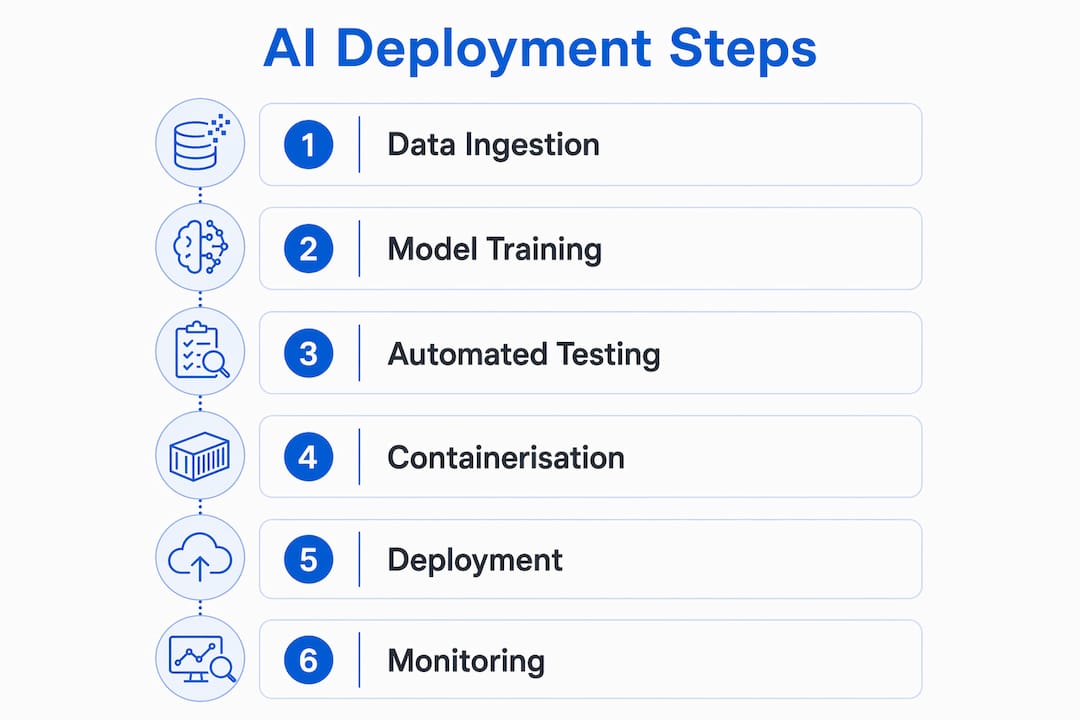
A well-structured pipeline follows these stages in order:
- Data ingestion and versioning. Raw data is collected from source systems and versioned so every model training run is traceable. Tools like DVC (Data Version Control) manage this layer.
- Model training and experimentation. Data scientists train candidate models, track experiments, and log metrics. Frameworks like MLflow record parameters, metrics, and artefacts for each run.
- Automated testing and quality gates. The pipeline runs automated checks against gold-standard datasets before any model advances. This is where ML CI/CD diverges from traditional software CI/CD.
- Containerisation and packaging. The approved model, its dependencies, and the serving code are packaged into a Docker container image. This step is covered in detail below.
- Deployment via orchestration. The container is deployed to a Kubernetes cluster, which manages scaling, load balancing, and restarts.
- Monitoring and retraining. Production metrics like latency, accuracy, and data drift are tracked continuously. When performance drops below a threshold, the pipeline triggers retraining automatically.
Each stage hands off to the next without human intervention. That automation is what makes the pipeline repeatable and auditable.
Pro Tip: Version your data and your models together. A model trained on unversioned data is impossible to reproduce or debug when something goes wrong in production.

Why containerisation is the backbone of AI deployment
Containerised AI deployment solves the single most common failure mode in AI projects: the “it works on my machine” problem. A Docker container packages the model, the Python libraries, the CUDA GPU drivers, and every other dependency into one immutable unit. That unit runs identically on a developer’s laptop, a private cloud server, or an edge device in a remote facility.
Without containerisation, environment drift causes models to fail in production due to hidden dependency mismatches, particularly around GPU drivers and library versions. Containers act as immutable blueprints that replicate the exact environment at every pipeline stage. This is why containerisation is a necessity, not an optional extra, for any organisation running AI at scale.
The practical benefits for large organisations include:
- Reproducibility. Any team member can rebuild the exact environment from the container image.
- Portability. The same image runs across public cloud, private cloud, and hybrid infrastructure.
- Isolation. Multiple models run on the same host without interfering with each other’s dependencies.
- Faster rollbacks. If a new model version fails, Kubernetes can revert to the previous container image within seconds.
Pro Tip: Use multi-stage Docker builds to keep production images small and free of build tools. Smaller images reduce attack surface and cut deployment time.
What are the best practices for deploying AI models at scale?
Successful AI deployment is fundamentally an operations and security challenge, not purely an AI science challenge. Teams that treat it as only a data science problem consistently underestimate infrastructure demands and end up with models that work in notebooks but fail under real traffic.
Set KPIs before you scale
Define measurable business KPIs before deploying any model to production. Metrics like latency, prediction accuracy, and days-to-close give you a baseline to assess whether the AI is actually adding value. Without these, you cannot make a defensible case for scaling infrastructure spend.
Use a model registry
Scaling models to production fails most often because teams lack a centralised model registry. A registry tracks each model’s lineage, training data version, evaluation metrics, and deployment status. When something breaks in production, the registry tells you exactly which model version is running and what data it was trained on.
Apply safe deployment patterns
“Safe deployment patterns like shadow mode and canary releases allow validation in production with low risk, reducing downtime and failed rollouts.” — AI deployment best practices
Shadow mode runs the new model in parallel with the current model, comparing outputs without serving the new model’s predictions to end users. Canary releases direct a small percentage of live traffic to the new model before a full rollout. Both patterns give you real production signal with minimal risk. Rollback mechanisms must be tested before you need them, not after.
Security and reliability measures
Reliable AI deployments require multi-stage container builds, signed image verification, and automated health checks. These controls confirm that the image running in production is the one you approved, and that the serving endpoint restarts cleanly after a failure. Operational and security considerations take priority over model performance tuning at scale.
Pro Tip: Run automated health checks on your model serving endpoints as part of your Kubernetes liveness and readiness probes. A model that passes unit tests but fails to respond under load is a production incident waiting to happen.
How do you manage continuous improvement in an AI pipeline?
A deployed model is not a finished product. Data distributions shift, user behaviour changes, and model accuracy degrades over time. A mature AI pipeline workflow includes continuous training loops that trigger automatically when monitoring detects data drift or performance degradation below a defined threshold.
Automated data validation and quality gates
Every retraining run must pass automated data validation before a new model is promoted. This includes schema checks, distribution comparisons against the training baseline, and evaluation against a held-out gold dataset. These gates prevent a corrupted data feed from silently degrading your production model.
Integrating with existing DevOps practices
ML CI/CD extends traditional CI/CD by adding data validation, model evaluation, and model registry promotion as pipeline stages. Your existing Git workflows, pull request reviews, and environment promotion processes apply directly. The difference is that ML CI/CD pipelines include additional gates for data validation and staged deployment strategies like canary or shadow mode, beyond what traditional software pipelines require.
The table below compares deployment strategies by risk level and use case:
| Strategy | Risk level | Best use case |
|---|---|---|
| Direct replacement | High | Low-traffic internal tools |
| Canary release | Medium | Customer-facing models with measurable KPIs |
| Shadow mode | Low | High-stakes models where silent validation is required |
| Blue/green deployment | Low to medium | Environments requiring zero-downtime cutover |
Pro Tip: Treat your retraining pipeline as a first-class software system. Version it, test it, and review changes to it with the same rigour you apply to your production application code.
For teams deploying AI in enterprise IT, continuous improvement loops are what separate a one-off automation from a system that compounds value over time. The same principle applies to AI-driven communication workflows, where model performance directly affects customer outcomes.
Key takeaways
A well-governed AI deployment pipeline combines MLOps automation, containerisation with Docker and Kubernetes, and continuous monitoring to keep machine learning models reliable and measurable in production.
| Point | Details |
|---|---|
| Define the pipeline early | Establish automated stages from data ingestion to monitoring before writing model code. |
| Containerise every model | Use Docker to package models and dependencies, eliminating environment drift across infrastructure. |
| Set KPIs before scaling | Define latency, accuracy, and business metrics upfront to justify infrastructure investment. |
| Use safe rollout patterns | Apply canary releases or shadow mode to validate new models in production without full exposure. |
| Automate retraining triggers | Connect monitoring alerts to retraining pipelines so model performance recovers without manual intervention. |
The part most teams get wrong
The most common mistake I see in large organisations is treating AI deployment as the final step rather than the ongoing operating model. Teams invest months in model development, then hand off a trained model to infrastructure teams with no agreed monitoring thresholds, no model registry, and no retraining plan. The model degrades quietly over weeks, and nobody notices until a business metric drops.
The second mistake is underestimating the gap between a working notebook and a production-grade serving system. A model that achieves excellent accuracy in a Jupyter notebook still needs containerisation, a REST or gRPC endpoint, load testing, health checks, and a rollback plan before it belongs in production. Skipping these steps does not save time. It borrows time from your incident response queue.
What actually works is treating the deployment pipeline as a product. Assign ownership, define SLAs for model latency and availability, and run regular pipeline health reviews the same way you would review application uptime. Cross-team collaboration between data scientists, platform engineers, and security teams is not optional. It is the mechanism that keeps the pipeline running when things go wrong, and things will go wrong.
The organisations that get the most value from AI are not the ones with the most sophisticated models. They are the ones with the most disciplined deployment and monitoring practices. Build the pipeline first. The model science follows.
— Sowrabh
How Conversational AI supports reliable AI deployment for Australian businesses
Conversational AI is built on the same MLOps and containerisation principles covered in this article, with infrastructure hosted entirely within Australia to meet local data sovereignty requirements. The platform runs multi-channel AI agents across voice, SMS, email, and live chat, all deployed through a production-grade pipeline that includes continuous monitoring and automated performance management. For IT teams and project managers who need AI agents built for scale, Conversational AI provides a ready-made deployment foundation without the overhead of building and maintaining pipeline infrastructure from scratch. Contact the team to see how the platform fits your organisation’s existing technology stack.
FAQ
What is an AI deployment pipeline in simple terms?
An AI deployment pipeline is an automated workflow that moves a machine learning model from training through to live production use, including monitoring and retraining. It replaces manual handoffs with repeatable, auditable stages.
What are the main steps in an AI deployment pipeline?
The core steps are data ingestion and versioning, model training, automated testing, containerisation with Docker, deployment via Kubernetes, and continuous monitoring for drift and performance degradation.
Why is containerisation important for AI deployment?
Containerisation packages a model and all its dependencies into one portable unit, eliminating environment drift between development and production. Docker is the industry standard tool for this process.
What is the difference between ML CI/CD and traditional CI/CD?
ML CI/CD includes additional stages for data validation, model evaluation against gold datasets, and model registry promotion. Traditional software CI/CD does not account for data quality or model performance as pipeline gates.
How do you know when to retrain a deployed AI model?
Retraining is triggered when monitoring detects data drift, a drop in prediction accuracy, or degradation in business KPIs like latency or conversion rate. Automated pipelines can trigger retraining without manual intervention once thresholds are defined.