Types of enterprise AI integration architectures: 2026 guide
Discover the types of enterprise AI integration architectures for 2026. Learn how to enhance security and scalability in your organization.

Enterprise AI integration architecture is the structured approach to embedding AI within large organisations, combining layered components that enforce security, scalability, and governance across all AI interactions and data flows. Choosing the wrong types of enterprise AI integration architectures creates brittle systems that break under regulatory pressure or operational load. The most effective architectures are modular and layered, isolating AI components from core business logic while enabling governed, auditable deployment. This guide covers the proven AI architecture types that enterprise IT decision-makers and architects need to evaluate in 2026, from AI Gateways and Anti-Corruption Layers to cloud, on-premise, and hybrid AI solutions.
1. AI Gateway-centred modular architecture
The AI Gateway is the single control point for all AI requests in an enterprise, and every production-grade system needs one. Think of it the way you think of an API Gateway in a microservices architecture. Every request passes through it, every response is logged, and every policy is enforced at that layer.
A well-designed AI Gateway handles:
- Provider routing: Switch between AI model providers without touching application code.
- Rate limiting and budget controls: Enforce per-team or per-product cost caps before spend escapes.
- PII redaction: Strip personally identifiable information before it reaches any external model.
- Prompt injection filtering: Block adversarial inputs that attempt to override system instructions.
- Structured logging: Capture every request and response for audit trails and compliance reporting.
The gateway also enables caching and circuit breaking. Caching reduces redundant model calls and cuts costs. Circuit breaking prevents a failing model provider from cascading failures into your application layer.
Without a centralised gateway, observability disappears entirely. You cannot track usage, enforce cost controls, or demonstrate regulatory compliance when requests scatter across multiple direct integrations. That is not a theoretical risk. It is the most common failure mode in early enterprise AI deployments.

Pro Tip: Design the AI Gateway as core infrastructure from day one, not as an optional component you add later. Retrofitting it into a live system is significantly more disruptive than building it in at the start.
2. Anti-Corruption Layer pattern for clean domain integration
The Anti-Corruption Layer (ACL) is a design pattern that isolates your core business domain from AI-specific semantics. The ACL translates domain requests into AI prompts and parses AI responses back into domain objects. Your business logic never directly touches a raw AI response.
Without an ACL, AI concepts leak into your domain model. A support ticket classification system, for example, might start returning confidence scores directly to business logic. That creates a dependency on the AI model’s output format. When you change models or providers, the business logic breaks.
The ACL prevents that by acting as a strict translation boundary. Key responsibilities include:
- Input sanitisation: Clean and structure user data before it becomes part of a prompt.
- XML or structural delimiters: Wrap user-supplied content to prevent it from being interpreted as instructions.
- Output filtering: Clamp confidence scores and validate response formats before passing results upstream.
- Domain object mapping: Convert raw AI output into typed, validated domain entities.
Avoiding AI concept leakage through the ACL directly improves long-term maintainability. When you migrate from one model to another, you update the ACL, not the entire application.
Pro Tip: Treat the ACL as a security boundary, not just a translation layer. Sanitising inputs at the ACL is your primary defence against prompt injection attacks that bypass the AI Gateway.
3. Agentic architectures and orchestration models
Agentic AI architectures move beyond single model calls into systems where multiple AI agents collaborate to complete complex tasks. Enterprise AI systems benefit from hybrid multi-agent architectures that combine orchestration, specialised agents, and routing to handle tasks no single model handles well alone.
The four primary patterns are:
- Single agent: One model handles the full task. Suitable for simple, well-scoped use cases with low coordination overhead.
- Orchestrator and worker: A central orchestrator breaks goals into subtasks and delegates to worker agents. The orchestrator synthesises results.
- Router and specialist: A routing agent classifies incoming requests and directs them to the most capable specialist agent.
- Supervised autonomous swarm: Multiple agents operate in parallel with an oversight layer monitoring for failures and conflicts.
Multi-agent systems introduce real coordination challenges. Agents can produce conflicting outputs. Failure in one agent can stall the entire pipeline if dependencies are not managed carefully. Retry logic, fallback agents, and timeout handling are not optional in production.
Hybrid architectures that split goals into subtasks and delegate to specialists consistently outperform single-agent approaches in production reliability. The orchestrator pattern is the most common starting point for enterprises moving beyond proof-of-concept deployments.
4. Legacy systems integration: API middleware, data lakes, and embedded AI modules
Integrating AI with legacy systems is the most common challenge Australian enterprises face. Three proven patterns address different risk profiles and capability requirements.
| Pattern | Best for | Risk level | Latency |
|---|---|---|---|
| API middleware layer | Decoupling AI from legacy without touching core systems | Low | Medium |
| Data lake abstraction | Analytical AI tasks using historical data | Low to medium | High (batch) |
| Embedded AI modules | Real-time inference requiring sub-second response | Medium to high | Low |
The API middleware layer is the lowest-risk entry point. It sits between the legacy system and the AI component, translating requests and responses without modifying the underlying system. This suits use cases like document classification or customer data enrichment.
Data lake abstraction works well for analytical AI tasks. You replicate legacy data into a staging lake, run AI models against that copy, and feed results back. The legacy system is never directly exposed to AI components.
Embedded AI modules deliver the lowest latency but carry the highest integration risk. They run inference directly within or adjacent to the legacy system process. This suits real-time fraud detection or live call scoring.
Legacy system AI integration works best as a phased process. The five stages are: assess, isolate, connect, validate, and scale. Skipping the isolate stage is the most common cause of production incidents in legacy AI projects. For a broader view of how this applies to customer-facing systems, the contact centre AI integration guide covers the operational side in detail.
5. Cloud, on-premise, and hybrid AI architectures
Cloud AI architecture, on-premise AI systems, and hybrid AI solutions each serve different enterprise needs. The right choice depends on your data residency requirements, latency constraints, and governance obligations.
Cloud-native AI architectures provide elastic compute and managed model services, while on-premise deployments address data residency and latency constraints. Many enterprises adopt hybrid models to get the benefits of both.
Cloud AI architecture suits:
- Workloads with variable or unpredictable compute demand.
- Teams that want managed model services without infrastructure overhead.
- Use cases where data residency regulations permit cloud processing.
On-premise AI systems suit:
- Regulated industries where data cannot leave a physical facility.
- Low-latency inference requirements that cloud round-trip times cannot meet.
- Organisations with existing data centre investment and the operational capability to run AI infrastructure.
Hybrid AI solutions blend both. Sensitive data stays on-premise for inference. Non-sensitive workloads and model training run in the cloud. The governance challenge with hybrid models is maintaining consistent policy enforcement across both environments. Your AI Gateway must span both deployment zones to preserve observability.
For Australian enterprises, data sovereignty is a specific driver. Hosting AI workloads within Australia addresses Privacy Act obligations and sector-specific regulations in healthcare and finance. The private AI deployment guide covers the governance considerations for on-premise and private cloud deployments in the Australian context.
6. Governance and trust as built-in infrastructure layers
KPMG’s 2026 enterprise AI framework treats governance, trust, and operational controls as built-in infrastructure layers, not afterthoughts. The framework spans ten layers from data to trust. Shortcuts in any layer become liabilities at scale.
Governance in an AI architecture is not a policy document. It is a set of enforced technical controls. Rate limits at the AI Gateway enforce cost governance. The ACL enforces data governance by sanitising inputs before they reach a model. Structured logging at every layer enforces audit governance.
Trust layers include model output validation, confidence thresholds, and human-in-the-loop escalation paths. An AI system that cannot escalate to a human when confidence is low is not production-ready. That applies whether you are running a single agent or a multi-agent orchestration system.
Outcome-driven design is the principle that ties governance to business value. You define what a successful AI interaction looks like in measurable terms, then build the governance controls that protect that outcome. This is the opposite of building AI features first and adding governance later.
Key takeaways
The most effective enterprise AI integration architectures combine an AI Gateway, Anti-Corruption Layer, agent orchestration, and phased legacy integration to deliver governed, auditable, and maintainable AI systems at scale.
| Point | Details |
|---|---|
| AI Gateway is non-negotiable | Build it as core infrastructure from day one to enforce cost, compliance, and observability. |
| ACL protects your domain model | Translate all AI inputs and outputs at the boundary to prevent concept leakage and enable model migration. |
| Multi-agent systems need coordination controls | Use orchestrator-worker or router-specialist patterns with retry logic and fallback agents in production. |
| Legacy integration requires phased approach | Follow the assess, isolate, connect, validate, and scale sequence to reduce production risk. |
| Governance must be technical, not just policy | Enforce trust and audit controls at the infrastructure layer, not through documentation alone. |
My view on where most enterprise AI projects go wrong
I have watched a lot of enterprise AI projects move from proof-of-concept to production, and the failure pattern is almost always the same. Teams build the AI feature first and treat the architecture as something to sort out later. The AI Gateway gets added as an afterthought. The ACL never gets built at all. Six months in, the system is brittle, costs are uncontrolled, and the compliance team is asking questions nobody can answer.
The uncomfortable truth is that most AI integration problems are not AI problems. They are architecture problems. A well-designed AI Gateway with proper logging would have caught the cost blowout. An ACL would have prevented the domain model from becoming tangled with model-specific output formats. These are not exotic patterns. They are the same discipline that good software engineers apply to any external dependency.
The other thing I see consistently is teams underestimating the operational maturity required for agentic systems. A single model call is relatively easy to reason about. An orchestrator managing five specialist agents, each with its own failure modes, is a distributed system. You need the same observability, retry logic, and incident response capability you would apply to any critical distributed system.
My advice is to start with the AI Gateway and the ACL before you write a single line of application code. Get those two layers right, and everything else becomes significantly easier to build, govern, and maintain.
— Sowrabh
How Conversational AI supports enterprise AI integration
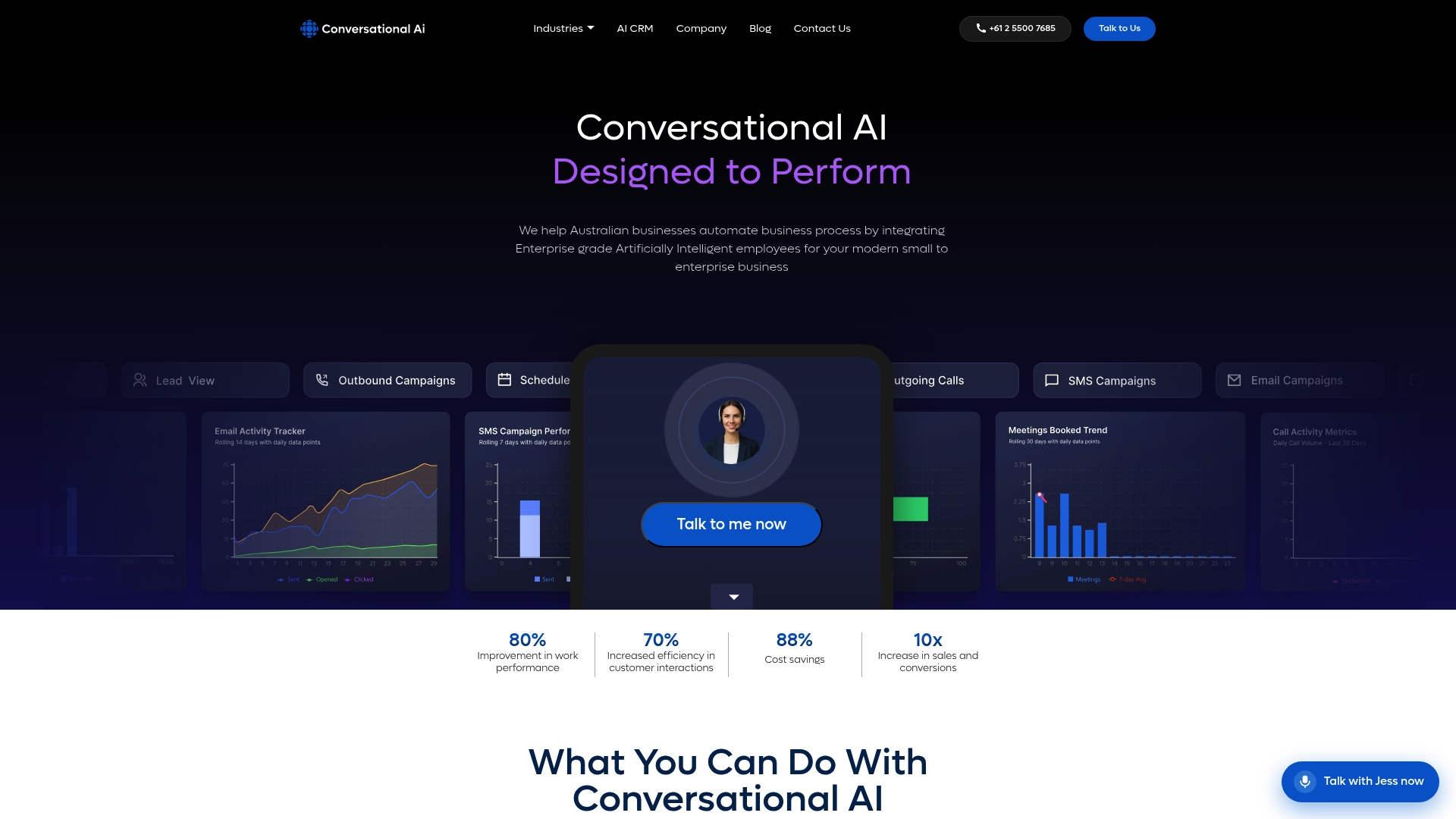
Conversational AI builds enterprise AI agent platforms specifically for Australian businesses, with architecture designed around the principles covered in this guide. Data stays within Australia, addressing Privacy Act obligations and sector-specific requirements in healthcare, finance, and professional services. The platform integrates across voice, SMS, email, and live chat channels, connecting with existing CRM systems without requiring a full infrastructure rebuild.
For IT decision-makers evaluating AI agent solutions for their organisation, Conversational AI offers a private, governed deployment model that fits within the layered architecture frameworks described here. The platform handles the AI Gateway, observability, and compliance controls as part of the core product, not as optional add-ons.
FAQ
What is enterprise AI integration architecture?
Enterprise AI integration architecture is the structured set of components, patterns, and governance controls that embed AI into large organisation systems. It includes layers such as the AI Gateway, Anti-Corruption Layer, agent orchestration, and data infrastructure.
What is the AI Gateway and why does every enterprise need one?
The AI Gateway is the central control point for all AI requests, enforcing rate limits, PII redaction, cost controls, and structured logging. Without it, enterprises cannot maintain observability or demonstrate regulatory compliance at scale.
What is the Anti-Corruption Layer in AI architecture?
The Anti-Corruption Layer translates domain requests into AI prompts and parses AI responses back into domain objects, preventing AI-specific concepts from leaking into core business logic. It also sanitises inputs to guard against prompt injection attacks.
When should an enterprise choose a hybrid AI architecture?
A hybrid AI architecture suits enterprises that need to keep sensitive data on-premise for compliance reasons while running non-sensitive workloads in the cloud. Governance controls, particularly the AI Gateway, must span both environments to maintain consistent policy enforcement.
How do you integrate AI with legacy systems without disrupting operations?
The lowest-risk approach uses an API middleware layer to decouple AI from legacy systems without modifying the underlying infrastructure. A phased process covering assess, isolate, connect, validate, and scale reduces the risk of production incidents during integration.
Recommended
- Contact centre AI integration: a 2026 enterprise guide - Conversational AI
- Private AI deployment explained for enterprise IT teams - Conversational AI
- Automate customer service operations: 2026 enterprise guide - Conversational AI
- AI automation for Australian businesses explained - Conversational AI