How CRM AI synchronisation works: an enterprise guide
Discover how CRM AI synchronisation works to automate customer data management. Transform your enterprise with intelligent integration and insights.

CRM AI synchronisation is defined as the continuous, automated alignment of customer data across multiple systems using artificial intelligence, APIs, and event-driven architecture. For IT managers evaluating how CRM AI synchronisation works, the core mechanism involves AI agents capturing, enriching, and reconciling data in real time, replacing manual entry with intelligent automation. The industry term for this capability is “agentic CRM integration,” and it represents a fundamental shift in how enterprises manage customer relationships. Understanding this process matters because AI agents reduce seller drag by automatically capturing and enriching engagement data, shifting the CRM from a passive repository into an active intelligence engine. Platforms like Conversational AI are built specifically around this model, connecting voice, SMS, email, and live chat channels directly into CRM workflows.
How CRM AI synchronisation works: architectural models and technologies
CRM AI synchronisation relies on four core sync models, each suited to different operational contexts. Choosing the wrong model creates data lag, conflicts, or unnecessary infrastructure cost.
The four models are:
- One-way synchronisation: Data flows in a single direction, typically from a source system into the CRM. This suits scenarios where one system is the authoritative record, such as a billing platform pushing payment status into the CRM.
- Two-way synchronisation: Data flows in both directions simultaneously. This is the most common enterprise model but requires explicit conflict resolution rules to prevent overwrites.
- Batch synchronisation: Data is collected and transferred at scheduled intervals. This works for non-time-sensitive updates like overnight contact list refreshes, but introduces latency.
- Real-time synchronisation: Changes trigger immediate data transfer using webhooks, streaming APIs, or Change Data Capture (CDC). Event-driven sync architectures reduce data mismatches by over 90% compared to batch updates. That gap is significant for enterprises where stale data directly affects sales or support outcomes.
Middleware platforms sit between systems and manage routing, field mapping, and data transformation. Middleware manages routing and transformation, reducing technical complexity and maintenance burden across the integration layer. AI adds a layer above this infrastructure by automating conflict resolution, detecting anomalies in data flows, and triggering downstream workflows without human intervention.
Change Data Capture is worth understanding specifically. CDC monitors database transaction logs and fires events only when a record changes, rather than polling entire datasets. This makes it far more efficient than scheduled batch jobs and is the backbone of most real-time enterprise CRM sync architectures.

Pro Tip: Match your sync model to how your teams actually work. If your sales team updates records throughout the day, real-time two-way sync is the right fit. If your marketing team runs weekly campaigns from a static list, batch sync reduces infrastructure overhead without sacrificing accuracy.
How does AI improve CRM data integration and customer engagement?
AI transforms CRM integration from a passive data-transfer exercise into an active, self-correcting system. The improvements are specific and measurable across four key areas.
-
Automated data capture. AI agents capture interaction data from calls, emails, and chat sessions and write structured records directly into the CRM. 88% of B2B buyers value seller engagement mid-buying journey. AI-driven capture means sellers spend time on that engagement rather than on data entry.
-
Data enrichment and predictive scoring. AI cross-references incoming contact data against external signals, firmographic databases, and behavioural history to enrich records automatically. Lead scoring models then rank contacts by conversion probability, giving sales teams a prioritised queue without manual analysis.
-
Conflict resolution logic. In two-way sync environments, two systems can update the same field simultaneously. AI applies field-level ownership rules to determine which system wins. Without this logic, the most recent write overwrites the correct value silently.
-
Workflow automation and engagement triggers. When AI detects a qualifying event, such as a contact opening a proposal email three times, it can trigger a follow-up task, send an SMS, or escalate to a human agent. This is what agentic CRM means in practice: the system acts in the flow of work rather than waiting for a human to notice a signal.
Platforms that connect live chat AI to CRM demonstrate this pattern clearly. Every chat interaction is transcribed, classified, and written to the contact record, with sentiment scores and intent tags added automatically.
Pro Tip: Before enabling AI enrichment, audit your existing CRM fields for consistency. AI output quality depends directly on input data quality. Inconsistent field formats produce unreliable enrichment results and erode trust in the system quickly.
What are the implementation best practices for CRM AI synchronisation?
A production-ready AI agent CRM integration can be deployed in under 6 weeks, but only when the implementation follows a disciplined sequence. Skipping steps creates technical debt that compounds quickly.
The critical practices are:
- Run a pilot phase first. Test with 50–80 real-world cases covering edge scenarios before full rollout. Edge cases expose gaps in field mapping, conflict resolution logic, and API error handling that clean test data never reveals.
- Standardise and validate field data. Field data must be normalised and validated before AI processing to improve output consistency and reduce errors. Define accepted formats for phone numbers, addresses, and date fields before the integration goes live.
- Define field-level data ownership explicitly. Defining field-level ownership is essential to prevent sync conflicts and data loops in two-way setups. Document which system owns each field and encode that rule in the integration layer, not in the AI model.
- Use middleware for legacy systems. Legacy CRMs without REST APIs require middleware or robotic automation bridges for maintainable AI integration. Attempting direct API connections to legacy platforms creates brittle integrations that break on every system update.
- Build monitoring and feedback loops from day one. Monitoring AI output quality post-launch ensures continuous improvement and operational stability. Set up dashboards that track sync error rates, field conflict frequency, and AI enrichment accuracy. Review these weekly for the first three months.
CRM data hygiene is foundational. Missing or inconsistent data feeds directly impact AI output quality and user trust. An integration built on dirty data will produce confident-sounding but incorrect outputs, which is worse than no AI at all.
What enterprise tools and platforms support CRM AI synchronisation?
Enterprise CRM AI synchronisation requires several distinct infrastructure layers working together. Understanding each layer helps IT managers make build-versus-buy decisions with clear criteria.
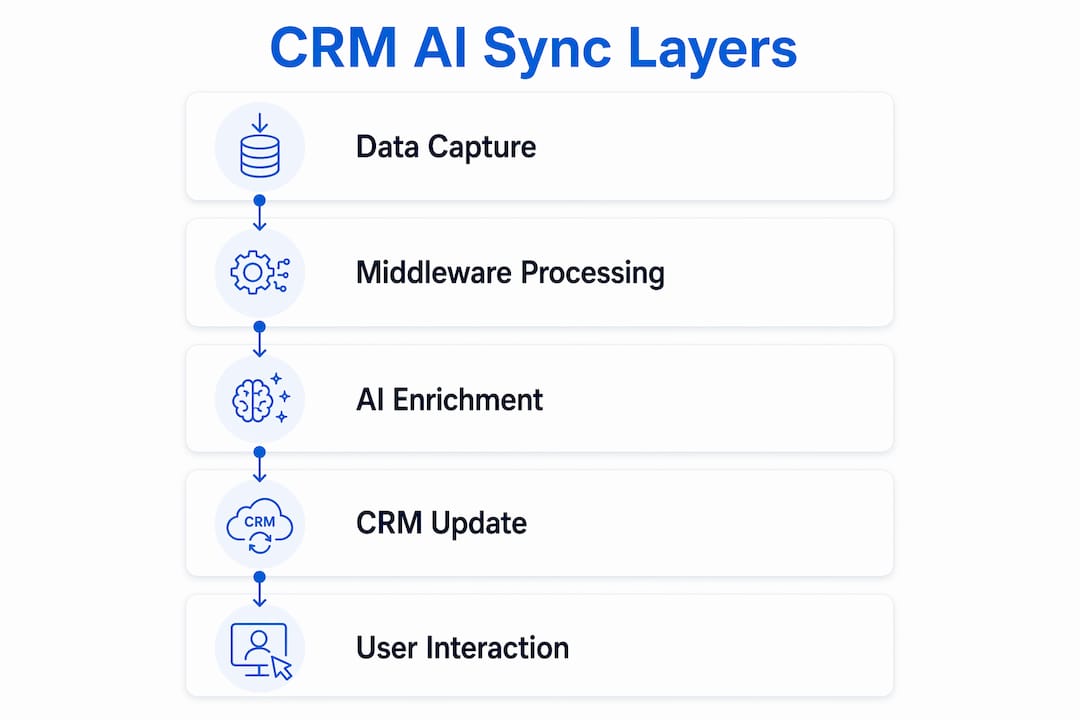
Integration approach characteristics
| Approach | Best for | Key trade-off |
|---|---|---|
| Native AI integration | Platforms with built-in AI modules | Faster setup, less flexibility for custom logic |
| Middleware platform | Multi-system environments with varied data formats | Higher control, requires integration expertise |
| Custom API build | Unique business logic or proprietary data models | Maximum flexibility, highest maintenance cost |
API orchestration and role-based permissions are foundational for secure, compliant AI CRM integrations in regulated industries. This is particularly relevant for Australian enterprises in healthcare and financial services, where data sovereignty requirements add compliance constraints to every integration decision.
Cloud infrastructure choices also affect sync performance. Enterprises hosting CRM data in Australian data centres must confirm that AI processing also occurs within those boundaries. Offshore AI processing of Australian customer data can breach the Privacy Act 1988, making infrastructure geography a compliance question, not just a performance one.
Native AI integrations offered by major CRM vendors reduce deployment time but limit the ability to customise conflict resolution logic or connect non-standard data sources. Custom API builds offer full control but require dedicated engineering resources for ongoing maintenance. Middleware platforms sit between these options, providing pre-built connectors, field mapping tools, and transformation logic without requiring custom code for every integration point.
For enterprises running AI at enterprise scale, the middleware approach typically wins on total cost of ownership when the environment includes more than three integrated systems.
CRM AI synchronisation is a long-term operational commitment
The most common mistake I see enterprises make is treating CRM AI synchronisation as a project with a go-live date and a close-out report. It is not. It is an ongoing operational responsibility that requires continuous performance monitoring and user feedback to remain effective.
The shift that matters most is conceptual. A CRM that receives AI-synchronised data stops being a database and starts behaving like a sales support system. Modern AI agents should proactively draft communications, flag at-risk accounts, and surface next-best actions, rather than passively recording what already happened. That capability only works when the underlying data is current, clean, and correctly attributed.
Generative AI is accelerating this further. Predictive engagement models now personalise outreach based on behavioural signals that no human analyst could process at scale. But those models degrade when data quality slips, which is why the monitoring infrastructure built during implementation is not optional overhead. It is the mechanism that keeps the system honest.
My honest observation after working across multiple enterprise deployments is this: the organisations that get the most from CRM AI synchronisation are the ones that treat data governance as a product, not a policy. They assign ownership, track quality metrics, and iterate on conflict resolution rules the same way they iterate on software. The ones that treat it as a one-time configuration task spend the next 18 months wondering why their AI outputs are unreliable.
— Sowrabh
How Conversational AI supports CRM AI synchronisation for Australian enterprises
Australian enterprises evaluating CRM AI synchronisation need a platform built for local compliance requirements, not retrofitted from offshore infrastructure.
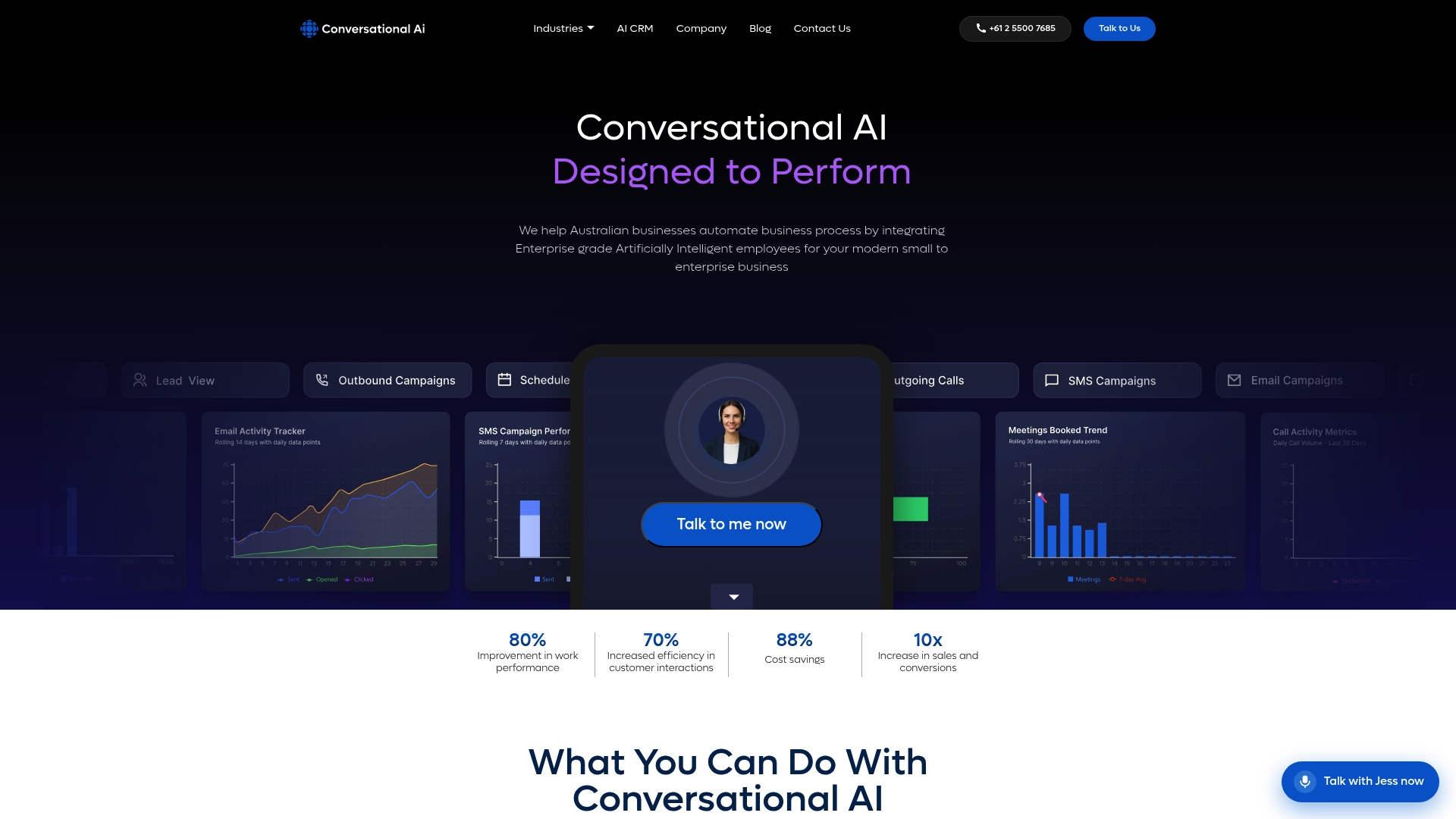
Conversational AI delivers AI agent solutions designed specifically for Australian businesses, with all data hosted within Australia to meet Privacy Act obligations. The platform connects voice, SMS, email, and live chat channels directly into existing CRM systems, automating data capture, follow-ups, and workflow triggers without requiring a full CRM replacement. For IT managers who need production-ready integration with clear governance controls, Conversational AI offers a practical starting point. You can review the platform’s enterprise chatbot capabilities or speak with the team about a scoped deployment for your environment.
Key takeaways
CRM AI synchronisation works by combining event-driven architecture, field-level conflict resolution, and AI automation to keep customer data accurate, current, and actionable across every connected system.
| Point | Details |
|---|---|
| Sync model selection matters | Match one-way, two-way, batch, or real-time sync to your team’s data update frequency and control requirements. |
| AI automates more than data entry | AI agents enrich records, score leads, resolve conflicts, and trigger engagement workflows without human input. |
| Data hygiene is non-negotiable | Normalise and validate field data before AI processing to prevent unreliable outputs and eroded user trust. |
| Field-level ownership prevents conflicts | Explicitly define which system owns each CRM field to stop silent overwrites in two-way sync environments. |
| Monitoring must be built in from day one | Post-launch feedback loops track sync errors and AI output quality, preventing model drift over time. |
Perspective
FAQ
What is CRM AI synchronisation?
CRM AI synchronisation is the automated, continuous alignment of customer data across integrated systems using AI, APIs, and event-driven architecture. It replaces manual data entry with intelligent agents that capture, enrich, and reconcile records in real time.
How does real-time sync differ from batch sync?
Real-time sync transfers data immediately when a change occurs, using webhooks or Change Data Capture, while batch sync transfers data at scheduled intervals. Event-driven real-time sync reduces data mismatches by over 90% compared to batch updates.
How long does a CRM AI integration take to deploy?
A production-ready AI agent CRM integration can be scoped and deployed in under 6 weeks, provided the pilot phase tests 50–80 edge-case scenarios before full rollout.
What causes data conflicts in two-way CRM sync?
Data conflicts occur when two systems update the same field simultaneously without defined ownership rules. Explicit field-level ownership rules prevent silent overwrites and data loops in two-way synchronisation setups.
Do Australian enterprises face specific compliance requirements for CRM AI sync?
Yes. Australian enterprises must ensure that AI processing of customer data occurs within Australian data centres to comply with the Privacy Act 1988. Offshore AI processing of local customer records can constitute a breach of Australian privacy law.