What is AI-powered live chat? A guide for businesses
Discover what AI-powered live chat is and how it can enhance customer service. Learn how it resolves queries efficiently and keeps businesses running 24/7.

AI-powered live chat is defined as a customer service technology that uses artificial intelligence to conduct real-time text conversations with customers, resolving queries automatically and escalating complex issues to human agents. The industry term for this capability is conversational AI, and it sits at the intersection of natural language processing (NLP), large language models (LLMs), and machine learning. Businesses deploying this technology report that AI can autonomously resolve 60–80% of routine queries while maintaining 24/7 availability. Conversational AI builds on this foundation by adding contextual memory, multi-channel reach, and data sovereignty features designed specifically for Australian enterprises.
How does AI-powered live chat work?
AI-powered live chat processes a customer’s message through several layers of analysis before generating a response. Each layer adds context, making the reply more accurate and relevant than a simple keyword match.

Natural language processing and intent detection
NLP is the engine that reads what a customer actually means, not just what they typed. It performs three tasks simultaneously: intent detection (what does the customer want?), entity recognition (which product, account, or date are they referring to?), and sentiment analysis (are they frustrated, neutral, or satisfied?). Sentiment analysis flags emotional escalation automatically, prompting a timely handover to a human agent before the conversation deteriorates.
Large language models and contextual understanding
LLMs are trained on a business’s own knowledge base, past support tickets, and product documentation. This training is what separates a generic chatbot from a capable AI agent. Generative AI models improve continuously with ongoing training, with resolution rates climbing from 40% to 85% as the model learns. That improvement compounds over time, meaning the system gets measurably better the longer it runs.
CRM integration and personalised responses
The AI does not operate in isolation. Integrations with CRMs and helpdesk systems give the AI access to a customer’s purchase history, open tickets, and account status before it types a single word. The result is a response that feels personal rather than scripted. When the AI cannot resolve an issue, it passes the full conversation context to a human agent, so the customer never has to repeat themselves.
Pro Tip: Train your AI on real support tickets from the past 12 months, not just your FAQ page. Tickets contain the actual language customers use, which dramatically improves intent detection accuracy from day one.
What are the benefits of AI chat for businesses?
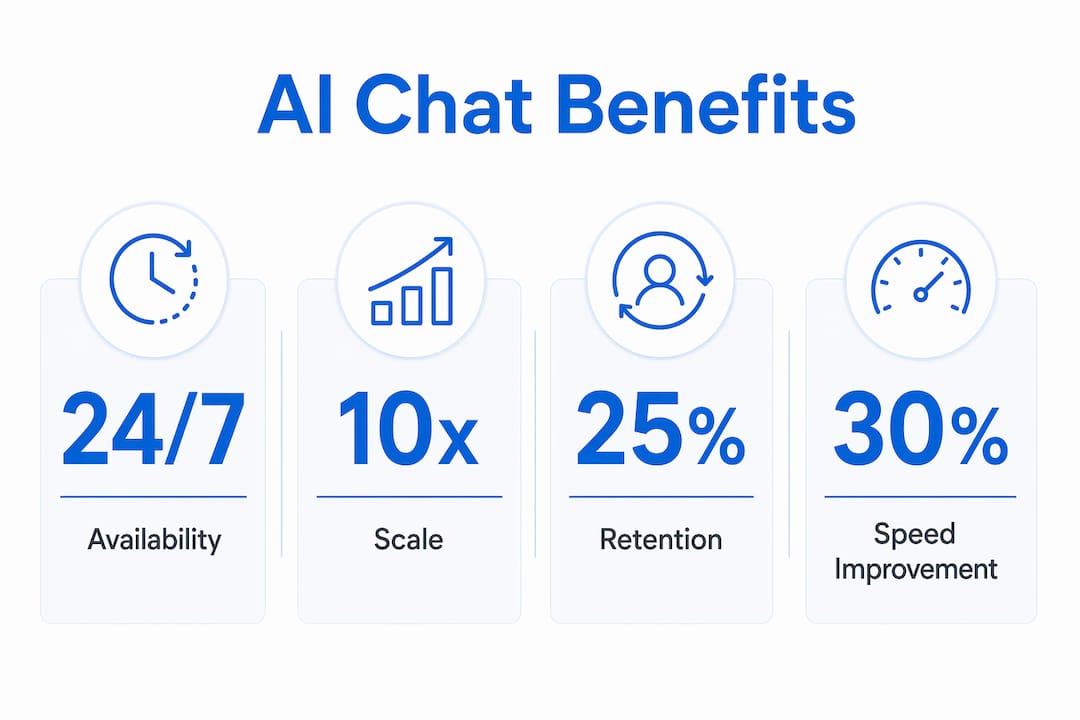
The business case for AI customer support chat is built on four measurable outcomes: speed, scale, retention, and agent effectiveness.
Speed and availability
Traditional live chat depends on staff rosters. AI-powered live chat does not. AI handles tier-1 tasks 24/7, covering order status, password resets, and FAQs outside business hours. Abandoned messages traditionally account for 60% of after-hours contacts. AI eliminates that loss entirely by responding instantly, regardless of the time.
Scale without additional headcount
Hiring more agents to handle volume spikes is expensive and slow. AI removes that constraint. Businesses handle up to 10x query volume with AI live chat without adding staff. That scalability is particularly valuable during product launches, seasonal peaks, or unexpected service disruptions when contact volumes can double overnight.
The benefits of AI chat extend to customer retention as well. Contextual memory across sessions reduces drop-off by 25%, because customers do not need to re-explain their situation each time they return. That continuity builds trust and reduces frustration at the same time.
AI as a copilot for human agents
AI does not just handle conversations independently. It also works alongside human agents in real time, surfacing relevant knowledge base articles, drafting suggested replies, and flagging sentiment shifts. 79% of support agents report improved effectiveness when using AI assistance. Agents spend less time searching for answers and more time on the conversations that genuinely need human judgement. You can read more about AI’s impact on customer service to see how this plays out across different industries.
AI replacing humans: the hybrid model explained
The most persistent misconception about AI live chat is that it replaces human agents entirely. It does not. The industry standard is the hybrid model, and it is the most effective live chat strategy available.
How the hybrid model works
In a hybrid model, AI manages tier-1 queries instantly: the routine, repetitive questions that make up the bulk of any support queue. When a query exceeds the AI’s confidence threshold, or when sentiment analysis detects frustration, the system escalates to a human agent with full context attached. Hybrid AI-human chat models are the industry standard, balancing automation with human judgement to preserve empathy and trust.
The table below compares the three main live chat approaches across key operational criteria.
| Criteria | AI only | Human only | Hybrid AI + human |
|---|---|---|---|
| Availability | 24/7 | Business hours | 24/7 |
| Response speed | Instant | Minutes | Instant for tier-1 |
| Complex query handling | Limited | Strong | Strong |
| Cost at scale | Low | High | Moderate |
| Empathy and nuance | Low | High | High |
| Agent job satisfaction | N/A | Lower (repetitive tasks) | Higher (focused on value work) |
The hybrid approach protects what matters most in customer service: the human connection on issues that genuinely need it. AI handles the volume; humans handle the complexity.
Pro Tip: Set your escalation threshold conservatively at first. It is far better to over-escalate to a human agent early in deployment than to frustrate customers with an AI that overreaches its capability. Tighten the threshold as confidence in the model grows.
For a deeper look at how chatbots function in customer support, including escalation protocols and integration patterns, the practical detail is worth reviewing before you configure your own model.
How to implement AI live chat: practical steps
Deploying AI live chat is significantly faster than most decision-makers expect. Modern platforms have removed the technical barriers that made earlier deployments a months-long project.
-
Choose your deployment method. No-code deployments via a single script or plugin can go live in under 10 minutes. This contrasts sharply with traditional rollouts that took six weeks or more. Most enterprise platforms offer a copy-paste embed code that works with any website or CRM.
-
Connect your knowledge base and CRM. The AI needs access to your product documentation, support articles, and customer data to give accurate, personalised responses. Connect your helpdesk, ecommerce platform, or CRM during setup. The more context the AI has, the fewer escalations you will see in the first week.
-
Train on real customer conversations. Upload past support tickets and chat transcripts to accelerate the model’s learning. Generic training data produces generic responses. Business-specific training produces accurate ones.
-
Define escalation rules clearly. Decide which query types always go to a human agent: complaints, billing disputes, medical or legal questions, and any conversation where sentiment analysis detects high frustration. Document these rules before go-live, not after.
-
Review pricing structure carefully. Flat-fee pricing models help businesses budget predictably and avoid the unpredictable costs of per-chat billing common in legacy software. Confirm whether your chosen platform charges per conversation, per seat, or a flat monthly fee before signing a contract.
-
Plan for ongoing training. AI live chat is not a set-and-forget deployment. Schedule monthly reviews of unresolved queries and escalation logs. Each review cycle is an opportunity to improve resolution rates and reduce the load on your human team. For businesses moving off older systems, the process of migrating legacy systems to conversational AI is well-documented and manageable with the right preparation.
Key takeaways
AI-powered live chat works best when AI handles routine queries at scale and human agents focus on complex, emotionally sensitive conversations that require genuine judgement.
| Point | Details |
|---|---|
| Core technology | NLP, LLMs, and machine learning work together to understand intent and generate accurate responses. |
| Scalability | AI handles up to 10x query volume without additional headcount, making it cost-effective at scale. |
| Hybrid model is standard | AI manages tier-1 queries; human agents handle complex and emotional issues for best outcomes. |
| Deployment is fast | No-code single-script deployments can go live in under 10 minutes with modern platforms. |
| Ongoing training matters | Resolution rates improve from 40% to 85% with continuous training on business-specific data. |
What I have learned from watching AI live chat mature
I have watched businesses approach AI live chat in two very different ways. The first group treats it as a cost-cutting tool, deploying it to reduce headcount and measuring success purely by ticket deflection. The second group treats it as a capability multiplier, using it to free their best agents for the conversations that actually build customer loyalty. The second group consistently gets better results, and the reason is straightforward: customers can tell when they are talking to an AI that has been set up to avoid them rather than help them.
The technology has matured considerably. The gap between a well-trained AI agent and a mediocre human agent has closed faster than most people expected. What has not changed is the importance of the handover moment. When a customer’s frustration spikes and the AI escalates cleanly, with full context, to a human who already knows the situation, that is when trust is built. When the handover is clumsy or the context is lost, that is when customers leave.
My practical advice: do not obsess over the resolution rate in isolation. Track the quality of escalations just as carefully. An AI that resolves 80% of queries but botches the remaining 20% handovers will cost you more in lost customers than one that resolves 65% and escalates the rest perfectly. The AI chatbot satisfaction outcomes data backs this up consistently. Build the handover protocol first, then tune the resolution rate upward from there.
— Sowrabh
AI live chat built for Australian businesses
Australian businesses face a specific set of requirements that generic platforms do not address: data sovereignty, local privacy regulations, and the need for systems that integrate with Australian CRM and helpdesk infrastructure.
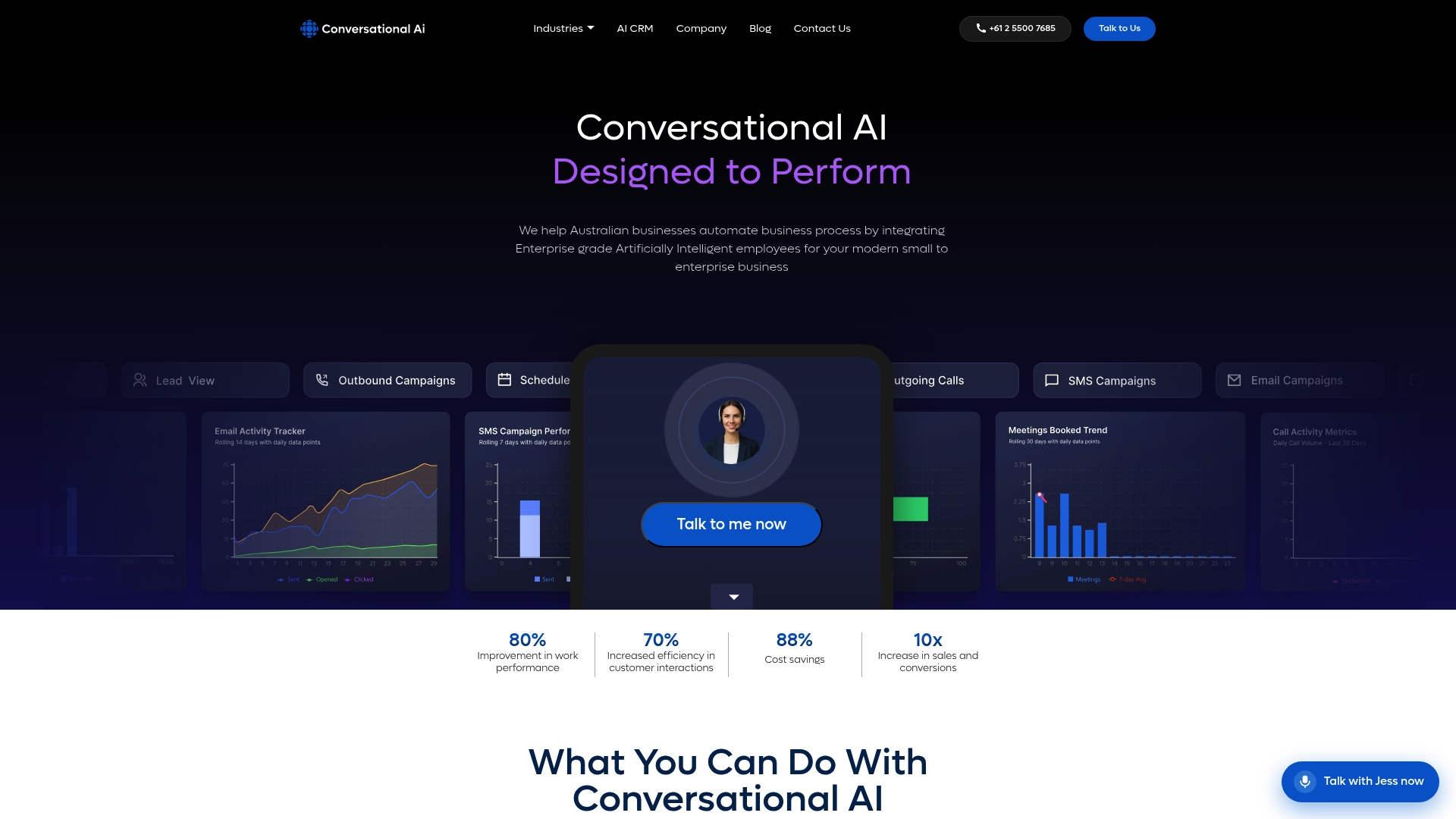
Conversational AI is an enterprise-grade platform built entirely within Australia, offering AI-powered live chat agents alongside voice, SMS, and email automation. Every conversation stays on Australian soil, giving your organisation full control over its data and compliance obligations. The platform connects with your existing CRM, supports no-code deployment, and includes contextual memory and real-time analytics from day one. If you are ready to see what a locally hosted, enterprise-grade AI chat solution looks like in practice, contact Conversational AI to arrange a demonstration.
FAQ
What is AI-powered live chat in simple terms?
AI-powered live chat is software that uses artificial intelligence to respond to customer messages in real time, resolving routine queries automatically and passing complex ones to a human agent.
How does AI live chat differ from a basic chatbot?
A basic chatbot follows fixed decision trees. AI live chat uses NLP and large language models to understand intent, remember context across a conversation, and generate natural responses trained on your specific business data.
Does AI live chat replace human support agents?
No. The industry standard is a hybrid model where AI handles tier-1 queries and human agents manage complex or emotional issues. 79% of agents report improved effectiveness when working alongside AI rather than being replaced by it.
How long does it take to deploy AI live chat?
Modern platforms support no-code deployment via a single script, with go-live times under 10 minutes. Enterprise integrations with CRMs and helpdesk systems add setup time but remain far faster than legacy rollouts.
Is AI live chat suitable for regulated industries like healthcare and finance?
Yes, provided the platform meets local data privacy requirements. Australian businesses in regulated sectors should choose a platform that hosts data within Australia and complies with the Privacy Act 1988 to maintain compliance and data sovereignty.