AI chatbot customer satisfaction examples: 2026 guide
Discover key AI chatbot customer satisfaction examples that boost problem-solving and information quality in 2026. Learn how to succeed!

AI chatbots drive customer satisfaction primarily through information quality and problem-solving capability, not through human-like conversation. A 2026 ScienceDirect study of 282 respondents confirmed that quality information, problem-solving ability, and understanding of humanness are the key satisfaction drivers, while anthropomorphic cues have no significant impact. This finding reshapes how business leaders and CX teams should evaluate and deploy conversational AI. The best ai chatbot customer satisfaction examples across banking, retail, insurance, and telco all share one trait: they resolve issues accurately and fast. Understanding what separates high-performing deployments from costly failures gives your organisation a clear path forward.
What AI chatbot features actually drive customer satisfaction?
Satisfaction depends on core utility factors like quality information and effective problem resolution, not on superficial human-like cues. This is the most important finding for any CX leader evaluating chatbot investments. Spending budget on personality design before fixing knowledge coverage is the wrong order of priorities.
The features that consistently appear in high-performing chatbot deployments are:
- Information accuracy: The chatbot retrieves correct, current answers on the first attempt. Customers who receive wrong information once rarely trust the channel again.
- Problem-solving depth: The system resolves the full issue, not just the surface question. Partial answers force customers to call back, which destroys satisfaction scores.
- Clear escalation paths: When the chatbot cannot resolve an issue, it hands off to a human agent without asking the customer to repeat themselves.
- 24/7 availability: Consistent performance outside business hours is a baseline expectation, particularly for financial services and healthcare customers.
- Contextual memory: The chatbot retains conversation history within a session so customers do not repeat information across turns.
Anthropomorphic features like friendly names, emojis, or casual phrasing do not move satisfaction scores in a statistically significant way. That does not mean tone is irrelevant. It means tone is secondary to resolution. Fix the knowledge base first.
Pro Tip: Measure first-contact resolution rate separately for bot-resolved and human-escalated cases. The gap between those two numbers tells you exactly where your chatbot’s knowledge coverage is failing.
Top AI chatbot customer satisfaction examples across industries
The following cases represent measurable outcomes from real deployments. Each one illustrates a specific driver of satisfaction in action.
1. Commerzbank’s Bene chatbot (banking)
Commerzbank deployed its internal AI chatbot, Bene, to handle employee and customer service queries at scale. Bene handles over 2 million chats with a 70% successful resolution rate. That resolution rate reflects strong knowledge coverage across common banking queries. The remaining 30% route to human agents, which keeps satisfaction high for complex cases that genuinely need human judgement.

2. LUXGEN’s LINE chatbot (automotive)
Taiwanese automotive brand LUXGEN deployed an AI agent on the LINE messaging platform to handle customer enquiries. The result: a 30% reduction in human workload for the customer service team. That freed agents to focus on high-value conversations while the AI handled routine queries about vehicle specifications, service bookings, and warranty information.
3. Loadsure’s claims automation (insurance)
Loadsure used AI to automate insurance claims processing end-to-end. Near real-time claim settlements replaced what had previously been a slow, manual process. Faster settlements directly improve customer satisfaction in insurance because speed and accuracy are the two things policyholders care about most when they need to make a claim.
4. Amdocs telco customer experience agent (telecommunications)
Amdocs built a telco-specific AI agent that autonomously resolves complex issues end-to-end, improving both resolution speed and customer satisfaction. Telco customers typically contact support for billing disputes, outages, and plan changes. These are not simple queries. The fact that an AI agent handles them autonomously demonstrates how far knowledge-grounded AI has advanced.
5. Albo neobank (financial services)
Albo, a Mexican neobank, deployed an AI chatbot to provide 24/7 financial guidance to first-time banking customers. Many of its customers had never held a bank account before. The chatbot answered questions about account features, transaction limits, and card usage at any hour. Availability and accuracy together built trust with a customer base that had historically been underserved by traditional banking.
6. Hybrid routing models (cross-industry)
Across industries, hybrid AI-human models routing 60–70% of cases to AI and 30–40% to humans consistently outperform full automation for both satisfaction and cost savings. This is not a compromise. It is the optimal design. AI handles volume and speed. Humans handle complexity and emotion.
“The organisations achieving the highest satisfaction scores are not the ones with the most human-like chatbots. They are the ones with the most accurate knowledge bases and the clearest escalation protocols.”
What AI chatbot failures teach us about customer satisfaction
Not every deployment succeeds. The failures are as instructive as the wins.
Klarna is the most cited cautionary case. The Swedish fintech replaced a large portion of its customer service team with AI automation. Klarna re-hired humans for complex cases after AI-only automation caused customer satisfaction to decline notably in 2025. The core problem was not the AI itself. It was the absence of a structured escalation path for emotionally sensitive and complex financial disputes.
The specific failure points that recur across poor deployments include:
- No escalation path: Customers who cannot reach a human when the chatbot fails become frustrated quickly. Frustration compounds when the issue is urgent or emotionally charged.
- Information repetition on handoff: Satisfaction for escalated cases drops significantly when customers must repeat their details to a human agent after a chatbot interaction. This single friction point erases the goodwill built earlier in the conversation.
- Over-automation of sensitive cases: Debt collection, complaints, and medical queries require human empathy. Routing these to a chatbot without a fast override option damages trust.
- Stale knowledge bases: A chatbot trained on outdated product information or policy details gives wrong answers confidently. Customers do not distinguish between a wrong answer from a bot and a wrong answer from a person. Both destroy trust.
The lesson from Klarna and similar cases is clear. Full automation without quality control and human backup is not a cost-saving strategy. It is a satisfaction risk.
How to choose the right AI chatbot approach for your organisation
The right chatbot approach depends on your query mix, your escalation capacity, and your knowledge management maturity. Start by auditing your current support volume and categorising queries by complexity and emotional sensitivity.
Pro Tip: Before selecting a platform, map your top 20 query types and test whether your candidate chatbot resolves each one accurately. Resolution coverage on your actual query mix matters more than any feature list.
Use this framework to evaluate your options:
| Evaluation criterion | What to prioritise |
|---|---|
| Knowledge quality | Accuracy and currency of answers across your top query categories |
| Resolution coverage | Percentage of query types the bot can fully resolve without escalation |
| Escalation design | Speed and context-preservation quality of human handoff |
| Satisfaction segmentation | Ability to measure CSAT separately for bot-resolved and escalated cases |
| Anthropomorphic features | Treat as secondary; do not invest here before resolving knowledge gaps |
Segment your CSAT scores by bot-resolved, human-escalated, and bot-failed cases. Averages hide the problem. A decent overall CSAT score can mask a serious satisfaction collapse in the escalated segment. That collapse is where customer churn begins.
Avoid over-investing in conversation design before your knowledge base is solid. A chatbot that sounds warm but gives wrong answers will score worse than a plain-spoken bot that resolves issues correctly every time. For Australian businesses managing AI natural language customer support, the priority is always resolution quality first, then experience refinement.
The role of AI in communication orchestration also matters here. Chatbots do not operate in isolation. They sit within a broader channel mix that includes voice, SMS, and email. Your chatbot strategy should account for how queries flow across channels and where handoffs occur.
Key takeaways
AI chatbots improve customer satisfaction when they prioritise accurate information and effective problem resolution over human-like conversation design.
| Point | Details |
|---|---|
| Resolution quality drives satisfaction | Accurate, complete answers on the first attempt are the primary satisfaction driver. |
| Hybrid models outperform full automation | Routing 60–70% of cases to AI and the rest to humans delivers better satisfaction and cost outcomes. |
| Escalation design is non-negotiable | Customers who repeat information on handoff report significantly lower satisfaction scores. |
| Measure CSAT by case type | Segment scores by bot-resolved and escalated cases to identify where satisfaction is actually failing. |
| Knowledge base comes before conversation design | Fix information coverage before investing in anthropomorphic or personality features. |
My honest take on AI chatbots and customer satisfaction
The industry conversation about AI chatbots spends too much time on personality and not enough on plumbing. I have seen organisations invest heavily in chatbot naming, tone guides, and avatar design while their knowledge base is riddled with outdated policy documents. The result is a bot that sounds great and resolves nothing.
The Klarna case is not a story about AI failing. It is a story about a business removing human oversight before the AI was ready to handle the full complexity of customer needs. That is a deployment decision, not a technology limitation.
What actually works is unglamorous. Audit your knowledge base quarterly. Test resolution accuracy on your real query mix, not a curated demo set. Build escalation paths that preserve context. Measure satisfaction at the segment level, not just as an average. These are operational disciplines, not technology features.
Australian businesses have an additional consideration. Data sovereignty and compliance requirements shape what platforms you can use and how you can configure them. Choosing a platform hosted locally is not just a privacy preference. For regulated industries like finance and healthcare, it is a compliance requirement that directly affects what your chatbot can safely do.
The organisations I respect most in this space are the ones that treat their chatbot as a product with a knowledge team behind it, not a set-and-forget deployment. That mindset is what separates the Commerzbank results from the Klarna cautionary tale.
— Sowrabh
How Conversational AI supports Australian businesses with AI chatbot deployment
Australian enterprises face specific requirements around data privacy, compliance, and local hosting that generic platforms do not address. Conversational AI is built specifically for this environment, offering AI agents across voice, SMS, email, and live chat that are hosted entirely within Australia.
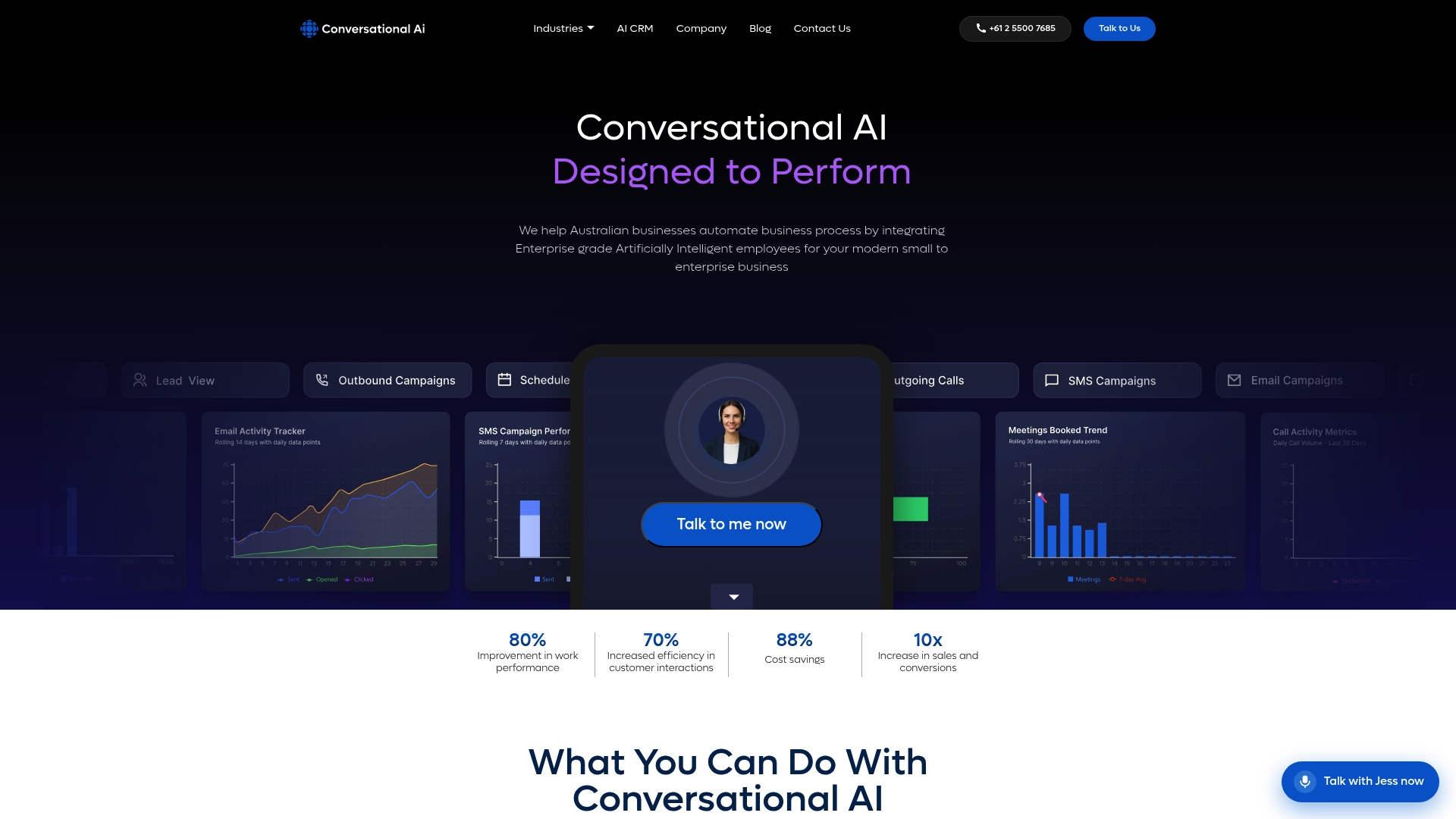
The platform prioritises resolution quality and context-preserving human handoff, the two factors that research consistently links to higher customer satisfaction. It integrates with existing CRM systems so agents retain full conversation history across channels. For organisations in finance, healthcare, and professional services, that combination of local hosting and resolution-focused design addresses both the compliance requirement and the satisfaction imperative. If you are evaluating AI agents for your business, Conversational AI offers a practical starting point built for Australian enterprise needs.
FAQ
What drives AI chatbot customer satisfaction most?
Quality information and effective problem resolution are the primary drivers of chatbot satisfaction. A 2026 ScienceDirect study confirmed that anthropomorphic features have no significant impact on satisfaction scores.
What is a good chatbot resolution rate?
Commerzbank’s Bene chatbot achieves a 70% resolution rate across more than 2 million chats, which represents a strong benchmark for enterprise deployments. The remaining cases route to human agents.
Why did Klarna’s AI chatbot strategy fail?
Klarna’s AI-only model caused customer satisfaction to decline because it lacked structured escalation paths for complex and emotionally sensitive cases. The company re-hired human agents in 2025 to address the gap.
How should I measure chatbot customer satisfaction?
Segment your CSAT scores by bot-resolved, human-escalated, and bot-failed cases. Overall averages mask satisfaction collapses in the escalated segment, which is where customer churn typically originates.
What is the best hybrid model ratio for AI and human support?
Hybrid models routing 60–70% of cases to AI and 30–40% to humans consistently outperform full automation for both customer satisfaction and cost efficiency across industries.