What is secure conversational AI: a 2026 guide
Discover what secure conversational AI is and how it protects your business data. Ensure compliance and security in every interaction.

Secure conversational AI is defined as an AI dialogue system built with multi-layered security controls that govern how data is collected, processed, stored, and disclosed during every interaction. These controls include input validation, output filtering, behavioural guardrails, and audit logging with review cycles, forming the architecture that separates a compliant enterprise deployment from a liability. For Australian business leaders, this distinction matters enormously. The Privacy Act 1988 and frameworks like the ASD Essential Eight apply directly to AI agents handling customer data, and the consequences of getting it wrong reach well beyond a data breach notification.
What security controls constitute secure conversational AI?
Secure conversational AI relies on four critical control layers: input validation, output filtering, behavioural guardrails, and audit logging. Each layer addresses a different point of failure in the interaction lifecycle.
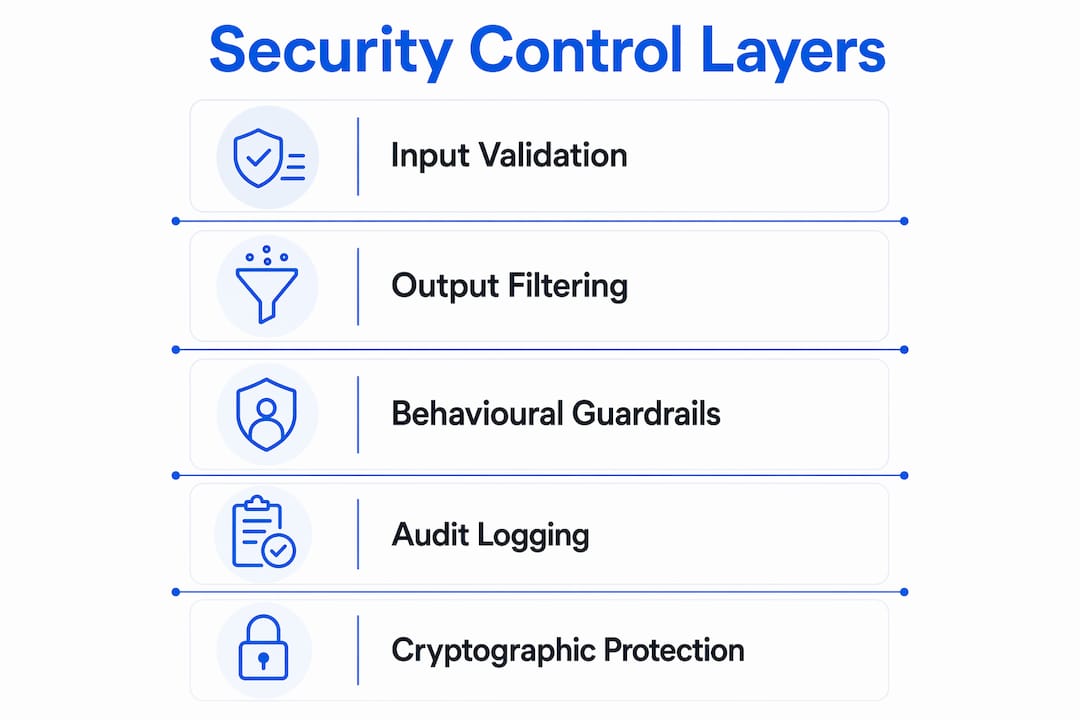
Input validation sits at the front of every conversation. It detects prompt injection attempts, flags personally identifiable information (PII) before it reaches the model, and blocks malformed or adversarial queries. Without this layer, a customer could inadvertently expose their own data, or a bad actor could manipulate the AI into disclosing information it should not.

Output filtering catches what input validation misses on the return path. PII obfuscation tools automatically detect and remove sensitive data such as phone numbers, email addresses, IP addresses, and credit card details from both input and output streams. These tools typically handle more than 15 distinct PII types, which covers the breadth of data Australian businesses routinely process.
Behavioural guardrails enforce safe response boundaries at the model level. They prevent the AI from generating harmful, off-topic, or legally problematic content, regardless of how a query is phrased. Think of them as the policy layer that keeps the AI on script even when customers push back or test its limits.
Audit logging records every interaction for traceability. Logs must capture user identities, queries, data accessed, agent responses, and escalation paths. Logs alone are not enough, though. Runtime governance requires a policy enforcement layer that inspects and blocks unsafe content in real time, between the model and the user.
Beyond these four layers, cryptographic protections are non-negotiable. Encryption at rest and in transit protects data whether it sits in a database or travels across a network. Voice interactions require protocols like SRTP (Secure Real-time Transport Protocol) to protect audio streams. Standard network firewalls cannot detect sophisticated AI threats. Specialised AI-aware firewalls understand semantic context, which means they can catch multi-turn jailbreak attempts that unfold across several messages rather than a single query.
Pro Tip: Test your AI agent’s input validation by running a controlled prompt injection exercise before go-live. If the agent returns data it should not, your input layer needs hardening before customers interact with it.
How do Australian data protection laws shape secure AI implementation?
Australian law sets the floor for what secure conversational AI must achieve. The Privacy Act 1988 applies fully to AI agents handling personal data, requiring informed collection, controlled storage, and compliant disclosure. This is not optional guidance. It is the legal baseline every Australian enterprise must meet.
The practical implications for AI deployment are significant. Here is how the key obligations translate into technical requirements:
- Data minimisation. Collect only what the interaction requires. If a customer books an appointment, the AI does not need to store their full medical history.
- Data residency. Personal data must remain within Australian borders unless specific cross-border disclosure conditions are met. Hosting within regions such as Azure Australia East or Southeast satisfies this requirement for most deployments.
- Customer rights. Customers can request deletion of their data. Customer data wipe capabilities that execute in under 10 minutes are now a practical benchmark for compliant Australian AI deployments.
- Breach notification. The Notifiable Data Breaches scheme requires prompt notification to the Office of the Australian Information Commissioner and affected individuals when a breach is likely to cause serious harm.
- Sector-specific obligations. APRA CPS 234 mandates information security standards for financial institutions, including AI agents. Healthcare organisations face additional obligations around biometric data and sensitive health information.
“Privacy engineering must make privacy claims true by default, rather than relying only on legal or UI promises. Architectural controls, not policy documents, are what protect customer data in practice.”
The ASD Essential Eight provides a practical governance framework that complements the Privacy Act. Patching, application control, and restricting administrative privileges all apply to AI infrastructure. Treating these as a checklist rather than a living programme is where many deployments fall short.
What are the common security risks in conversational AI?
Conversational AI introduces threat vectors that traditional IT security teams have not encountered before. Understanding them is the first step toward mitigating them.
- Prompt injection attacks. A malicious user crafts a query designed to override the AI’s instructions. Direct injections appear in the user’s own message. Indirect injections hide in documents or web content the AI retrieves. Both can cause the agent to leak data, execute unauthorised actions, or abandon its guardrails entirely.
- Identity spoofing. Voice AI systems are vulnerable to synthetic voice attacks, where a cloned voice attempts to authenticate as a legitimate customer. Video AI faces similar risks with deepfake inputs.
- API credential misuse. When AI agents connect to backend systems, poorly scoped API credentials give attackers access far beyond what the interaction requires. Managed identities with scoped API access and strict memory partitioning prevent data leaks across users in multi-tenant environments.
- Multi-tenant memory leaks. In shared AI environments, conversation context from one user can bleed into another’s session if memory is not properly isolated. This is a silent risk that standard security audits often miss.
- Data leakage through model outputs. An AI trained on or given access to sensitive data can inadvertently reproduce it in responses to unrelated queries.
Effective mitigation combines several controls. Session scoping limits what data the AI can access within a single interaction. Prompt sanitisation and hardened system prompts reduce the attack surface for injection attempts. PII redaction removes sensitive data before it reaches the model. Continuous adversarial testing, not just annual penetration tests, keeps defences current as attack techniques evolve.
Pro Tip: Treat your AI model as an untrusted component by default. Privacy-by-design controls such as ephemeral sessions and minimal data exposure reduce risk even if the model itself is compromised.
What does good operational monitoring look like for AI agents?
Deploying a secure AI agent is not a one-time event. Maintaining security requires continuous monitoring, structured auditing, and a tested incident response plan.
- Real-time anomaly detection. Monitor conversation volumes, query patterns, and API call rates. A sudden spike in data access requests or unusual query phrasing can signal an active attack or a misconfigured integration.
- Comprehensive audit trails. Logs must capture user identities, queries, data accessed, agent outputs, and escalation paths. These records support both internal investigations and regulatory reporting.
- Change control logging. Every change to the AI agent’s system prompt, knowledge base, or integration configuration must be logged with a timestamp and the identity of the person who made it. This is where many deployments have gaps.
- Incident response for AI agents. A standard IT incident response plan does not account for AI-specific scenarios. Your plan should include rapid agent disablement, session termination, and a defined investigation workflow that covers prompt logs and model outputs.
- Board-level reporting. Australian regulators expect boards to demonstrate oversight of material technology risks. AI agent security metrics, including incident counts, audit findings, and compliance status, belong in board reporting cycles.
| Monitoring area | What to track |
|---|---|
| Conversation anomalies | Unusual query patterns, volume spikes, off-topic requests |
| Audit trail completeness | User identity, query content, data accessed, agent response |
| Integration access | API call frequency, credential usage, scope violations |
| Incident response | Time to detect, time to disable, investigation completion |
For business leaders exploring enterprise chatbot deployment, this monitoring framework is the difference between a compliant deployment and one that creates regulatory exposure.
Key takeaways
Secure conversational AI requires four control layers, Australian-hosted data, continuous monitoring, and adversarial testing to meet Privacy Act 1988 obligations and protect customer data.
| Point | Details |
|---|---|
| Four control layers | Input validation, output filtering, behavioural guardrails, and audit logging are all required. |
| Australian data residency | Host data within Australian regions to meet Privacy Act 1988 and sector-specific obligations. |
| Runtime governance | Policy enforcement must operate in real time, not just through after-the-fact log review. |
| Adversarial testing | Run prompt injection and identity spoofing tests continuously, not just at deployment. |
| Board-level oversight | AI security metrics belong in board reporting to satisfy Australian regulatory expectations. |
Why security cannot be bolted on after the fact
I have seen the same pattern repeat itself across Australian enterprise AI projects. A business deploys a conversational AI agent quickly, the security review happens after go-live, and the team discovers that the system prompt is injectable, the API credentials are over-scoped, and the logs do not capture enough detail to reconstruct what happened in an incident. Fixing these issues post-deployment costs three to five times more than building them in from the start, and that is before you account for the reputational damage if a breach occurs.
The misconception I encounter most often is that hosting in a private cloud solves the compliance problem. It does not. Private cloud alone does not guarantee compliance. You still need to validate vendor data flows in Data Processing Agreements, confirm how biometric data is managed, and verify that the model itself does not retain conversation data between sessions. A DPA that says “data stays in Australia” is meaningless if the model vendor’s fine-tuning pipeline pulls data offshore.
The other misconception is that UI-level privacy settings like incognito modes are sufficient. True ephemeral sessions require client-side PII redaction and query hashing at the engineering level, not a toggle in a settings menu. If your vendor cannot explain the engineering controls behind their privacy claims, treat those claims as unverified.
My strongest recommendation is to bring your legal, technical, and executive teams into the same room at the start of an AI project, not at the end. The Privacy Act obligations, the APRA CPS 234 requirements, and the ASD Essential Eight controls all have technical implications that need to be designed in from day one. Security is not a feature you add later. It is the architecture you build everything else on top of.
— Sowrabh
Conversational AI: built for secure Australian deployments
Australian businesses need AI agents that are compliant by design, not compliant by documentation. Conversational AI hosts all customer data within Australia, meeting Privacy Act 1988 and sector-specific obligations from the ground up. The platform includes native jailbreak protection, prompt injection defence, enterprise-grade encryption, and data wipe capabilities that execute on request.
For businesses in healthcare, finance, and professional services, where data protection is non-negotiable, Conversational AI provides AI agent solutions built specifically for Australian regulatory requirements. Whether you need voice, SMS, email, or live chat automation, the platform delivers multi-channel engagement without trading away security or compliance. Speak with the team to see how it fits your environment.
FAQ
What is secure conversational AI?
Secure conversational AI is an AI dialogue system built with layered security controls including input validation, output filtering, behavioural guardrails, and audit logging to protect sensitive data and maintain regulatory compliance.
How does the Privacy Act 1988 apply to AI chatbots?
The Privacy Act 1988 requires AI agents handling personal data to collect only what is necessary, store it securely within Australia, and allow customers to request deletion of their information.
What is prompt injection and why does it matter?
Prompt injection is an attack where a malicious query overrides an AI agent’s instructions, potentially causing it to leak data or take unauthorised actions. It is one of the most common and damaging threats in conversational AI security.
Do Australian businesses need to host AI data locally?
Australian data sovereignty requirements mean personal data must generally remain within Australian borders. Hosting within regions such as Azure Australia East satisfies this requirement for most enterprise deployments.
What certifications should I look for in a secure AI vendor?
SOC 2 Type II and ISO/IEC 27001 are baseline certifications, but they are insufficient alone. Require evidence of adversarial testing, prompt injection assessments, and contract-level data processing agreements before deployment.