What is multi-channel AI? A guide for Australian businesses
Discover what is multi-channel AI and how it can reduce resolution times by 40% for Australian businesses. Transform customer support now!

Multi-channel AI is a single AI agent deployed simultaneously across voice, SMS, email, and live chat, carrying consistent knowledge and context regardless of which platform a customer uses. For Australian organisations, the practical payoff is significant: unified multi-channel AI delivers up to a 40% reduction in resolution times and up to a 35% improvement in customer satisfaction scores. That is not a marginal efficiency gain — it is the difference between a support operation that scales and one that keeps hiring.
The bottom-line benefits come down to three things:
- Faster resolution. Customers do not repeat themselves when they switch from chat to SMS to voice. The AI already knows the context.
- Reduced agent load. Routine queries are handled automatically across every channel, freeing human agents for complex escalations.
- Consistent experience. Whether a customer contacts you via email at 9 AM or WhatsApp at 11 PM, the response quality does not vary.
The sections below cover how the architecture actually works, where multi-channel AI differs from omnichannel, practical use cases for regulated Australian sectors, and a step-by-step implementation checklist.
Table of Contents
- How does multi-channel AI work?
- Multi-channel versus omnichannel: which do you actually need?
- What can multi-channel AI do? Key capabilities and Australian use cases
- How to implement multi-channel AI in Australia
- Limitations and risks you need to plan for
- Sample multi-channel AI flows you can test today
- Why Australia-hosted platforms matter for compliance
- Key takeaways
- When multi-channel AI is the right call — and when to wait
- Conversational AI: Australia’s private cloud option for multi-channel deployment
- Useful sources and further reading
How does multi-channel AI work?
The architecture rests on a central intelligence layer that receives input from every channel, processes it through a shared natural language understanding (NLU) engine, and returns a response adapted to the originating platform. Key architecture elements include channel adapters, a unified context store, CRM and order-system integrations, and analytics.

Core components
| Component | What it does |
|---|---|
| Central intelligence layer | Hosts the NLU engine, intent classification, and decision logic shared across all channels |
| Channel adapters | Translate platform-specific message formats (WhatsApp JSON, email MIME, voice SSML) into a common internal schema |
| Session / context store | Persists conversation history, user identity, and intent state so context survives a channel switch |
| Routing engine | Decides whether to respond automatically, escalate to a human agent, or trigger a workflow |
| CRM / OMS integrations | Pull and push customer data, order records, and booking states in real time |
| Analytics layer | Aggregates cross-channel metrics: resolution rate, handover frequency, CSAT signals |
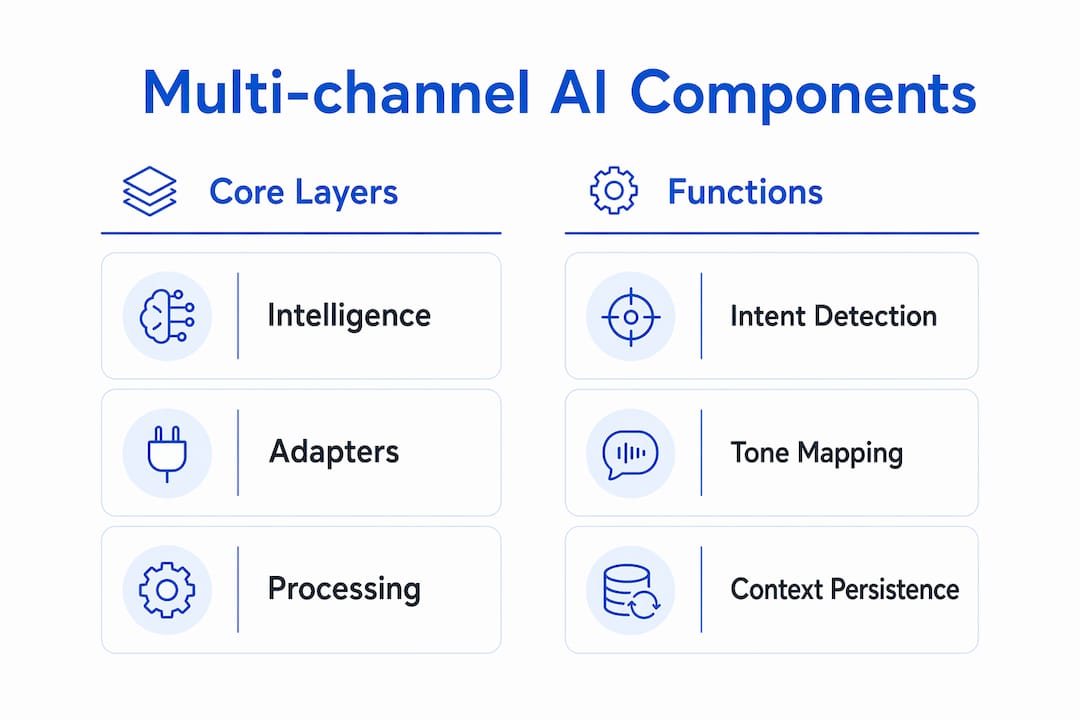
The flow looks like this: a customer message arrives via a channel adapter, the central intelligence layer retrieves their session from the context store, classifies intent, queries integrated systems if needed, then returns a response through the same adapter — formatted for that channel’s conventions.
Pro Tip: Tone mapping is as important as data mapping. An email response can carry a formal greeting and a signature block; the same intent delivered via WhatsApp should be concise and conversational. Build tone profiles per channel from day one — retrofitting them later is costly. See how voice and chat AI differ for a detailed breakdown of channel-format considerations.
Cross-channel intent persistence demands more than transferring conversation history. It requires adapting tone and format when moving between channels — for example, from a formal email thread to a brief SMS follow-up — while keeping the underlying intent state intact.
Multi-channel versus omnichannel: which do you actually need?
The terms are often used interchangeably, but the operational difference matters when you are scoping a project. Multichannel systems are present on many platforms but can keep separate histories per channel; omnichannel systems share identity, intent, and context across every touchpoint in a single continuous conversation.
| Dimension | Multi-channel AI | Omnichannel AI |
|---|---|---|
| Context persistence | Within a session on one channel | Across channels and sessions, indefinitely |
| Identity linking | Often per-channel (phone number, email) | Unified customer profile across all channels |
| Analytics | Channel-level and cross-channel aggregates | Single customer journey view |
| Agent handover | Transfers context at escalation point | Agent sees full cross-channel history |
| Implementation complexity | Moderate — channel adapters plus shared NLU | High — requires identity resolution and data unification |
| Best suited for | Businesses expanding channel presence | Businesses with mature CRM and data infrastructure |
The practical decision rule: start with multi-channel when your priority is coverage and automation at scale. Move to a full omnichannel architecture when your customers regularly switch channels mid-journey and your CRM data is clean enough to support reliable identity resolution. Most Australian enterprises find that a well-implemented multi-channel deployment delivers the majority of the business value at a fraction of the integration complexity.
What can multi-channel AI do? Key capabilities and Australian use cases
Multi-channel artificial intelligence handles a broad range of business interactions. The core capabilities to look for in any platform are:
- Contextual memory — retains conversation history within and across sessions
- NLU and intent classification — understands natural language queries, not just keyword triggers
- Channel adapters — connects to voice, SMS, WhatsApp, email, live chat, and internal tools
- Scheduled follow-ups — sends automated reminders and follow-on messages without human intervention
- Routing and escalation — hands off to a human agent with full context when needed
- CRM and booking-system integrations — reads and writes customer records in real time
- Analytics and reporting — tracks resolution rates, CSAT, and cross-channel handover frequency
Use cases mapped to channels
Customer service (email, live chat): An AI agent handles tier-one queries — order status, account changes, policy questions — across email and web chat simultaneously, with AI in customer service reducing the volume reaching human agents.

Bookings and reminders (SMS, voice): Healthcare providers use SMS reminders with two-way confirmation, then escalate to a voice agent if the patient needs to reschedule. The booking system updates automatically.
Collections and payments (SMS, email): Finance teams deploy automated payment-due notifications via SMS, with email follow-ups carrying secure payment links. The AI tracks response and escalates unresolved accounts.
Lead qualification (website chat to WhatsApp): A prospect starts on a website chat widget, qualifies their interest, then opts into WhatsApp for ongoing communication. The AI carries the qualification data into the CRM without any manual handoff.
Internal operations (Slack, Microsoft Teams): Operations teams use AI agents for internal triage — routing IT tickets, answering HR policy questions, or triggering approval workflows — across collaboration platforms.
Regulated Australian sectors
Healthcare: Patient communication workflows (appointment reminders, post-visit follow-ups, triage screening) benefit from multi-channel AI, provided the platform meets Australian Privacy Principles and data is hosted locally. A GP clinic, for example, can automate appointment reminders via SMS and handle rescheduling via voice without exposing patient data to offshore systems.
Finance: Secure payment notifications, account alerts, and collections sequences across SMS and email are well-suited to multi-channel AI. AFSL-licensed businesses need audit trails and access controls baked into the platform, not bolted on.
Professional services: Client onboarding across email and live chat — collecting documents, answering scope questions, scheduling calls — can be largely automated. Pairing this with customer onboarding best practices helps firms design workflows that reduce drop-off and manual follow-up.
How to implement multi-channel AI in Australia
A phased rollout reduces risk and lets the NLU and knowledge base improve with real interactions before you extend to additional channels.
- Audit your channels. List every platform your customers currently use to contact you. Rank by volume and query complexity. This determines your pilot channel.
- Select your pilot channel. Start with the highest-volume, lowest-complexity channel — typically live chat or SMS. Perfect the knowledge base before expanding.
- Integrate core systems. Connect your CRM and, where relevant, your order management or booking system. A channel that cannot access order or CRM data is of limited value for transactional queries.
- Map intents and build the knowledge base. Document the top 20–30 intents your customers express. Write response templates per intent, with tone variants per channel.
- Configure the context store. Define how sessions are identified (phone number, email, customer ID) and how long context persists between interactions.
- Run a 6–8 week pilot. Measure resolution rate, escalation frequency, and CSAT. Retrain the NLU on real interactions before extending to the next channel.
- Extend channels progressively. Add voice, then email, then WhatsApp — each time carrying the accumulated knowledge base forward.
Timeline: A typical pilot runs 6–8 weeks from integration to live traffic. A full multi-channel deployment across three to four channels generally takes four to six months, depending on integration complexity and the volume of custom intents.
Cost drivers: Integration complexity (custom API work for legacy CRMs), custom NLU training, hosting model (private cloud versus shared), and implementation services are the primary variables.
Data sovereignty is not optional for Australian enterprises. Hosting your AI platform within Australia means customer data does not traverse international borders, reducing exposure under the Privacy Act 1988 and the Australian Privacy Principles. Ask any vendor: where is data stored at rest? Where are backups held? Is encryption applied in transit and at rest? For healthcare and finance, these are not due-diligence questions — they are compliance requirements.
Risk controls to implement from day one: role-based access controls, full audit logging of automated actions, explicit policies governing what the AI can do autonomously (payments, cancellations, account changes), and a human-in-the-loop escalation path for edge cases.
Limitations and risks you need to plan for
Multi-channel AI is not a set-and-forget deployment. The most common failure modes are predictable — and preventable.
| Risk | Likely impact | Mitigation |
|---|---|---|
| Context continuity gaps | Customer repeats information; CSAT drops | Implement a persistent session store with cross-channel identity linking |
| Identity mismatches | AI treats returning customer as new | Use a unified customer ID (email or phone) as the session anchor across channels |
| Channel-format errors | Truncated messages, broken links in SMS | Enforce character limits and format validation per channel adapter |
| False positives in automation | Wrong action taken (e.g. wrong booking cancelled) | Add confirmation steps for high-stakes automated actions |
| Regulatory non-compliance | Privacy breach, audit failure | Use an Australia-hosted platform with audit logging and access controls |
| NLU drift over time | Intent classification degrades as language evolves | Schedule quarterly model reviews and retrain on recent interactions |
Best practices that experienced teams apply from the outset:
- Instrument cross-channel metrics from day one — measure how often conversations transfer channels without context loss, not just channel-level activity in isolation.
- Enforce intent persistence explicitly: when a session moves from chat to SMS, pass the intent state and the last three turns of conversation, not just a summary.
- Test with real customers in a controlled cohort before full rollout. Lab testing does not surface the edge cases that live traffic does.
- Retrain the NLU on a regular cadence. Language patterns, product names, and customer phrasing shift over time.
Sample multi-channel AI flows you can test today
These scenarios illustrate how context moves between channels and what system actions occur at each step.
Scenario 1: Website chat to WhatsApp follow-up
- Customer opens website chat, asks about a pending order.
- AI queries the OMS via integration, returns order status with estimated delivery.
- Customer opts into WhatsApp for delivery updates.
- AI stores the opt-in preference and order ID in the context store.
- On dispatch, the AI sends a WhatsApp message: “Your order #4821 has shipped. Track it here: [link].”
- Customer replies “Can I change the delivery address?” — AI retrieves the order record and presents options, no context re-entry required.
Sample prompt to test this flow: “I placed an order yesterday. Can you check where it is and send me updates on WhatsApp?”
Scenario 2: Email escalation to voice call booking
- Customer emails support about a billing dispute.
- AI classifies intent as “billing dispute — high value,” retrieves account record, and responds with an initial resolution offer via email.
- Customer replies that they want to speak to someone.
- AI presents available call slots, customer selects one, booking is written to the CRM calendar.
- A voice agent (human or AI) joins the call with the full email thread and account context pre-loaded.
Sample prompt: “I’ve been charged twice this month. I want this sorted out and I’d prefer to talk to someone.”
Scenario 3: SMS appointment reminder with follow-up action
- AI sends SMS 48 hours before appointment: “Hi [Name], your appointment is on Thursday at 2 PM. Reply YES to confirm or NO to reschedule.”
- Customer replies “NO.”
- AI responds: “No problem. Here are the next available times: [list]. Reply with your preferred option.”
- Customer selects a time. AI updates the booking system and sends a confirmation SMS.
- If no reply within 4 hours, AI sends a follow-up email with the same options.
Prompt engineering note: Pass the customer’s name, appointment ID, and preferred channel in the session initialisation payload. This prevents the AI from asking for information it already holds and keeps the interaction feeling personal rather than transactional.
Why Australia-hosted platforms matter for compliance
For Australian enterprises, where data lives is as important as what the AI does with it. An Australia-hosted private cloud deployment keeps all customer data, conversation logs, and model outputs within Australian jurisdiction — directly relevant to obligations under the Privacy Act 1988 and sector-specific frameworks like the My Health Records Act for healthcare providers.
The compliance advantage of local hosting is concrete: data does not cross international borders, breach notification obligations remain within a single jurisdiction, and audit logs are accessible under Australian law without cross-border legal complexity. For AFSL-licensed businesses and healthcare providers, this is not a preference — it is a material risk reduction.
Conversational AI is built specifically for this requirement. The platform’s capabilities relevant to Australian enterprise deployments include:
- Australia-hosted private cloud — all data at rest and in transit stays within Australian infrastructure
- Voice, SMS, email, and live chat — full channel coverage from a single platform
- Contextual memory — conversation history persists across channels and sessions
- CRM integrations — connects to existing customer records without duplicating data
- Automated follow-ups and scheduling — handles reminders, confirmations, and escalations without manual intervention
- Agentic analytics and reporting — cross-channel performance metrics in a single dashboard
- White-label capability — available for organisations that need branded deployments
A typical customer journey on the platform: a patient contacts a healthcare provider via live chat to reschedule an appointment. The AI retrieves the booking, offers alternatives, confirms the new time, and sends an SMS confirmation — all within the Australian-hosted system, with no patient data leaving the country. The interaction is logged, auditable, and the patient never had to repeat their details.
For enterprise AI deployment at scale, the combination of local hosting, contextual memory, and deep CRM integration is what separates a compliant deployment from a liability.
Key takeaways
Multi-channel AI delivers measurable business impact when deployed on a platform with genuine cross-channel context persistence, Australia-hosted infrastructure, and deep CRM integration.
| Point | Details |
|---|---|
| Core definition | A single AI agent across voice, SMS, email, and live chat, preserving context across every channel. |
| Headline metrics | Up to a 40% reduction in resolution times and up to a 35% improvement in CSAT for organisations using unified multi-channel AI. |
| Multi-channel vs omnichannel | Multi-channel covers presence and automation; omnichannel adds unified identity and continuous cross-session context. |
| Implementation approach | Start with one channel, perfect the knowledge base, then expand progressively over a 4–6 month rollout. |
| Conversational AI | Australia-hosted private cloud platform covering voice, SMS, email, and live chat with CRM integration and full data sovereignty. |
When multi-channel AI is the right call — and when to wait
The case for multi-channel AI is strongest when your customers already use multiple platforms to reach you and your team is spending real hours on repetitive, channel-specific queries. That is the signal that automation will land well.
Where I see organisations get into trouble is rushing deployment before the data foundations are ready. Identity resolution — knowing that the person who emailed you yesterday is the same person texting you today — sounds straightforward. In practice, it requires clean, deduplicated CRM records and a consistent customer identifier across systems. If your CRM is a patchwork of duplicates and legacy imports, the AI will create a fragmented experience, not a unified one. Fix the data before you deploy the AI.
For healthcare and finance in Australia, the calculus is different. The compliance pressure to automate patient and client communications is real, and the risk of offshore data handling is equally real. These sectors should accelerate adoption — but they should prioritise an Australia-hosted platform and build consent and audit workflows before going live, not after.
Professional services firms often underestimate the value of chatbots in customer support for client onboarding. A well-configured multi-channel AI can handle document collection, scope clarification, and scheduling across email and live chat — cutting onboarding time without reducing the quality of the client relationship.
On resourcing: most Australian enterprises do not have the internal capability to configure NLU, build channel adapters, and manage a phased rollout simultaneously. A managed implementation partner with local knowledge of Australian compliance requirements is worth the investment, particularly for the first deployment. Once the first channel is live and the knowledge base is proven, internal teams can take over ongoing management.
The phased approach is not just a risk-reduction tactic. It is how the NLU gets better. Real interactions surface edge cases that no internal workshop will anticipate. Start small, measure rigorously, and extend only when the pilot metrics justify it.
Conversational AI: Australia’s private cloud option for multi-channel deployment
Most of the operational complexity in multi-channel AI comes down to one question: where does your data live, and who controls it? For Australian enterprises in healthcare, finance, and professional services, that question has a compliance answer, not just a preference.
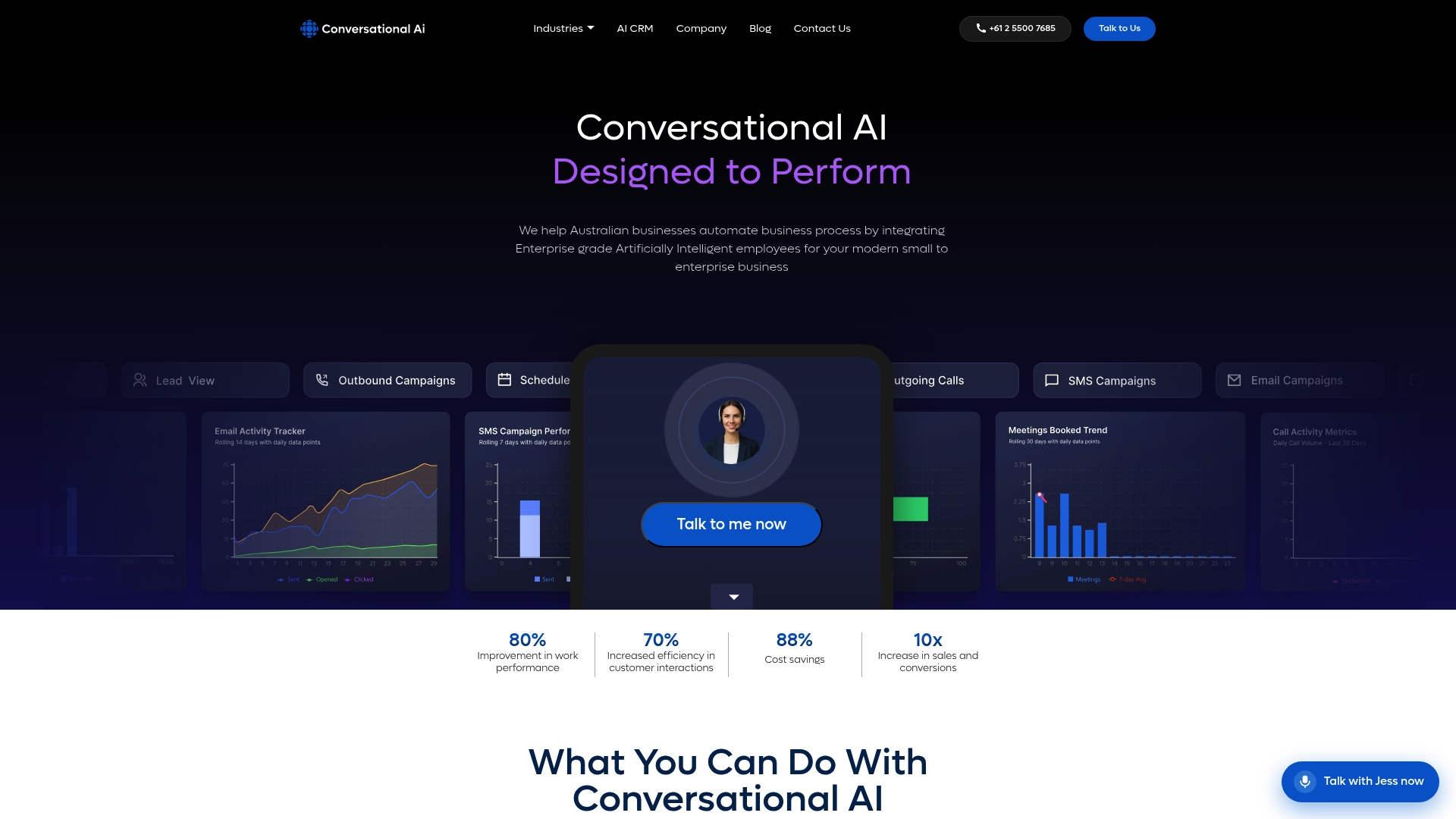
Conversational AI is an Australia-hosted, private cloud platform that covers voice, SMS, email, and live chat from a single system, with CRM integration, contextual memory, and full audit logging built in. There is no data leaving Australian jurisdiction, no shared infrastructure with offshore tenants, and no retrofitting compliance controls after the fact. Resolution times and CSAT improvements are measurable from the pilot phase — the enterprise benefits are documented, not projected.
If you are ready to scope a pilot or want to see the platform handling a live multi-channel flow, request a demo and the team will walk you through a deployment matched to your industry and channel mix.
Useful sources and further reading
- Multi-Channel AI: Building unified customer support across every platform — headline metrics and architecture overview
- What is a multichannel chatbot? A complete 2025 guide — practical distinction between multi-channel and omnichannel
- Why your business needs a multi-channel AI chatbot in 2026 — phased rollout strategy and integration depth guidance
- Multichannel AI chatbot: unified support across web, mobile and social channels — component architecture and tone mapping
- What is multi-channel AI — AI across platforms — glossary definition and deployment examples
- Enterprise chatbot implementation best practices: 2026 guide — technical and project guidance for pilots and phased rollouts
- AI chatbot customer satisfaction examples: 2026 guide — CSAT uplift metrics and case examples
Recommended
- Multichannel AI agent deployment guide for enterprises - Conversational AI
- AI system integration for Australian enterprises - Conversational AI
- Multichannel customer communication examples for Australian businesses - Conversational AI
- AI automation for Australian businesses explained - Conversational AI