Why live chat improves conversion: 2026 evidence guide
Discover why live chat improves conversion rates by 2.8 times. Engage customers in real time and reduce purchase abandonment effectively!

Visitors who engage in live chat are 2.8 times more likely to convert than those who do not. That single figure from Forrester Research tells you most of what you need to know about live chat effectiveness. Strategic implementation can lift conversions significantly, and the mechanism is straightforward: customers who get answers in real time buy, while customers who wait abandon.
The stakes are concrete. 53% of consumers will abandon a purchase if they cannot get a quick answer. That is more than half your potential buyers walking away from a solvable problem. Live chat closes that gap by putting a knowledgeable response exactly where the hesitation occurs.
Key figures that frame the live chat conversion story:
- Visitors using live chat convert at 2.8 times the rate of non-chat visitors
- Strategic live chat implementation can lift conversion rates by 20–40%, depending on how it is deployed.
- 53% of consumers abandon purchases without instant answers
- Live chat customers spend on average 60% more per purchase than customers who do not use chat.
- 42% of businesses report live chat as their top lead generation channel.
Conversion lift in focus: Live chat can deliver a strong ROI when factoring in conversion increases and support cost savings combined.
Seven research-backed reasons why live chat boosts conversions
The conversion gains from live chat are not accidental. They follow from specific behavioural and operational mechanisms that play out every time a visitor engages with a chat window.
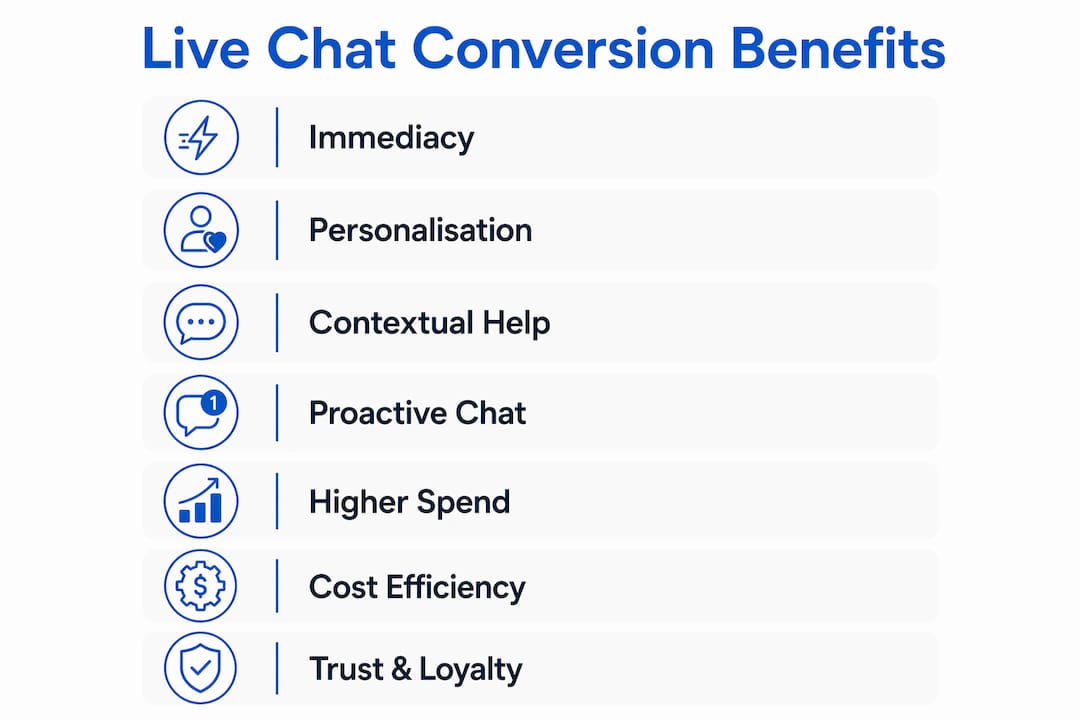
1. Immediacy meets modern consumer expectations
Speed is the single biggest driver of live chat’s conversion advantage. When a customer has a question at the moment of decision, a 24-hour email response is useless. Live chat delivers an answer in seconds, keeping the buyer in the purchase flow rather than sending them off to a competitor’s site. The Forrester data on purchase abandonment makes this concrete: more than half of consumers will not wait.

2. Personalised support reduces hesitation
Generic FAQ pages cannot address a specific buyer’s concern about their specific situation. Live chat can. An agent who asks “What are you trying to achieve?” and responds to the actual answer creates a personalised experience that builds confidence. That confidence is what converts a browser into a buyer, particularly for higher-value purchases where uncertainty is the primary barrier.

3. Live chat informs and persuades based on product context
Research published in the Wiley journal on traffic-to-sales conversion found that live chat plays two distinct roles depending on the product. When product information on a page is sparse, chat fills the knowledge gap by informing. When perceived product value is high, chat persuades by building trust and mitigating buyer hesitation. Understanding which role applies to your product determines how you should script and train your agents.
4. Proactive chat cuts cart abandonment
Waiting for a visitor to initiate chat is a missed opportunity. Proactive chat invitations at checkout reduce cart abandonment by around 30%. The trigger does not need to be complex: a visitor who has spent more than 90 seconds on a pricing page, or who has added items to a cart but stopped moving, is signalling uncertainty. A well-timed prompt from an agent can resolve that uncertainty before the visitor leaves.
Pro Tip: Segment your proactive chat triggers by page type. Pricing pages warrant a different opening message than product detail pages. A visitor on pricing is evaluating cost; a visitor on a product page is evaluating fit. Tailor the first message accordingly.
5. Chat customers spend more per transaction
Live chat customers tend to spend more per purchase on average than customers who do not engage with chat. This happens because agents can surface relevant add-ons, clarify product tiers, and guide buyers toward options that better fit their needs. The conversation itself creates upsell opportunities that a static product page cannot replicate.
6. Cost efficiency that funds further conversion investment
Businesses typically see a 15–20% reduction in support costs after implementing live chat, largely because one agent can handle multiple conversations simultaneously in a way that phone support cannot match. That cost saving does not just improve margins. It frees budget to invest in better chat tooling, more agent training, and proactive outreach programmes that compound the conversion gains.
7. Trust and satisfaction drive repeat purchases
Live chat achieves strong customer satisfaction scores across industries, and satisfied customers return. The loyalty effect compounds the initial conversion gain: a customer who had a good chat experience is more likely to come back, more likely to recommend the business, and less likely to need reassurance on their next purchase. 42% of businesses already report live chat as their top lead generation channel, which reflects this cumulative trust-building effect.
How do you measure and optimise live chat conversion rates?
Tracking live chat performance requires a focused set of metrics. Without measurement, you cannot distinguish a well-run chat programme from one that is simply busy.
Core metrics to track:
- Chat engagement rate: the percentage of site visitors who initiate or accept a chat session
- Post-chat conversion rate: the proportion of chat sessions that result in a purchase, sign-up, or qualified lead
- Average handling time: how long each chat session takes from open to resolution
- First response time: seconds from visitor message to agent reply
- Customer satisfaction score (CSAT): post-chat rating collected immediately after the session closes
- Cart recovery rate: for proactive chat, the percentage of abandoning visitors who complete a purchase after engaging
| Metric | What it measures | How to calculate |
|---|---|---|
| Chat engagement rate | Visitor participation | (Chats initiated ÷ total site visitors) × 100 |
| Post-chat conversion rate | Revenue impact | (Conversions from chat ÷ total chats) × 100 |
| Average handling time | Agent efficiency | Total chat duration ÷ number of chats |
| First response time | Speed of service | Time from visitor message to first agent reply |
| Cart recovery rate | Abandonment recovery | (Recovered carts ÷ proactive chats triggered) × 100 |
Integrating your live chat platform with your CRM is the step that turns these metrics into actionable intelligence. When chat transcripts, visitor history, and purchase data sit in the same system, you can identify which conversation patterns correlate with conversion and which lead to drop-off. Connecting live chat AI to your CRM also enables automated follow-up sequences for visitors who chatted but did not convert on the day.
Ongoing testing matters as much as initial setup. A/B testing different proactive trigger timings, opening messages, and agent scripts against conversion outcomes will surface improvements that are invisible without controlled comparison. Treat your chat programme as a living system, not a set-and-forget feature.
Best practices for implementing live chat to maximise conversion
Deployment decisions made at the start shape your results for months. Getting the fundamentals right from day one avoids the common pattern of businesses adding live chat, seeing modest results, and concluding it does not work.
Implementation priorities:
- Choose a platform that fits your existing stack. A live chat tool that does not integrate with your CRM, analytics platform, or e-commerce system creates data silos that undermine measurement and follow-up.
- Deploy proactively on high-intent pages. Pricing pages, checkout pages, and comparison pages are where decisions happen. These are the pages where a well-timed chat invitation has the highest conversion potential.
- Train agents on persuasion, not just product knowledge. Knowing the product is necessary but not sufficient. Agents need to ask qualifying questions, listen actively, and guide conversations toward resolution without being pushy.
- Optimise for mobile. A chat widget that works well on desktop but is clunky on a phone will frustrate the growing proportion of visitors browsing on mobile devices.
- Set trigger frequency limits. A visitor who dismisses a chat invitation should not receive another one 30 seconds later. Repeated prompts feel intrusive and damage the experience you are trying to create.
Pro Tip: AI-powered chatbots handle routine queries around the clock, freeing human agents for complex or high-value conversations. The most effective implementations use AI to qualify and triage, then hand off to a human agent when the conversation reaches a decision point. This hybrid model keeps response times fast without burning out your team.
The role of chatbots in customer support has expanded significantly as natural language understanding has improved. Customers increasingly cannot tell whether they are talking to a bot or a person in the early stages of a chat, which means a well-configured AI agent can handle the first two or three exchanges effectively before any handoff is needed.
Live chat AI for Australian businesses: security and compliance
Australian businesses face specific obligations under the Privacy Act 1988 and the Australian Privacy Principles, and any live chat platform that handles customer data must comply. This is not a minor consideration. A data breach or non-compliant data handling practice carries reputational and regulatory consequences that can outweigh any conversion gain.
Conversational AI platforms designed for Australian businesses prioritise data sovereignty by hosting entirely within Australia. That means customer conversation data never leaves Australian jurisdiction, which simplifies compliance and gives your legal and IT teams a clear answer when auditors ask where data is stored.
Key security and compliance benefits for Australian deployments:
- Local data hosting: all conversation data stored within Australian borders, meeting data sovereignty requirements
- Privacy Act alignment: platform configuration that supports compliance with the Australian Privacy Principles
- CRM integration: direct connection to existing systems without routing data through offshore servers
- Contextual memory: AI agents that retain conversation history within a session, reducing the need for customers to repeat themselves
- Automated follow-ups: post-chat sequences triggered by conversation outcomes, keeping leads warm without manual intervention
- Modular deployment: sector-specific configurations for healthcare, finance, and professional services where privacy standards are highest
Productivity in focus: AI-powered live chat improves agent productivity by handling routine queries automatically, enabling real-time support and follow-up at a scale that human-only teams cannot sustain.
The modular approach matters for Australian enterprises because it allows businesses to deploy live chat in the channels and contexts where it adds the most value, without committing to a monolithic system that requires full replacement when needs change. Healthcare providers, financial services firms, and professional services organisations each have different compliance profiles, and a configurable platform accommodates those differences without custom development.
What are the real limitations of live chat for conversion?
Live chat is not a universal fix. Understanding where it falls short helps you deploy it where it genuinely works rather than applying it indiscriminately.
Staffing and availability gaps are the most common failure point. A live chat widget that shows “offline” during business hours, or that routes visitors to a bot that cannot answer their question, damages trust rather than building it. Customers who initiate chat and receive no response within a reasonable time are more likely to abandon than customers who never saw a chat option at all.
High chat volume without adequate resourcing creates a different problem. When agents are handling too many simultaneous conversations, response quality drops, handling times blow out, and satisfaction scores fall. The efficiency gains from chat over phone support are real, but they have limits. AI automation helps here, but only if the AI is configured well enough to handle the queries it receives without frustrating customers.
Not every product or service benefits equally. Live chat conversion gains are strongest for considered purchases where buyers have genuine questions, and for high-value transactions where hesitation is the primary barrier. For low-consideration, low-price impulse purchases, the overhead of a chat interaction may add friction rather than remove it. The Wiley research on traffic-to-sales conversion confirms this: live chat’s persuasive effect is strongest when product value is high.
Privacy-conscious customers may be reluctant to engage with chat if they are uncertain about how their conversation data is handled. Displaying a clear, plain-language data handling notice at the start of a chat session addresses this directly and tends to increase engagement rather than reduce it.
Case studies showing live chat’s direct conversion impact
The conversion statistics cited throughout this article are drawn from large-scale studies, but the pattern holds at the individual business level too.
E-commerce retailers that have deployed proactive chat on checkout pages consistently report cart recovery improvements in line with the 30% abandonment reduction figure from the research pool. The mechanism is the same in each case: a visitor who pauses at the payment step receives a prompt, asks a question about shipping or returns, gets an immediate answer, and completes the purchase. Without the chat prompt, that visitor leaves.
B2B software companies using live chat for lead qualification report faster conversion from first contact to qualified opportunity. When a visitor on a pricing page can ask “Does this integrate with Salesforce?” and receive a confirmed answer in under a minute, the sales cycle shortens. The alternative, submitting a contact form and waiting for a callback, introduces delay that allows competing options to fill the gap.
Professional services firms, including accounting practices and legal service providers, have used AI chatbot implementations to handle initial enquiries outside business hours. A prospective client who visits a firm’s website at 9:00 PM and receives an immediate, accurate response to their question about service scope is far more likely to book a consultation than one who submits a contact form and waits until the next morning. The conversion window for professional services enquiries is often narrow, and live chat keeps it open.
The pattern across these contexts is consistent: live chat converts because it removes the friction of waiting at the exact moment a buyer is ready to decide.
Conversational AI gives Australian businesses a live chat advantage
Most live chat tools are built for global markets and hosted offshore. That creates a compliance headache for Australian businesses operating under the Privacy Act, and it puts customer data outside your control.
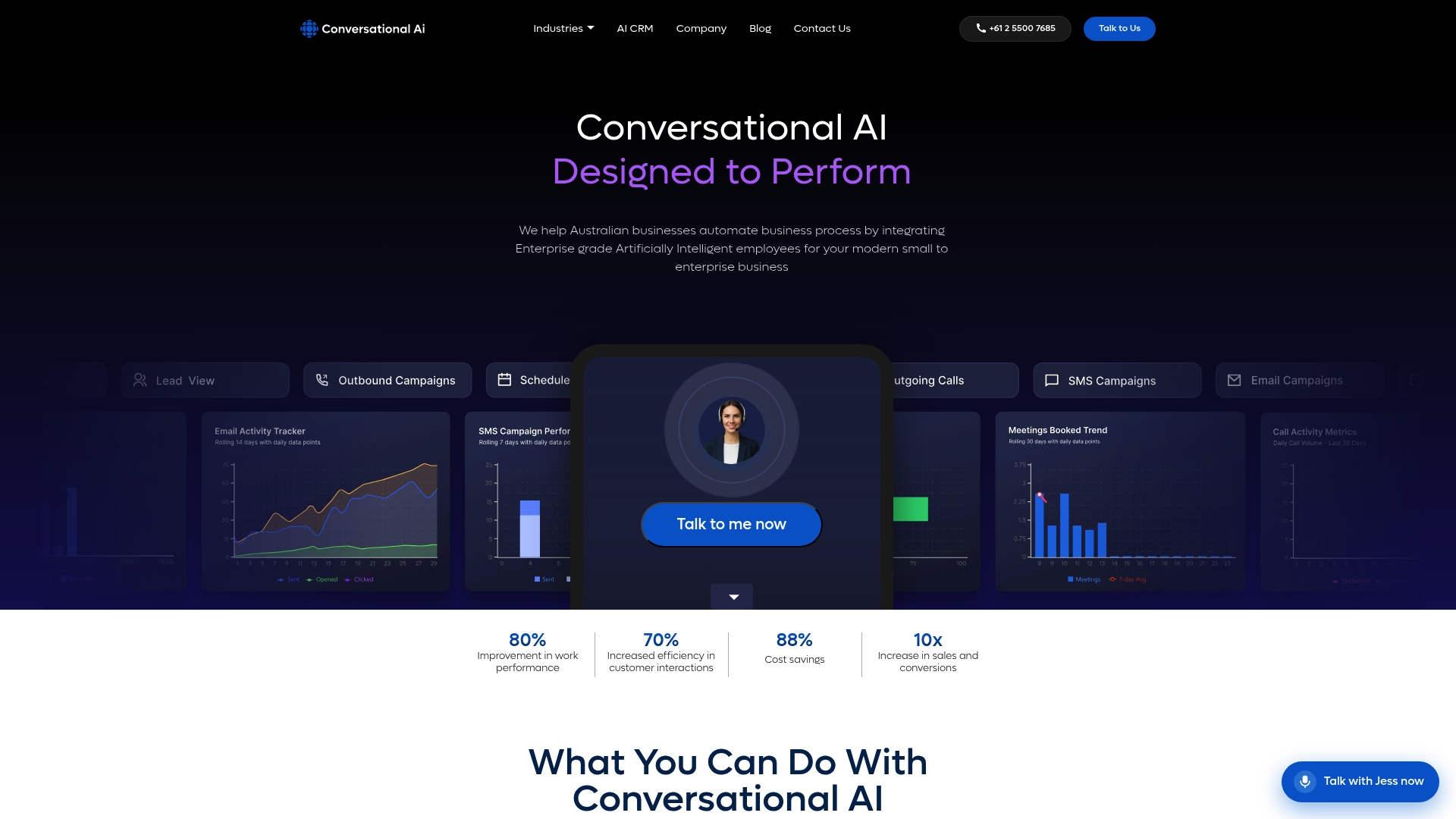
Conversational AI is built specifically for Australian enterprises. The platform hosts entirely within Australia, so your customer conversation data stays in Australian jurisdiction from the first message to the final follow-up. It connects directly to your existing CRM, supports AI-powered triage and handoff to human agents, and includes contextual memory so customers never have to repeat themselves. For sectors like healthcare, finance, and professional services where data handling is scrutinised closely, that local architecture is not a nice detail. It is the foundation the whole system rests on.
The platform’s AI agent capabilities cover live chat, voice, SMS, and email from a single modular system, which means you can deploy where your customers actually are rather than forcing them into one channel. If you want to see how it fits your current setup, book a consultation with the Conversational AI team directly through the website.
Key takeaways
Live chat improves conversion because it delivers immediate, personalised answers at the exact moment a buyer is deciding, removing the hesitation that causes abandonment.
| Point | Details |
|---|---|
| Conversion lift is proven | Visitors using live chat convert at 2.8 times the rate of non-chat visitors, with strategic implementation lifting conversion rates by 20–40%. |
| Proactive triggers recover lost sales | Chat invitations triggered at checkout reduce cart abandonment by around 30%, recovering revenue that would otherwise be lost. |
| Higher spend per transaction | Live chat customers spend 60% more per purchase on average, driven by agent-guided upselling and better product fit. |
| Measure what matters | Track post-chat conversion rate, cart recovery rate, and first response time to identify where your chat programme gains or loses ground. |
| Conversational AI for Australian compliance | Conversational AI hosts entirely within Australia, meeting Privacy Act obligations while delivering AI-powered live chat across multiple channels. |