Australian Data Sovereignty: 12 Questions Compliance Officers Must Ask
Procurement-ready, compliance-first guide for Australian teams. Follow a five-step checklist and 12 vendor questions to verify APP 8, HCF, SoCI Act and...

Data sovereignty means your data stays subject to Australian law and under operational control you can enforce, not merely stored in an Australian data centre. That distinction matters because APP 8 of the Privacy Act 1988 and the Hosting Certification Framework both test jurisdiction and control, not just geography. If you handle regulated data, start with two things this week: a data-flow map and a formal assessment of every vendor touching that data.
TL;DR:
- Vendors hosting data in Australia can still breach sovereignty if support, support staff, or encryption key management occurs offshore, creating jurisdictional risks.
- Australian sovereignty compliance requires control over the entire data stack, including legal ownership, infrastructure, operational personnel, and cryptographic keys.
- A structured five-step process—including mapping data flows and enforcing contractual, technical, and operational controls—is essential to close sovereignty gaps before breaches happen.
- Genuine sovereignty in cloud hosting demands Australian-owned legal entities, local staff, infrastructure, and control over the entire platform, not just local servers.
- For AI and chatbot platforms, sovereignty hinges on keeping data, model inference, logs, and third-party providers within Australian jurisdiction and under contractually enforceable control.
Table of Contents
- What is data sovereignty, and how does it differ from residency and localisation?
- Legal and regulatory framework that matters in Australia
- A practical compliance checklist: map, control, and contract your data flows
- Sovereign hosting and cloud options in Australia (what “sovereign” really requires)
- Indigenous data sovereignty and cultural governance considerations
- How government customers and regulated sectors meet certification and procurement requirements
- How to assess a provider: 12 practical questions to ask vendors and counsel
- Implications of data sovereignty laws on multinational corporations operating in Australia
- Impact of emerging technologies (like AI and blockchain) on Australian data sovereignty
- Recent and upcoming legislative changes affecting data sovereignty in Australia
- Case studies of data sovereignty breaches and lessons learned
- Interplay between Australian data sovereignty and international data protection regulations
- Meeting sovereignty requirements in practice
- Australia-hosted conversational AI for regulated industries
- Sources
- FAQ
What is data sovereignty, and how does it differ from residency and localisation?
These three terms get used interchangeably in vendor marketing, and that’s exactly where compliance teams get burned. Data residency simply means data sits on a server in a particular location, usually chosen for latency or cost reasons. Data localisation is a legal requirement that certain data must stay within a country’s borders, often set by regulation for specific sectors. Data sovereignty goes further: it asks which country’s laws actually govern that data, and who can compel access to it, regardless of where the servers physically sit.
A vendor can host your database in a Sydney data centre and still fail the sovereignty test. Here’s how that happens in practice.
- The database lives in Australia, but the support team troubleshooting it works from Manila or California, with full administrative access.
- Encryption keys are managed by the vendor’s global infrastructure, hosted overseas, meaning a foreign court order could compel key disclosure even though the data never left Australian soil.
- Telemetry, logs, and diagnostic metadata route through offshore systems for “product improvement,” creating a parallel data trail your contract never mentioned.
- The vendor’s parent company is a US corporation, which means US law (including the CLOUD Act) can reach data the vendor controls anywhere in the world.
This is what practitioners call the “sovereignty gap.” One local provider frames it bluntly: residency is only half the story, because the control plane, the admin access, and the legal ownership structure sit outside the geography claim entirely. Genuine sovereignty requires control over the whole stack: the legal entity, the physical infrastructure, the operational support team, and the cryptographic keys.
So when a vendor tells you “your data is stored in Australia,” treat that as the opening line of a longer conversation, not the answer. Ask who can access it, from where, under whose legal authority, and what happens if a foreign government issues a compulsion order to the vendor’s parent entity. If the sales team can’t answer those questions in writing, you don’t have sovereignty. You have a data centre address.
The practical test is simple: could a foreign court, regulator, or law enforcement agency compel access to this data without an Australian entity being able to refuse or even know about it? If the answer is yes, or “we’re not sure,” you’re carrying jurisdictional risk that no amount of “hosted in Sydney” language will fix.
Legal and regulatory framework that matters in Australia
Australian data sovereignty isn’t governed by a single sovereignty law. It’s assembled from several statutes and frameworks, each covering a different slice of risk, and compliance officers need to know which one applies to their sector.
The Privacy Act 1988 is the backbone. Australian Privacy Principle 8 (APP 8) makes an organisation accountable for personal information it discloses to an overseas recipient, unless a specific exception applies, such as the recipient being subject to a substantially similar privacy law or a binding scheme. This is broader than most compliance teams assume. Offshore support staff viewing customer records, log files routed through an overseas server, or a SaaS vendor’s global backup system can all count as a cross-border disclosure under APP 8, and each one needs to be documented and justified in your data-flow audit.
The majority of Australians now consider it a misuse of their personal information when an organisation allows overseas access, indicating a rising concern since earlier surveys, according to the OAIC’s community attitudes survey. That’s not a regulatory statistic. It’s a customer trust statistic, and it should shape how you talk about vendor selection with your board.
For critical infrastructure operators, energy, water, healthcare, communications, transport, and finance among them, the Security of Critical Infrastructure Act (SoCI Act) adds a harder edge. Responsible entities must run risk management programs that minimise or eliminate the risk of sensitive operational information being stored, transmitted, or processed outside Australia. This isn’t a best-practice suggestion. It’s a statutory obligation with real enforcement teeth.
Government procurement runs on a different but related track: the Hosting Certification Framework (HCF). Providers seeking to handle sensitive government workloads need HCF certification, which verifies infrastructure, personnel, and operational controls against a defined standard. Even if you’re not selling to government, HCF certification is a useful signal when you’re assessing any vendor’s sovereignty claims.
Two more pieces round out the framework:
- The Notifiable Data Breaches (NDB) scheme under the Privacy Act requires organisations to notify affected individuals and the OAIC when a breach is likely to cause serious harm, with strict timing expectations.
- IRAP (Infosec Registered Assessors Program) assessments and the Essential Eight mitigation strategies from the Australian Signals Directorate are the technical benchmarks most government and regulated-sector procurement teams now expect vendors to reference, even outside formal government contracts.
Together, these frameworks mean sovereignty compliance in Australia isn’t one checkbox. It’s a layered obligation that changes depending on your sector, your data type, and who’s asking.
A practical compliance checklist: map, control, and contract your data flows
Most organisations discover their sovereignty gaps during an audit or, worse, after a breach. A structured five-step process closes that gap before it becomes a headline. Work through these in order. Skipping ahead to contracts before you’ve mapped your data flows is the single most common mistake compliance teams make.
- Map and classify your data flows. Document every system that touches personal, financial, health, or operational data, and trace where it physically goes, who has access, and under what legal basis. Include SaaS tools, marketing platforms, and AI chatbots. These are the systems compliance teams forget until an APP 8 review forces the question.
- Run vendor due diligence properly. Establish who legally owns the vendor, where support staff sit, who can access production data, and who holds the encryption keys. A structured vendor due-diligence process should cover ownership structure, financial stability, and data-handling practices, not just a feature comparison.
- Build contractual protections that actually bite. Your Data Processing Agreement should specify data residency, the scope of processing, audit rights, breach notification timelines, and, critically, what happens to your data if the vendor is acquired by a foreign entity.
- Lock down technical controls. Push for customer-held or customer-controlled encryption keys where the platform supports it. Minimise telemetry that routes offshore. Confirm encryption in transit and at rest meets a defined standard, not a vague “industry-leading security” claim.
- Build operational controls and an incident playbook. Assign clear internal ownership for sovereignty compliance, and write a breach response plan that maps directly to your NDB scheme obligations, including who notifies whom and within what window.
Pro Tip: Run your vendor due diligence before you sign, not during renewal. Sovereignty gaps found six months into a three-year contract are expensive to fix and painful to explain to a board.
This process isn’t a one-off audit. Data flows change every time you add an integration, a new CRM field, or a chatbot plugin, so revisit the map at least annually, and always before any material vendor change. If you’re evaluating an AI platform specifically, a structured compliance approach for sovereign AI deployments covers many of the same mapping and diligence steps, adapted for conversational and automation tools where data flows are often less visible than in a traditional database.
The step organisations most often shortcut is step 4, technical controls, because it requires engineering resources rather than a signature on a contract. That’s a mistake. A beautifully worded DPA means little if the underlying platform routes diagnostic logs through a US data centre by default.
Sovereign hosting and cloud options in Australia (what “sovereign” really requires)
Four hosting models sit on a spectrum from full jurisdictional control to shared, offshore-influenced infrastructure, and picking the wrong one for a regulated workload is one of the more expensive mistakes a compliance team can sign off on.
On-premises infrastructure gives you the most direct control: your hardware, your building, your staff. It’s also the most expensive to run and scale, which is why few organisations run everything this way anymore.
Private cloud, hosted in a local data centre but managed by a dedicated provider, offers a strong middle path for regulated workloads, provided the provider’s legal entity, staff, and key management are genuinely Australian.
Sovereign cloud is the term vendors use most loosely, and the one compliance officers should interrogate hardest. A genuine sovereign cloud offering means the legal entity operating it is Australian-incorporated, its administrative and support staff work from Australia, and it holds no structural dependency on a foreign parent that could be compelled to grant access.
Dedicated tenancy on a major hyperscaler’s Australian region sits in the grey zone. The servers are local. The parent company, and often the control plane, is not.
That last point is where most sovereignty claims fall apart under scrutiny. Full-stack sovereignty requires four things together: Australian legal entity ownership, physically local infrastructure, local operational and support staff, and customer or local control over cryptographic keys. Drop any one of these and you’ve got residency, not sovereignty.
Common gaps to test for when evaluating a hyperscaler-based option:
- Does the control plane, the console used to configure and manage the environment, run through infrastructure based overseas?
- Is support staff access genuinely restricted to Australia, or does “follow the sun” support mean 2am access from a data centre in another hemisphere?
- Does the platform’s telemetry and diagnostic data get pooled into a global system for product analytics, effectively creating an offshore copy of your metadata?
Hybrid approaches make sense for many organisations: keep the genuinely sensitive workloads (customer PII, health records, financial transaction data) on a private or sovereign platform, while lower-risk workloads run on more cost-effective infrastructure. The mistake is applying that same risk tolerance uniformly across every system, which is how sensitive data ends up on infrastructure it should never have touched.
Indigenous data sovereignty and cultural governance considerations
Indigenous data sovereignty is a distinct governance obligation, not a subset of general privacy compliance, and it’s one many organisations overlook until a research partnership or government contract requires it. The InDatOCS framing, developed through Australian Indigenous data governance work, treats Indigenous data as an asset class requiring ownership, custodianship, and stewardship that sits apart from how mainstream commercial data is typically governed.

The distinction matters practically. Ownership in this context means Indigenous communities and organisations hold the right to determine how their data is used, not just consent to its initial collection. Custodianship recognises that a research institution or government agency might hold data on behalf of a community without owning it outright. Stewardship covers the ongoing responsibility to manage that data in line with community interests, which can outlast any single research project or contract.
This affects procurement, research design, and consent processes well beyond what a standard privacy consent form covers. If your organisation collects, stores, or processes data relating to Aboriginal and Torres Strait Islander communities, whether through health research, land management, education programs, or government service delivery, standard Privacy Act compliance is a floor, not a ceiling.
Practical steps that matter here:
- Engage with the relevant community or representative body before data collection begins, not after a project design is locked in.
- Negotiate custodial agreements that specify who controls access, use, and downstream sharing of the data, separate from your standard vendor contracts.
- Build in benefit-sharing and access controls that give the community ongoing visibility into how their data gets used, not just a one-time consent signature.
Treat this as a governance conversation that runs parallel to, not underneath, your general data sovereignty program.
How government customers and regulated sectors meet certification and procurement requirements
Government agencies and regulated sectors lean on a small set of recognised frameworks to evidence sovereignty and security posture, and knowing which one applies saves months in procurement cycles.
Hosting Certification Framework (HCF) certification demonstrates a provider has met defined standards across infrastructure, personnel vetting, and operational controls for handling sensitive government data. Verify certification status directly with the framework rather than taking a vendor’s word for it.
IRAP assessments, conducted by ASD-endorsed assessors, evaluate a system against the Australian Government’s Information Security Manual. Ask vendors for their most recent IRAP report and its scope, not just a claim of “IRAP assessed.”
APRA CPS 234 applies specifically to APRA-regulated entities, banks, insurers, and superannuation funds, requiring them to maintain information security capability proportionate to the size and extent of threats they face, including third-party and outsourcing arrangements. Evidence to collect includes vendor security assessments, incident response testing records, and board-level attestations. A structured CPS 234 alignment playbook can help financial services teams map AI-specific tooling against these obligations.
How to assess a provider: 12 practical questions to ask vendors and counsel
Before you sign, work through this list with your vendor and, where the workload is high-risk, with legal counsel.
- Who legally owns this company, and in what jurisdiction is the parent entity incorporated?
- Where is your management plane and admin console physically hosted?
- Where are your support and engineering staff located, and can you restrict access to Australian-based personnel?
- Who holds the encryption keys, and can we hold or control them ourselves?
- What data gets logged, and where does that log data route to?
- Does any telemetry or diagnostic data leave Australia, even for product improvement purposes?
- Do you hold HCF certification, an IRAP report, or equivalent SOC 2 / ISO 27001 artefacts?
- What are our audit rights under the contract, and how often can we exercise them?
- What’s the breach notification timeline in the contract, and does it meet NDB scheme requirements?
- Can you export our data in full, in a usable format, on contract termination?
- What happens to our data if your company is acquired by a foreign entity?
- Which specific APP 8 exception, if any, applies to your handling of our data?
Acceptable evidence includes current HCF certification, a scoped IRAP report, ISO 27001 certification, and SOC 2 Type II reports, each cross-checked against the actual systems your data will touch, not just the vendor’s corporate parent.
Implications of data sovereignty laws on multinational corporations operating in Australia
Multinational corporations operating in Australia face a structural tension: their global infrastructure is built for efficiency across borders, while Australian sovereignty expectations push in the opposite direction. A US-headquartered SaaS provider might run a single global database architecture for cost reasons, which puts Australian customer data at odds with APP 8 obligations the moment support or backups touch offshore systems.
This creates real compliance exposure for the Australian arm of a multinational, even when the parent company genuinely intends no harm. The Australian entity is typically the one accountable to the OAIC and, where relevant, the SoCI Act regulator, regardless of where the parent’s engineering decisions get made.
Multinationals serious about the Australian market increasingly stand up dedicated local infrastructure, local legal entities with genuine decision-making authority over Australian data, and local support teams, precisely to close this gap. That’s a meaningfully bigger investment than simply choosing an Australian AWS region, and it’s the difference between a genuine local compliance posture and a marketing claim that unravels the first time a regulator asks pointed questions. Compliance officers assessing a multinational vendor should ask directly whether the Australian entity has the legal and operational authority to refuse a parent company’s request for data access.
Impact of emerging technologies (like AI and blockchain) on Australian data sovereignty
AI systems complicate sovereignty in a specific way: training data, model weights, and inference logs often move through infrastructure the vendor doesn’t clearly disclose. A chatbot platform that markets itself as “hosted in Australia” might still route conversation transcripts through an overseas large language model API for processing, which is exactly the kind of hidden cross-border disclosure APP 8 is designed to catch.
This is why chatbot data residency deserves its own line of questioning during vendor assessment, separate from general infrastructure hosting. Ask specifically where the model inference happens, where conversation logs and contextual memory get stored, and whether any third-party AI provider touches that data at any point in the pipeline.
Blockchain and distributed ledger technologies raise a different problem: their whole design premise is data replication across many nodes, often in unknown jurisdictions. That’s structurally difficult to reconcile with sovereignty requirements that demand a defined, controllable jurisdiction. Organisations exploring blockchain for regulated data should treat jurisdictional control as a design constraint from day one, not an afterthought solved with a permissioned ledger.
The practical response for AI specifically is choosing platforms where the entire processing pipeline, not just the storage layer, sits within Australian jurisdiction and under contractually enforceable control.
Recent and upcoming legislative changes affecting data sovereignty in Australia
Privacy law reform has been building momentum for several years, with proposed amendments to the Privacy Act aimed at strengthening individual rights, tightening cross-border disclosure rules, and increasing penalties for serious breaches. Compliance teams should treat the current APP 8 framework as a floor that’s likely to rise, not a fixed target.
The SoCI Act has also expanded scope since its introduction, drawing more sectors and asset classes into its risk management program obligations. Organisations that assumed they sat outside critical infrastructure definitions should reassess that assumption periodically, since asset class definitions have broadened over time.
Digital identity policy is another area to watch closely. Government-led digital ID initiatives raise sovereignty questions of their own: where identity data is verified, stored, and shared, and under what legal safeguards. Compliance officers in sectors that will eventually integrate with a national digital ID framework should track this space, because the sovereignty expectations placed on identity verification data are likely to be stricter than for general customer data.
The direction of travel across all these fronts points the same way: tighter cross-border disclosure rules, broader critical infrastructure scope, and higher public expectations for local control. Building compliance programs with headroom for stricter future requirements is cheaper than retrofitting them later.
Case studies of data sovereignty breaches and lessons learned
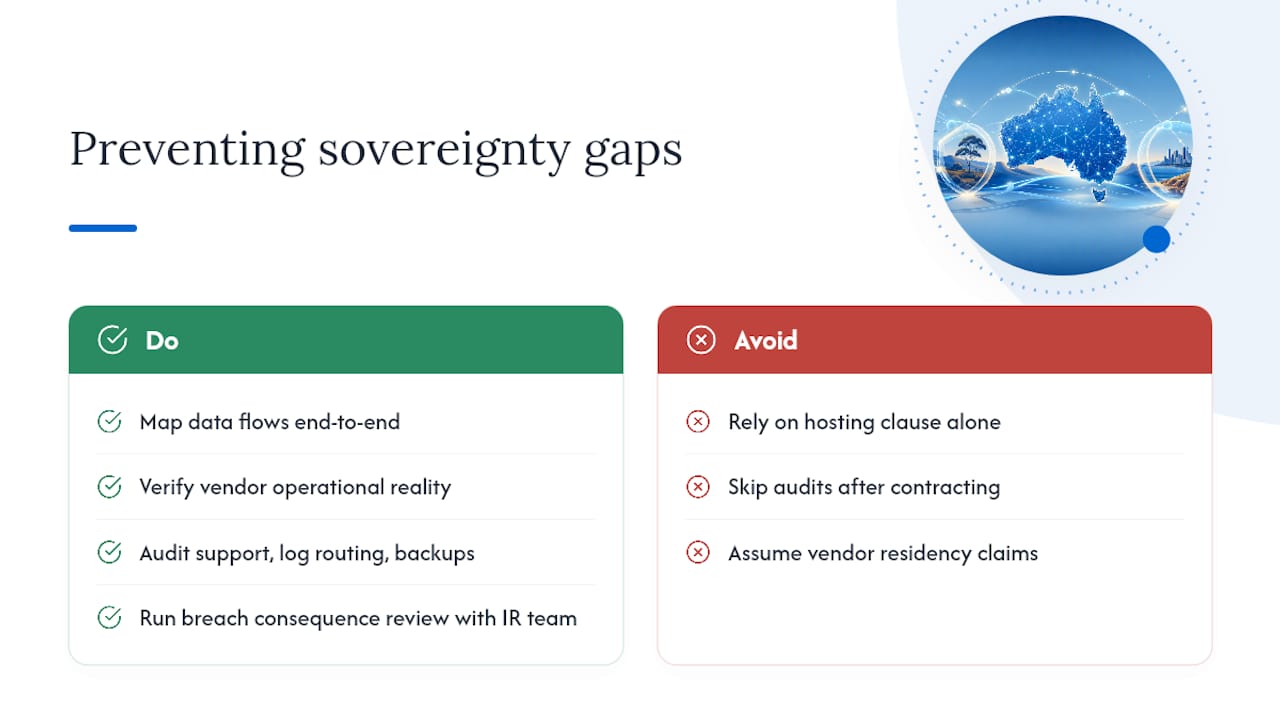
Sovereignty failures rarely look dramatic at the point they occur. They tend to surface during a breach investigation, when a compliance team discovers that customer data supposedly held onshore was, in fact, accessible to overseas support staff, or that backup systems replicated records to an offshore region no one had documented.
The recurring pattern across breach post-mortems is the same: an organisation trusted a vendor’s residency claim without verifying the operational reality behind it. Support access, log routing, and backup replication are the three places sovereignty assumptions most often fail, because they’re rarely covered in the initial sales conversation and rarely audited after the contract is signed.
The lesson compliance officers consistently draw from these incidents is that contractual language alone doesn’t prevent a breach. A DPA that specifies “data will be hosted in Australia” but says nothing about support access or backup locations leaves the exact gap that caused the incident in the first place. Organisations that came through breach investigations with the least regulatory and reputational damage were the ones that had already mapped their data flows and could demonstrate, quickly, exactly what data went where and why. A structured review of breach consequences and remediation is worth working through with your incident response team before an actual event forces the exercise.
The practical takeaway is straightforward: the data-flow mapping exercise from earlier in this guide isn’t paperwork. It’s the difference between answering a regulator’s questions in hours versus weeks.
Interplay between Australian data sovereignty and international data protection regulations
Australian data sovereignty rules don’t operate in isolation, and multinational organisations often need to satisfy the Privacy Act and a foreign regime simultaneously, most commonly the EU’s General Data Protection Regulation (GDPR).
The two frameworks share some DNA, both regulate cross-border data transfers and both require accountability for how personal data is handled, but they’re not identical, and treating APP 8 compliance as automatically covering GDPR obligations (or vice versa) is a mistake. GDPR’s adequacy decision mechanism and its stricter consent and data subject rights requirements go further in some respects than the Privacy Act currently does. Australia does not currently have a direct GDPR equivalent in scope or enforcement power, though ongoing Privacy Act reform is narrowing some of those gaps.
For an Australian organisation handling EU residents’ data, or a multinational balancing both regimes, the practical approach is to map data flows against both frameworks separately and apply whichever standard is stricter for a given data category. That usually means GDPR-level consent practices paired with APP 8’s cross-border disclosure documentation, run as one combined compliance program rather than two competing checklists.
Meeting sovereignty requirements in practice
The most common procurement pitfall I see is teams stopping their diligence the moment a vendor says “our servers are in Sydney.” That single line closes the conversation when it should open it. Residency claims get accepted at face value far more often than they get tested, and the gap only surfaces later, usually during a breach or an audit, exactly when you don’t want to be discovering it.
Phasing matters more than perfection. You don’t need every system sovereign-compliant on day one. Prioritise by risk: health records, financial transaction data, and anything touching critical infrastructure definitions go first. Marketing analytics and low-sensitivity operational data can wait.
Realistically, a mid-sized organisation should budget three to six months for a proper data-flow map and vendor reassessment across its core systems, longer if legacy contracts need renegotiation. That’s not a compliance officer working alone. It needs IT, procurement, and legal at the same table from week one, because sovereignty gaps hide in the space between those three functions more often than within any one of them.
— Sowrabh
Australia-hosted conversational AI for regulated industries
If your organisation is assessing chatbot data residency as part of a vendor review, consider platforms built to close that gap. Such platforms run entirely on Australian infrastructure, giving healthcare, finance, and professional services teams local operational control and avoiding offshore support ambiguities.
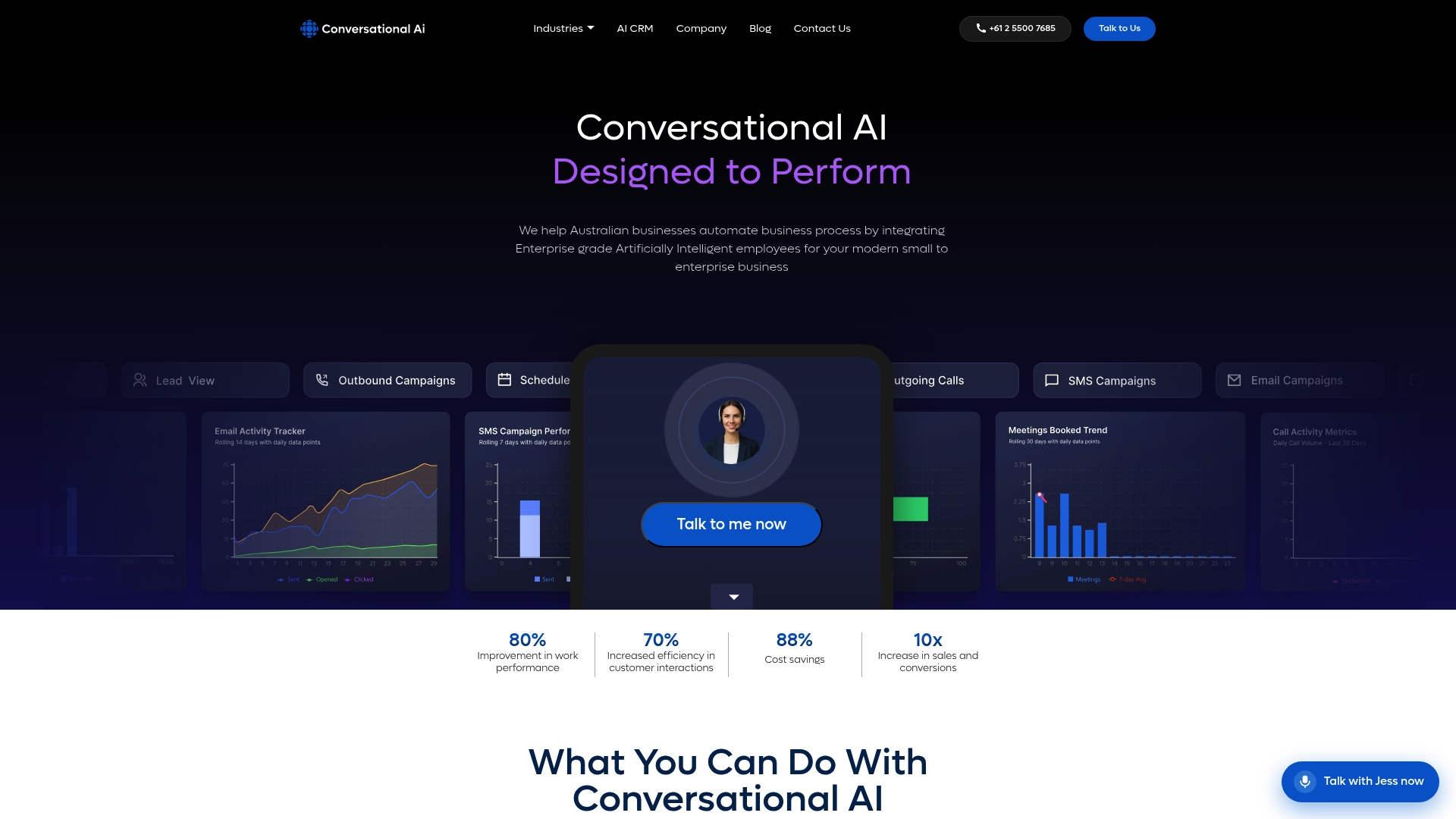
Multichannel agents—including voice, SMS, email, and live chat—can integrate with existing CRM systems without routing conversation data through offshore infrastructure, and contextual memory remains within an Australian-controlled environment rather than a third-party global pipeline. For compliance teams building the kind of vendor evidence pack this guide has walked through, that’s a materially simpler due-diligence conversation than most alternatives allow. If chatbot data residency is on your current vendor assessment list, start by reviewing the sovereign AI compliance guide or get in touch directly through Conversational AI to talk through your specific procurement requirements.
This article is general information, not a substitute for advice from a qualified lawyer. Consult a qualified legal professional about your own circumstances before acting on anything here.
Sources
- Security of Critical Infrastructure Act (SoCI Act) guidance (CISC)
- Hosting Certification Framework (Australian Government)
- Indigenous data governance in Australia: towards a national framework (IDN / University of Melbourne)
FAQ
Can I refuse a digital ID in Australia?
Digital ID use for government services is generally designed around choice, with alternative verification pathways typically available, though specific requirements depend on the individual service and its enabling legislation.
Does Australia have a GDPR equivalent?
Australia does not currently have a direct GDPR equivalent in scope or enforcement power; the Privacy Act 1988 and APP 8 govern data protection instead, and reform proposals are narrowing some gaps between the two regimes.
What does data sovereignty mean?
Data sovereignty means data remains subject to the laws of the country where it’s held and under enforceable operational control, covering legal jurisdiction, key management, and support access, not just the physical location of the servers.
Is Australia pushing for digital ID?
The Australian Government has progressed digital ID policy in recent years, and organisations handling identity verification data should track this space closely given the stricter sovereignty expectations likely to apply to it.
How is chatbot data residency different from general data residency?
Chatbot data residency covers where conversation transcripts, contextual memory, and any third-party AI model processing occur, which can involve offshore routing even when the core hosting infrastructure sits in Australia, as with platforms like Conversational AI that keep the full pipeline local.