Avoid Fines: 5 Steps to Call Recording Compliance in Australia
Practical compliance for Australian businesses: state by state consent rules, a five step operational checklist, vendor checks, and Australia hosted...

Yes, you can record phone calls in Australia, but the rules shift depending on which state your caller sits in and what you plan to do with the recording. The safest default for any business operating nationally is simple: tell the caller you’re recording, state why, and give them a genuine way to opt out. Layer the Privacy Act on top, secure what you record, and delete it on a schedule you can defend.
TL;DR:
- Businesses must treat outbound calls into all-party consent states as requiring explicit consent, regardless of their own location or perceived jurisdiction.
- Verbal notices must clearly state the recording, its purpose, and include a genuine opt-out, logged and proven before the conversation progresses.
- All recordings should be stored securely within Australian infrastructure, encrypted, and subject to automated retention and deletion schedules.
- Handling of sensitive sectors or vulnerable callers requires additional documentation, parental notification, and careful notice design to avoid harm or non-compliance.
- Vendor systems should provide auditable access logs, encryption, and retentive controls to ensure operational compliance and reduce legal risks.
Table of Contents
- Call recording laws in Australia: the state and territory map
- What counts as valid consent for a recorded call
- Cross-border calls: whose rules apply?
- The practical compliance checklist for call recording
- Privacy Act and interception law: the federal overlay
- Penalties and whether a recording holds up as evidence
- Policies and documents your compliance team needs
- How an Australia-hosted platform supports recording compliance
- Recording in regulated sectors: healthcare, finance, and government
- Recording calls involving minors or vulnerable people
- Employee monitoring and consent for internal calls
- Emergency services calls: a different legal category
- A conservative risk posture is the only one that scales
- Where a purpose-built platform makes compliance easier
- Primary sources worth checking directly
- Sources
- FAQ
Call recording laws in Australia: the state and territory map
State and territory legislation, not a single national law, decides whether you can hit record. Each jurisdiction runs its own Surveillance Devices Act or Listening Devices Act, and the wording differs just enough to trip up businesses that assume one national rule applies everywhere.
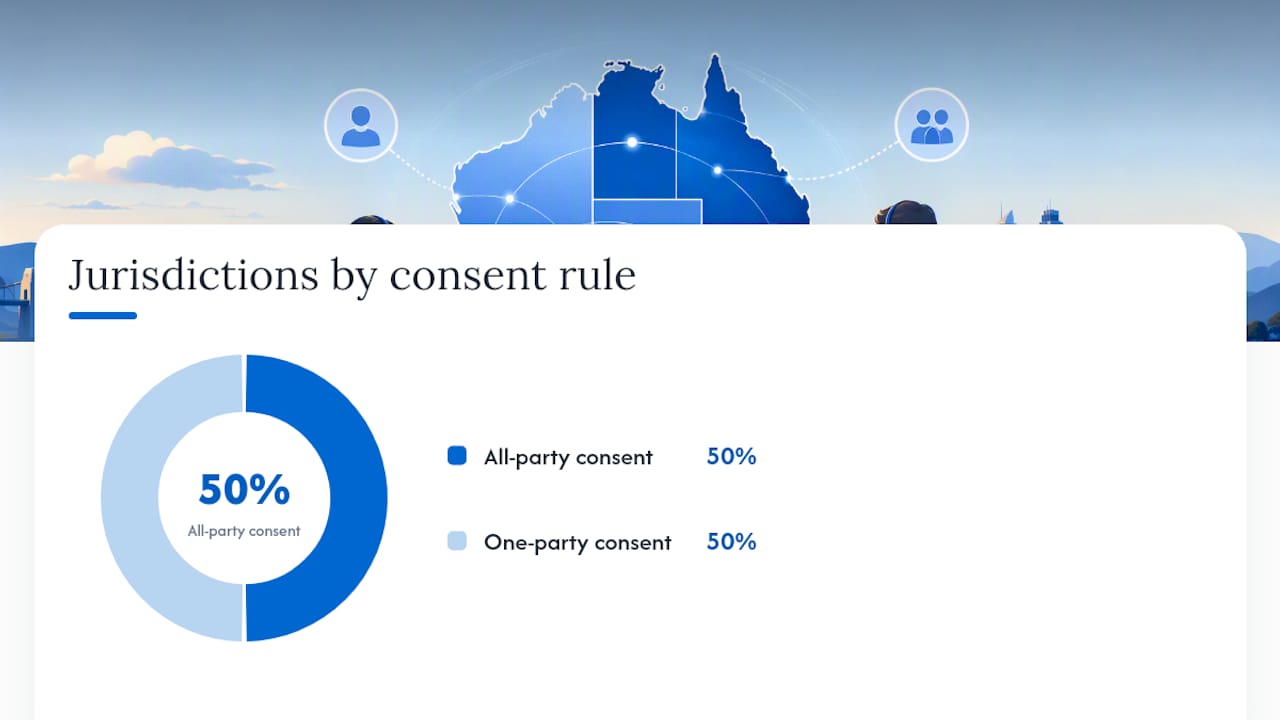
Practically, jurisdictions fall into two camps:
- All‑party consent states: New South Wales, the Australian Capital Territory, South Australia and Western Australia are commonly treated as requiring every party’s consent before a private conversation is recorded lawfully.
- One‑party consent states: Queensland, Victoria, Tasmania and the Northern Territory generally allow a participant to record their own conversation without the other party’s agreement, subject to narrow exceptions.
Victoria’s own Surveillance Devices Act 1999 illustrates the pattern: section 6 restricts the use of listening devices to record a “private conversation” but carves out a participant who is party to that conversation. Queensland’s Invasion of Privacy Act follows similar logic. South Australia and Western Australia read the opposite way, treating recording without consent from every party as an offence in most circumstances.
For a call centre or sales team, the practical question isn’t “what does my head office state say?” It’s “where is the person on the other end of the line?” Outbound calls into New South Wales or South Australia trigger all‑party rules even if your business is based in Brisbane. Inbound calls carry the same risk in reverse. Matching caller area codes or CRM address fields to a jurisdiction is a rough but useful first filter, and it’s exactly the kind of check worth automating rather than leaving to memory. If you can’t confidently identify the caller’s location, treat the call as if it sits in an all‑party state.
What counts as valid consent for a recorded call
Consent comes in two forms, and only one of them holds up reliably in an all‑party jurisdiction. Express consent is a clear, affirmative acknowledgment. Implied consent is inferred from context. Businesses that lean on implied consent alone, such as assuming a customer “must have known” because of an industry norm, take on real legal risk in New South Wales, the ACT, South Australia and Western Australia.
A lawful notice needs three things:
- What is happening. State plainly that the call is being recorded.
- Why it’s happening. Give a purpose, such as quality assurance, training or dispute resolution.
- How to opt out. Offer a real alternative, not a buried disclaimer.
Script components should play automatically, before the substantive part of the conversation begins: an IVR message from experienced app developers or a live agent line stating the recording is starting, followed by a short pause to let the caller respond, then a clear path to decline (transfer to a non-recorded line, or continue the call unrecorded). Log the outcome against the call record, because a consent process nobody can prove happened is barely better than no process at all.
Pro Tip: Don’t rely on a “lawful interest” exception to justify routine QA recording. Regulators and legal commentators read that exception narrowly, and it’s not a substitute for asking.
Cross-border calls: whose rules apply?
A single call can cross two jurisdictions at once, your agent in Melbourne, your customer in Adelaide, and each state’s law technically applies to its own resident. When the rules conflict, the stricter regime usually governs how a court or regulator will assess your conduct, so defaulting to the toughest standard is the only workable approach at scale.
Operationally, that means:
- Standardise every outbound and inbound recording process to all‑party consent, regardless of which state the call originates from.
- Use an IVR notice or a scripted agent line consistently, so there’s no manual judgment call about which state’s rule applies on any given call.
- Log party locations where your systems allow it, even roughly, to support your position if a complaint ever arises.
International callers add another layer. A customer phoning from the United Kingdom or New Zealand may fall under that country’s own recording law, not just Australia’s. Check the destination country’s rules before running large offshore campaigns, and consider adding explicit consent wording for cross‑border calls rather than assuming Australian defaults travel well.
The practical compliance checklist for call recording
Turning the law into daily practice comes down to five operational habits.
- Document your purpose. Write down exactly why you record calls, whether it’s dispute resolution, training or regulatory record‑keeping, and collect no more than that purpose requires.
- Notify and offer a real opt‑out. Every call gets a consistent notice, whether by IVR prompt or agent script, with a genuine alternative for callers who decline.
- Secure the recordings. Encrypt files at rest and in transit, apply role‑based access control, and keep an audit trail of who accessed what and when.
- Set a retention schedule. Decide how long recordings live before deletion, and apply it automatically rather than leaving it to someone’s memory.
- Handle payment data separately. Calls touching card details need PCI‑aware handling, which usually means pausing or masking recording during the payment step.
Beyond the checklist, two governance gaps cause most of the trouble Sowrabh has seen discussed in legal commentary:
- Staff using personal devices to record calls off the books, outside any approved system.
- Vendors who can’t confirm where your data is actually hosted.
Ban personal recording outright and name your approved platform in policy. Vet vendors on data location, encryption standard, and whether they can produce an audit log on demand, not just on price.
Pro Tip: Ask any telephony vendor to demonstrate their audit log live, not just describe it in a sales deck. If they can’t show you who accessed a specific recording last month, that’s your answer.
Privacy Act and interception law: the federal overlay
State surveillance law governs whether you can record. Federal law governs what you do with the recording once it exists, and that’s where most businesses lose track of their obligations.
The Privacy Act 1988 and its Australian Privacy Principles apply whenever a recording contains personal information, which is almost always the case with a customer service call. That means:
- Your privacy policy needs to disclose that calls may be recorded and roughly why.
- You can only use the recording for the purpose you stated, not repurpose it later for something unrelated without fresh consent.
- The Office of the Australian Information Commissioner expects reasonable security safeguards around storage and access.
The Telecommunications (Interception and Access) Act 1979 sits alongside this but rarely bites in the way businesses fear. It’s aimed squarely at third parties intercepting a communication in transit, not at a participant recording their own call. A participant recording their own conversation typically sits outside the federal interception offence, leaving state Acts to do the heavy lifting on consent. Where it does matter is third‑party wiretapping, or a vendor accessing call content beyond their authorised role, which is exactly why access logging matters as much as encryption.
Penalties and whether a recording holds up as evidence
Getting call recording wrong isn’t just a compliance footnote, it carries real statutory teeth. South Australian law, for example, sets a substantial maximum corporate penalty under the Surveillance Devices Act for a body corporate found to have used a listening device unlawfully, well beyond what most businesses budget for as a risk.
Beyond fines, there’s the question of whether an unlawfully obtained recording is even useful. Courts and tribunals hold discretion to exclude evidence gathered in breach of surveillance law, and the Fair Work Commission generally discourages covert recordings as evidence in workplace disputes, even where it occasionally allows them. A recording made to protect your business can end up worthless, or worse, become the evidence against you.
Publishing or sharing a recording adds a separate layer of risk again. Playing a recorded call in marketing material, a training session outside its stated purpose, or a public dispute can trigger both privacy complaints and defamation exposure, regardless of whether the original recording was lawful.
Policies and documents your compliance team needs
A handful of internal documents do most of the work of demonstrating good governance.
- Privacy policy wording disclosing that calls may be recorded, the purpose, and your retention period in plain terms.
- A workplace policy banning unauthorised personal‑device recordings and naming the approved enterprise platform staff must use instead.
- A written retention schedule specifying how long recordings are kept before automatic deletion, tailored to the purpose you documented.
- Vendor contract clauses requiring Australian data hosting, encryption in transit and at rest, and auditable access logs as a condition of the contract, not a nice‑to‑have.
Publish these once, review them annually, and update them whenever your call volume, vendor stack, or state footprint changes.
How an Australia-hosted platform supports recording compliance
Getting the policy right is one problem. Enforcing it consistently across every call, every day, is another, and that’s usually where manual processes break down. A platform built around Australian data hosting removes one entire category of risk by keeping recordings inside local infrastructure rather than routed through offshore servers you can’t audit.
The operational features that actually matter:
- Encryption at rest and in transit, so a recording is protected the moment it’s captured, not just when someone remembers to secure it later.
- Role‑based access control and audit logs, so you can prove exactly who listened to a recording and when.
- Automated retention and deletion, so recordings age out on schedule instead of piling up indefinitely because nobody owns the cleanup task.
- Pause and resume on IVR triggers, useful for skipping payment card details or sensitive sections of a call automatically.
None of this replaces a written consent policy or a trained team. Platform controls operationalise your compliance decisions, they don’t make those decisions for you.
Recording in regulated sectors: healthcare, finance, and government
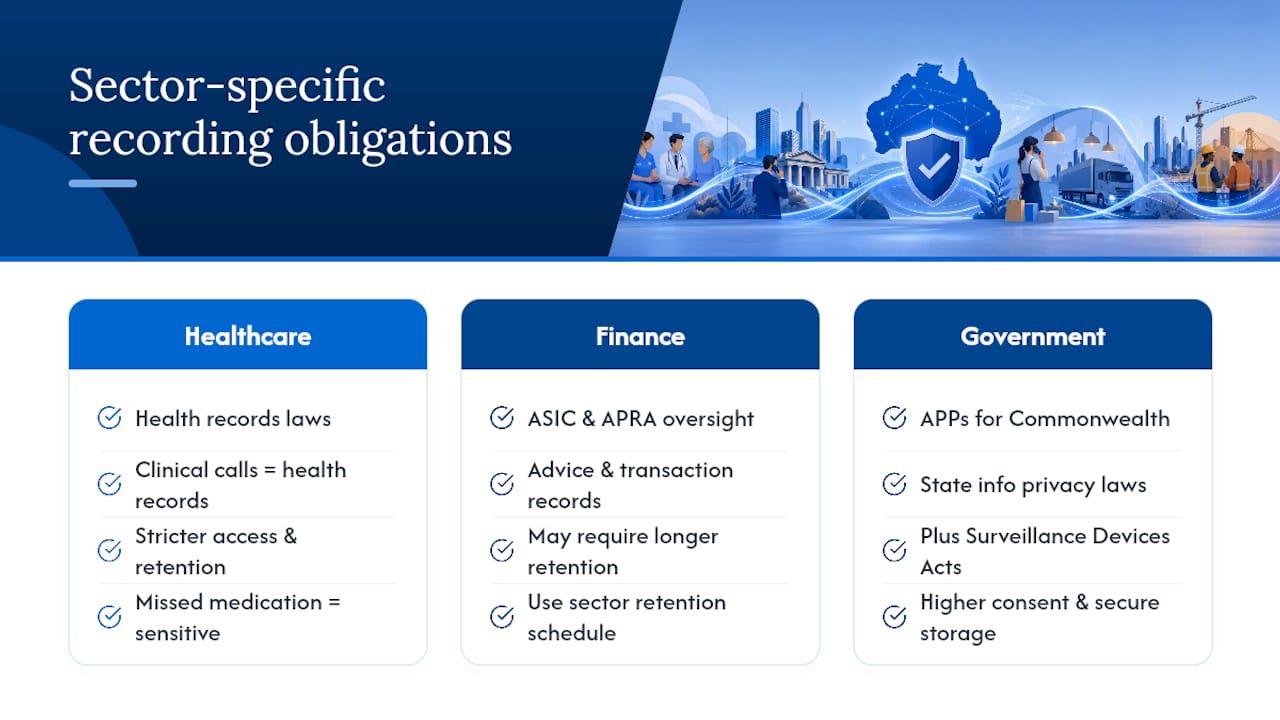
Sector-specific obligations stack on top of the general state and federal rules, and they rarely get simpler.
Healthcare providers face an additional layer through health records legislation in several states, which treats call recordings containing clinical information as health records subject to stricter access and retention rules than a standard customer service call. A missed medication query captured on a recorded line becomes sensitive health information the moment it’s stored.
Finance and financial services firms operate under ASIC and, in many cases, APRA expectations around record‑keeping for advice and transactions, which can actually require longer retention than a business might otherwise choose, not shorter. That creates tension with general privacy guidance to keep only what you need. The resolution is usually a documented, sector‑specific retention schedule rather than a generic one‑size‑fits‑all policy.
Government agencies carry their own overlay through the Privacy Act’s Australian Privacy Principles as they apply to Commonwealth entities, plus, in some cases, state‑level information privacy legislation that runs in parallel with the Surveillance Devices Acts already covered. Agencies handling recordings involving vulnerable citizens should expect a higher bar for both consent documentation and secure storage than a typical private business call.
Recording calls involving minors or vulnerable people
Extra care applies whenever a caller may be a minor or otherwise vulnerable, and “extra care” means something specific here, not just a general instinct to be gentle.
Consent from a minor generally can’t be treated as informed consent in the same way an adult’s can. Where a call plausibly involves a child, such as a service line that fields calls from teenagers directly, businesses should default to parental or guardian notification wherever practical, and avoid relying on a standard IVR disclosure as sufficient on its own.
Vulnerable callers, including people in psychological distress, people with cognitive impairment, or people calling a crisis or support line, raise a different concern: whether recording itself could discourage disclosure or cause harm. Many support services choose not to record counselling calls at all, prioritising the caller’s willingness to speak openly over the organisation’s record‑keeping convenience. Where recording does proceed for genuine safety or quality reasons, the notice needs to be delivered clearly and simply, without legal jargon, and the opt‑out needs to be real and immediate rather than requiring the caller to navigate a menu.
Document these decisions in your privacy policy and staff training material, because a generic recording notice designed for retail customers won’t hold up as adequate care for a vulnerable caller.
Employee monitoring and consent for internal calls
Recording staff calls for quality assurance or training sits under the same state surveillance laws as customer calls, and that surprises a lot of managers who assume workplace monitoring runs on a separate, more permissive set of rules. It doesn’t.
In all‑party consent states, an employer generally still needs the employee’s consent to record their side of a call, alongside the customer’s. Burying this in an employment contract clause signed once at onboarding is weak practice; best practice is a standalone monitoring policy that employees acknowledge specifically, refreshed periodically rather than left to a single signature years earlier.
Two things regularly go wrong. First, businesses assume that because they own the phone system, they own an unrestricted right to record every call on it, regardless of consent. Second, businesses use monitoring recordings for disciplinary action without having disclosed that possibility upfront, which creates exactly the kind of dispute the Fair Work Commission tends to view unfavourably when covert recording surfaces as evidence. Tell staff clearly what recordings are for, including whether performance management is one of those purposes, before you start recording, not after a dispute arises.
Emergency services calls: a different legal category
Calls to and from emergency services (000, police, ambulance, fire) operate under a materially different framework than commercial business calls, and businesses sometimes assume the general consent rules discussed throughout this guide apply equally here. They don’t, not in the same way.
Emergency call centres typically record every call as a matter of operational necessity and public safety, under specific legislative authority that overrides the general consent framework applying to private businesses. The person calling 000 isn’t asked for consent before the call is recorded, because the legal basis for recording sits in emergency services legislation and public interest grounds rather than ordinary surveillance device law.
For businesses, the practical relevance is narrower but still real: if your organisation operates any kind of emergency, crisis, or safety‑critical hotline (an after‑hours medical triage line, for instance), don’t assume standard commercial consent scripting applies wholesale. These lines often need their own legal assessment, because the safety justification for recording without a standard opt‑out can be stronger, but the sensitivity of what’s discussed is also higher. Treat this as a case for tailored legal advice rather than applying the general checklist covered earlier in this guide.
A conservative risk posture is the only one that scales
The businesses that get this wrong aren’t the ones ignoring the law, they’re the ones assuming a policy written for one state travels safely to every other state. It doesn’t, and the cost of that assumption only shows up after a complaint lands.
Sowrabh’s view: default to all‑party notice and consent nationally, even where a stricter state rule doesn’t technically apply to a particular call. Vendor governance and staff training, not the law itself, are usually where compliance actually breaks down. Document your retention schedule, and make the opt‑out genuinely easy to use.
— Sowrabh
Where a purpose-built platform makes compliance easier
Everything covered above, consent notices, retention schedules, access logs, comes down to whether your systems can actually enforce what your policy says. Conversational AI is built as an Australia‑hosted platform specifically for organisations that can’t afford ambiguity about where their call data lives or who’s touched it. 
Other platforms keep voice, SMS, and chat data hosted within Australia, with encryption in transit and at rest, role‑based access, and audit logs integrated into the system rather than bolted on. Some platforms offer pause‑and‑resume controls to handle sensitive moments like payment card capture automatically, and retention rules may be automated instead of managed manually. When assessing vendors, consider data location, retention automation, and their ability to produce access logs on request, not just price. Explore the Conversational AI platform to see how these controls fit into a broader compliance strategy, including how it handles do not call obligations for outbound campaigns.
Primary sources worth checking directly
- Surveillance Devices Act 1999 (Vic), s 6 on AustLII for the statutory wording.
- OAIC guidance on Privacy Act compliance.
- Speak to a lawyer for edge cases involving multiple states, minors, or sensitive sectors.
Sources
- Can You Legally Record a Phone Call in Australia? | Sprintlaw
- OAIC guidance and media centre - Office of the Australian Information Commissioner (OAIC)
FAQ
Do you legally have to tell someone the call is being recorded?
In all‑party consent states, yes, you generally need the other party’s consent, which in practice means telling them. Even in one‑party states, telling callers is the safer, more defensible practice and the recommended conservative default.
Can I sue someone for recording me without my permission in Australia?
Potentially, depending on your state. In all‑party jurisdictions like New South Wales, South Australia and Western Australia, recording without consent can breach surveillance device law and expose the recorder to civil or criminal consequences.
Can someone record you without permission in Australia?
It depends entirely on which state governs the call. In one‑party states such as Queensland, Victoria, Tasmania and the Northern Territory, a participant can generally record their own conversation without the other party’s agreement.
Is it illegal to record a phone call in Queensland?
Not automatically. Queensland is commonly treated as a one‑party consent jurisdiction, meaning a person who’s a party to the call can generally record it without the other side’s agreement, subject to narrow exceptions.
Does the Privacy Act stop me from recording customer calls?
No, but it governs what happens to the recording afterwards. If the recording contains personal information, you need a clear purpose, appropriate notice, and secure handling under the Australian Privacy Principles.