Prevent data offshore transfers: AI compliance guide for privacy teams
Learn how to prevent data offshore transfers AI with effective strategies. Implement a strong compliance framework to safeguard your data.

To prevent AI-related data from being transferred or accessed offshore, implement an auditable control stack combining data residency, access-only architectures, inference-layer routing, contractual restrictions, and continuous monitoring. Together, these demonstrate the “reasonable steps” that APP 8 of the Privacy Act 1988 (Cth) requires before any cross-border disclosure.
Your five immediate actions:
- Audit all AI vendor data flows within 30 days, including API endpoints, telemetry pipelines, and support-staff access locations.
- Restrict inference routing to Australian-hosted endpoints or deploy an AI gateway with PII detection and redaction before any prompt leaves your network.
- Renegotiate or amend supplier contracts to include geographic restrictions, named subprocessors, and a right-to-audit clause.
- Deploy logging and DLP controls that generate immutable audit trails for every AI session, egress event, and access decision.
- Conduct a Data Protection Impact Assessment (DPIA) scoped to your AI systems, documenting legal basis, transfer mechanisms, and residual risk.
The Office of the Australian Information Commissioner (OAIC) has published specific guidance on how the Australian Privacy Principles apply when organisations use commercial AI products, including where third-party vendors access personal information. The accountability sits with you, not the vendor.
Table of Contents
- How does Australian law treat cross-border AI data disclosures?
- How do you map AI data flows to find hidden offshore processing?
- What architectural controls actually stop data leaving Australia?
- What contract clauses and vendor checks prevent covert offshore processing?
- What policies and access controls reduce accidental offshore transfers?
- How do you detect offshore access or covert transfers before they become breaches?
- How do you build governance that proves “reasonable steps” to the OAIC?
- What is the phased roadmap to implement these controls?
- Why does Australian-hosted private AI reduce your residual legal risk?
- Key takeaways
- The real tension between sovereignty, capability, and cost
- How Conversational AI helps you meet these controls from day one
- Useful sources and references
How does Australian law treat cross-border AI data disclosures?
APP 8 of the Privacy Act 1988 (Cth) is the central obligation. Before disclosing personal information to an overseas recipient, an Australian Privacy Principle entity must take “reasonable steps” to ensure the recipient will not breach the APPs. Critically, giving an overseas party access to data held in Australia counts as a cross-border disclosure under APP 8, even if the data never physically leaves an Australian server. A vendor’s support engineer in Manila accessing your AI platform’s logs, or an inference API call routed to a US data centre, both trigger APP 8.
Section 16C goes further. If an overseas recipient breaches the APPs, the Australian entity is taken to have breached them too, and the OAIC can pursue the Australian organisation directly. You cannot contract your way out of this accountability. A supplier indemnity clause helps commercially, but it does not extinguish your regulatory exposure.
What does “reasonable steps” actually mean? The OAIC’s guidance makes clear it is a proportionality test: the sensitivity of the data, the volume processed, and the likelihood of harm all scale the steps required. For health or financial records processed by AI, reasonable steps will typically include contractual restrictions, technical controls such as VDI or inference-layer routing, and documented evidence that both were in place before the disclosure occurred.
The OAIC’s guidance on commercially available AI products specifically addresses how APP 1 (open and transparent management), APP 5 (notification), and APP 11 (security) apply when organisations deploy third-party AI tools. It also flags that AI vendors may use customer data for model training, which constitutes a secondary use requiring separate legal basis.
Enforcement risk is real. The OAIC has pursued organisations for systemic failures to implement reasonable steps before offshore disclosures, and the 2022 amendments to the Privacy Act increased civil penalty maximums substantially. Regulated sectors, particularly health and finance, face additional obligations under the My Health Records Act 2012 and APRA’s CPS 234, which layer on top of APP 8 requirements. The combination means a single misconfigured AI vendor integration can simultaneously breach multiple regulatory frameworks.
Key legal reference points:
- Privacy Act 1988 (Cth), APP 8 and Section 16C
- OAIC guidance on commercially available AI products
- APRA CPS 234 (information security, financial sector)
- My Health Records Act 2012 (health sector)
- Notifiable Data Breaches (NDB) scheme, Part IIIC of the Privacy Act
How do you map AI data flows to find hidden offshore processing?
Most organisations discover offshore AI data exposure not through deliberate design but through gaps in vendor due diligence. An inference API call to a US-hosted LLM, telemetry data sent to a European analytics platform, or a support ticket that attaches a conversation log and routes it to an offshore helpdesk: each is a disclosure that APP 8 captures. A structured DPIA is the tool that surfaces them.
DPO checklist: hidden offshore processors
- Legal basis for each transfer confirmed and documented?
- Transfer mechanism in place (contractual clauses, binding corporate rules, or exemption)?
- Residual risk assessed and accepted at appropriate executive level?
- Subprocessor list current and contractually bound to the same geographic restrictions?
- Telemetry and monitoring tools audited for offshore data sinks?
- Support-access locations confirmed and restricted by contract?
- Retraining pipeline reviewed for offshore training data sources?
The DP-REG working paper on large language models highlights specific technical risks from LLMs relevant to this mapping exercise, including the difficulty of attributing outputs to specific training data and the opacity of retraining pipelines. These characteristics make the DPIA more complex for AI systems than for conventional data processors, and regulators are increasingly aware of that complexity.
What architectural controls actually stop data leaving Australia?
The honest answer is that no single control is sufficient. The right architecture depends on data sensitivity, operational requirements, and budget. Three broad patterns cover most enterprise scenarios.
Access-only architectures: VDI and clean rooms
Virtual Desktop Infrastructure (VDI) lets offshore personnel or third-party vendors work with data held on Australian servers without the data ever residing on their local device. The session runs entirely within the Australian environment; the remote user sees a screen. Controls that make this effective include disabled USB ports, blocked clipboard copy-paste, disabled printing, watermarked screen output, and session recording. Paired with robust contractual restrictions, VDI is one of the most auditable evidence-backed mitigations available for satisfying Section 16C accountability requirements.
Clean rooms extend this concept to AI model development: a vendor’s data scientists work within a controlled Australian environment where they can query aggregated outputs but cannot export raw training data. Both VMware Horizon and Citrix provide enterprise VDI platforms available in Australia, and both support the endpoint controls described above.
Inference-layer controls: AI gateways and private deployments
For AI workloads where you cannot avoid using a frontier model hosted offshore, an AI gateway is the pragmatic middle ground. A gateway sits between your users and the model endpoint, inspecting every prompt, detecting and redacting PII before the request leaves your network, logging routing decisions, and enforcing policy rules (e.g., “never route health record data to a non-AU endpoint”). This approach preserves access to capable models while materially reducing the volume of personal information that crosses borders.
Private cloud deployments in Australian regions (AWS ap-southeast-2, Microsoft Azure Australia East/Southeast, Google Cloud Australia regions) keep data within Australian jurisdiction for storage and processing. Customer-managed encryption keys (CMEK) add a further layer: even if the cloud provider’s staff could theoretically access infrastructure, they cannot read encrypted data without your keys. Confidential computing (e.g., AWS Nitro Enclaves, Azure Confidential Computing) goes further still, isolating workloads from the cloud provider’s own operators.
For the highest-sensitivity workloads, on-premises or private-cloud inference using open-weight models (deployed within your own Australian infrastructure) eliminates the offshore API call entirely. The trade-off is capability: on-premises models currently lag frontier hosted models on many tasks, and the infrastructure cost is significant.
Encryption and tokenisation
Field-level encryption protects specific sensitive fields (e.g., Medicare numbers, account identifiers) so that even if data is processed offshore, it is unintelligible without the key. Tokenisation replaces sensitive values with non-sensitive tokens before data enters the AI pipeline, with the mapping table held in Australia. Both patterns reduce the risk of offshore inference but do not eliminate it: if the AI model needs to reason about the sensitive field, it needs the plaintext, which means the token must be resolved before inference.
Pro Tip: When a vendor claims their platform runs “AU region only,” ask for a current data flow diagram showing every API dependency, telemetry sink, and support-access pathway, not just the primary compute region. Vendors routinely use AU regions for primary storage while routing monitoring, logging, or support traffic offshore.
Architecture trade-off comparison
| Architecture | Legal/compliance assurance | Residual privacy risk | Implementation complexity | Cost (capex/opex) | Latency impact | Auditability | Regulated sector suitability |
|---|---|---|---|---|---|---|---|
| Private on-prem inference | Highest | Lowest | High | High capex | Lowest | High (full control) | Health, defence, finance |
| Private cloud (AU tenant, CMEK) | High | Low | Medium | Medium opex | Low | High | Health, finance, professional services |
| Hosted public API with AU gateway | Medium | Medium | Low–medium | Low opex | Low–medium | Medium (gateway logs) | Finance, professional services |
| VDI/clean room (access-only) | High | Low | Medium | Medium opex | Medium | High (session logs) | All regulated sectors |
| Public API, no controls | Low | High | None | Lowest | Lowest | Low | Not suitable for regulated workloads |
What contract clauses and vendor checks prevent covert offshore processing?
Contracts are your legal backstop when technical controls are imperfect or unavailable. They also form part of the evidence package you present to the OAIC to demonstrate reasonable steps. A contract that lacks geographic restrictions or audit rights is not evidence of reasonable steps; it is evidence of their absence.
Validating vendor attestations
Vendor claims of “AU-hosted” or “ISO 27001 certified” require evidence, not just assertions. Request:
- A current data flow diagram showing all processing locations, including subprocessors.
- ISO 27001 or SOC 2 Type II certificates with scope statements confirming Australian operations are in scope.
- Support staffing locations and access policies, including whether offshore staff can access production data.
- Penetration test summaries or security assessment reports from the past 12 months.
- Evidence of customer-managed key capability or confirmation of key management location.
For compliance obligations under APP 8, the voluntary AI safety standard published by industry.gov.au provides a useful benchmark for what reasonable governance and technical practices look like, and referencing it in your vendor assessment criteria strengthens the reasonableness argument.
Subprocessor governance
Require vendors to flow down your geographic restrictions to every subprocessor through their own contracts. A cascade clause should state that the vendor’s agreements with subprocessors must impose at least equivalent data residency and security obligations to those in your agreement. Trigger a re-evaluation whenever the vendor adds a new subprocessor, updates their model with new training data, or introduces new telemetry features. These events are common vectors for new offshore exposure.
Due diligence checklist for new AI suppliers:
- Data flow diagram provided and reviewed?
- Geographic restrictions confirmed for all processing locations?
- Subprocessor list reviewed and contractually bound?
- ISO 27001 / SOC 2 certificates reviewed (scope confirmed)?
- Support-access locations and policies confirmed?
- NDB-aligned breach notification clause included?
- Right-to-audit clause included and exercisable?
- Retraining data sources confirmed as Australian or approved offshore?
- DPIA completed and residual risk accepted?
Security and compliance obligations under APP 8 also align with the security and trust controls that well-governed platforms implement to evidence reasonable steps to clients and regulators.
What policies and access controls reduce accidental offshore transfers?
Technical architecture sets the boundaries; operational controls determine whether people stay within them. The most common cause of accidental offshore transfer is not a misconfigured server: it is a staff member uploading a client document to a public LLM, or a developer connecting a production dataset to a personal API key.
Least-privilege access and role-based controls mean that only personnel with a documented business need can access sensitive AI datasets. Just-in-time (JIT) access provisioning goes further: access is granted for a defined window, logged, and automatically revoked. This limits the blast radius of a compromised credential and generates an audit trail showing access was controlled.
Data labelling and classification at the point of creation gates export and processing rules at the gateway. A document classified “PROTECTED: AU processing only” triggers a policy rule that blocks it from being submitted to any non-AU endpoint. Classification schemes should align with the Australian Government Information Security Manual (ISM) categories where relevant, and with your sector’s own classification requirements (e.g., APRA’s data sensitivity tiers for financial institutions).
Approved tools list and prohibited behaviours should be documented in a policy that every staff member with access to sensitive data signs. The policy must explicitly prohibit:
- Uploading personal information or confidential business data to public LLMs (ChatGPT, Gemini, or similar consumer-facing tools).
- Using personal API keys to access AI services with organisational data.
- Copying AI-generated outputs containing personal information to unapproved storage or communication channels.
- Sharing credentials with offshore contractors or third parties not covered by the geographic restriction clause.
Staff training checklist:
- Privacy Act obligations and APP 8 explained in plain language.
- Approved AI tools list reviewed and signed.
- Prohibited behaviours acknowledged.
- Data classification scheme understood and applied.
- Incident reporting procedure known (who to call, what to document).
- Annual refresher completed and recorded.
The ACSC’s AI governance resources provide practical user education materials that can be adapted for staff training programmes, including guidance on safe AI adoption and the security risks of uncontrolled AI tool use.
How do you detect offshore access or covert transfers before they become breaches?
Detection is the control that catches what prevention misses. For AI workloads, the detection challenge is specific: AI traffic is high-volume, often encrypted, and the “data” being transferred may be embedded in a prompt or inference response rather than a file download.
Logging and audit trail requirements:
- Session logs for every VDI session, including user identity, access time, duration, and any policy exceptions triggered.
- Gateway logs capturing every inference request, the destination endpoint, whether PII was detected and redacted, and the routing decision applied.
- Immutable log retention for a minimum of seven years for regulated sectors, stored in Australian jurisdiction, with access controls preventing modification or deletion.
- API call logs showing every external endpoint contacted by the AI system, with timestamps and data volumes.
DLP and egress detection tuned for AI traffic:
- Token-level redaction triggers that fire when a prompt contains patterns matching personal information (Medicare numbers, ABNs, account identifiers, names combined with dates of birth).
- Unusual inference volume alerts: a spike in API calls to an offshore endpoint outside business hours may indicate automated exfiltration or a misconfigured pipeline.
- Telemetry sink monitoring: alerts when the AI platform establishes a new outbound connection to an IP address outside approved Australian ranges.
- Shadow AI detection: network monitoring for connections to known public LLM endpoints from devices that should not be making them.
Pro Tip: Set your DLP rules to alert on combinations of data fields, not just individual identifiers. A prompt containing a first name and a postcode may not trigger a single-field rule, but the combination is often sufficient to identify an individual under the Privacy Act’s definition of personal information.
Alert and investigation playbook:
When a potential offshore transfer is detected, the immediate steps are: isolate the affected session or API connection, preserve logs in immutable storage, notify the Privacy Officer within four hours, and begin a preliminary assessment of whether the NDB threshold (likely serious harm) has been met. If it has, the OAIC must be notified within 30 days of becoming aware of the eligible data breach.
Forensic evidence to retain: raw gateway logs, session recordings (if VDI), API call logs with payloads (redacted for any personal information not relevant to the investigation), vendor access logs, and a timeline of events. This package is what you present to the OAIC if asked to demonstrate reasonable steps.
How do you build governance that proves “reasonable steps” to the OAIC?
Governance is the connective tissue between technical controls and legal accountability. A well-configured AI gateway means nothing to a regulator if there is no record that it was configured intentionally, tested, and monitored. The evidence package is the governance programme.
Approval gates for new AI use cases:
- Every new AI use case involving personal information requires a completed DPIA before deployment.
- Use cases involving health, financial, or government data require executive sign-off (CISO and Privacy Officer at minimum).
- Any use case that involves offshore inference or training requires board-level awareness and documented risk acceptance.
- Change control records must capture who approved the use case, what controls were in place at approval, and any residual risks accepted.
Recordkeeping checklist for audits:
- DPIA artefacts (scoping document, data flow diagram, risk register, sign-off record).
- Supplier evidence (data flow diagrams, ISO/SOC certificates, subprocessor lists, contractual clauses).
- Training records (staff training completion logs, policy acknowledgement records).
- Incident records (detection logs, investigation reports, NDB notifications if applicable).
- Audit logs (gateway logs, session logs, access logs, immutable and retained per policy).
Practical metrics and KPIs:
- Audit pass rate: percentage of AI use cases with a current, approved DPIA.
- Blocked egress events: number of offshore transfer attempts blocked by gateway or DLP controls per month.
- Mean time to remediate: average days from detection of a policy violation to confirmed remediation.
- Subprocessor review currency: percentage of active AI vendors with a subprocessor review completed in the past 12 months.
- Staff training completion: percentage of staff with access to sensitive AI systems who have completed current-year training.
When presenting evidence to the OAIC or a client auditor, package the audit folder in a logical sequence: legal framework (APP 8 obligations, DPIA), technical controls (architecture diagram, gateway configuration, VDI policy), contractual controls (relevant clauses, vendor certificates), operational controls (training records, approved tools policy), and monitoring evidence (log samples, blocked egress reports). A well-organised folder signals a mature programme; a disorganised one signals the opposite.
What is the phased roadmap to implement these controls?
Implementation does not need to be all-or-nothing. A phased approach lets you address the highest-risk exposures first while building toward a mature programme. The ITIF’s analysis of data localisation measures and the OECD’s economic implications research both reinforce that compliance programmes should be risk-targeted rather than blanket localisation, which means prioritising controls where the data sensitivity and harm potential are highest.
- Phase 0–1: Quick wins (0–90 days)
- Issue vendor attestation requests to all current AI suppliers (data flow diagrams, subprocessor lists, support-access locations).
- Complete a DPIA for your highest-risk AI use case (typically health or financial data processing).
- Block or restrict access to unapproved public LLM endpoints via network policy or DNS filtering.
- Deploy initial DLP rules for known sensitive data patterns on email and web egress.
- Publish and have staff sign an approved AI tools policy.
- Estimated cost: primarily internal staff time; minimal capex.
-
Phase 2: Medium-term projects (3–9 months)
- Deploy an AI gateway with PII detection, redaction, and routing enforcement for all inference traffic.
- Roll out VDI or clean-room access for any offshore vendor or support staff who require access to production data.
- Renegotiate or amend supplier contracts to include geographic restrictions, named subprocessors, and right-to-audit clauses.
- Implement immutable log retention in an Australian-hosted SIEM.
- Migrate primary AI workloads to Australian cloud regions (AWS ap-southeast-2, Azure Australia East, Google Cloud Sydney) with customer-managed keys.
- Estimated cost: AU$50,000–AU$300,000 depending on existing infrastructure and vendor negotiation complexity.
-
Phase 3: Strategic investments (9–24 months)
- Evaluate private on-premises or sovereign cloud inference for highest-sensitivity workloads (health records, financial account data).
- Implement customer-managed keys on all Australian cloud tenancies.
- Establish a formal AI governance committee with quarterly review cadence.
- Conduct an independent third-party audit of the full control stack.
- Estimated cost: AU$200,000–AU$1,000,000+ for on-premises inference infrastructure; sovereign cloud tenancy costs vary by provider.
| Workload type | Priority | Recommended architecture | Phase |
|---|---|---|---|
| Health records / clinical AI | Highest | Private cloud AU + CMEK or on-prem | Phase 1–2 |
| Financial account data | Highest | Private cloud AU + CMEK + AI gateway | Phase 1–2 |
| Professional services (legal, HR) | High | Private cloud AU + AI gateway | Phase 2 |
| General business automation | Medium | AU cloud region + gateway + DLP | Phase 2–3 |
| Internal productivity tools | Lower | Gateway + approved tools policy | Phase 1 |
Why does Australian-hosted private AI reduce your residual legal risk?
Choosing an Australian-hosted private AI platform is not just a procurement preference; it is a risk reduction decision with direct legal consequences. When inference, storage, keys, and audit logs all sit within Australian jurisdiction, the APP 8 analysis simplifies materially: there is no cross-border disclosure to an overseas recipient, so the Section 16C accountability chain does not engage.
Local hosting also improves auditability in a practical sense. When the OAIC or a client auditor asks for evidence of controls, you can point to logs held in Australian infrastructure, keys managed by your team, and personnel whose access is governed by Australian employment law. That is a qualitatively different evidence package from one that relies on a US cloud provider’s compliance attestations.
Deployment patterns for private conversational AI:
- Private cloud tenant (AU region): The AI platform runs in a dedicated tenancy within an Australian cloud region, with no shared infrastructure with other customers. Customer-managed keys control encryption. This is the most common pattern for regulated enterprises.
- On-premises inference: The AI model runs on infrastructure owned and operated by the enterprise within Australia. Suitable for the highest-sensitivity workloads where even cloud provider operator access is unacceptable.
- Hybrid gateway model: Sensitive data is processed by a private AU-hosted model; lower-sensitivity queries are routed through a gateway to a frontier model with PII redaction applied. This balances capability and control for organisations that need frontier model performance on some tasks.
Integration checklist for enterprise systems:
- CRM integration: confirm data sync occurs only within Australian endpoints; review CRM-AI synchronisation patterns for residency-preserving architectures.
- API integrations: document every external API the AI platform calls and confirm each endpoint’s hosting jurisdiction.
- Legacy system connections: review data extraction and transformation pipelines for offshore routing; see guidance on integrating AI with legacy systems in Australian enterprise environments.
Trust signals to request from any AU-hosted AI provider:
- Hosting proof: a written statement confirming all data is stored and processed in named Australian data centres, with the specific facility or cloud region identified.
- ISO 27001 certificate with scope statement covering the Australian deployment.
- SOC 2 Type II report covering the Australian service.
- Named personnel locations for support and engineering staff with production access.
- Customer-managed key capability confirmed in writing.
Pro Tip: Residency is necessary but not sufficient. A platform hosted in an Australian cloud region but operated by a parent company subject to US CLOUD Act orders may still be subject to foreign government access. For the highest-sensitivity workloads, confirm the parent company’s jurisdiction and whether any foreign law could compel disclosure of your data.
Where a local private AI platform is the recommended option: health, financial services, legal, and government workloads where personal information is processed at scale and the harm from a breach is significant. Where gateway and redaction patterns may suffice: internal productivity tools, lower-sensitivity customer service automation, and use cases where the data processed contains no personal information or only publicly available information.
Key takeaways
Preventing AI data from crossing Australian borders requires a layered control stack: data residency, access-only architectures, inference-layer routing, contractual restrictions, and continuous monitoring, all documented as evidence of the “reasonable steps” APP 8 demands.
| Point | Details |
|---|---|
| APP 8 accountability cannot be contracted away | Under Section 16C, the Australian entity is liable for an overseas recipient’s breach regardless of supplier indemnities. |
| DPIA is the starting point | Map every AI data flow, including telemetry, subprocessors, and support access, before deploying any AI system that handles personal information. |
| Gateway controls reduce risk without blocking capability | An AI gateway with PII detection and redaction is the practical middle ground for enterprises that need frontier models but cannot accept full offshore inference. |
| Contracts must include geographic restrictions and audit rights | Vendor attestations without contractual teeth and a right-to-audit are not evidence of reasonable steps. |
| Conversational AI provides AU-hosted private deployment | Conversational AI’s Australia-hosted private platform eliminates the cross-border disclosure risk for conversational AI workloads in regulated sectors. |
The real tension between sovereignty, capability, and cost
The compliance frameworks are clear enough. The hard part is the conversation that happens in the procurement meeting when the frontier model your team wants to use is hosted in the United States, costs a fraction of a private deployment, and performs measurably better on the tasks that matter. That tension is not going away, and pretending it does not exist produces compliance programmes that look good on paper and get quietly circumvented in practice.
The honest position is that most Australian enterprises will end up with a hybrid architecture, at least for the medium term. Private AU-hosted inference for the highest-sensitivity workloads: health records, financial account data, legal documents. A well-configured gateway with PII redaction for everything else. The gateway is not a perfect control, but it is a documented, auditable, proportionate one, and proportionality is what the OAIC’s “reasonable steps” test actually asks for.
Where I see organisations get into trouble is in two specific places. The first is treating “AU region” as synonymous with “sovereign.” It is not. A US-headquartered cloud provider hosting your data in Sydney can still be subject to foreign government access orders under laws like the US CLOUD Act. For workloads where that risk is unacceptable, you need either an Australian-owned and operated infrastructure provider or customer-managed keys that the provider cannot access. The second is model retraining. Organisations lock down their inference pipeline carefully, then approve a model update without reviewing whether the vendor’s new training data includes offshore sources. The DP-REG working paper on large language models flags this exact risk: LLM governance must extend to the training data pipeline, not just the inference layer.
The compliance programme that actually works is one that is honest about these trade-offs, documents the risk acceptance decisions at the right level of the organisation, and builds detection controls that would catch it if the accepted residual risk materialises. That is what “reasonable steps” looks like in practice, and it is what the OAIC will look for if something goes wrong.
How Conversational AI helps you meet these controls from day one
For Australian enterprises in health, finance, and professional services, the fastest path to a compliant conversational AI deployment is a platform that was built for Australian data sovereignty from the ground up, not retrofitted to it.
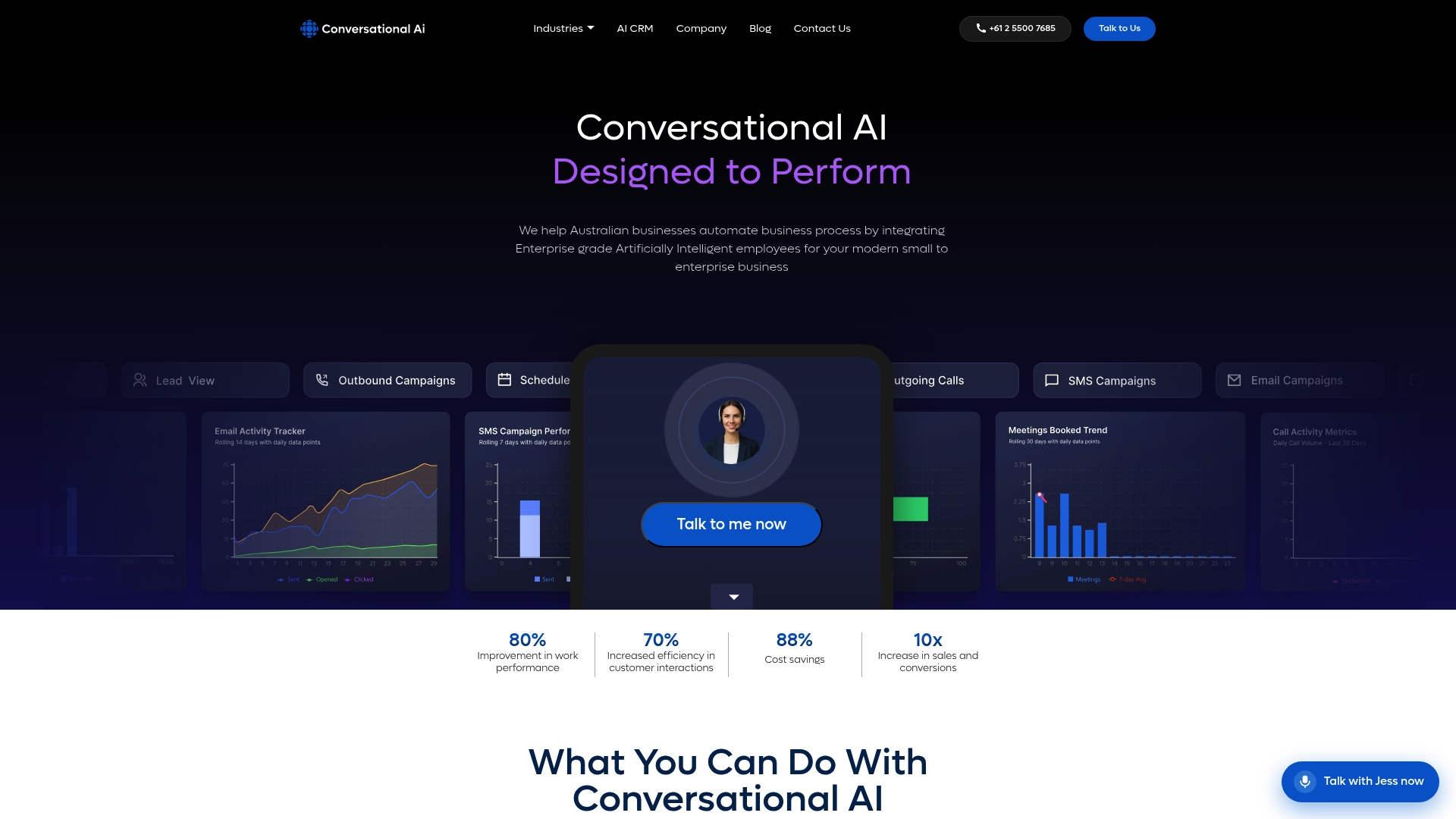
Conversational AI’s Australia-hosted private platform eliminates the cross-border disclosure problem for conversational AI workloads entirely. Every inference, every conversation log, every CRM sync runs within Australian infrastructure. There is no offshore API call to route through a gateway, no US cloud provider to negotiate CLOUD Act exposure with, and no subprocessor list to audit for hidden offshore processing. The platform supports private tenant deployments, customer-managed encryption, immutable audit logs, and role-based access controls that map directly to the APP 8 evidence package described in this guide.
For regulated sectors, Conversational AI also offers a compliance assessment to help your team scope a DPIA, review your current AI vendor stack against the control framework above, and produce a deployment blueprint that satisfies OAIC expectations. Whether you are replacing an offshore-hosted chatbot, automating customer service in a regulated context, or building a compliant AI agent for enterprise-scale operations, the platform is designed to meet you where your compliance obligations are. Contact the team to arrange a discovery call or proof-of-concept scoped to your sector.
Useful sources and references
The following sources are the authoritative references for the legal, technical, and policy claims in this guide. Each is suitable for inclusion in an internal audit folder or vendor RFP.
| Source | Why it matters to a compliance lead |
|---|---|
| OAIC — Guidance on commercially available AI products | Sets out how APPs apply to AI vendor deployments, including third-party access and secondary use for model training. |
| Privacy Act 1988 (Cth) — APP 8 and Section 16C | The primary legal obligation for cross-border disclosures and the accountability chain that cannot be contracted away. |
| ACSC / Cyber.gov.au — Introduction to AI | Practical governance and user education controls for safe AI adoption, aligned with Australian government security standards. |
| DP-REG — Working Paper 2 (LLMs) | Technical risk analysis of large language models relevant to retraining governance, telemetry, and regulatory expectations. |
| industry.gov.au — Voluntary AI safety standard | Australian voluntary standard that benchmarks reasonable technical and governance practices for AI deployment. |
| OECD — Economic implications of data regulation | Policy context for data localisation trade-offs; supports risk-targeted rather than blanket localisation approaches. |
| ITIF — Barriers to cross-border data flows | Documents the global spread of data localisation measures and the compliance and economic costs for enterprises. |
| NeuralTrust — AI data sovereignty for enterprise | Technical reference for AI gateway patterns: routing, PII detection, redaction, and audit logging at the inference layer. |
| TechLawyers — Offshoring client data legally | Practical legal analysis of APP 8 / Section 16C obligations and VDI/clean-room as evidence-backed mitigations. |
- Guidance on privacy and the use of commercially available AI products (OAIC)
- Economic implications of data regulation (OECD)
- How barriers to cross-border data flows are spreading globally — what they cost (ITIF)
- Voluntary AI safety standard (industry.gov.au)
- An introduction to artificial intelligence (Cyber.gov.au / ACSC)
This article provides general information about Australian privacy law and technical controls. It is not legal advice. Confirm current obligations with the OAIC, your legal counsel, or a qualified privacy professional before implementing controls or making disclosures.