Make Oversight Meaningful: Human in the Loop AI for Regulated Enterprises
Practical guide for regulated enterprises on human in the loop AI. Build meaningful checkpoints, give reviewers authority, and log every decision.

Human-in-the-loop AI (HITL) is a design pattern where people review, correct, or approve AI outputs at defined points in a system, rather than letting the model run unsupervised. The verdict: add HITL wherever potentially costly or sensitive decisions occur. That means cases like identity fraud, medical triage, credit decisions, or anything regulators may require review for. For low-stakes, high-volume tasks, full automation usually wins on cost.
TL;DR:
- Human-in-the-loop AI is essential for high-risk decisions like identity verification, healthcare triage, and financial approvals to ensure accuracy and compliance.
- Cost and scalability limitations of HITL include increased latency, reviewer fatigue, bias, and data privacy risks, especially when handling large volumes of cases.
- Effective HITL implementation requires designing verification-focused checkpoints, giving reviewers decision authority, and maintaining detailed logs for auditability.
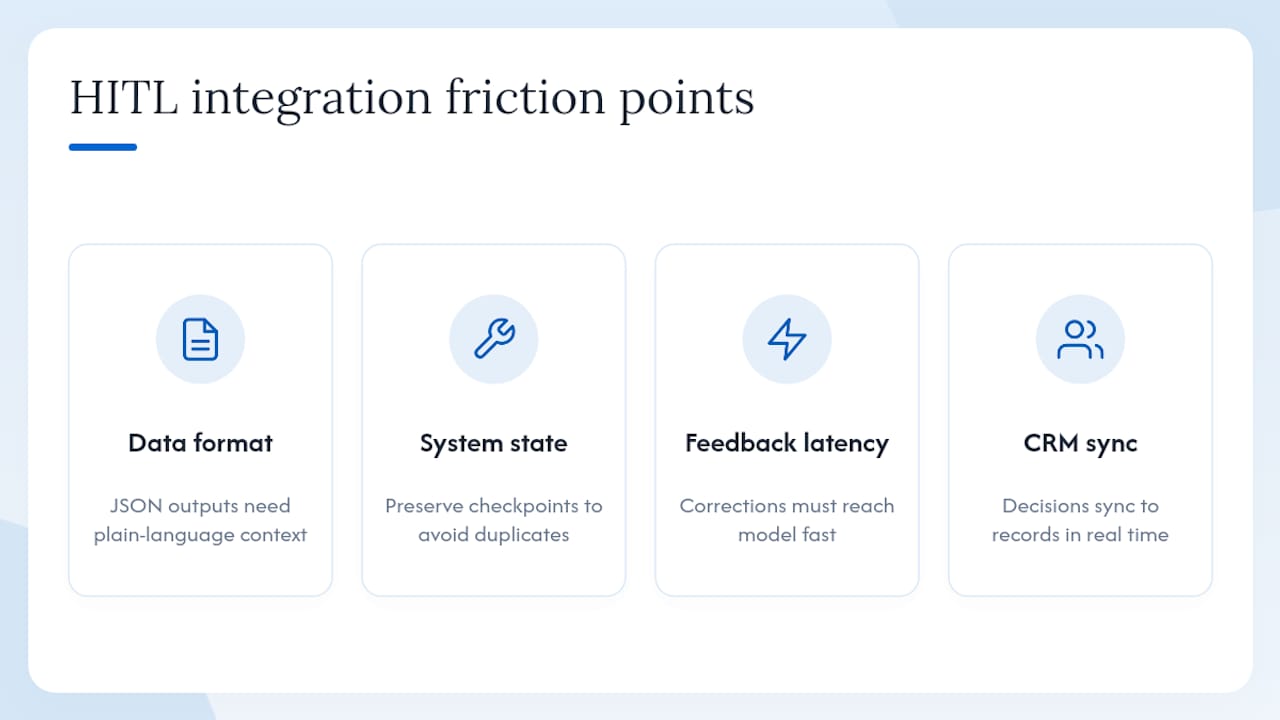
- Integration challenges stem from data format mismatches, workflow state preservation, feedback latency, and real-time CRM updates, which can hinder review speed and accuracy.
- Future developments will focus on smarter, targeted review systems, improved provenance logging, and interfaces that make model reasoning transparent to enhance oversight.
Table of Contents
- What is human-in-the-loop AI and how does the feedback loop work?
- In-the-loop, on-the-loop, over-the-loop and RLHF explained
- Where HITL earns its cost: benefits and industry use cases
- Why HITL breaks down: limitations and operational challenges
- How to implement human in the loop AI that actually works
- The friction point: integrating human input with automated workflows
- The ethics of putting humans in AI decisions
- Where human-in-the-loop AI is headed next
- How HITL fits a privacy-first enterprise conversational AI strategy
- Bringing meaningful oversight into your automation stack
- Sources
What is human-in-the-loop AI and how does the feedback loop work?
The mechanics of HITL span three distinct phases: training, review, and production. Each requires a different kind of human involvement, and skipping any of them can lead to oversight gaps.
During training, humans label data, correct model outputs, and rank responses so the system learns what “good” looks like. This is where reinforcement learning from human feedback (RLHF) comes in: human raters score multiple model outputs, and that ranking signal trains the model toward responses people actually prefer. Active learning extends this by having the model flag the examples it’s the least confident about, so human effort goes where it matters most rather than being spread evenly across easy and hard cases.
Before deployment, validation checks and review queues catch what training missed. A model might perform well on test data and still fail on edge cases nobody thought to sample, so a pre-launch human review pass against real-world scenarios is standard practice for anything customer-facing.
In production, the loop looks different again. Here’s roughly how it runs:
- The AI system processes a request and generates a response or decision.
- A confidence score, sentiment signal, or topic classifier checks whether the case meets a threshold for automatic handling.
- If it fails that threshold, the case routes to a human reviewer instead of resolving automatically.
- The reviewer approves, corrects, or escalates the case, and that decision becomes a labelled training example.
- The system logs the outcome for auditing and, ideally, feeds it back into the next training cycle.
The triggers that matter most in practice are low model confidence, negative or escalating customer sentiment, and sensitive topics like health, legal, or financial detail. A human-in-the-loop chatbot handling a billing question can resolve it end to end. The same chatbot handling a fraud dispute should hand off the moment sentiment turns hostile or the customer mentions an unauthorised transaction.
In-the-loop, on-the-loop, over-the-loop and RLHF explained
These terms get used interchangeably, and that’s a problem because they describe fundamentally different levels of human control.
- Human-in-the-loop: a person reviews or approves individual decisions before they take effect. Used where each case carries real risk, such as loan approvals or content moderation escalations.
- Human-on-the-loop: a person monitors the system in real time and can intervene, but doesn’t approve every action. Common in fraud detection dashboards where the AI blocks transactions automatically and a human watches for patterns and false positives.
- Human-over-the-loop: a person sets policy, boundaries, and periodic audits but isn’t watching live. This suits lower-risk, high-volume automation like routine appointment reminders.
- RLHF: not a supervision level at all, but a training method that uses human preference data to shape model behaviour before it ever reaches production.
A single product often needs more than one of these at once: on-the-loop monitoring for routine traffic, in-the-loop approval for flagged exceptions.
Where HITL earns its cost: benefits and industry use cases
The case for human intervention in AI is strongest where errors are expensive, rare, and hard to detect statistically. Four benefits show up consistently across regulated sectors:
- Higher accuracy on edge cases the model wasn’t trained to handle confidently.
- Trust and adoption, because staff and customers accept AI decisions more readily when a person can override them.
- Compliance readiness, since many regulatory frameworks now expect documented human checkpoints for high-risk automated decisions.
- Auditability, because every human decision creates a record explaining why a specific outcome occurred.
Identity verification is a clean example. An AI system can flag a document as potentially fraudulent in milliseconds, but a trained reviewer confirms it before an account gets locked, protecting both the business and a legitimate customer from a false positive. Fraud detection in banking works the same way: the model scores transactions continuously, and only the borderline cases land in front of a human. In healthcare triage, a model might prioritise patients by urgency, but a clinician still makes the final call on anything flagged as high-risk, because the cost of a missed deterioration is unacceptable.
The EU AI Act’s Article 14 formalises this logic for high-risk systems, mandating documented human oversight rather than leaving it optional. The trade-off is straightforward: added latency and reviewer cost in exchange for a materially lower error rate on the cases that matter most.
Why HITL breaks down: limitations and operational challenges
Oversight sounds like a safety net until you try to run it at scale. Four failure modes show up again and again.
- Cost and scalability limits: every case routed to a human adds latency and reviewer hours, which doesn’t scale linearly with traffic.
- Vigilance decay: reviewers who approve hundreds of routine cases a day start rubber-stamping, missing the rare case that actually needed scrutiny.
- Human bias: reviewers bring their own inconsistencies and prejudices, which can undo the fairness gains HITL is meant to deliver.
- Privacy and data governance risk: giving people access to sensitive cases for review widens the surface for data leaks, particularly in health and financial contexts.
There’s a subtler operational gap too. When a workflow interrupts mid-task to wait for human approval, systems that don’t checkpoint state properly can lose context, forcing the reviewer to reconstruct what happened from scratch. That’s a documented failure pattern in production LangChain implementations, and it’s an easy one to miss until a real incident exposes it.
Pro Tip: Reserve human review for genuinely high-value or high-risk edge cases rather than routing everything through a person. Over-monitoring causes reviewer fatigue, and a tired reviewer is worse than no reviewer at all.
How to implement human in the loop AI that actually works
Meaningful oversight isn’t about adding more checkpoints. It’s about designing checkpoints humans can actually use well.
- Design for verification, not re-solving. Structure AI outputs so a reviewer can check them far faster than they could redo the task from scratch. This is called solve-verify asymmetry, and it’s the single biggest factor in whether human review stays sustainable at volume. A fraud model that highlights the three data points driving its flag lets a reviewer verify in seconds; one that just says “suspicious” forces a full manual investigation every time.
- Give reviewers evaluative agency. A person needs enough context and authority to actually intervene, not just tick a box. Springer Nature’s research on meaningful human oversight warns that oversight without real decision power becomes symbolic rather than functional.
- Define signals, thresholds, and provenance logging up front. Decide what triggers escalation, log every decision with enough context to reconstruct why it happened, and preserve state before handing a task to a human so nothing gets lost mid-interrupt.
- Train overseers and track KPIs. Measure escalation rate, mean review time, false-positive and false-negative rates after intervention, and reviewer agreement rate, then use drift in those numbers to catch fatigue or poor guidance early.
| Design element | What it prevents |
|---|---|
| Solve-verify asymmetry | Reviewer fatigue and slow turnaround |
| Evaluative agency | Symbolic oversight with no real authority |
| Provenance logging | Untraceable decisions during audits |
| Oversight KPIs | Silent drift in reviewer accuracy |
Layered oversight frameworks that combine these elements, as outlined in recent arXiv research on effective human oversight, tend to hold up far better under real production load than ad hoc review processes bolted on after launch. Teams building this from scratch often benefit from reviewing enterprise chatbot implementation practices before locking in an escalation architecture.
The friction point: integrating human input with automated workflows
Most HITL failures aren’t model failures. They’re integration failures, where the handoff between AI and human breaks down at the seams.
The first friction point is data format. AI systems generate structured confidence scores and classifications; humans need plain-language context to make a fast decision. If a reviewer has to translate a JSON payload into a judgement call every time, review speed collapses and errors creep in.
The second is system state. A workflow that pauses for human input needs to preserve exactly where it left off, including any partial actions already taken. Without proper checkpointing, a reviewer approving a case might trigger a duplicate action or miss a step the AI had already queued.
The third is feedback loop latency. A reviewer’s correction is only valuable if it reaches the model or the rules engine quickly enough to prevent the same mistake recurring. Many organisations collect review data diligently and then never retrain on it, which turns HITL into a one-way cost centre instead of a genuine feedback mechanism.
CRM integration adds a fourth layer: the reviewer’s decision needs to sync back into the customer record in real time, or the next interaction, human or automated, starts from stale information. Multi-channel systems make this harder still, since a decision made on a voice call needs to be visible instantly if the same customer follows up by chat or email.
The ethics of putting humans in AI decisions
Adding a human to a decision loop is often treated as an automatic ethical upgrade. It isn’t, and treating it as one creates its own risks.
The first issue is accountability diffusion. When an AI system makes a recommendation and a human approves it, responsibility for a bad outcome can get lost between the two. Was it the model’s fault for a poor recommendation, or the reviewer’s for approving it? Clear governance has to assign that responsibility explicitly, rather than letting it default to whichever party is easiest to blame after the fact.
The second is the illusion of control. A human checkpoint that exists on paper but lacks real decision authority, or the time to exercise it properly, gives false confidence to everyone downstream, including regulators and customers who assume a person genuinely reviewed the case.
There’s also a fairness dimension. Human reviewers bring their own biases into decisions that AI models were sometimes built specifically to reduce bias in. A hiring tool designed to reduce demographic bias in initial screening can have that benefit undone if the human reviewer applies inconsistent standards at the approval stage. This doesn’t argue against human oversight. It argues for structured decision criteria that constrain reviewer discretion on the dimensions where bias is most likely to creep in, while still preserving room for genuine judgement calls.
Where human-in-the-loop AI is headed next
Research is moving away from “more checkpoints” toward “smarter checkpoints”, and that shift will define the next wave of HITL tooling.
Active learning systems are getting better at identifying exactly which cases genuinely need human judgement, rather than routing broad categories of traffic to review by default. That precision reduces reviewer load without weakening the safety net.
Provenance and audit-trail standards are also maturing quickly, partly in response to regulatory pressure like the EU AI Act, and partly because organisations have learned the hard way that undocumented human decisions are almost impossible to defend after an incident. Expect logging and explainability tooling to become a standard expectation rather than a differentiator.
The most interesting research direction is around evaluative agency: building interfaces that give human reviewers genuine understanding of why a model reached its conclusion, not just a binary approve or reject button. Layered oversight frameworks combining provenance, escalation design, and continuous KPI monitoring are likely to become the baseline architecture for any AI system operating in a regulated sector, rather than the advanced option they are today.
How HITL fits a privacy-first enterprise conversational AI strategy
Enterprise HITL only works when data sovereignty, audit trails, and live handoff are built into the platform, not added afterwards. That’s the architecture we’ve focused on at Conversational AI: Australian-hosted infrastructure, contextual memory that persists through escalations, and reporting that makes every human decision traceable. For teams starting a pilot, scope oversight to your highest-risk workflow first and expand from there.
— Sowrabh
Bringing meaningful oversight into your automation stack
Everything above only matters if your platform can actually support it, with real audit trails, reliable live handoff, and data that never leaves Australian soil. Conversational AI is built specifically around that gap: private cloud hosting for full data sovereignty, contextual memory that carries through a human handoff without losing state, and CRM integration that keeps every reviewer decision synced in real time across voice, SMS, email, and live chat.
For enterprises in healthcare, finance, or professional services, that combination matters more than raw automation speed. Compliance teams need to see why a decision happened, not just that it happened, and our enterprise AI deployment guide walks through phased onboarding for exactly this kind of rollout. Many of our clients start with a single high-risk workflow, such as identity verification or collections escalation, and expand once the oversight patterns prove out. If you’re weighing where human review adds the most value in your own stack, book a pilot conversation with our team and we’ll map it against your existing CRM and compliance requirements.
Sources
- What is Human-in-the-Loop (HITL)? — Databricks blog
- What Is Human In The Loop (HITL)? — IBM
- Designing meaningful human oversight in AI — Springer Nature (2026)
- Keeping an eye on AI: A framework for effective human oversight of AI systems — arXiv (2026)