Enterprise AI onboarding: a phased playbook for IT teams
Streamline your enterprise AI onboarding process with our phased playbook, ensuring smoother deployments and enhanced project outcomes.

An enterprise AI onboarding process runs through five phases: discovery, data foundation, pilot, deployment and monitoring. It typically takes between 4 and 16 weeks depending on regulatory load and how many systems you’re connecting. The first move, and the one that determines whether everything after it goes smoothly, is a focused discovery sprint of 1 to 3 weeks that maps your data sources, identifies the stakeholders who need to sign off, and locks down a single measurable use case.
Skip that step and you’ll pay for it later. Discovery reduces rework and improves deployment velocity precisely because it surfaces integration gaps, data quality problems and compliance obligations before they become expensive mid-project surprises.
By the end of discovery, you should have three concrete things on paper:
- A project charter naming the sponsor, the IT owner and the business owner
- A data readiness score for the systems the AI will touch
- One prioritised use case with a defined success metric and go/no-go criteria
Everything from here is about turning that charter into a live, governed system.
Key Takeaways
A successful enterprise AI onboarding process depends on sequencing discovery, data foundation, pilot and monitoring correctly, and assigning named ownership to every checklist category.
| Point | Details |
|---|---|
| Start with discovery | Run a 1 to 3 week discovery sprint to map data, stakeholders and one measurable use case before any build work. |
| Budget realistic timelines | Focused pilots close in 60 to 90 days; complex regulated rollouts often take 12 to 24 weeks. |
| Cover all five checklist categories | Security, data compliance, integration, model governance and operations each need named owners and specific checks. |
| Pilot with supervision first | Start supervised, log edge cases, and expand autonomy through staged canary rollout only once accuracy holds. |
| Conversational AI fits regulated rollouts | Australian-hosted private cloud infrastructure, CRM connectors and built-in analytics map directly to the checklist’s residency, integration and monitoring requirements. |
Table of Contents
- What does the enterprise AI onboarding process actually involve?
- What should be on your enterprise AI IT checklist?
- How long does an enterprise AI rollout actually take?
- How do you design a pilot that actually proves the case?
- What monitoring and retraining does production AI need?
- Who owns each part of the onboarding process?
- What are the most common onboarding mistakes?
- How does Conversational AI support each onboarding stage?
- Why most onboarding advice undersells governance
- Ready to start your enterprise AI rollout?
- Sources
What does the enterprise AI onboarding process actually involve?
The phased structure exists because AI rollouts fail in predictable, avoidable ways. Rushing straight to a pilot without checking data quality is the single most common cause of stalled projects. A phased approach forces the checks that prevent that, in the order that actually matters.
- Discovery (1 to 3 weeks). Map data sources, stakeholders, integration points and regulatory constraints. Output: a charter and one prioritised use case.
- Data foundation (1 to 4 weeks). Audit data quality, resolve access and format issues, and classify sensitive data. Teams that skip this phase tend to fail further down the line, usually during pilot testing when the model behaves unpredictably on data nobody cleaned.
- Pilot (2 to 6 weeks). Build and test against a bounded scope with supervised review before any autonomous action.
- Deployment (1 to 3 weeks). Roll out to production with staged access, monitoring and a documented rollback plan.
- Monitoring and retraining (ongoing). Track drift, error rates and business KPIs, with a defined retraining trigger.
Two variables decide whether you land at the short end or the long end of that range. Data readiness is the first: if your CRM records are clean, tagged and accessible via API, data foundation might take a week. If they’re scattered across three systems with inconsistent fields, budget a month. Organisational alignment is the second: a single department with one decision maker moves fast; a rollout touching five business units, legal, and a compliance committee moves slower, no matter how good the technology is.
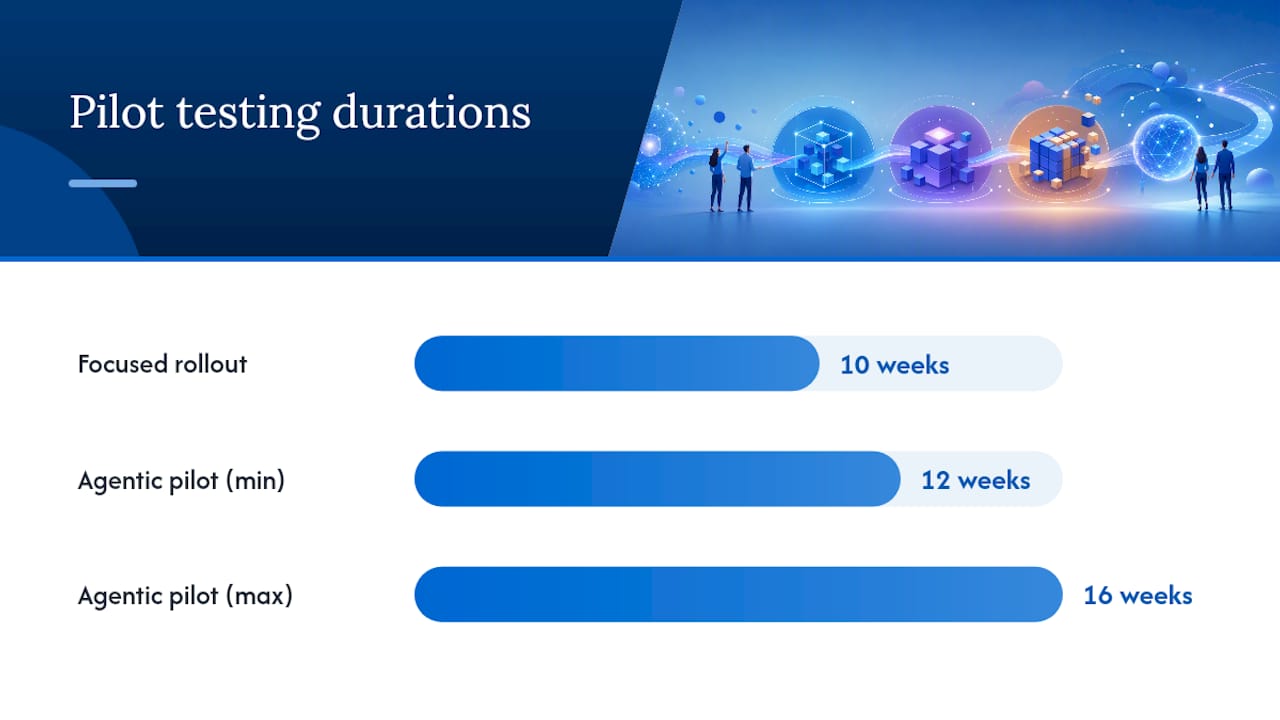
Focused pilots that stay within one team or one workflow generally close out within a few months. Complex, regulated rollouts spanning multiple systems and compliance sign-offs commonly stretch to 12 to 24 weeks, particularly for agentic AI deployments handling higher volumes or more decision autonomy. Treat that range as your planning anchor, not the specific pilot’s actual duration.
What should be on your enterprise AI IT checklist?
This is the section you’ll come back to before every go-live. A structured IT checklist covering security, compliance, integration, governance and operations is what separates a smooth rollout from a scramble, and enterprise onboarding built around one typically runs several weeks for the technical build, with regulated industries taking longer. Below are the five categories that matter, with the checks worth doing before you touch production data.
Security and access
- Single sign on (SSO) configured and tested against your identity provider
- Multi factor authentication (MFA) enforced for all admin accounts
- Role-based access control (RBAC) mapped to job function, not convenience
- Least-privilege principle applied to every service account and API key
- Session timeouts set and tested, not left on vendor defaults
- Audit logging enabled and retained per your record-keeping policy
- Encryption confirmed at rest and in transit, with certificates checked, not assumed
Data and compliance
- Data classified by sensitivity before any of it reaches the model
- A signed data processing agreement (DPA) in place with the vendor
- Data residency verified against where the platform actually hosts data, not where its marketing claims it does
- Regulatory mapping completed against relevant frameworks, whether that’s the GDPR for European customer data or sector-specific rules for healthcare and finance
- PII and PHI handling procedures documented and tested with a sample data set
If your organisation operates in a regulated sector, sovereign hosting and data residency verification deserve more scrutiny than any other line item on this list, because a failure here isn’t a bug, it’s a breach.
Integration and connectivity
- API credentials scoped to only the endpoints the AI actually needs
- Graceful failure modes defined for every integration point, so a downed API doesn’t take down the customer experience
- Rate limits documented and tested under realistic load, not just a demo script
- Network, VPC and firewall requirements confirmed with your infrastructure team before build starts, not after
Getting this category wrong is usually what causes the most visible early failures, particularly when connecting AI agents to legacy CRM and telephony systems that were never designed for real-time API calls.
Model and AI governance
- Model documentation covering training data provenance, known limitations and intended use case
- Explainability checkpoints built into the workflow, especially for any decision affecting a customer outcome
- Human-in-the-loop policy defined: which actions the model can take autonomously, and which require sign-off
- Output logging and retention policy set, with retention periods matching your compliance obligations
Model governance is the category most enterprises under-resource, and it’s usually the one regulators ask about first. Human review checkpoints and output logging aren’t optional extras for regulated sectors; they’re the difference between a defensible audit trail and a liability.
Operations and training
- Admin training completed and tested, not just delivered as a slide deck
- End-user training scheduled with enough lead time before go-live to actually land
- Monitoring dashboards live and checked by a named owner before the first production interaction
- Escalation paths documented, with response time expectations attached
- A 30-day post-launch review scheduled on the calendar, not left as a vague intention
Pro Tip: Run your IT checklist as a shared document with named owners against every line, not a static PDF. The moment a checklist item has no owner attached, it’s the item that gets skipped under deadline pressure.
How long does an enterprise AI rollout actually take?
Here’s a realistic 10-week timeline for a focused, single-use-case enterprise rollout, the kind most IT teams are actually running rather than a sprawling, multi-department agentic deployment.
- Weeks 1 to 2, discovery. Stakeholder mapping, data source inventory, use case selection. Gate: discovery sign-off from the business owner and IT lead.
- Weeks 3 to 4, data foundation. Data audit, cleansing, access provisioning. Gate: data readiness sign-off, confirming the data meets a minimum quality threshold.
- Weeks 5 to 6, build and training. Model or agent configuration, integration build, initial testing. Gate: training accuracy threshold met, commonly 85 to 95% depending on the use case’s risk profile.
- Weeks 7 to 8, pilot. Supervised rollout to a bounded group. Gate: pilot acceptance criteria met.
- Weeks 9 to 10, go/no-go and deployment. Final review against success metrics, staged production rollout.
Success metrics worth setting before you start, not after: an accuracy threshold specific to your use case, a user adoption rate target (what percentage of eligible interactions actually route through the AI), and a business KPI tied to the original charter, whether that’s average handle time, resolution rate or cost per interaction.
On volume: agentic AI pilots commonly need a testing window of 12 to 16 weeks when the use case involves higher-complexity decision-making, precisely because you need enough interaction volume to trust the accuracy numbers you’re seeing. A pilot that only handles ten conversations a week isn’t giving you a statistically meaningful result, no matter how clean those ten conversations look.
How do you design a pilot that actually proves the case?
A pilot’s only job is to generate evidence you can defend when someone asks “why are we scaling this?” That means scope and volume decisions come first, before a single line of configuration.
-
Choose a scope narrow enough to control variables, but with enough volume to be statistically meaningful, generally several hundred interactions at minimum for a customer-facing use case.
-
Start supervised: every AI action reviewed by a human before it reaches a customer, for at least the first one to two weeks.
-
Move to staged canary rollout once supervised accuracy holds steady, expanding autonomy gradually rather than flipping a full switch, and keep monitoring in place at each stage rather than removing it once things look stable.
-
Test acceptance against four criteria: accuracy against your defined threshold, first-contact resolution rate, user satisfaction score, and a running log of every edge case the model handled badly.
That edge-case log matters more than most teams expect. It’s not just a debugging aid, it’s the evidence base for your go/no-go decision and the training material for round two. If you’re testing proactive outreach or trigger-based engagement as part of the pilot, a staged pilot approach to proactive AI triggers applies the same logic: supervise first, expand once the data backs you up.
What monitoring and retraining does production AI need?
Deployment isn’t the finish line. It’s the point where a different discipline, MLOps or LLMOps depending on your architecture, takes over from project delivery. Continuous monitoring, versioning and safe deployment patterns are what keep a model reliable months after go-live, not just on launch day.
- Track input distribution drift: is the AI now seeing queries or data patterns that look different from what it was trained on?
- Monitor model-level metrics: accuracy, confidence scores, and rate of fallback to human handoff.
- Watch business KPIs directly, not just technical metrics, because a model can be technically accurate and still be failing the business outcome it was deployed for.
- Set alert thresholds before you need them, so a spike in error rate triggers a page, not a quarterly review.
- Define retraining triggers in advance, tied to drift severity or a set time interval, and route retraining through version control with a safe deployment pattern such as blue-green or canary release rather than a direct swap.
Pro Tip: Assign monitoring ownership to a named person, not a team inbox. A dashboard nobody’s accountable for is a dashboard nobody checks. A dedicated model management approach covering versioning and retraining pipelines makes this ownership concrete rather than aspirational.
Who owns each part of the onboarding process?
Ambiguous ownership kills more AI projects than bad technology does. Map each checklist category to a named role before build starts.
- Security and access: IT security lead accountable, infrastructure team responsible, CISO informed on major decisions.
- Data and compliance: Data governance lead accountable, legal/compliance consulted on every DPA and regulatory mapping decision.
- Integration and connectivity: Solutions architect accountable, application owners responsible for their systems’ API exposure.
- Model and AI governance: AI/ML lead or a designated governance committee accountable, with business unit heads consulted on human-in-the-loop thresholds.
- Operations and training: Operations manager accountable, department champions responsible for end-user adoption.
Change management runs alongside this, not after it. Aligning talent and process with new digital capability is what separates adoption from a system nobody uses.
- Identify and brief champions in each affected team before go-live, not after complaints start.
- Run hands-on workshops rather than passive demos. Structured, role-based learning pathways measurably reduce operator error during rollout.
- Document escalation paths with named contacts and response-time SLAs, and circulate them before the first production incident, not during it.
- Set a recurring training cadence, quarterly at minimum, since the model and the workflow around it will both change. For teams managing this across professional services or legal environments, structured change communication matters as much as the technical rollout itself.
What are the most common onboarding mistakes?
Three failure patterns show up again and again, and all three are fixable if you catch them early.
- Rushing or skipping the data foundation phase. Remediation: stop the build, run a focused 2-week data sprint before touching the pilot again.
- Over-provisioned access with no audit trail. Remediation: run an immediate access review, tighten to least privilege, and enable audit logging that day, not next sprint.
- No monitoring or governance in place at launch. Remediation: stand up a minimal dashboard covering accuracy and error rate within a week, and schedule a standing weekly review until it’s stable.
Every one of these is cheaper to fix in week 3 than in month 6.
How does Conversational AI support each onboarding stage?
The checklist above isn’t theoretical. It maps directly onto how Conversational AI is built for enterprise environments where compliance and integration aren’t optional extras.
- Data residency and security: Australian-hosted private cloud infrastructure satisfies the data residency check without a workaround, particularly relevant for organisations in regulated sectors.
- Integration and connectivity: multichannel agents across voice, SMS, email and live chat connect through scoped CRM synchronisation, addressing the API credential and access-scope checklist items directly.
- Monitoring and governance: real-time analytics and reporting give named owners the dashboards the monitoring phase requires, without a separate tool to bolt on.
Typical implementation support aligns with the phases above: a discovery and scoping engagement, a data and integration build, a supervised pilot, then staged deployment with monitoring built in from day one.
| Checklist item | How it’s addressed |
|---|---|
| Data residency | Private, Australia-hosted infrastructure |
| Integration | CRM connectors and multichannel agent deployment |
| Monitoring | Real-time analytics and reporting dashboards |
Why most onboarding advice undersells governance
The conventional advice on enterprise AI onboarding spends most of its energy on the pilot and barely mentions who’s accountable once the model is live. That’s backwards. A pilot proves a concept works for a few weeks under supervision; governance is what keeps it working for the next two years without anyone noticing it’s still running correctly.

What’s underrated here is the boring stuff: named ownership, audit logging, and a weekly review cadence that outlasts the initial excitement. What’s overrated is speed to pilot. Rushing discovery to “show progress” in week one is exactly how projects end up back at square one in month four, rebuilding on data nobody properly audited.
If you take one thing from this playbook, prioritise the data foundation phase and the governance ownership map before you write a single line of pilot configuration. Everything else, timelines, success metrics, rollout cadence, only works if those two foundations are solid first.
— Sowrabh
Ready to start your enterprise AI rollout?
Conversational AI is the alternative to piecing together separate chat, voice and CRM tools yourself, or handing data governance to an offshore platform you can’t fully audit. Every agent runs on private, Australia-hosted infrastructure, which means the data residency and compliance checks in this article’s checklist are answered by the platform itself, not bolted on afterwards.
That matters most for healthcare, finance, real estate and professional services teams, where the model governance and audit logging requirements above aren’t nice-to-haves, they’re the reason a project gets approved or blocked. Conversational AI’s multichannel agents for voice, SMS, email and live chat connect directly into your existing CRM, with contextual memory and automated follow-ups handling the operational load your onboarding plan accounts for in the pilot and deployment phases.
If you’re at the discovery stage already, the next step is straightforward: book a discovery workshop through Conversational AI and walk through your specific data, integration and compliance requirements before you commit to a build timeline.
Sources
- Enterprise AI Onboarding Checklist: 30 IT Must-Checks (2026)
- The Enterprise Guide to Agentic AI Training and Onboarding
- The Enterprise AI deployment playbook: 5 phases from data to production
- Arrival: deployment strategies (Azure AI in Production Guide)
Recommended
- Common AI system integration failures (and how to stop them) - Conversational AI
- Private AI deployment explained for enterprise IT teams - Conversational AI
- AI proactive engagement triggers: pilot guide for decision-makers - Conversational AI
- Types of enterprise AI integration architectures: 2026 guide - Conversational AI