Conversational AI enterprise benefits: 2026 guide
Discover the top conversational AI enterprise benefits for 2026. Learn how it enhances engagement, reduces costs, and boosts operational control.

Conversational AI is defined as software that uses natural language understanding and machine learning to hold goal-directed dialogues with people across voice, chat, SMS, and email channels. The enterprise case for deploying it is now well established. 67% of enterprises are actively expanding their conversational AI solutions, even as confidence levels remain moderate. That gap between confidence and commitment tells you something important: the business case is strong enough to act on, even before every question is answered. For Australian enterprises weighing the conversational AI enterprise benefits, the evidence points clearly toward cost reduction, better customer engagement, and greater operational control.
What are the primary conversational AI enterprise benefits for operations?
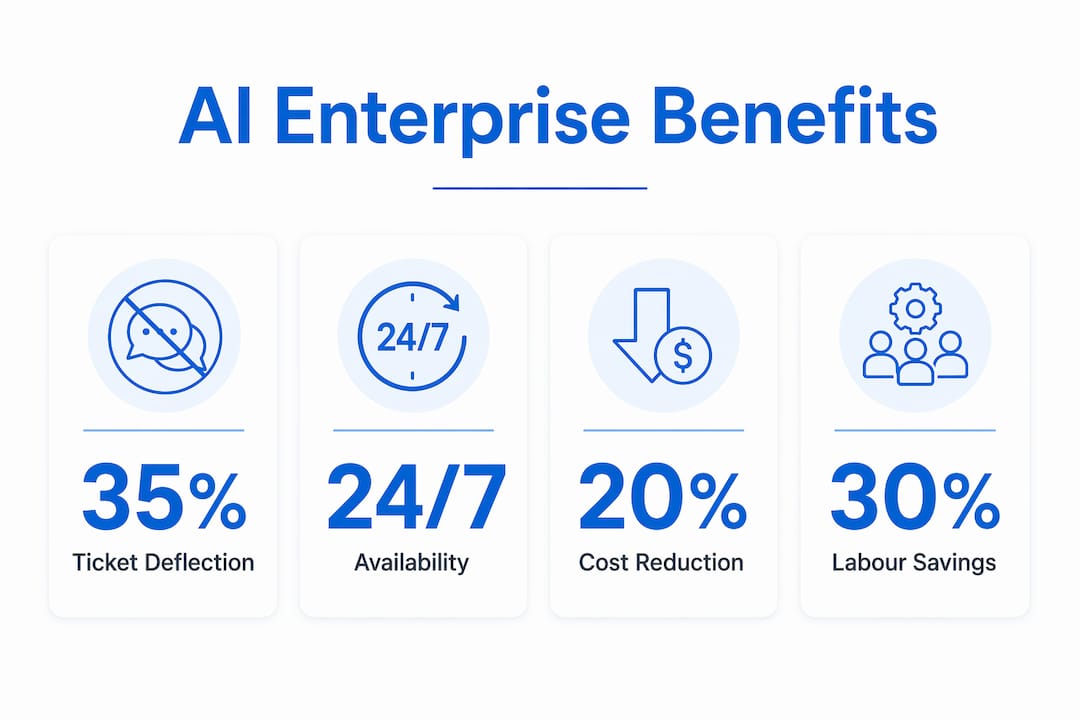
The most direct benefit is cost reduction through ticket deflection. Conversational AI deflects 30%–40% of support tickets, removing them from the human agent queue entirely. For a contact centre handling 2,000 tickets per month at $15 per ticket, a 30% deflection rate saves roughly $9,000 every month. That is not a rounding error. It is a structural reduction in operating costs.
Beyond ticket deflection, AI agents work around the clock without shift penalties or fatigue. This 24/7 availability removes the need for overnight staffing on routine queries, freeing your human team for complex, high-value interactions. Gartner projects $80 billion in contact centre labour cost savings globally by 2026 from AI automation. Australian enterprises in financial services, healthcare, and professional services stand to capture a meaningful share of those savings.

The table below shows how key metrics typically shift after conversational AI deployment.
| Metric | Before AI deployment | After AI deployment |
|---|---|---|
| Ticket deflection rate | 0% | 30%–40% |
| Average response time | Minutes to hours | Seconds |
| After-hours coverage | Limited or nil | 24/7 |
| Labour cost per interaction | $15+ | Significantly reduced |
| Agent focus | Mixed (routine + complex) | Complex issues only |
Agent productivity improves because AI handles the repetitive work. Agents spend less time resetting passwords or answering FAQ-style queries, and more time on escalations that actually require human judgement. That shift also reduces agent burnout, which is a real cost driver in high-volume contact centres.
- Ticket deflection reduces cost per contact immediately.
- 24/7 AI coverage removes the need for overnight human shifts on routine queries.
- Faster response times increase throughput without adding headcount.
- Agents focus on complex issues, improving both quality and job satisfaction.
Pro Tip: Track deflection rate and cost per contact from day one. These two metrics give you the clearest picture of ROI and make the business case for scaling your deployment.
How does conversational AI improve customer engagement at scale?
Customer engagement improves when every interaction feels consistent and relevant. Conversational AI maintains full conversation context across web, mobile, messaging, email, and voice channels. That means a customer who starts a query on live chat and continues via SMS does not have to repeat themselves. Consistent omnichannel context builds trust and reduces friction at every touchpoint.
Personalisation is the other major lever. When your AI agent connects directly to your CRM, it can greet customers by name, reference their account history, and tailor responses to their specific situation. Native CRM integration is the difference between a generic bot and a genuinely useful agent. Without it, personalisation is superficial and workflow automation is severely limited. You can read more about how to connect live chat AI to your CRM systems for practical integration guidance.
The satisfaction numbers back this up. Conversational AI deployment improves customer satisfaction scores by 10–15 percentage points within 90 days, based on Salesforce’s 2025 State of Service report. A 10-point CSAT lift in 90 days is a result most enterprises would struggle to achieve through hiring or training alone.
Key engagement benefits include:
- Personalised responses drawn from live CRM data at every interaction.
- Multilingual support extending your reach to non-English-speaking customers.
- Consistent tone and policy compliance enforced across every channel.
- Conversation history preserved across sessions, reducing customer effort.
Pro Tip: Connect your AI agent to your CRM before go-live, not after. Retrofitting integration adds cost and delays the personalisation benefits that drive CSAT improvements.
What governance and compliance considerations matter most?
Governance has moved from a back-office concern to a boardroom priority. 93% of enterprise leaders now rate transparency as very important or critical in their AI deployments. That figure reflects a genuine shift in how enterprises think about risk. A conversational AI system that cannot explain its decisions creates legal exposure and erodes stakeholder confidence.
The “black box” problem is the most cited concern. 60% of enterprise leaders rank black-box behaviour and compliance concerns above deployment complexity or resource constraints. This means your governance architecture matters more than your feature list. Auditability, human handoff mechanisms, and clear escalation paths need to be built in from the start, not added later. Baking transparency in early avoids costly retrofits and reduces operational risk significantly.
Data residency is a specific pressure point for Australian enterprises. Two-thirds of enterprises consider on-premise or own-cloud deployment very important or essential. In the retail sector, that figure rises to 89%. Australian privacy law and sector-specific regulations in healthcare and finance make local data hosting a practical requirement, not a preference.
| Governance feature | Business impact |
|---|---|
| Auditability and logging | Supports regulatory compliance and internal review |
| Human handoff protocols | Reduces risk of poor outcomes on complex queries |
| Data residency controls | Meets Australian Privacy Act and sector requirements |
| Transparent decision logic | Builds stakeholder and customer trust |
| Role-based access controls | Limits exposure of sensitive customer data |
Architecture choices also matter. 63% of enterprises prefer hybrid AI architectures that combine large language models with deterministic logic. Only 13% opt for fully agentic AI. Hybrid models give you the natural language capability of modern AI with the predictability and control that compliance teams require.
Pro Tip: Treat your governance framework as a design input, not a post-launch checklist. Enterprises that build auditability and escalation paths into their initial architecture spend far less time and money fixing problems later.
What practical steps should Australian enterprises take to realise these benefits?
Planning and integration decisions made early determine how much value you actually capture. The following roadmap reflects what works in medium to large Australian enterprise deployments.
-
Define your use cases before selecting a platform. Identify the top five query types by volume. These are your first automation targets. Common starting points include appointment booking, account enquiries, password resets, and collections follow-up.
-
Prioritise native CRM and backend integration. Your AI agent needs live access to customer data to personalise interactions. Map your integration requirements before you sign any contract. For a detailed walkthrough, the AI deployment at enterprise scale guide covers integration architecture in depth.
-
Set your performance metrics from day one. Response accuracy is the most critical metric for scaling success, rated at 90% priority by enterprise teams. Also track deflection rate, CSAT, and average handling time. These four metrics tell you whether your deployment is working.
-
Deploy across channels in stages. Start with your highest-volume channel, typically live chat or voice. Once performance is stable, extend to SMS and email. Omnichannel deployment without a stable core creates inconsistent experiences that undermine trust.
-
Build a retraining schedule into your operating model. Conversational AI degrades without regular updates. Schedule monthly reviews of mishandled queries and update your training data accordingly. Treat retraining as maintenance, not an optional extra.
-
Establish clear human escalation paths. Define exactly which query types trigger a handoff to a human agent. Document these paths and test them before go-live. Customers who hit a dead end with an AI agent and cannot reach a person quickly become detractors.
Avoid the common pitfall of deploying AI on a single channel and calling it done. The efficiency and engagement benefits compound when your AI agent operates consistently across voice, chat, SMS, and email. Partial deployments deliver partial results.
Key takeaways
Conversational AI delivers the strongest enterprise results when governance, integration, and performance measurement are built into the deployment from the start, not added after launch.
| Point | Details |
|---|---|
| Cost reduction is immediate | Deflecting 30%–40% of tickets cuts cost per contact from day one of deployment. |
| CSAT improves quickly | Enterprises see 10–15 point satisfaction gains within 90 days of going live. |
| Governance is non-negotiable | 93% of enterprise leaders rate transparency as very important or critical in AI systems. |
| Data residency matters in Australia | Two-thirds of enterprises require on-premise or own-cloud deployment for compliance. |
| Measure response accuracy first | Response accuracy at 90% priority is the leading indicator of scaling success. |
What I have learned from watching enterprises get this wrong
I have seen a pattern repeat itself across enterprise AI deployments: organisations rush to launch and treat governance as something to sort out later. The result is a system that works technically but fails commercially. Stakeholders lose confidence, compliance teams raise flags, and the whole project stalls six months in while the team retrofits audit logs and escalation paths that should have been there from day one.
The enterprises that get the most out of conversational AI do the opposite. They spend more time on architecture than on feature selection. They ask “can we audit this decision?” before they ask “can the AI handle this query?” That discipline pays off. When your AI agent can show its reasoning, flag its own uncertainty, and hand off cleanly to a human, your compliance team signs off faster and your customers trust the system more.
The Australian regulatory context adds another layer. Privacy obligations under the Australian Privacy Act, combined with sector-specific requirements in healthcare and finance, mean that data residency and access controls are not optional. Enterprises that choose platforms with local hosting and role-based access controls avoid a category of risk that their counterparts using offshore cloud deployments carry indefinitely.
My practical advice: choose a hybrid architecture. Fully agentic AI is impressive in a demo and unpredictable in production. A hybrid model that combines large language model capability with deterministic logic gives you the natural language quality your customers expect and the control your compliance team requires. That balance is where the real value sits.
— Sowrabh
How Conversational AI can help your enterprise move forward
Australian enterprises do not need to choose between capability and compliance. Conversational AI offers an enterprise AI platform built specifically for Australian businesses, with private cloud hosting, full data sovereignty, and native integration across voice, SMS, email, and live chat.
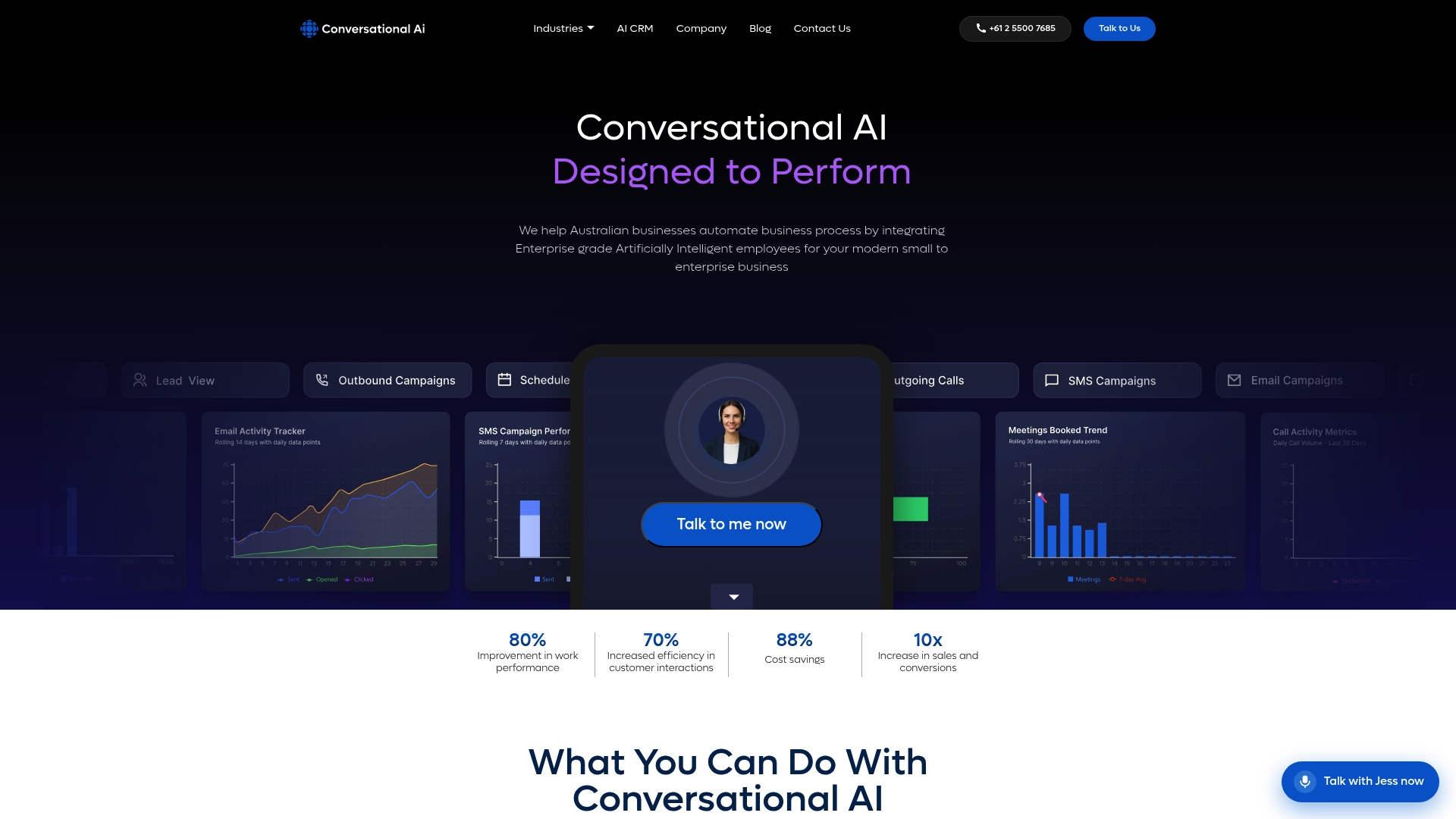
The platform includes contextual memory, automated follow-ups, real-time analytics, and human escalation protocols built in from the ground up. It is designed for sectors where privacy and auditability are non-negotiable, including healthcare, finance, and professional services. If you want to see how the platform performs against your specific use cases, a consultation or live demo is the fastest way to assess fit. Your team can be talking to a working AI agent within days, not months.
FAQ
What are the main conversational AI enterprise benefits?
Conversational AI reduces support costs through ticket deflection, improves customer satisfaction scores, and provides 24/7 coverage without additional staffing. Enterprises also gain consistent, auditable interactions across every channel.
How does conversational AI reduce costs for large businesses?
AI agents deflect 30%–40% of support tickets and reduce labour costs by up to 20%–30% through automation. Gartner projects $80 billion in global contact centre savings by 2026 from AI deployment.
Why do Australian enterprises prioritise data residency in AI deployments?
Australian privacy law and sector regulations in healthcare and finance require that customer data stays within Australian borders. Two-thirds of enterprises globally rate on-premise or own-cloud deployment as very important or essential.
What is a hybrid AI architecture and why does it matter?
A hybrid AI architecture combines large language models for natural conversation with deterministic logic for predictable, auditable outcomes. 63% of enterprises prefer this approach because it balances capability with the control that compliance teams require.
How quickly can conversational AI improve customer satisfaction?
Enterprises typically see customer satisfaction scores improve by 10–15 percentage points within 90 days of deploying conversational AI, based on Salesforce’s 2025 State of Service report.