What is a sovereign cloud solution for enterprise data control?
Discover how a sovereign cloud solution enhances data control for enterprises, ensuring compliance, protection, and operational transparency.

A sovereign cloud solution is a cloud environment engineered and governed so that data, operations and legal exposure stay under the laws and oversight of a specified jurisdiction. It goes further than picking a local datacentre. It locks down who can access your systems, where administrative decisions are made, and which courts have authority over your data, according to Teradata’s definition of sovereign cloud.
For enterprise decision-makers, three things matter most:
- Compliance assurance — you can demonstrate to regulators, auditors and boards that sensitive data never leaves its required jurisdiction.
- Protection from extraterritorial risk — foreign subpoenas or government access requests can’t reach data that sits under sovereign controls.
- Tighter operational control — you know exactly who can touch your infrastructure and when, with an audit trail to prove it.
Your next move: sort your workloads by sensitivity before you shortlist a single vendor.
Key Takeaways
A sovereign cloud solution keeps data, operations and legal exposure inside a defined jurisdiction, and it works only when residency, operator access, key management and auditability are all addressed together.
| Point | Details |
|---|---|
| Definition matters | Sovereignty means jurisdictional control over data, operators and law, not just data residency. |
| Apply sovereignty by workload | Reserve sovereign environments for regulated or high-risk data to control cost and complexity. |
| Demand auditable evidence | Require ISO 27001, SOC 2 reports and independent audits, not vendor self-attestation. |
| Weigh the trade-offs | Expect higher cost and possible feature lag against tighter jurisdictional control. |
| Conversational AI’s approach | Hosts its platform entirely within Australia with customer-controlled keys, built for regulated conversational AI workloads. |
Table of Contents
- What does a sovereign cloud solution cover that public cloud doesn’t?
- Core sovereignty dimensions every solution must address
- Why organisations adopt sovereign cloud solutions
- How does sovereign cloud work in practice?
- What compliance and legal checks does sovereign cloud require?
- What are the risks and trade-offs of sovereign cloud?
- Which industries and use cases need sovereign cloud most?
- How do you evaluate and choose a sovereign cloud vendor?
- How do major vendors position their sovereign cloud offerings?
- When is sovereign cloud actually the right call?
- How does an Australia-hosted platform approach sovereign hosting?
- Sources
What does a sovereign cloud solution cover that public cloud doesn’t?
People conflate three distinct ideas: data residency, data sovereignty, and cloud sovereignty. Data residency is simply where your data physically sits. Sovereignty is broader. It’s about which laws govern that data and which operators can lawfully access it, regardless of the server’s postcode. A dataset stored in a local region can still be legally exposed to a foreign government’s reach if the operator is headquartered elsewhere and subject to that country’s disclosure laws.
Cloud sovereignty adds a third layer: who actually runs the platform. Can support engineers offshore log in and make administrative changes? Are encryption keys held by the provider or by you? Genuine sovereign solutions typically guarantee in-country data residency, restrict operator access to personnel within the jurisdiction, and hand customers control of key management rather than leaving keys with the provider by default, as Cisco outlines in its sovereign cloud explainer.
- Data residency: where the bytes physically live
- Operational sovereignty: who can administer the system and from where
- Legal sovereignty: which courts and laws have jurisdiction over the data
Pro Tip: Don’t assume “hosted locally” equals “sovereign.” A local datacentre owned by a foreign multinational can still be compelled to hand over data under that company’s home-country laws. Ask who owns the entity operating the infrastructure, not just where the racks sit.
Core sovereignty dimensions every solution must address
Any credible sovereign cloud solution needs to answer six questions convincingly, and a vendor that dodges one of them is a vendor to scrutinise harder.
- Data residency — physical and logical location of data at rest and in transit
- Operator access controls — who can log in, from where, and under what approval process
- Legal jurisdiction exposure — which government’s laws can compel disclosure
- Key management — whether encryption keys are customer-held or provider-held
- Logging and auditability — whether every administrative action produces a verifiable record
- Network and disaster recovery boundaries — whether failover and backups stay in-jurisdiction
Each dimension maps to a real compliance risk. Weak key management means a provider (or anyone who compromises the provider) can decrypt your data without your knowledge. Poor auditability means you can’t prove compliance when a regulator asks.
The technical architecture behind this usually comes down to landing zones with strict identity and privileged access management, paired with local key custody arrangements. Confidential computing environments (TEEs) add a further layer, ensuring data stays encrypted even while being processed, not just at rest.
Why organisations adopt sovereign cloud solutions
The business case rarely comes down to a single motive. Compliance simplification is the obvious driver. Defence against extraterritorial access requests is the one that keeps general counsel up at night. Improved risk posture for sensitive workloads and clearer governance transparency for auditors round out the list.
- Simplifies compliance reporting for regulated data categories
- Reduces exposure to foreign government access requests
- Strengthens risk posture for health, financial and government data
- Gives auditors clear, verifiable evidence of control
An IDC InfoBrief sponsored by Microsoft found organisations prioritise sovereign cloud for enhanced data security and privacy, tighter control of data access, and protection against extraterritorial requests, with finance and healthcare weighting these benefits differently depending on their regulatory load. Finance leans hardest on key management and audit evidence; healthcare tends to prioritise residency and access restrictions for patient records.
How does sovereign cloud work in practice?
Sovereignty gets built through one of four common deployment patterns, and each enforces control differently.
- Hyperscaler sovereign regions — a major cloud provider operates a dedicated, in-jurisdiction region with local staff and legal separation from its global operations.
- Dedicated local regions — a domestic operator runs infrastructure entirely within the country, often for government or highly regulated clients.
- On-premises or air-gapped sovereign stacks — data and processing never leave the customer’s own facilities or a fully isolated network.
- Hybrid managed local host — sensitive workloads run with a local managed provider while less sensitive functions use public cloud for scale.
Underneath all four sit the same technical building blocks: a properly segmented landing zone, local key management, confidential computing (TEEs) for data-in-use protection, personnel localisation policies, and an automated pipeline that generates audit evidence rather than relying on manual reporting, as Cisco notes.
- Map your workload’s data flow before choosing a model
- Confirm where administrative logins physically originate
- Request a simple architecture diagram showing data, key, and log paths
- Validate disaster recovery sites sit within the same jurisdiction
What compliance and legal checks does sovereign cloud require?
Procurement and legal teams need a specific list, not a vague assurance of “compliance.” Ask for:
- ISO 27001 certification and current SOC 2 reports
- Region-specific attestations relevant to your industry
- Independent third-party audit results, not just self-attestation
- Documented key-management policy showing customer control
Sovereign architecture can reduce exposure to laws like the US CLOUD Act, which can compel American companies to produce data regardless of where it’s stored, but no vendor contract eliminates jurisdictional risk entirely. EU regulators increasingly frame sovereignty around enforceable, auditable controls rather than geography alone, and continuous, independently verified monitoring is becoming the real benchmark rather than a one-off audit certificate.
Contractual guarantees matter, but they are not a substitute for legal review. Jurisdictional exposure is complex enough that a written opinion from counsel familiar with your sector should precede any sovereign cloud commitment.
For AI-specific workflows, a guide to preventing data offshore transfers in AI systems is worth reading before you sign anything.
What are the risks and trade-offs of sovereign cloud?
Sovereignty isn’t free, and pretending otherwise sets up procurement for disappointment later. Costs run higher than public cloud in most cases. Feature parity often lags, since sovereign regions launch new services later than global ones. Vendor lock-in risk increases if portability isn’t negotiated upfront.
| Risk | Likely Impact | Mitigation |
|---|---|---|
| Higher infrastructure cost | Smaller economies of scale than hyperscale public cloud | Apply sovereignty only to workloads that need it |
| Feature or service lag | Newer AI or platform tools arrive later in sovereign regions | Negotiate roadmap commitments in the contract |
| Vendor lock-in | Difficult, costly migration later | Demand documented exit and portability terms upfront |
| Governance complexity | More approval steps slow delivery | Automate audit evidence generation from day one |
A well-architected sovereign environment can match public cloud on reliability and scale, though service breadth typically remains narrower.
Pro Tip: Apply a “sovereignty by workload” strategy. Put only regulated or high-risk data in the sovereign environment and leave everything else in public cloud. This alone cuts most of the cost blowout enterprises hit when they over-apply sovereignty.
Which industries and use cases need sovereign cloud most?
Certain data types and sectors show up in procurement conversations again and again.
- Health records and clinical data subject to patient privacy law
- Financial transaction logs and payment data under sector-specific regulation
- National security, defence and public sector workloads
- AI and machine learning models trained on personal or sensitive data
- Backup and disaster recovery for systems classified as critical infrastructure
A hospital network migrating patient scheduling and clinical notes needs residency, operator restriction and audit logging all three at once. A bank running fraud-detection models needs customer-held keys and evidence its model training data never left the jurisdiction. Finance, healthcare, government and critical infrastructure operators are consistently the first movers in sovereign cloud procurement, largely because their regulators demand it explicitly rather than as best practice.
How do you evaluate and choose a sovereign cloud vendor?
Run this as a structured workshop with security, legal and architecture in the room together, not as a checklist emailed around for sign-off.
- Define workload sensitivity and classify data by regulatory obligation
- Map every applicable law and regulation to each workload category
- Run a proof-of-concept with a genuinely sensitive (not test) dataset
- Validate audit evidence against independent, third-party reports
Then put these questions directly to every vendor on your shortlist:
- Where exactly does administrative access originate, and can it be restricted to in-jurisdiction staff?
- Who holds the encryption keys, and can we rotate or revoke them ourselves?
- What audit logs are generated automatically, and how are they verified?
- What are the exact SLA terms for disaster recovery within our jurisdiction?
- What does contract exit and data portability look like, in writing?
Red flags worth walking away from: audit claims you can’t independently verify, vague answers on key custody, operator access that extends outside the jurisdiction “for support purposes,” and any SLA that goes quiet on disaster recovery specifics. A guide to scaling AI automation across the enterprise covers related governance questions worth raising in the same workshop.
How do major vendors position their sovereign cloud offerings?
The market splits roughly into three positioning strategies, and most established providers pick one as their primary pitch.
- IBM and SAP lean toward dedicated local infrastructure and industry-specific sovereign platforms, often built for government and regulated enterprise clients.
- OpenText and VMware position around hybrid and managed sovereign stacks that enterprises can deploy across on-premises and partner infrastructure, an approach VMware describes in detail on its sovereign cloud page.
- Google Cloud, Microsoft Azure and AWS have each built sovereign or dedicated regions inside their global hyperscale networks, aiming to combine local control with hyperscale service breadth.
No single model wins outright. Dedicated local infrastructure gives tighter jurisdictional certainty; hyperscaler sovereign regions offer broader feature parity. The right pick depends on which trade-off your regulator cares about more.
Treat this as a starting longlist for deeper technical due diligence, not a ranking.
A sovereign cloud example for conversational AI workloads
Picture a conversational AI deployment for a regulated business: model artefacts, training data, live inference and interaction logs all sit within a single jurisdiction, with encryption keys held by the customer rather than the platform operator. Support access requires in-jurisdiction approval and is fully logged.
- Governance gates before go-live: data classification review, key-custody sign-off, audit-log verification
- Outcome: reduced extraterritorial exposure and an audit trail regulators can inspect on request
- Lesson learned: CRM integration needs the same jurisdictional scrutiny as the AI platform itself
When is sovereign cloud actually the right call?
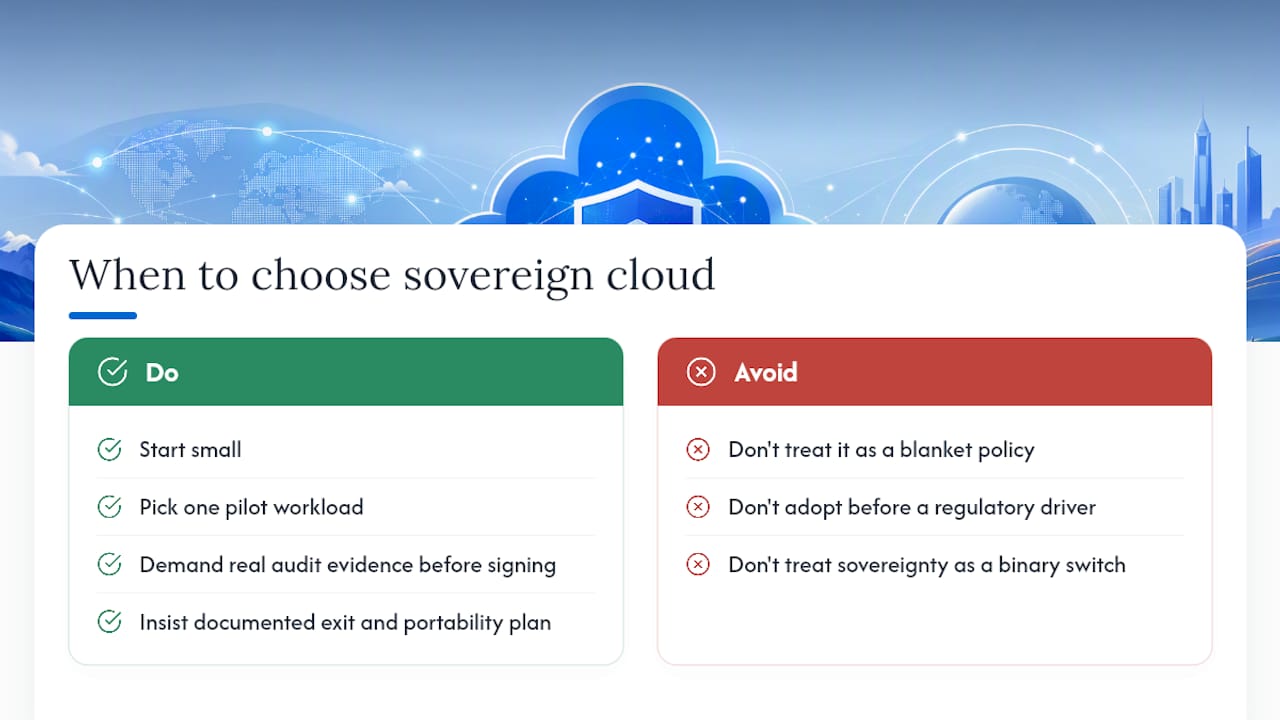
Sovereignty earns its cost when a regulatory mandate, a national policy requirement, or genuinely high-risk data forces the question. Outside those tipping points, it’s an expensive answer to a problem you don’t have yet, and I’d argue most enterprises reach for it too early, treating it as a blanket policy rather than a targeted decision.
Start small. Pick one pilot workload with a clear regulatory driver, demand real audit evidence from any vendor before you sign, and insist on a documented exit and portability plan from day one. Sovereignty and innovation aren’t opposites, but they do pull in different directions on cost and feature velocity. The organisations that get this right treat sovereignty as a continuum rather than a binary switch, running sensitive workloads sovereign while everything else stays on public cloud for scale.
How does an Australia-hosted platform approach sovereign hosting?
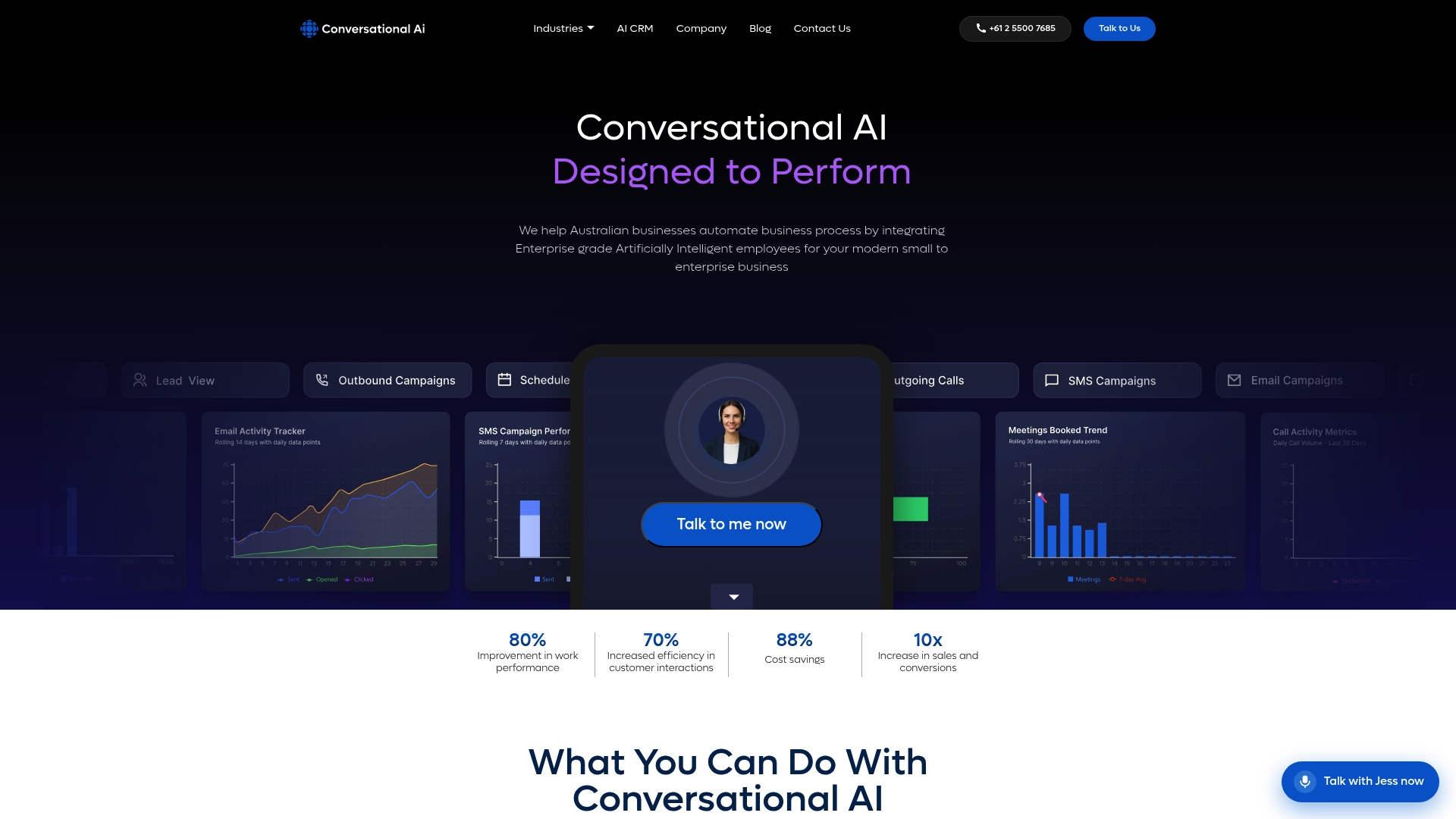
If your enterprise is weighing up sovereign options for a conversational AI deployment specifically, the calculus is a little different from general-purpose cloud infrastructure. Conversational AI is built as a private cloud platform hosted entirely within Australia, which means voice, SMS, email and live chat interactions, along with the data behind them, never leave the jurisdiction by design. Customers retain control over their data, and the platform integrates directly with existing CRM systems without routing sensitive interaction data through offshore infrastructure.
For regulated sectors like healthcare, finance and professional services, that in-jurisdiction hosting removes a whole category of the extraterritorial risk this guide has walked through. If you want to see how it applies to your own workload, request an architecture brief and a walkthrough of how key control and audit logging work in practice. Book a technical discussion through the Conversational AI platform page and bring your data classification list. It’s the fastest way to find out whether a pilot makes sense for your organisation.
Sources
- What Is Sovereign Cloud? Definition + Requirements | Teradata
- What Is Sovereign Cloud? - Cisco
- EU newsroom item on digital sovereignty
Recommended
- Prevent data offshore transfers: AI compliance guide for privacy teams - Conversational AI
- Top 3 Fullstop.ai Alternatives 2026 - Conversational AI
- Types of enterprise AI integration architectures: 2026 guide - Conversational AI
- Private AI deployment explained for enterprise IT teams - Conversational AI