What is customer intent detection: guide for decision-makers
Discover how customer intent detection transforms ambiguous queries into actionable insights, enhancing conversations and boosting conversions.

Customer intent detection is the AI process of mapping what a customer says, types, or does to the underlying goal behind it, whether that’s “cancel my subscription” or “compare pricing plans.” It works by combining transformer-based classifiers, BERT-style language models, and zero-party data signals to turn ambiguous input into a routable, actionable category. Done well, it cuts misrouted enquiries, speeds up automation, and lifts conversion by responding to what a customer actually wants rather than what they literally typed. For decision-makers evaluating a conversational AI investment, this distinction between reacting to words and understanding customer intent is the whole game.
Key Takeaways
Customer intent detection works because it combines transformer-based classification with layered signal data to route customers by goal, not just keywords, directly improving automation and conversion.
| Point | Details |
|---|---|
| Definition matters | Intent detection maps inputs to a business action using embeddings and classifiers, not simple keyword hits. |
| Signal hierarchy | Prioritise zero-party declarations first, then behavioural saves and alerts, then inferred clickstream patterns. |
| Confidence thresholds are critical | Low-confidence predictions should trigger a clarifying question or human handoff, never a silent guess. |
| Governance protects accuracy | Version your intent taxonomy and run ongoing drift monitoring to catch model degradation early. |
| Hosting shapes vendor choice | Conversational AI runs on Australia-hosted private cloud, pairing intent detection with data sovereignty for regulated sectors. |
Table of Contents
- How does customer intent detection actually work?
- Why does customer intent detection matter for your business?
- Where is customer intent detection used in customer experience?
- Intent detection vs intent classification vs search intent: what’s the difference?
- How do you implement customer intent detection in production?
- How do you measure if intent detection is actually working?
- What limits does customer intent detection have?
- What enterprise buyers get wrong about intent detection vendors
- How Conversational AI puts intent detection into practice
- Frequently asked questions about customer intent detection
- Sources
How does customer intent detection actually work?
Three signal types feed every system: explicit signals (zero-party data such as wishlist saves, back-in-stock alerts, and price-drop subscriptions), behavioural signals (clickstream, navigation paths, dwell time), and conversational signals (the actual words, phrases, and dialogue structure in a chat or call). Explicit actions carry stronger predictive weight than passive metrics like pageviews, which is why mature systems weight them first.
The pipeline itself runs in stages:
- Ingestion — raw text, voice transcripts, or clickstream events enter the system.
- Preprocessing — normalisation, tokenisation, and language detection clean the input.
- Representation — the text is converted into embeddings, numerical vectors that capture meaning rather than just keywords.
- Classification — a transformer-based classifier or intent scorer assigns a probability to each possible intent.
- Post-processing — confidence thresholds decide whether to act, ask a clarifying question, or escalate to a human.
Model choice matters more than most vendors admit. Rule-based systems are cheap and predictable but brittle. Classical machine learning sits in between. Fine-tuned transformer models handle nuance and context far better, because modern NLP infers meaning from semantics rather than pattern-matching keywords. Many enterprise deployments now run hybrid setups, using rules for high-confidence, high-frequency intents and transformer models for everything ambiguous. Latency matters too. A voice agent needs sub-second classification; an email triage system can tolerate a few seconds of batching.
Why does customer intent detection matter for your business?
Intent detection converts a technical capability into measurable business outcomes. Get the routing right, and support tickets land with the correct team on the first pass instead of bouncing through three transfers. Get personalisation right, and a browsing session becomes a qualified lead instead of a bounce.
The core benefits decision-makers should track:
- Improved SLA adherence through automatic queue and priority selection.
- Higher automation rates as more enquiries resolve without a human agent.
- Better personalisation, since intent expressed through navigation and category browsing signals purchase readiness.
- Faster lead qualification, cutting the time between first contact and sales handoff.
- Measurable conversion uplifts when real-time systems respond to intent as it changes mid-session.
Pro Tip: *Don’t chase blanket automation rates as your only KPI.
The metrics that matter most are contact deflection, first contact resolution, time to resolution, and revenue per contact, because these tie the technology back to what your board actually cares about.
Where is customer intent detection used in customer experience?
Support routing is the most common entry point. A customer message triggers a detected intent, and the system routes it before a human ever sees it. Say a customer writes “I want my money back.” The system detects a refund request intent, routes the ticket to the refunds queue, and fires an automated policy link in the same breath.
Other high-value applications:
- Virtual agents and chatbots use detected intent to select the right conversation flow, rather than forcing customers through a rigid menu tree.
- Triage and escalation flags urgent or high-risk intents (complaints, cancellation threats) for immediate human review.
- Lead qualification reads intent signals like pricing page visits or demo requests to score and route sales-ready leads.
- Personalised merchandising adjusts recommendations in real time as a customer’s intent shifts session to session.
- Targeted campaigns use accumulated intent data to time offers around actual purchase readiness rather than a generic send schedule.
Each use case needs different data. Support routing leans on conversational text; merchandising leans on clickstream and saved-item behaviour.
Intent detection vs intent classification vs search intent: what’s the difference?
These terms get used interchangeably in vendor pitches, and that’s where a lot of buying decisions go wrong.
- Intent detection is the end-to-end process: identifying that an intent exists, classifying it, scoring confidence, and triggering an action.
- Intent classification is narrower. It’s just the model step that assigns a label to an input. It’s a component of intent detection, not a substitute for it.
- Intent recognition is often used as a synonym for classification, though some vendors use it to describe the initial detection that something needs categorising at all.
- Search intent refers specifically to the goal behind a search query (informational, navigational, transactional) and belongs to SEO and search contexts, not conversational systems.
- Keyword matching simply returns pattern hits against a fixed word list. It’s fast and explainable but blind to context.
If your enquiry volume is low and predictable, keyword matching or simple rules will do the job cheaper. Once conversations get varied, colloquial, or multilingual, you need a full intent detection model with confidence scoring built in.
How do you implement customer intent detection in production?
- Assemble your data sources. Pull conversational logs, web clickstream, CRM events, and zero-party signals into one place. Define clear annotation rules and run quality checks before training anything, because inconsistent labelling poisons every model built on top of it.
- Design an intent taxonomy. Decide on pragmatic depth: broad top-level intents (billing, support, sales) with granular slots underneath (invoice dispute, payment method change). Version it and assign clear governance so intents don’t silently drift.
- Choose your model approach. Fine-tune a transformer when you have enough labelled examples per intent. Use embeddings with a nearest-neighbour classifier for smaller datasets or fast-changing catalogues. A hybrid rule-plus-ML setup often outperforms either approach alone in the first year.
- Integrate for production. Set latency SLAs per channel, define confidence thresholds for auto-action versus clarification, and build a human-in-loop escalation path for anything under threshold.
- Operationalise continuous improvement. Monitor drift, run A/B tests on taxonomy changes, and enforce data retention and privacy safeguards from day one, not as an afterthought.
Read how migrating legacy systems to conversational AI works if you’re integrating intent detection into an existing CRM stack rather than building greenfield.
How do you measure if intent detection is actually working?
Technical evaluation starts with precision, recall, and F1 score per intent, plus a confusion matrix to spot which intents get mixed up. Confidence calibration matters as much as raw accuracy.
Operational metrics to watch:
- Latency and throughput under real traffic load.
- Human takeover rate, which tells you how often the model hands off.
- False-accept and false-reject rates, since each carries a different business cost.
Business impact metrics close the loop: conversion lift, deflection rate, time to resolution, and revenue tied to intent-driven interventions. Build a monitoring checklist covering drift detection, regular sample audits, and performance broken out by channel and language. Set near real-time alerts for degradation. Read more on AI deployment pipelines for the monitoring architecture this requires.
What limits does customer intent detection have?
No model handles everything cleanly. Ambiguous inputs (“I have a problem with my order”) often carry multiple plausible intents at once. Out-of-distribution queries, things the model has never seen in training, produce unreliable confidence scores. Multilingual and code-switching conversations (customers mixing two languages mid-sentence) remain a genuine weak spot for most commercial models.
Mitigation is mostly procedural, not purely technical:
- Use clarifying prompts when confidence sits below threshold rather than guessing.
- Build a fallback intent that routes to a human instead of failing silently.
- Roll out new intents incrementally, watching real traffic before full deployment.
- Augment thin categories with synthetic data and regular human review.
On privacy: minimise logs, get explicit consent for zero-party data collection, and store personally identifiable information separately from behavioural data with proper access governance.
What enterprise buyers get wrong about intent detection vendors
Most vendor evaluations focus almost entirely on model accuracy and ignore where the data actually lives. That’s backwards for any organisation in healthcare, finance, or professional services. Data sovereignty, CRM integration depth, and multichannel coverage matter as much as classification performance, because a brilliant model bolted onto infrastructure hosted outside your jurisdiction creates a compliance headache no accuracy score fixes.

Private cloud hosting within Australia removes a layer of regulatory uncertainty that offshore platforms simply cannot match for regulated sectors. Before signing anything, prioritise clear SLAs, proven integration patterns with your existing systems, and vendors who can demonstrate privacy controls rather than just claim them.
How Conversational AI puts intent detection into practice
Conversational AI is the alternative to piecing together disconnected chat, voice, and email tools for intent detection in Australia. It runs entirely on private, Australia-hosted cloud infrastructure, giving regulated businesses full data sovereignty instead of routing customer conversations through offshore servers.
The platform applies the same principles covered above, transformer-based natural language understanding, contextual memory, and confidence-driven routing, across voice, SMS, email, and live chat, with direct CRM integration rather than a bolt-on connector. For teams in healthcare, finance, or professional services, that means intent detection that respects compliance requirements without slowing down automation. If you’re evaluating how AI live chat integration or voice deployment could reduce misrouted enquiries, book a demo with Conversational AI to see the platform assess a real conversation from your own business.
Frequently asked questions about customer intent detection
What is customer intent detection in simple terms? It’s an AI process that reads what a customer says or does and matches it to a likely goal, like a refund request or a pricing enquiry, so a business can respond or route the enquiry automatically.
How accurate is customer intent detection? Accuracy varies heavily between in-domain queries the model was trained on and out-of-distribution inputs it hasn’t seen. Well-tuned transformer models perform strongly on familiar phrasing but need fallback flows for unusual queries.
Is customer intent detection the same as a chatbot? No. A chatbot is the interface; intent detection is the underlying capability that decides how the chatbot should respond. Many chatbots use intent detection, but not all intent detection systems power a chatbot.
What data do you need to start? Conversational logs, CRM events, and any zero-party signals like saved preferences or wishlist activity give you the strongest starting foundation, ahead of raw clickstream data alone.
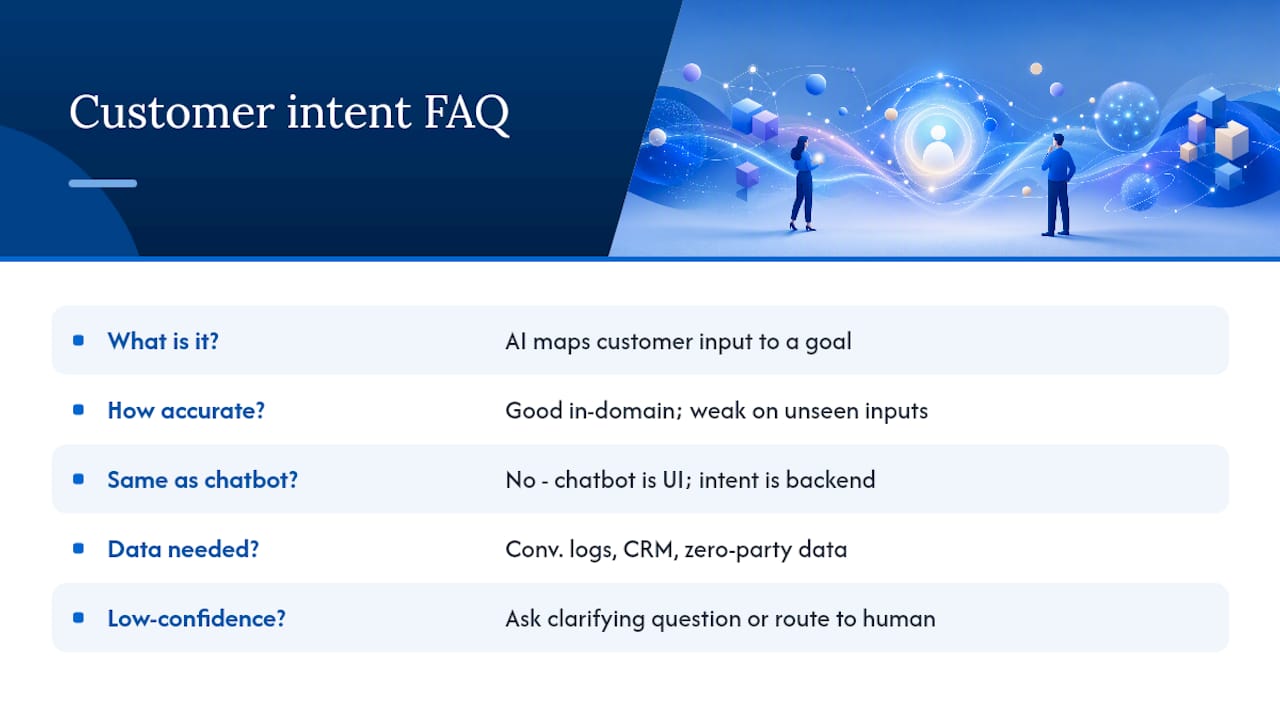
How do you handle low-confidence intent predictions? Route them to a clarifying question or a human agent rather than acting on a guess. This single practice reduces misrouting significantly while models mature.
Sources
- Customer Intent: Definition, Types, and Data Uses (2026) - Shopify
- Customer Intent Analysis: Drive Revenue from Real Signals
- Customer Intent: How to Understand, Capture & Capitalize It? - Qualaroo
- What is Customer Intent? | Sitecore
Recommended
- AI sentiment analysis for customer calls: CX manager’s guide - Conversational AI
- Types of customer service automation triggers: 2026 guide - Conversational AI
- Common customer engagement automation mistakes to fix now - Conversational AI
- Automate customer service operations: 2026 enterprise guide - Conversational AI