Common customer engagement automation mistakes to fix now
Avoid common customer engagement automation mistakes by defining success first. Learn key errors and how to fix them for better outcomes.

Most common customer engagement automation mistakes trace back to a single root cause: choosing technology before defining what success looks like. Research shows that 60% of automation initiatives fail when teams start with technology instead of measurable business outcomes. The Strategy-First Framework, OAIC-aligned privacy controls, and purpose-built conversational AI each address a different layer of this problem. Fix the foundation first, and the rest becomes manageable.
TL;DR: 10 mistakes to check right now
- Starting with a tool, not a measurable outcome
- No defined KPIs or ROI tracking before go-live
- Happy-path-only conversation design with no fallbacks
- Missing human-in-loop escalation paths
- Over-personalisation that breaches privacy expectations
- Data stored offshore without a Privacy Impact Assessment
- No governance owner or RACI for automation components
- Silent failures running undetected without monitoring
- Pilots scoped too broadly with no rollback criteria
- Treating deployment as a one-time event, not an ongoing system
Table of Contents
- What are the most common strategic mistakes in automation programmes?
- Design and UX mistakes that break customer journeys
- Data, privacy and compliance mistakes Australian enterprises must avoid
- Operational and governance mistakes that make automations fragile
- Implementation and measurement mistakes: pilots, testing and improvement
- What does an enterprise automation timeline actually look like?
- Quick diagnostic: 10 checks you can run on your programme today
- How a privacy-first, Australia-hosted platform prevents these mistakes
- Key takeaways
- Why strategy and privacy are the only place to start
- Conversational AI is built for exactly this challenge
- Useful Australian sources and further reading
What are the most common strategic mistakes in automation programmes?
Technology-first thinking is the single biggest cause of wasted automation spend. Teams select a platform, build impressive demos, and then discover the underlying process was never fit for automation. McKinsey’s analysis of automation execution pitfalls found that poor input data quality, too many client variations, and off-script procedures routinely undermine programmes that looked viable in high-level demos.
The remedy is the Strategy-First sequence: define measurable outcomes first, then map and fix processes, then design human-AI collaboration, and select technology last. A concrete outcome statement looks like this: reduce first-response time significantly within a short time frame, measured by CRM ticket timestamps. Vague goals produce vague results.
Remediation steps you can start today:
- Write one outcome statement per use case (metric, baseline, target, time frame).
- Map the current process end-to-end, including every exception and manual workaround.
- Fix upstream data quality issues before any automation build begins.
- Select technology only after steps 1–3 are complete.
- Assign a named owner to each automation component before go-live.
Pro Tip: Reserve at least 20% of your automation budget for ongoing maintenance, monitoring, and model updates. Teams that allocate only for the initial build routinely face unplanned spend in months 6–12 when automation treated as static becomes brittle as surrounding systems change.
Design and UX mistakes that break customer journeys
Conversation design fails most often because teams build only for the happy path. Real customer interactions are messy: partial inputs, mixed languages, mid-flow topic changes, and accessibility needs that scripted dialogues never surface. When the automation hits an unscripted state, it either loops, errors silently, or drops the customer entirely.

Sending identical messages across channels compounds the problem. An SMS that works at 160 characters reads as truncated in email. A voice agent’s phrasing sounds robotic in live chat. Channel context matters as much as content.
UX checklist for conversation flows:
- Test with real, messy inputs: partial postcodes, mixed English/Mandarin, incomplete form data.
- Define a fallback response for every intent the model cannot confidently resolve.
- Set a maximum of two failed attempts before escalating to a human agent.
- Surface full conversation context to the receiving agent, not just the last message.
- Confirm accessibility compliance (WCAG 2.1 AA minimum) for all text-based channels.
- Review automation trigger design to avoid over-triggering or misaligned prompts.
Pro Tip: Run a “chaos test” session monthly: give real staff a list of deliberately awkward inputs and watch where the flow breaks. Scripted UAT will never find what a confused customer will.
Data, privacy and compliance mistakes Australian enterprises must avoid
Over-personalisation is a genuine risk, not just a theoretical one. In BFSI and health sectors, using more data than a customer expects can feel intrusive and erode the trust the automation was meant to build. More data does not automatically mean better customer experience.
Australia’s Privacy Act 1988 and the Office of the Australian Information Commissioner (OAIC) set clear obligations around collection, purpose limitation, and deletion. A Privacy Impact Assessment (PIA) is required before deploying any system that handles sensitive personal information at scale, including conversational AI agents that log interaction transcripts.
Compliance checklist aligned with OAIC guidance:
- Log explicit consent at the point of collection, with a timestamp and the stated purpose.
- Limit data use strictly to the purpose disclosed at collection.
- Build deletion workflows that can execute within the statutory timeframe.
- Conduct a PIA before go-live for any health, financial, or government use case.
- Confirm data residency: all personal information must be stored on Australian-hosted infrastructure.
- For BFSI deployments, cross-reference APRA CPS 234 requirements alongside OAIC obligations.
Privacy signal: Hosting data offshore without a contractual data residency clause is a breach risk under the Australian Privacy Principles. Private AI deployment on Australian soil removes that exposure entirely.
Operational and governance mistakes that make automations fragile
Silent failures are the most dangerous operational risk. An automation can run continuously while producing wrong outputs, and without monitoring, no one notices until a customer complaint surfaces weeks later. Siloed automations with no single owner make this worse.
| Role | Responsibility | Escalation contact |
|---|---|---|
| Automation Owner | End-to-end outcome accountability | Head of CX or CTO |
| Operator | Daily monitoring, alert triage | Automation Owner |
| Integration Lead | CRM sync health, API uptime | Platform vendor support |
| Privacy Officer | Consent audit, PIA review | Legal / OAIC |
Incident playbook: common failure modes
- API timeout: retry with exponential backoff; alert Operator after three consecutive failures.
- Null input received: route to fallback intent; log for weekly review.
- Downstream CRM mismatch: pause write operations; alert Integration Lead immediately.
- Escalation queue overflow: notify human team lead; suspend new inbound automation sessions.
Assign RACI before go-live. Without it, incidents become blame cycles rather than resolved outages.
Implementation and measurement mistakes: pilots, testing and improvement
Poor pilot design is where many enterprise programmes stall. Scope too broadly and the pilot produces no clear signal. Skip a rollback path and a failed pilot becomes a political problem rather than a learning exercise.
Pilot plan template:
- Scope: a narrowly scoped pilot focusing on a single use case, channel, and customer segment.
- Success metric: defined before launch with clear success criteria for containment rate.
- Sample size: sufficient volume to reach statistical confidence within the pilot window.
- Duration: several weeks minimum duration for conversational AI pilots.
- Rollback criteria: if containment rate or customer satisfaction falls below acceptable levels, revert.
Core KPIs for conversational automation include: cycle time (end-to-end resolution time), containment rate (interactions resolved without human escalation), escalation rate, and customer sentiment score. Many organisations cannot state their total automation ROI because these metrics were never defined before deployment—less than 20% have mastered measuring automation initiatives. Define them first.
Hardcoding rules that change frequently creates heavy maintenance cost and prevents scaling. Build configuration-driven logic wherever possible, and run A/B tests on conversational variants monthly to keep performance improving.
What does an enterprise automation timeline actually look like?
Enterprise conversational AI projects in Australia typically run across several phases spanning multiple weeks and months, including discovery, design, pilot, rollout, and optimization. Optimisation and continuous improvement: ongoing from month four.
Primary cost drivers:
- Legacy CRM integration complexity and data cleansing effort
- PIA and legal review for regulated sectors (health, BFSI, government)
- Content design: intent libraries, fallback scripts, multilingual variants for Australia’s diverse population
- Ongoing operations: monitoring staff, model retraining, alert management
- Accessibility testing and remediation
Pro Tip: Year-one and year-two forecasts must include recurring maintenance costs. Teams that budget only for build consistently underestimate total cost of ownership by a significant margin. Include CRM AI synchronisation maintenance as a line item from day one.
Quick diagnostic: 10 checks you can run on your programme today
Score each item: Green (done), Amber (partial), Red (not done). Any Red item is an immediate action.
- Written outcome statement exists for every active automation. (Strategy)
- KPIs were defined before go-live, not after. (Measurement)
- Conversation flows include fallback responses for unresolved intents. (Design)
- Human escalation path is tested and SLA-timed. (UX)
- Explicit consent is logged with timestamp and purpose. (Privacy)
- All personal data is stored on Australian-hosted infrastructure. (Data residency)
- A named owner exists for every automation component. (Governance)
- Monitoring alerts fire within 15 minutes of a failure event. (Operations)
- A pilot rollback plan was documented before the pilot launched. (Implementation)
- A continuous improvement review is scheduled at least quarterly. (Optimisation)
Three or more Red scores indicate systemic risk. Prioritise governance and privacy items first: they carry regulatory exposure. Design and measurement gaps follow. Convert each Red item into a task with an owner and a due date within 48 hours of running this diagnostic.
How a privacy-first, Australia-hosted platform prevents these mistakes
Conversational AI maps directly to the failure modes above. The platform hosts entirely within Australia, removing offshore data residency risk from the outset. Built-in human-in-loop escalation means no conversation drops silently when the AI reaches its confidence threshold.
| Failure mode | Conversational AI capability |
|---|---|
| Technology-first selection | Strategy-first onboarding with outcome mapping support |
| No human escalation | Configurable escalation triggers with full context handoff |
| Offshore data storage | Australia-hosted infrastructure, OAIC-aligned |
| Silent failures | Real-time analytics and monitoring alerts |
| Single-channel assumption | Voice, SMS, email, and live chat from one platform |
| CRM sync failures | Native CRM integration with sync health monitoring |
| No phased rollout support | Modular deployment designed for pilot-first programmes |
Platform proof points:
- Natural language understanding with contextual memory across sessions.
- Automated follow-ups and real-time analytics for containment and sentiment tracking.
- Modular architecture supports phased rollout across BFSI, health, and professional services.
- Enterprise AI integration architectures documented for IT teams.
Key takeaways
The most effective way to avoid customer engagement automation mistakes is to define measurable outcomes before selecting any technology, then govern, monitor, and improve the system continuously.
| Point | Details |
|---|---|
| Strategy before technology | Define outcome statements with metrics and time frames before evaluating any platform. |
| Privacy is non-optional | Conduct a PIA, log consent, and confirm Australian data residency before go-live in any regulated sector. |
| Governance prevents silent failures | Assign a named owner and monitoring alerts to every automation component from day one. |
| Pilots need rollback criteria | Define containment rate thresholds and rollback conditions before the pilot launches, not during it. |
| Conversational AI addresses the core risks | Australia-hosted infrastructure, human escalation, and real-time analytics map directly to the top failure modes. |
Why strategy and privacy are the only place to start
There is a pattern worth naming directly. Most enterprise automation programmes that struggle are not struggling because the technology failed. They struggle because the organisation moved faster than its own processes, data, and governance could support. The technology performed exactly as designed. The design was just wrong.
The Australian privacy context adds a layer that many global frameworks underweight. OAIC obligations, APRA requirements for financial services, and the sensitivity of health data mean that a privacy breach is not just a reputational event. It is a regulatory one. Enterprises that treat data sovereignty as a procurement checkbox rather than an architectural requirement tend to discover the cost of that decision at the worst possible moment.
Strategy first, privacy by design, and continuous operational ownership are not ideals. They are the minimum conditions for an automation programme that holds up under real operational load.
Conversational AI is built for exactly this challenge
Australian enterprises that have mapped their automation gaps against the checklist above often find the same three pressure points: offshore data risk, missing escalation design, and no clear governance owner. Conversational AI resolves all three from the platform level, not as an add-on.
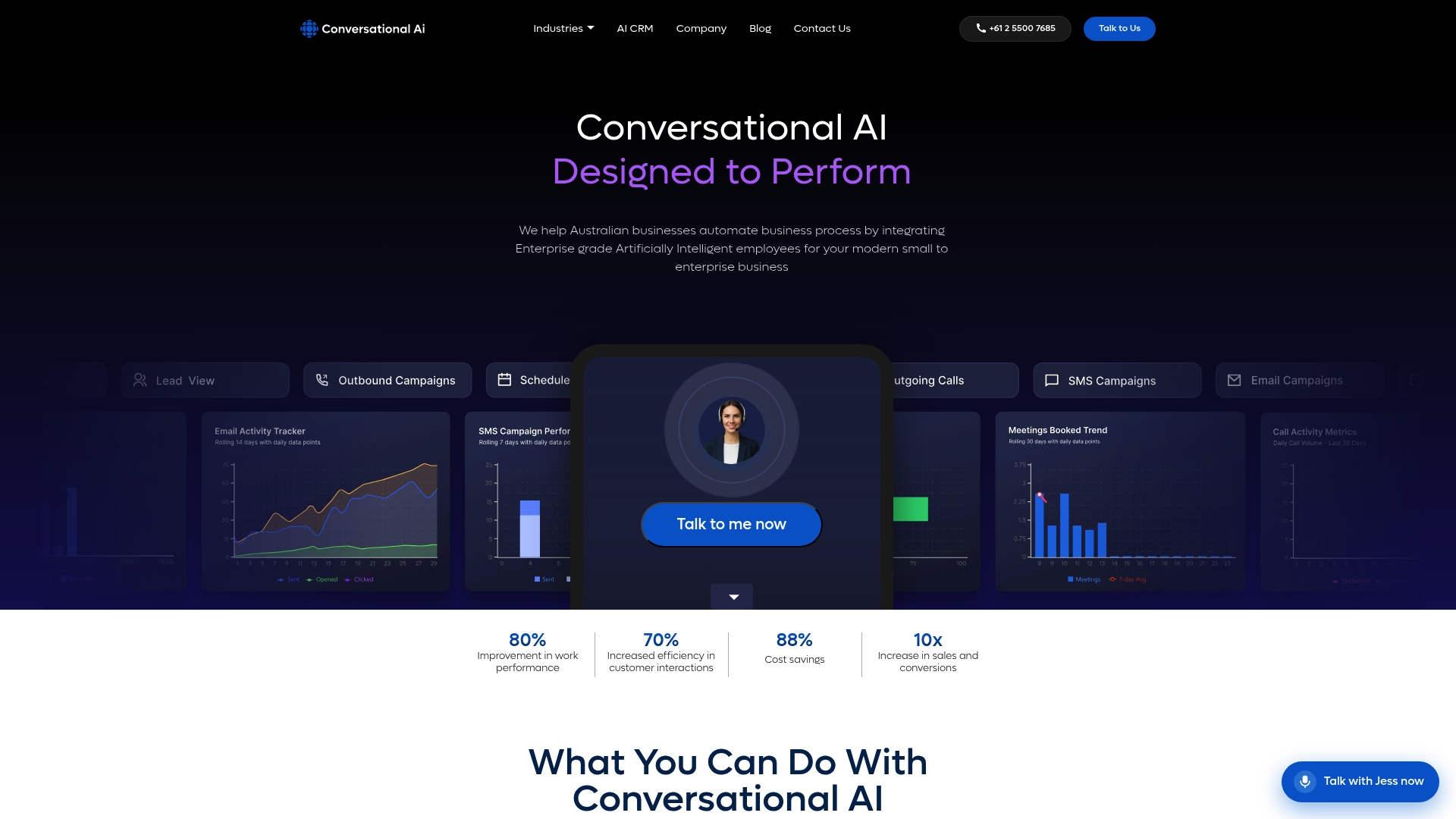
The platform delivers voice, SMS, email, and live chat agents hosted entirely within Australia, with native CRM integration, real-time monitoring, and configurable human escalation built in. There is no need to bolt privacy controls onto an offshore product after the fact. For BFSI, health, and professional services teams, that architecture difference is material.
If your programme has three or more Red scores from the diagnostic above, a discovery call with the Conversational AI team is the practical next step. Book a consultation to scope a pilot that fits your compliance requirements and existing infrastructure.
Useful Australian sources and further reading
Authoritative references:
- Office of the Australian Information Commissioner (OAIC): Privacy Act guidance, PIA requirements, and Australian Privacy Principles.
- McKinsey: Avoiding automation execution pitfalls: Three common execution failures and how to prevent them.
- Strategy-First Framework (Himanshu Shukla): Practical sequence for outcome-led automation.
- VisionX: Business process automation strategy: Why treating automation as static causes brittleness.
Conversational AI further reading:
- Automate customer service operations: 2026 enterprise guide
- AI automation for Australian businesses explained
- Multichannel AI agent deployment guide for enterprises
- Contact centre AI integration: a 2026 enterprise guide
- Conversational AI enterprise benefits: 2026 guide
This article provides general information about automation strategy and privacy compliance. It is not legal or regulatory advice. Confirm your obligations under the Privacy Act 1988 and relevant sector regulations with a qualified legal professional or the OAIC directly.
Recommended
- Automate customer service operations: 2026 enterprise guide - Conversational AI
- Types of customer service automation triggers: 2026 guide - Conversational AI
- Multichannel customer communication examples for Australian businesses - Conversational AI
- Conversational AI enterprise benefits: 2026 guide - Conversational AI