What is 24/7 AI customer support? A 2026 enterprise guide
Discover what 24/7 AI customer support is and how it transforms customer service. Learn to meet customer demands anytime with AI solutions.

24/7 AI customer support is the deployment of autonomous AI agents to resolve customer inquiries instantly, at any hour, without human intervention. These agents handle 70–80% of routine inquiries around the clock, covering tasks like order tracking, password resets, and FAQs. When a query exceeds the AI’s authority, it escalates to a human agent with full conversation context intact. For enterprise customer service managers, this model is no longer experimental. It is the operational standard that customers now expect.
What is 24/7 AI customer support and how does it differ from traditional service?
24/7 AI customer support, also called always-on AI service or autonomous customer service automation, means your support function never goes offline. Traditional support relies on rostered human agents, which creates gaps after hours, during peak periods, and across time zones. AI agents fill those gaps by responding in seconds, not hours.
The industry term for this model is conversational AI automation, and it covers more than simple chatbots. Modern AI agents use natural language understanding, contextual memory, and integration with your CRM and helpdesk to deliver responses that feel informed and consistent. They do not just match keywords. They interpret intent, retrieve relevant policy or product information, and generate replies in your brand’s voice.

AI handles routine inquiries so your human agents can focus on complex, high-stakes conversations. That division of labour is the core value proposition for enterprise teams managing thousands of interactions per week.
How does 24/7 AI customer support work in practice?
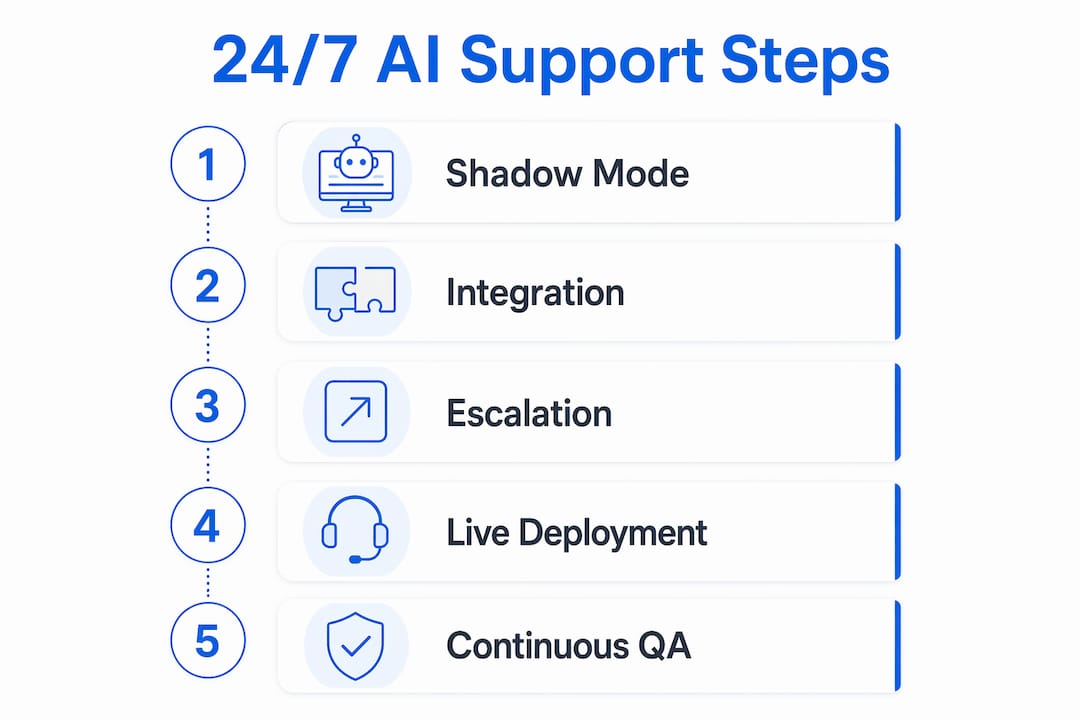
The operational mechanics follow a clear sequence. Understanding each step helps you plan deployment and set realistic expectations for your team.
- Training on your knowledge base. The AI agent ingests your existing support documentation, past tickets, macros, and product information. This is what allows it to answer accurately in your brand’s voice without manual scripting.
- Multichannel deployment. AI-powered chatbots deploy across your website, SMS, email, and social messaging apps simultaneously. Customers get a consistent experience regardless of which channel they use.
- Intent recognition and response. When a customer sends a message, the AI interprets the intent, retrieves the relevant answer, and replies instantly. Common use cases include order status, billing queries, appointment bookings, and account access issues.
- Escalation with full context. When the AI reaches its authority boundary, it hands the conversation to a human agent. Passing full conversation history and intent summaries into the agent’s system prevents customers from repeating themselves. This is the single most important technical step in the handoff process.
- Continuous audit trail. Every reply and escalation is logged automatically, creating a compliance record and a dataset for ongoing performance review.
Pro Tip: Before going live, run your AI in shadow mode. In this configuration, the AI drafts responses for human review rather than sending them automatically. Teams that skip shadow QA frequently encounter tone inconsistencies and erroneous replies that damage customer relationships.
Integration is straightforward for most enterprise environments. AI support solutions connect natively with platforms like Zendesk, Intercom, and Freshdesk, reducing deployment complexity and accelerating time to value. You do not need to overhaul your existing stack.
What are the main advantages of implementing AI customer service?
The advantages of round-the-clock AI assistance go well beyond cost reduction. Here is what enterprise leaders consistently report after deployment:
- Instant response times. Customers receive answers in seconds rather than waiting in a queue. This directly improves satisfaction scores and reduces abandonment rates.
- High-volume query handling. AI manages repetitive inquiries at scale without fatigue or inconsistency. Your human agents are freed to handle the conversations that genuinely require judgement and empathy.
- After-hours coverage without staffing costs. Overnight and weekend support no longer requires additional shifts or outsourced teams. The AI operates continuously at a fixed cost.
- Consistent brand tone. Every response follows your approved language and policy. There is no variation between agents or shifts.
- Multichannel and multilingual reach. AI agents cover multiple channels and can respond in multiple languages without requiring native-speaking staff for each market.
- Improved compliance and auditability. Every interaction is recorded, which supports regulatory requirements and internal quality assurance.
AI reduces wait times from hours to seconds while lowering support costs by automating repetitive inquiries. That combination of speed and cost efficiency is what makes the business case compelling for medium to large enterprises.
The role of AI in customer service extends beyond deflection metrics. When human agents are no longer buried in password reset requests, they build stronger relationships with customers who have complex or sensitive needs. That shift in agent workload is one of the most underrated benefits of the model.
What challenges and limitations should businesses consider?
AI customer support is not without its risks. Knowing them in advance lets you plan around them rather than react to them.
- Lack of empathy in sensitive situations. AI cannot read emotional distress the way a skilled human agent can. Complaints involving grief, health, or financial hardship require human handling, and your escalation rules must reflect that.
- Risk of misinterpretation. AI’s inherent limitations include misreading ambiguous queries, which can produce incorrect automated resolutions. Regular quality audits catch these errors before they compound.
- Data continuity during handoffs. The primary failure point in AI-human handoffs is data discontinuity. If the human agent receives no context, the customer must repeat their entire issue. This erodes trust quickly.
- Brand voice drift. AI trained on outdated documentation can produce responses that no longer reflect your current policies or tone. Knowledge base maintenance is an ongoing requirement, not a one-time task.
- Privacy and compliance obligations. Customer data processed by AI must comply with Australian Privacy Act requirements and any sector-specific regulations. Data sovereignty matters, particularly in healthcare and financial services.
Pro Tip: Assign a dedicated QA reviewer for the first 60 days of deployment. Review a random sample of AI responses weekly and flag any that fall outside your tone guidelines or policy boundaries. This discipline catches problems early and builds confidence in the system.
How can enterprises successfully implement 24/7 AI customer support solutions?
A phased implementation reduces risk and builds internal confidence. The following sequence reflects best practice for enterprise deployments.
- Audit your current support volume. Identify the top 20 query types by volume. These are your first automation targets. Starting narrow and deep is more effective than broad and shallow.
- Deploy in shadow mode first. Let the AI draft responses while human agents review and send them. Shadow mode deployment is the critical QA step that aligns brand voice before full automation begins.
- Integrate with your existing systems. Connect the AI to your CRM, helpdesk, and knowledge base. Migrating legacy systems to conversational AI requires careful data mapping, but the integration pays off in response accuracy and context continuity.
- Define escalation rules clearly. Clear escalation rules and authority boundaries determine when the AI hands off to a human. Define these by query type, sentiment signal, and customer tier.
- Train the AI on brand tone and policy. Feed the system your style guide, approved responses, and current product documentation. Refresh this content whenever policies change.
- Monitor, measure, and adjust. Track resolution rate, escalation rate, customer satisfaction scores, and average handling time. Use these metrics to retrain the AI and expand its scope progressively.
The table below summarises the key evaluation criteria for each deployment phase.
| Deployment phase | What to measure | Success indicator |
|---|---|---|
| Shadow mode | Tone accuracy, factual correctness | Less than 5% of responses flagged for correction |
| Partial automation | Resolution rate, escalation rate | AI resolves majority of targeted query types |
| Full deployment | CSAT, average handling time, ticket volume | Measurable reduction in queue and improved satisfaction |
| Ongoing optimisation | Knowledge base freshness, error rate | Declining error rate month on month |
What does the future hold for AI customer service in enterprises?
The next generation of AI customer support moves from reactive to proactive. Several trends are already shaping enterprise deployments in 2026.
- Agentic AI with autonomous decision-making. Rather than simply answering questions, agentic AI takes actions. It can process a refund, reschedule an appointment, or update account details without human involvement.
- Omnichannel orchestration. AI agents will manage the full customer journey across voice, chat, SMS, and email from a single conversation thread. Understanding how voice and chat AI differ becomes critical as enterprises build unified channel strategies.
- Personalised responses at scale. Advances in natural language understanding allow AI to tailor responses based on customer history, preferences, and sentiment. Generic replies are giving way to contextually aware conversations.
- Hybrid AI-human workspaces. AI complements human agents by handling volume while humans focus on high-stakes interactions. Shared workspaces where AI suggests responses in real time and humans approve them are becoming standard.
- Predictive and proactive support. AI will identify patterns in customer behaviour and reach out before a problem escalates. A customer whose order is delayed receives a proactive update rather than waiting to contact support.
These trends reinforce a clear direction. AI customer support is not a cost-cutting measure. It is a customer experience investment that compounds over time as the system learns and improves.
Key takeaways
24/7 AI customer support delivers the greatest value when shadow mode deployment, clear escalation rules, and continuous knowledge base maintenance are treated as non-negotiable operational standards.
| Point | Details |
|---|---|
| Core resolution capacity | AI agents resolve 70–80% of routine inquiries instantly, freeing human agents for complex cases. |
| Shadow mode is non-negotiable | Deploy AI in review mode first to catch tone errors and policy gaps before full automation. |
| Data continuity drives satisfaction | Pass full conversation history to human agents during escalation to prevent customers repeating themselves. |
| Integration accelerates value | Connecting AI to your CRM and helpdesk from day one improves accuracy and reduces deployment risk. |
| Future is proactive and agentic | Next-generation AI will take autonomous actions and reach out to customers before issues escalate. |
What I have learned from watching enterprises deploy AI support
The enterprises that get the most from AI customer support share one habit: they treat the first 90 days as a learning period, not a launch. They run shadow mode longer than feels necessary. They review flagged responses weekly. They update their knowledge base before it drifts out of date.
The ones that struggle do the opposite. They automate quickly, skip the QA phase, and then spend months firefighting tone complaints and incorrect resolutions. I have seen this pattern repeat across industries. The technology is not the problem. The process discipline is.
Data continuity during escalation is the issue that surprises managers most. You can have a technically excellent AI and still frustrate customers if the handoff to a human agent loses context. The customer repeats their issue. The agent starts from scratch. The satisfaction score drops. Fixing this requires deliberate integration work upfront, not a patch after complaints arrive.
The other thing worth saying plainly: AI does not replace your best agents. It removes the work that was never a good use of their skills in the first place. When your team stops answering the same ten questions on repeat, they have capacity for the conversations that actually build customer loyalty. That shift in workload is where the real return on investment lives.
— Sowrabh
How Conversational AI supports Australian enterprises around the clock
Australian enterprises face specific compliance and data sovereignty requirements that generic AI platforms do not address. Conversational AI is built for this environment.
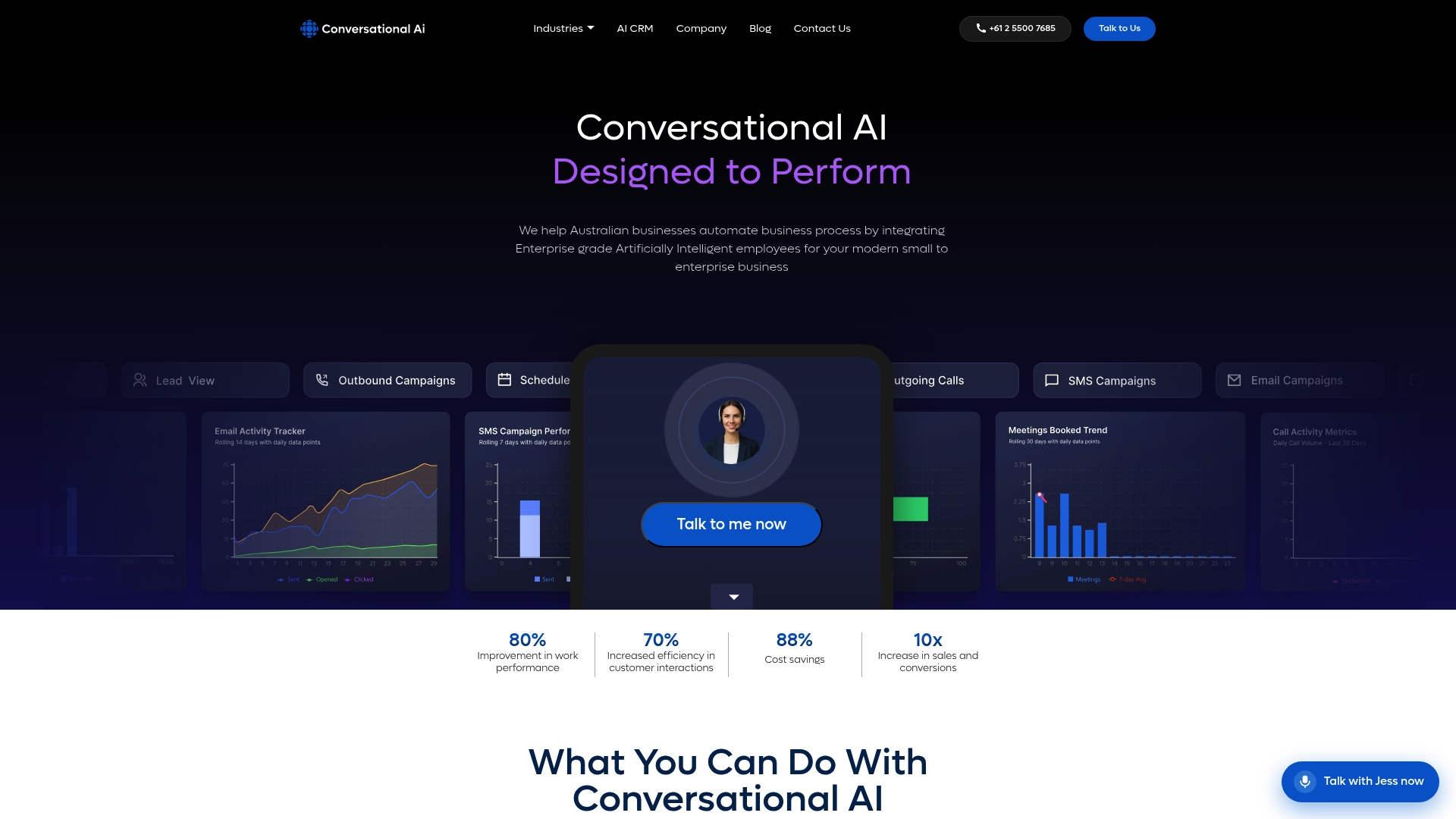
The Conversational AI platform provides multi-channel AI agents across voice, SMS, email, and live chat, all hosted within Australia to meet local privacy obligations. Integration with your existing CRM and helpdesk is built into the deployment process, not bolted on afterwards. The platform supports phased rollouts, including shadow mode, so your team maintains quality control throughout. If you are evaluating AI chatbots for support or planning a full enterprise deployment, Conversational AI offers the infrastructure and local expertise to do it properly.
FAQ
What is 24/7 AI customer support?
24/7 AI customer support is the use of autonomous AI agents to resolve customer inquiries instantly at any hour, without requiring human agents to be online. These agents handle the majority of routine queries and escalate complex issues to human staff with full conversation context.
How does AI customer support handle complex or sensitive queries?
AI support systems use defined escalation rules to transfer complex or sensitive conversations to human agents. The AI passes the full conversation history and customer context so the agent can continue without asking the customer to repeat themselves.
What is shadow mode in AI support deployment?
Shadow mode is a deployment stage where the AI drafts responses for human review before they are sent to customers. This QA step allows teams to verify tone, accuracy, and policy compliance before enabling full automation.
How does 24/7 AI support reduce costs for enterprises?
AI handles high volumes of repetitive inquiries continuously without additional staffing costs for after-hours or peak periods. This reduces the need for overnight shifts and outsourced support while maintaining consistent response quality.
Is 24/7 AI customer support suitable for regulated industries in Australia?
Yes, provided the platform stores and processes data within Australia to meet Privacy Act obligations. Enterprises in healthcare, finance, and professional services should confirm that their AI provider offers Australian data hosting and maintains a full audit trail of every interaction.