Security Teams: Three Vendor Demands for Knowledge Base AI
Enterprise security teams: three procurement checks and OAIC-aligned acceptance criteria to verify permission-aware retrieval, in-use protections and...

A secure knowledge base AI is a retrieval and generation system that answers questions from your organisation’s own documents while enforcing the same access rules, encryption and audit standards your existing systems already meet. Three things separate a genuinely secure platform from a demo that merely looks polished: retrieval that respects each user’s permissions, a firm no-training-on-customer-data commitment, and provenance logs you can hand to an auditor. This matters most for IT and security teams in regulated enterprises, where a wrong answer or a leaked record is a compliance incident, not just an inconvenience.
TL;DR:
- Permission-aware retrieval must enforce access controls at every query stage to prevent unauthorized information from being disclosed, not just at login.
- Provenance logging should explicitly record document IDs, passages, and policy versions for each answer to enable auditability and explainability.
- Data in transit and while in use must be protected with encryption or homomorphic encryption to limit exposure during computation, especially in regulated industries.
- Vendors should demonstrate denial of access or refused retrieval attempts to prove security controls effectively enforce permissions.
- Deployment options like on-premises or sovereign hosting are often required for compliance, with control over data location, keys, and integration with existing security systems.
Table of Contents
- Where a secure AI knowledge base fits in your architecture
- Key security and access-control features to demand
- How secure knowledge base AI works under the hood
- Privacy and compliance checklist for regulated data
- Deployment and hosting: on-premises, private cloud or SaaS
- Logging, audit trails and ongoing assurance
- Procurement checklist: what to ask before you sign
- Why security-first design still gets underrated
- How Conversational AI supports secure knowledge deployments
- Sources
- FAQ
Where a secure AI knowledge base fits in your architecture
A secure knowledge base AI is not a single tool. It is a chain of components, and each one is a place security can either hold or fail. The ingestion pipeline pulls in documents from wikis, CRMs, ticketing systems and file shares, then breaks them into chunks and converts them into embeddings stored in a vector index. A retrieval layer matches a user’s query against that index, a grounding step attaches the retrieved passages to the prompt, and the language model generates the final response. Connectors sit at the edges, moving data in and requests out.
For enterprise deployments, the integration points matter as much as the model. The platform needs to talk to your identity provider for authentication, your CRM or document stores for content, and your SIEM for security telemetry. If any of those connections skip permission checks or fail to log activity, the rest of the security design is cosmetic.
Regulated sectors give the clearest picture of why this matters. In healthcare, a clinician’s assistant needs to surface patient history without exposing records outside that clinician’s care team. In banking and finance, a compliance officer querying transaction policy documents cannot be shown draft material still under legal review. In HR, an employee asking about leave entitlements should never retrieve another staff member’s file by accident. Each of these is a permission boundary the retrieval layer has to enforce at query time, not just at login. A knowledge base that gets this wrong does not fail loudly. It fails by quietly answering questions it should have refused.

Key security and access-control features to demand
Feature checklists are easy to write and hard to verify. During a vendor evaluation, ask for a live demonstration of each of the following rather than accepting a slide that lists them.
- Permission-aware retrieval: the system inherits access control lists from source systems and enforces them per query, refusing or redacting passages the requesting user cannot see rather than filtering after the fact.
- Fine-grained RBAC and ABAC: roles and attributes govern not just who can log in, but which documents, fields and answer types each session can touch, with support for ephemeral or just-in-time elevated access.
- PII detection at ingestion: sensitive fields are classified and either redacted or minimised before they ever reach the vector index, rather than relying on the model to behave well later.
- Exportable retrieval provenance: every answer traces back to specific document IDs, exact passages and the policy version that was enforced at the time.
- Strong identity integration: single sign-on, SCIM provisioning, multi-factor authentication and session expiry policies that match your existing identity stack rather than running a parallel login system.
Vendors will often describe permission awareness as a feature of the underlying vector database. Push past that. Ask whether enforcement happens at every query or only at ingestion, and ask for a test case where a user without access to a document type still cannot retrieve it through a rephrased question.
Pro Tip: Ask a vendor to demonstrate a denied retrieval, not just a successful one. A system that only shows you what it can find rarely shows you what it correctly refuses.
How secure knowledge base AI works under the hood
Retrieval-augmented generation follows a consistent pattern: ingest documents, index them as embeddings, retrieve the closest matches to a query, ground the model’s prompt in those matches, then generate a response. Provenance is not optional in this chain. Without a record of which passages fed which answer, you cannot explain a wrong response, cannot prove a data boundary held, and cannot satisfy an auditor asking how a specific answer was produced.

The exposure points sit at three stages: data at rest in the vector store, data in transit between the retrieval layer and the model, and data in use while the model processes a prompt. Standard vector databases protect the first two reasonably well with disk encryption and TLS. The third, protecting data while it is actively being computed on, is where most platforms are weakest, and where security architects should ask the most pointed questions.
Some vendors now offer encrypted-search vector databases that keep embeddings encrypted through most of the retrieval process, decrypting only at a final reranking step, which limits how much plaintext is ever exposed. Fully homomorphic encryption takes this further by allowing computation on encrypted data throughout, but it carries a real performance cost and adds engineering complexity that most enterprise deployments are not yet ready to absorb at scale.
A well-structured knowledge base is not a nice-to-have. A significant portion of digital workers report struggling to find the information they need to do their jobs, which means a poorly indexed or poorly governed knowledge base does not just create a security risk, it undermines the reason the AI agent exists in the first place.
The design patterns that prevent customer data leaking into shared models are reasonably well established: ground answers at query time rather than fine-tuning on customer content, commit contractually to a no-training policy, and where the sensitivity warrants it, run a private model instance rather than a shared multi-tenant one. On the operational side, integration hooks for data loss prevention, prompt and output inspection, and controlled model update windows let your existing security tooling watch the AI layer the same way it watches everything else.
Privacy and compliance checklist for regulated data
The OAIC’s guidance on commercially available AI products is direct on one point that trips up a lot of procurement teams: there is no broad “legitimate interests” basis for using personal information to train AI under the Privacy Act. If a system will collect, store or use personal information, you need to work that out early, and sensitive information generally requires consent or a clear legal basis rather than an assumption that business benefit is enough.
Turning that guidance into action looks like this:
- Run a privacy impact assessment before any customer or employee data touches the ingestion pipeline, and repeat it whenever the scope of indexed data changes.
- Prefer de-identification wherever a use case allows it, and treat data minimisation as the default rather than an afterthought.
- Get explicit consent when sensitive information (health, financial, biometric) has no other lawful basis for use.
- Meet APP 5 notification obligations by telling individuals when their information is being used in an AI system, not only when it is collected.
- Map APP 8 cross-border disclosure obligations before any data flows offshore, including to a vendor’s overseas infrastructure or subcontractors, an area covered in more detail in our guide to preventing offshore data transfers.
- Document the model’s lifecycle, including retraining events and version changes, so auditors can reconstruct what the system knew and when.
OAIC’s own checklist for privacy considerations when training AI models covers similar ground in more procedural detail, including what to check before deciding data can be de-identified. Keep the outputs of every PIA, every consent record and every vendor agreement on file. Auditors ask for evidence, not intentions.
Deployment and hosting: on-premises, private cloud or SaaS
Where a knowledge base AI is hosted shapes how much control your security team retains. On-premises deployment gives full control over data location and network boundaries but pushes the operational burden, patching, scaling, model updates, entirely onto your own team. Private cloud hosting keeps that operational load with a vendor while still isolating your data from other tenants. Sovereign hosting arrangements guarantee data stays within a specific jurisdiction, which matters when a regulator asks where records physically sit. Commercial multi-tenant SaaS is the fastest to deploy but usually the hardest to get firm data residency and isolation guarantees from.
The controls that matter regardless of model are bring-your-own-key encryption, integration with your own hardware security module or key management service, network segmentation between the AI layer and core systems, and contractual clauses that specify exactly where data is processed and by whom.
For regulated sectors, particularly finance and healthcare, region-based or sovereign hosting is often a hard requirement rather than a preference. Our guides on passing APP 8 and APRA CPS 230 obligations with private cloud AI and sovereign AI compliance go into the contractual specifics worth putting in front of legal before signing anything.
Logging, audit trails and ongoing assurance
A retrieval trace is only useful if it contains enough detail to reconstruct what happened. At minimum, that means the requesting user’s identity, the exact query text, the IDs and passages of every document retrieved, the policy version enforced at that moment, and a timestamp. Practitioner guidance on audit-grade logging treats this level of detail as the baseline for reproducing an answer under audit, not an advanced feature.
- Logs should export in formats your SIEM already ingests, with retention periods that match your sector’s regulatory minimums rather than a vendor’s default.
- CISA’s logging reference architecture recommends preserving source fidelity and explicitly identifying AI inputs and outputs within logging pipelines, which supports both threat hunting and forensic reconstruction.
- Continuous validation matters as much as the initial setup: monitor for model drift, keep a human in the loop for high-stakes answers, and schedule audits rather than waiting for an incident to trigger one.
- Incident response plans need AI-specific runbooks: how to revoke a compromised model’s access, how to determine which retrieved documents were exposed, and how to notify affected individuals under your existing breach notification obligations.
Guidance on why audit trails matter for AI system decisions covers how to structure this evidence so it holds up when a regulator or a customer asks for it.
Procurement checklist: what to ask before you sign
Vendor evaluation should be structured, not conversational. Ask directly about data residency, whether customer data is ever used for training, whether logs are exportable in full, how data is encrypted while in use (not just at rest and in transit), and what third-party certifications or audit reports back their claims.
- Scope a proof of concept around a permission-boundary test, not just answer quality: can a low-privilege user extract high-privilege information through clever phrasing?
- Set integration acceptance criteria for identity, SIEM and DLP connections before the PoC starts, with defined performance service levels.
- Treat vague answers about “in-use” encryption or an unwillingness to name subcontractors as disqualifying red flags.
Our overview of enterprise AI model management is a useful companion when drafting these acceptance criteria.
Pro Tip: Get “no training on customer data” written into the contract, not just stated in a sales call. A verbal assurance is not evidence during an audit.
Why security-first design still gets underrated
Feature checklists matter, but the enterprises that get burned are usually the ones that stopped checking after signing. Governance, drift monitoring and human review need the same budget line as the initial security review. I have seen “no training on customer data” treated as marketing rather than a contractual, auditable commitment, and that gap is where the real risk sits.
— Sowrabh
How Conversational AI supports secure knowledge deployments
If your organisation needs a knowledge base AI that keeps data within its own control while automating customer-facing conversations, consider a private cloud, Australia-hosted platform built around data sovereignty rather than added onto an existing product.
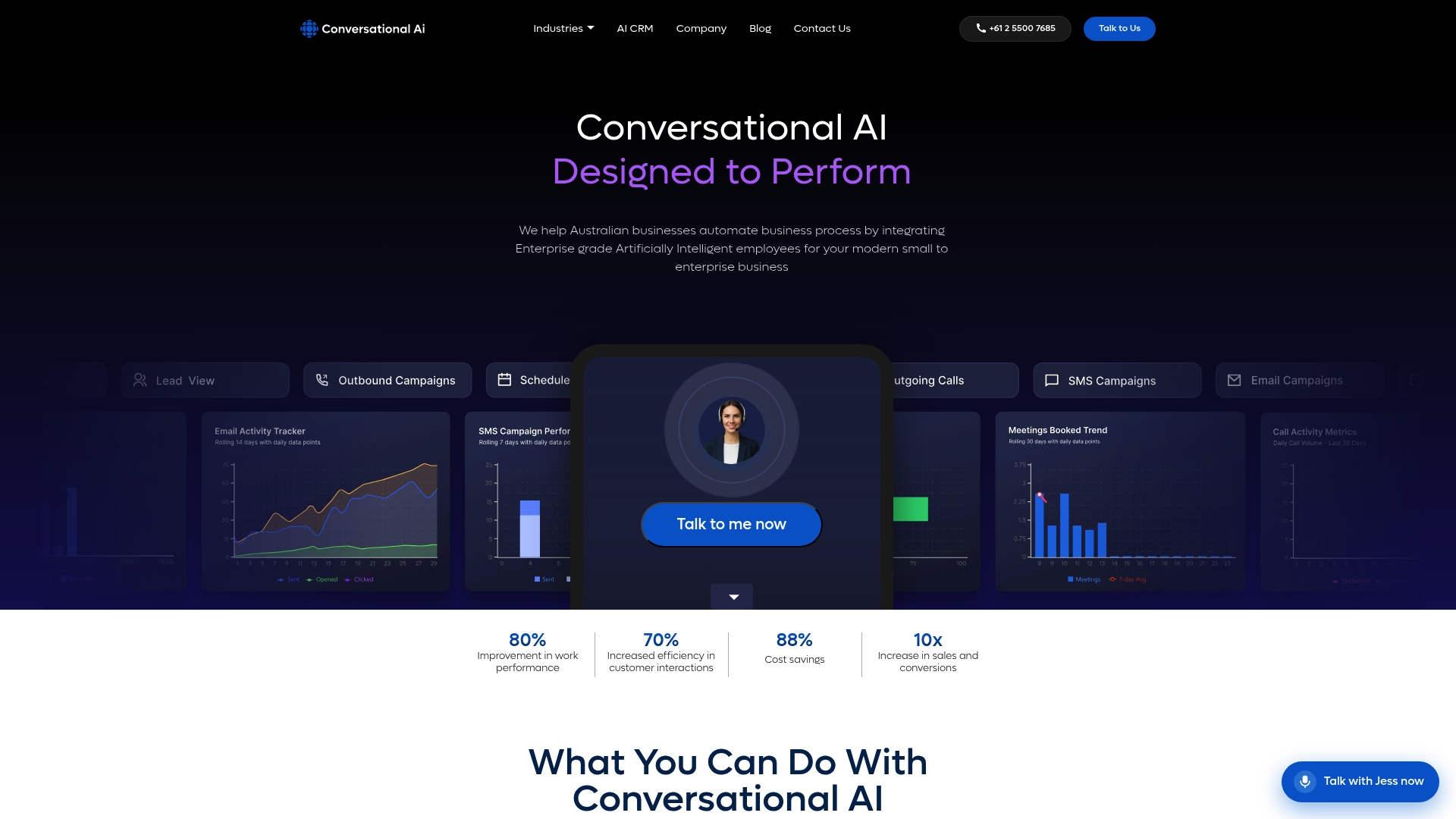
The platform’s multichannel agents cover voice, SMS, email and live chat, and its on-premises deployment option suits organisations that need to keep processing entirely within their own infrastructure. Regulated sectors are the platform’s core focus, with dedicated approaches for healthcare and banking and finance where data residency is not negotiable. For teams evaluating a secure knowledge base AI as part of a wider CRM integration, the Conversational AI CRM page is a reasonable next stop, and a technical demo is the fastest way to see how permission enforcement and provenance logging hold up against your own acceptance criteria.
Sources
- OAIC guidance on privacy and the use of commercially available AI products
- Logging reference architecture (CISA)
- Practitioner-level guidance on audit-grade logging and traceability
This article is general information, not a substitute for advice from a qualified lawyer. Consult a qualified legal professional about your own circumstances before acting on anything here.
FAQ
What is knowledge base AI?
Knowledge base AI refers to a system that retrieves answers from an organisation’s own documents and generates a response grounded in that content, rather than relying purely on a model’s general training. It typically combines a vector index, a retrieval layer and a language model in what is commonly called a retrieval-augmented generation architecture.
What is the best AI knowledge base tool?
There is no single best tool: the right choice depends on your data residency requirements, existing identity and SIEM stack, and whether you need on-premises, private cloud or SaaS hosting. Enterprises in regulated sectors typically prioritise platforms with permission-aware retrieval, exportable audit logs and a contractual no-training-on-customer-data commitment over ones that only score well on general answer quality.
What’s the most secure AI?
Security is not a single fixed property of an AI system. It depends on how well retrieval respects access controls, how data is protected at rest, in transit and while being processed, and whether the vendor can produce audit-grade logs on request, so evaluate each platform against your own threat model rather than a general reputation.
Can you give me an example of knowledge based AI?
A common example is an internal support assistant that answers employee questions by retrieving passages from HR policies, IT documentation or compliance manuals and grounding its response in those specific passages. In regulated sectors, the same pattern applies to clinical staff querying patient care guidelines or compliance officers checking policy documents, with access boundaries enforced at every query.