Private AI deployment explained for enterprise IT teams
Discover how private AI deployment explained can enhance your enterprise's data security, governance, and efficiency. Explore best practices now!

Private AI deployment is the practice of running AI workloads entirely within infrastructure your organisation controls, keeping data, models, and outputs inside your own security perimeter. The industry term for this practice is “on-premises or private cloud AI,” and it sits in direct contrast to public AI services where your data leaves your environment. 85% of enterprises currently operate two or more competing AI platforms, yet only 10% have automated monitoring in place. That gap is exactly why IT and operations managers are asking hard questions about data sovereignty, governance, and control. This article covers the core deployment models, the real challenges you will face, and the best practices that separate successful rollouts from expensive failures.
What is private AI deployment and why does it matter?
Private AI deployment means your AI systems operate on infrastructure you own or exclusively lease, with no shared tenancy and no data leaving your jurisdiction. This matters because Generative AI saves workers 3.6 hours per week on average, and enterprises want that productivity gain without surrendering control of sensitive data. For sectors like healthcare, finance, and professional services, sending customer data to a third-party public cloud is often a compliance breach waiting to happen. Private deployment closes that exposure.
Data sovereignty is the primary driver for most Australian enterprises making this move. Australian Privacy Act obligations, combined with sector-specific regulations, require organisations to demonstrate where data is processed and stored. A private AI architecture gives you that demonstrability. Conversational AI, for example, hosts its entire platform within Australia, giving clients documented proof of data residency rather than a contractual promise.

What are the primary private AI deployment models?
Private AI deployment models cluster into three distinct categories, each serving different sovereignty and operational needs. Understanding the trade-offs between them is the first decision your team needs to make.
Fully on-premises AI
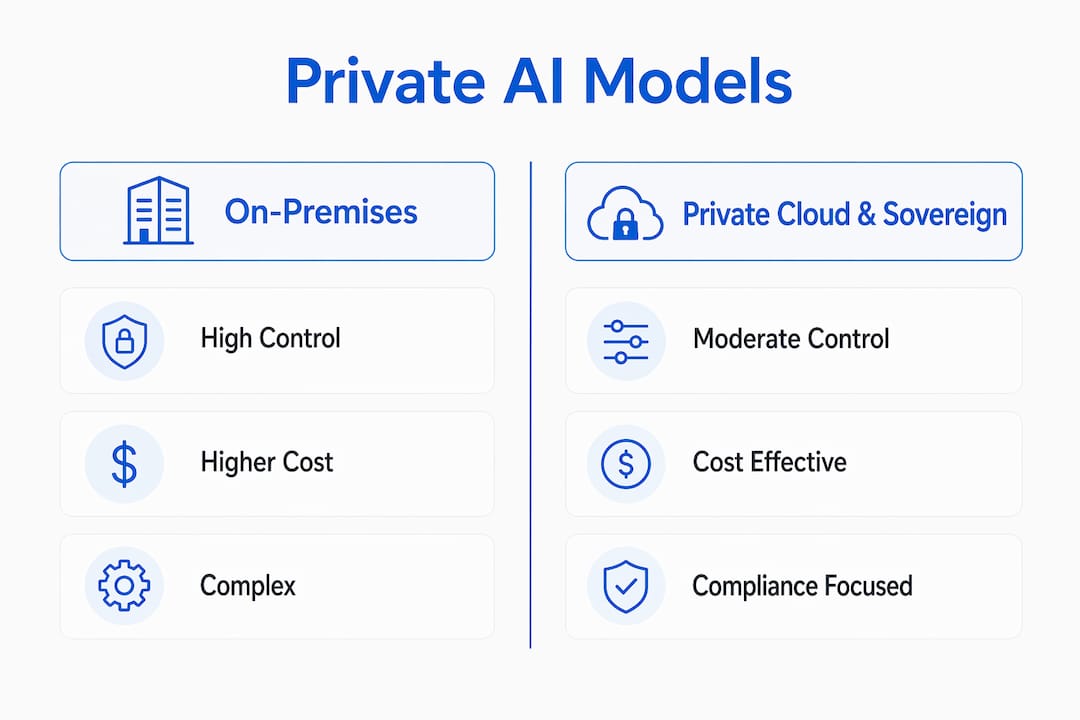
On-premises deployment runs AI workloads on hardware your organisation owns and operates inside its own data centres. This model gives you maximum control over data, network access, and security configuration. On-premises is preferred when datasets exceed 2–3 petabytes or when stringent data residency rules apply. The trade-off is capital expenditure, long procurement cycles, and the need for in-house infrastructure expertise.
Private cloud AI
Private cloud AI runs on dedicated cloud infrastructure, either in a colocation facility or a single-tenant cloud environment. You get cloud-style agility, including rapid provisioning and elastic capacity, without sharing compute or storage with other tenants. This model suits organisations that need to scale AI workloads quickly but cannot justify the capital cost of owned hardware. Egress fees and vendor lock-in are the main cost risks to manage.
Sovereign AI deployment
Sovereign AI deployment goes further than standard private cloud by ensuring data residency and jurisdictional immunity are legally demonstrable. It protects your data from foreign disclosure orders such as the US CLOUD Act or FISA requests. Sovereign AI can run on-premises or in an accredited sovereign cloud environment. Australian government agencies and regulated financial institutions are the most common adopters.
| Model | Control | Cost | Complexity | Compliance strength |
|---|---|---|---|---|
| Fully on-premises | Highest | High capital | High | Very high |
| Private cloud | High | Moderate operational | Moderate | High |
| Sovereign AI | Highest | High operational | High | Maximum |
Most large enterprises do not pick one model and stick with it. Hybrid private AI architectures combining public SaaS, private cloud, and on-premises components are pragmatic and necessary for most organisations to balance privacy, usability, and cost.
Pro Tip: Map each AI workload to a model based on data sensitivity and volume before you design infrastructure. Not every workload needs sovereign-grade control, and over-engineering early workloads wastes budget you will need later.
What are common challenges in deploying private AI?
Private AI deployment is not simply a technology problem. The hardest challenges are organisational and financial.
- Fragmented governance. 32% of enterprises cite the absence of a single accountable AI owner as their top governance barrier. Without a clear owner, decisions stall and accountability disappears.
- Cost overruns. Cost calculation errors for AI scaling projects can reach 500–1,000% without standardised infrastructure planning. That is not a rounding error. It is a project-killing surprise that appears when you move from pilot to production.
- Shadow AI. 49% of enterprises identify unauthorised AI pipelines as their most severe control failure. Teams build their own tools when official channels are too slow, and those tools often process sensitive data outside any governance framework.
- Skills mismatch. Only 35% of AI capabilities in large enterprises are built by IT. Data scientists who build models and infrastructure engineers who run production systems have non-overlapping skill sets, and conflating the two roles creates operational bottlenecks.
- Scaling complexity. Moving from a successful pilot to a production deployment serving multiple business units exposes every gap in your infrastructure design. Tooling that works for one model often breaks under the load of ten.
Pro Tip: Before you approve any AI pilot, document exit criteria with measurable business KPIs. Pilots without defined success metrics become indefinite, resource-draining experiments that never reach production.
How to choose the right private AI deployment approach
Choosing a deployment model requires honest assessment across four dimensions: data volume, jurisdictional exposure, workload diversity, and sustained cost.
-
Assess data gravity. The economics of AI workloads shift decisively towards on-premises when datasets exceed petabyte scale. Egress fees from cloud providers become prohibitive at that volume. Calculate your data growth trajectory over three years, not just current volume.
-
Map jurisdictional exposure. Identify which datasets are subject to Australian Privacy Act obligations, sector-specific rules, or contractual data residency requirements. If any dataset could be subject to a foreign disclosure order, sovereign AI deployment is the only defensible choice.
-
Catalogue workload diversity. List every AI use case your organisation runs or plans to run. Customer-facing conversational agents, internal analytics models, and document processing pipelines each have different latency, availability, and compliance requirements. A single deployment model rarely fits all of them.
-
Calculate cost at scale. Include egress charges, GPU capacity costs, licensing, and the labour cost of operating the infrastructure. 90% of CIOs identify cost as a primary constraint limiting AI value realisation. Build your cost model before you commit to architecture, not after.
-
Evaluate platform unification options. A unified AI platform layer providing consistent data contracts, identity-bound access, lifecycle policies, and audit chains reduces complexity across hybrid deployments. Without it, each model and environment becomes a separate operational silo.
-
Separate build and run responsibilities. AI model building and infrastructure engineering require non-overlapping skill sets. Assign clear ownership for each function before deployment begins. This single decision prevents more operational failures than any technology choice.
For practical guidance on the technical workflows involved, the AI deployment pipeline guide covers lifecycle management in detail.
What are best practices for managing private AI at scale?
Operational discipline separates private AI deployments that deliver value from those that drain budgets and erode trust.
- Containerise and orchestrate. Reliable production AI requires containerisation, orchestration via Kubernetes, API management, and monitoring. Without these, scaling a model from one environment to ten creates operational chaos rather than capacity.
- Establish a single AI owner. Distributed ownership is the root cause of most governance failures. Appoint one person or team accountable for the entire private AI portfolio, with authority to enforce standards across business units.
- Automate monitoring and alerting. Model drift, data quality failures, and infrastructure outages all degrade AI performance silently if you rely on manual checks. Automated monitoring with defined alert thresholds catches failures before they affect customers.
- Use risk-based deployment strategies. Canary deployments route 1% of traffic to a new model version initially, enabling safe rollbacks if failures emerge. This is the industry standard for customer-facing AI workflows where a bad model update can affect thousands of interactions instantly.
- Build audit trails and data contracts. Every model version, training dataset, and inference output should be logged with identity-bound access records. This is not optional for regulated industries. It is the evidence base for compliance audits and incident investigations.
- Control shadow AI actively. Set up a fast-track approval process for new AI tools so teams do not build unauthorised pipelines out of frustration. Speed of approval is the most effective shadow AI prevention measure available.
Pro Tip: Review your enterprise chatbot implementation approach against these operational standards before go-live. Most cost overruns trace back to governance gaps that were visible at the design stage.
Key takeaways
Private AI deployment succeeds when governance, infrastructure, and cost planning are treated as equally important as model selection.
| Point | Details |
|---|---|
| Define your model by data volume | Choose on-premises when datasets exceed 2–3 petabytes; private cloud suits moderate-scale workloads. |
| Appoint a single AI owner | 32% of enterprises lack one accountable owner, which is the leading cause of governance failure. |
| Plan costs before committing | Scaling errors can reach 500–1,000% without standardised infrastructure planning from the start. |
| Control shadow AI proactively | 49% of enterprises cite unauthorised pipelines as their most severe control failure. |
| Use canary deployments | Routing 1% of traffic to new model versions first is the industry standard for safe production rollouts. |
What I have learned from watching enterprise AI governance fail
The most consistent pattern I see in enterprise private AI deployments is not a technology failure. It is a governance failure that was predictable from day one. Organisations invest heavily in selecting the right infrastructure model, then neglect to assign a single person with real authority to govern it. The result is fragmented ownership, shadow AI pipelines running outside any control framework, and cost overruns that blindside the CFO twelve months into a project.
The second pattern is treating private AI deployment as a single architecture decision rather than a portfolio problem. Your customer-facing conversational AI agent has completely different sovereignty, latency, and compliance requirements than your internal analytics pipeline. Forcing both into the same deployment model either over-engineers the analytics workload or under-protects the customer-facing one.
The organisations that get this right start with a clear data classification exercise, appoint a named AI owner before the first pilot launches, and build a unified platform layer that lets them move workloads between on-premises, private cloud, and sovereign environments without rebuilding governance from scratch each time. That pragmatic, portfolio-based approach is not glamorous. It is, however, the only one I have seen consistently deliver value at scale.
— Sowrabh
How Conversational AI supports secure private AI deployment
Australian enterprises exploring private AI deployment need a platform that treats data sovereignty as a design principle, not an afterthought.
Conversational AI hosts its entire platform within Australia, giving IT and operations managers documented proof of data residency and compliance with Australian Privacy Act obligations. The platform supports voice, SMS, email, and live chat agents that integrate with existing CRM infrastructure, without routing data through offshore environments. For organisations in healthcare, finance, and professional services, that distinction matters enormously. Explore how Conversational AI’s enterprise agents can support your private AI strategy, or read more about AI in customer service to see how private deployment drives better customer outcomes.
FAQ
What is private AI deployment?
Private AI deployment is the practice of running AI workloads on infrastructure your organisation controls, keeping data and models within your own security perimeter rather than on shared public cloud services.
When should an enterprise choose on-premises over private cloud AI?
On-premises deployment is the right choice when datasets exceed 2–3 petabytes or when data residency rules require physical control of hardware. Private cloud suits organisations that need faster provisioning without the capital cost of owned infrastructure.
What is sovereign AI deployment?
Sovereign AI deployment ensures data residency and jurisdictional immunity are legally demonstrable, protecting data from foreign disclosure orders such as the US CLOUD Act. It can run on-premises or in an accredited sovereign cloud environment.
What causes the biggest cost overruns in private AI projects?
Cost calculation errors in AI scaling projects can reach 500–1,000% without standardised infrastructure planning. The most common cause is moving from pilot to production without accounting for egress fees, GPU capacity, and operational labour costs.
How does shadow AI create risk in private AI deployments?
Shadow AI refers to unauthorised AI pipelines built by teams outside official governance frameworks. 49% of enterprises identify it as their most severe control failure, because these pipelines often process sensitive data with no audit trail or compliance oversight.