Act in 48 Hours: OAIC Chatbot Rules, PIA, Contracts, Sovereign Hosting
Practical compliance playbook for Australian organisations. Convert OAIC chatbot guidance into PIA triggers, contract clauses and deployments hosted in...

The OAIC’s message is direct: the Privacy Act 1988 applies fully to AI chatbots, and staff should avoid entering personal or sensitive information into publicly available tools. Run or refresh a Privacy Impact Assessment, update your privacy notices, and flag AI clearly in your interface. Where the risk is material, favour an enterprise licence or an Australia-hosted private deployment over open public tools.
TL;DR:
- Conduct a Privacy Impact Assessment before deploying any AI chatbot, especially if it collects personal or sensitive data, to ensure privacy risks are managed proactively.
- Always inform users when interacting with AI and clearly disclose how their data will be used, especially if chat logs are used for model training or analytics.
- Prefer enterprise or Australia-hosted private deployments for sensitive data to maintain control over data residency, training, and retention policies, reducing privacy risks.
- Avoid entering personal or client details into free public chatbots, as such data can be absorbed into third-party models and be nearly impossible to delete.
- Ensure contracts with AI vendors specify data retention, training opt-outs, audit rights, and clear notification procedures for policy changes to maintain compliance and control.
Table of Contents
- Quick takeaways and what to action this week
- What the OAIC guidance documents actually say
- How the Privacy Act and key APPs apply to chatbots
- Practical compliance steps: governance, PIAs and contracts
- Technical controls and deployment choices
- Why chatbot outputs carry legal weight, not just inputs
- When to prohibit public chatbots outright
- Checklist and resources for immediate implementation
- The pragmatic case for sovereign hosting
- How Conversational AI supports OAIC-aligned deployments
- Sources
- FAQ
Quick takeaways and what to action this week
If you only read one section, read this one. The OAIC’s guidance on commercially available AI products boils down to five practical points, and none of them require a legal degree to action.
- Don’t feed public chatbots personal data. Staff pasting customer details into a free chatbot to “check something quickly” is the single biggest exposure the OAIC calls out.
- Run a PIA before rollout, not after. Retrofitting privacy assessments once a tool is embedded in daily workflows is far harder than scoping it upfront.
- Update your privacy notices. If your organisation uses AI to interact with customers, your collection notice needs to say so.
- Identify AI in the interface. Users should know when they’re talking to a bot, not a person.
- Prefer managed, enterprise-grade deployments when the data involved is sensitive, financial, or health-related.
For the next 48 hours, three things matter more than anything else. First, tell staff to stop entering client or patient details into public chatbots such as free-tier consumer tools. Second, apply temporary technical controls (blocked domains, browser extensions, or a simple usage policy memo) while you assess the situation properly. Third, get legal and IT in a room to scope a PIA — this shouldn’t sit with one person guessing at risk levels alone.
A reasonable timeline looks like this: temporary controls within a day, a PIA scoping meeting within a week, and a documented risk decision (approve, restrict, or prohibit) within a month. Assign a single owner, usually your privacy officer or IT lead, so accountability doesn’t evaporate between departments.
What the OAIC guidance documents actually say
The OAIC didn’t publish one document and call it done. It published two, and the split matters more than most compliance summaries let on.
The first, guidance on privacy and the use of commercially available AI products, targets organisations deploying chatbots and generative AI tools built by someone else. If your business is bolting a chatbot onto its website or CRM using a third-party model, this is your document. It sets out the core warning against feeding personal or sensitive information into public tools, and it pushes deployers toward PIAs and clear user notices.
The second, guidance on developing and training generative AI models, speaks to developers building or fine-tuning models. It’s a different set of obligations: dataset selection, training data provenance, and whether scraped or purchased data still counts as personal information under Australian law (it usually does).
Why the distinction matters practically: a retail business licensing an off-the-shelf chatbot has different obligations to a fintech company fine-tuning its own model on customer transaction histories. Conflating the two guides leads organisations to either over-engineer compliance for a simple deployment, or under-engineer it for a genuinely custom build.
The OAIC’s technology-neutral reading of the law
The OAIC has been explicit that existing privacy law applies to AI without modification — you can’t argue your way out of an Australian Privacy Principle (APP) obligation by pointing at technical complexity. This is the regulator closing a door some organisations hoped might stay open: “our AI is a black box” is not a defence.
The guidance uses three examples that map cleanly onto real chatbot behaviour:
- Collection via prompts. When a customer types their date of birth, account number, or health condition into a chat window, that’s a collection event under APP 3, whether or not your organisation intended to gather it.
- Secondary use for training. If a customer’s chat transcript is later used to fine-tune the underlying model, that’s a secondary use requiring its own lawful basis, separate from the original customer service interaction.
- Outputs as new personal information. A chatbot that infers a customer’s likely income bracket, health risk, or family situation from context has generated new personal information, even if no one typed it in directly.
That third point trips up more organisations than the first two combined, because it’s counterintuitive. Most privacy thinking focuses on what data goes in. The OAIC is telling you to watch what comes out just as closely.
The checklist that ties it together
The OAIC’s checklist for privacy considerations when using commercially available AI products is the most useful single download in this entire space. It’s a short PDF, but it condenses PIA trigger questions, vendor due-diligence prompts, and retention considerations into something you can genuinely hand to a project manager and expect action on. If you read nothing else from the regulator, read that.
Pro Tip: Print the OAIC checklist PDF and attach it to your vendor onboarding template. Every new AI tool request should have that checklist filled in before procurement signs off, not after.
How the Privacy Act and key APPs apply to chatbots
Four Australian Privacy Principles do most of the heavy lifting when a chatbot is involved, and each one changes shape slightly once you’re dealing with a conversational interface instead of a form.
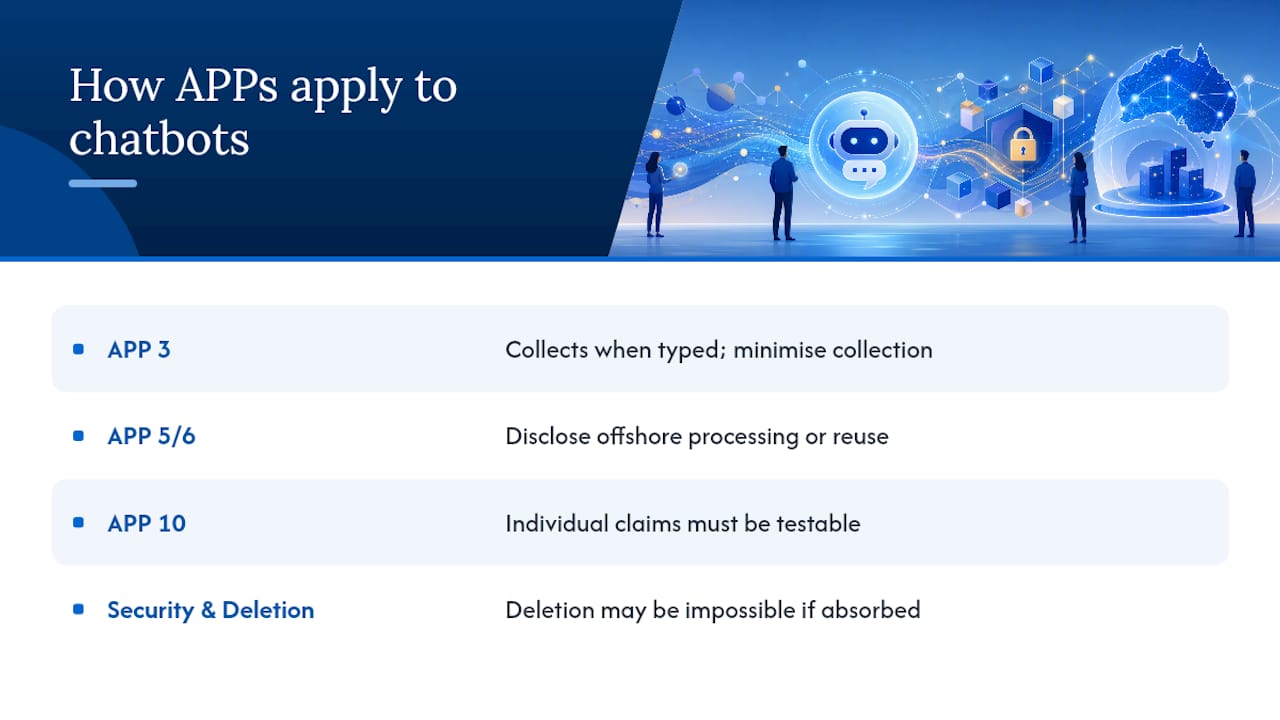
APP 3 (collection) governs what counts as collecting personal information, and a chat window collects data the moment a user types it in, regardless of whether your organisation “wanted” that field. The updated APP 3 guidelines now include AI-specific examples and stress data minimisation. Practically, this means your chatbot shouldn’t be prompting users for more detail than the task requires, and any information volunteered beyond that should be handled with the same care as anything you deliberately collected.
APP 5 and APP 6 cover notice and use. If a chatbot vendor processes data offshore, or if chat logs get used for anything beyond the original customer interaction (model improvement, analytics, staff training), your privacy notice needs to say so in plain language, not buried in a linked terms-of-service page nobody reads.
APP 10 (accuracy) is where developer and deployer obligations meet. The OAIC’s developer-focused guidance stresses that dataset choice affects downstream accuracy, and a chatbot confidently stating something false about a real person is an accuracy problem with legal weight, not just a customer experience glitch. If your chatbot ever generates a claim about a specific individual (their eligibility, their history, their status), that claim needs to be testable and correctable.
Security, access, and deletion obligations get genuinely harder once a public model is involved. If a customer later asks you to delete their data under an access request, and part of that data has already been absorbed into a third-party model’s training set, you may not be able to comply in any meaningful sense. That’s not a hypothetical edge case. It’s the exact scenario the OAIC flags when it warns that information entered into public generative AI tools can be near impossible to retrieve or remove.
Practical compliance steps: governance, PIAs and contracts
Knowing the law is one thing. Building a process your compliance team can actually run is another. Here’s a sequence that works for most mid-to-large Australian organisations rolling out a chatbot.
- Scope the PIA before writing a line of code or signing a vendor. Cover data types collected (including anything volunteered by users beyond structured fields), storage location, retention period, who at the vendor can access raw logs, and whether the vendor trains its models on your data by default.
- Draft plain-language UI copy. Tell users they’re speaking with an AI, and give a one-line summary of what happens to their message. This satisfies both a transparency expectation and, frankly, a trust expectation.
- Rewrite your privacy notice or collection statement. Add a specific section on AI-assisted interactions if one doesn’t already exist. Generic “we use third parties to process data” language isn’t enough anymore.
- Negotiate contract terms with any vendor. You need explicit opt-outs from model training, defined retention windows, audit rights, and a contractual requirement that the vendor notify you before changing any training or retention policy. The OAIC’s developer guidance backs this expectation directly, and it’s worth checking vendor claims against a retention policy built for chatbot deployments rather than accepting default settings.
- Set staff rules with teeth. A policy memo is a start. Pairing it with basic monitoring (flagging when someone pastes an unusually long block of text into a public chatbot, for instance) closes the gap between policy and behaviour.
Contract negotiations are where most organisations lose leverage they didn’t know they had. Vendors will often offer enterprise tiers with training opt-outs and retention controls if you ask directly, features that aren’t advertised on the standard pricing page. Ask before you assume the default terms are all that’s on offer.
Technical controls and deployment choices
The deployment model you choose does more to manage privacy risk than any policy document sitting in a shared drive. Three broad options exist, and they carry genuinely different risk profiles.
Public, consumer-grade chatbots are the easiest to spin up and the hardest to control. You have limited visibility into training practices, retention periods, and offshore data flows. For anything involving customer, patient, or financial data, this tier is rarely appropriate.
Enterprise-licensed deployments sit in the middle. Most major AI vendors now offer enterprise tiers that let you opt out of training, set retention windows, and access audit logs. The OAIC’s own guidance treats enterprise licences with proper opt-outs and auditable logs as a meaningful step up from unmanaged public tools, and this is often where the risk-versus-effort trade-off lands for mid-sized organisations.
Australia-hosted private deployments give you the most control: data residency guarantees, no third-party training on your conversations by default, and full audit trails you own rather than request from a vendor. For regulated sectors, healthcare, finance, legal services, this is increasingly the only tier that makes a clean PIA outcome achievable without heavy caveats.
Whichever tier you land on, the same technical controls matter:
- Restrict provider access to raw prompts wherever the platform allows it.
- Block or opt out of model training on your organisation’s conversational data by default.
- Set explicit data residency requirements, especially if your customers are in regulated industries.
- Apply redaction pipelines that strip obvious identifiers (card numbers, Medicare numbers) before data is logged. A PCI-aware approach to chatbot data handling is a useful reference if payment details ever touch your chat channel.
- Keep audit logs that show who accessed what, and when, in case a regulator or customer asks.
If your organisation is weighing vendor options, it’s worth reading a broader primer on what makes a conversational AI deployment secure before locking in a platform choice you’ll be stuck with for years.
Why chatbot outputs carry legal weight, not just inputs
Most privacy checklists focus on what a user types in. The OAIC’s guidance makes clear that what a chatbot generates matters just as much, because an inference about a real person is treated as personal information the moment it’s produced, whether it’s correct or not.
Picture a chatbot that, based on a customer’s stated postcode and purchase history, generates a response implying their likely income bracket. Nobody typed that in. The system inferred it. Under the OAIC’s reading, that inference is now personal information your organisation holds, and it inherits every obligation that comes with holding personal information, including accuracy and security requirements.
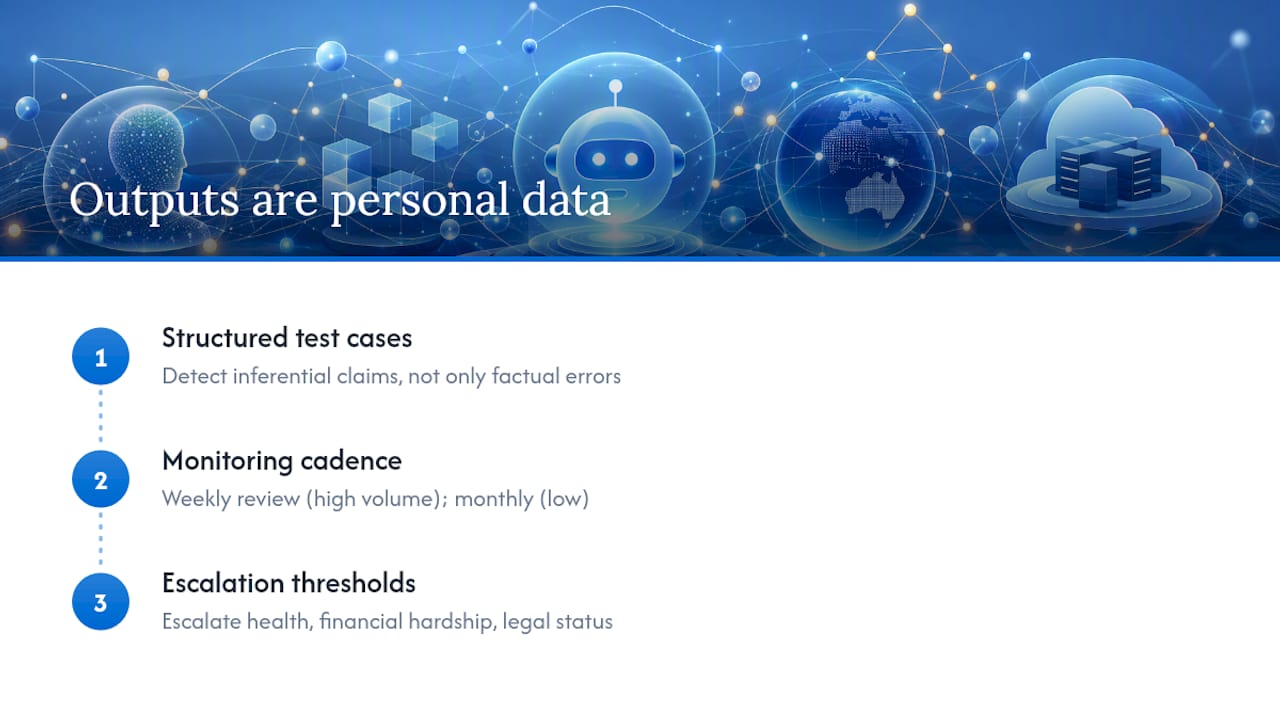
A practical testing regime should cover three things. First, run structured test cases covering common customer scenarios and check whether the chatbot generates any inferential claims about individuals, not just factual errors. Second, set a monitoring cadence, weekly for high-volume deployments, monthly for lower-traffic ones, reviewing a sample of transcripts for accuracy drift or concerning inferences. Third, define clear thresholds for human-in-the-loop review: any interaction touching health, financial hardship, or legal status should escalate to a person, not resolve entirely within the bot.
Visible disclaimers help manage expectations but don’t replace the underlying obligation. A line reading “this is general information, not advice” is good practice for the user relationship. It does not remove your organisation’s accuracy obligations under APP 10 if the chatbot has, in fact, generated a specific and wrong claim about a specific person.
When to prohibit public chatbots outright
Some scenarios are clear enough that the sensible answer is simply “don’t.” The OAIC’s guidance points toward prohibition, not just caution, when the data involved is sensitive health information, financial advice with regulatory consequences, anything touching a legal decision, or debt collection communications involving identifiable personal details.
The reasoning comes back to a point worth repeating because it changes the calculus entirely: once personal information is entered into a public generative AI system, it may be functionally impossible to remove. Deletion requests that would be straightforward against your own database become unworkable against a third-party model that has already absorbed the data into its training process.
A workable decision checklist asks three questions. Does the interaction touch sensitive categories under the Privacy Act (health, financial hardship, legal status)? Can the privacy risk be mitigated at reasonable cost through enterprise controls, or does mitigation require a fundamentally different deployment? Is there a genuinely private alternative, an Australia-hosted deployment or on-premises option, that achieves the same business outcome? If the answer to the first question is yes and the third is also yes, prohibiting the public tool and moving to a controlled alternative is usually the right call.
Checklist and resources for immediate implementation
Before you close this out, make sure these checkpoints are covered, and bookmark the primary sources rather than relying on secondhand summaries.
Minimum PIA checkpoints: data types collected through the chat interface, vendor training defaults, retention period, offshore storage location, and deletion feasibility if a customer requests it.
Contract clause checklist: training opt-out, defined retention window, audit rights, advance notice of policy changes, and data residency commitments.
Immediate operational tests: attempt to trigger the chatbot into generating an inference about a test user, check whether staff can currently paste unrestricted text into a public tool, and confirm your privacy notice mentions AI-assisted interactions.
For deeper implementation support, the OAIC’s own checklist PDF remains the fastest reference. Pair it with the Digital, which walks through privacy, protection and security considerations specifically built for government and enterprise AI rollouts.
The pragmatic case for sovereign hosting
Here’s where I’ll push back gently on how a lot of organisations approach this. The instinct after reading OAIC guidance is often to treat it as a brake, a reason to slow the chatbot project down or shelve it. That’s the wrong read. The guidance is a filter, not a stop sign, and it filters strongly toward one outcome: control over where your data sits and who can touch it.
Australian organisations don’t need to choose between automation gains and privacy compliance. That framing assumes public, consumer-grade tools are the only option, and they’re clearly not the option the OAIC is steering anyone toward for regulated data. Sovereign hosting and enterprise-grade controls aren’t a compliance tax you pay reluctantly. They’re the version of chatbot deployment that actually survives a PIA without heavy caveats attached.
If you’re building the business case internally, frame it in risk terms your finance and legal teams already understand: the cost of an enterprise or private deployment against the cost of a deletion request you can’t fulfil, or a regulator inquiry you can’t answer cleanly. That comparison usually settles the argument faster than any privacy principle recitation will, especially when working with a specialized AI agency in Australia to productionise compliant AI solutions effectively.
— Sowrabh
How Conversational AI supports OAIC-aligned deployments
Some conversational AI platforms offer Australia-hosted, private cloud infrastructure options where data remains within the country and do not train third-party models without explicit consent. For organisations weighing a PIA outcome, that’s not a marketing line, it’s a data residency answer you can hand straight to your privacy officer.
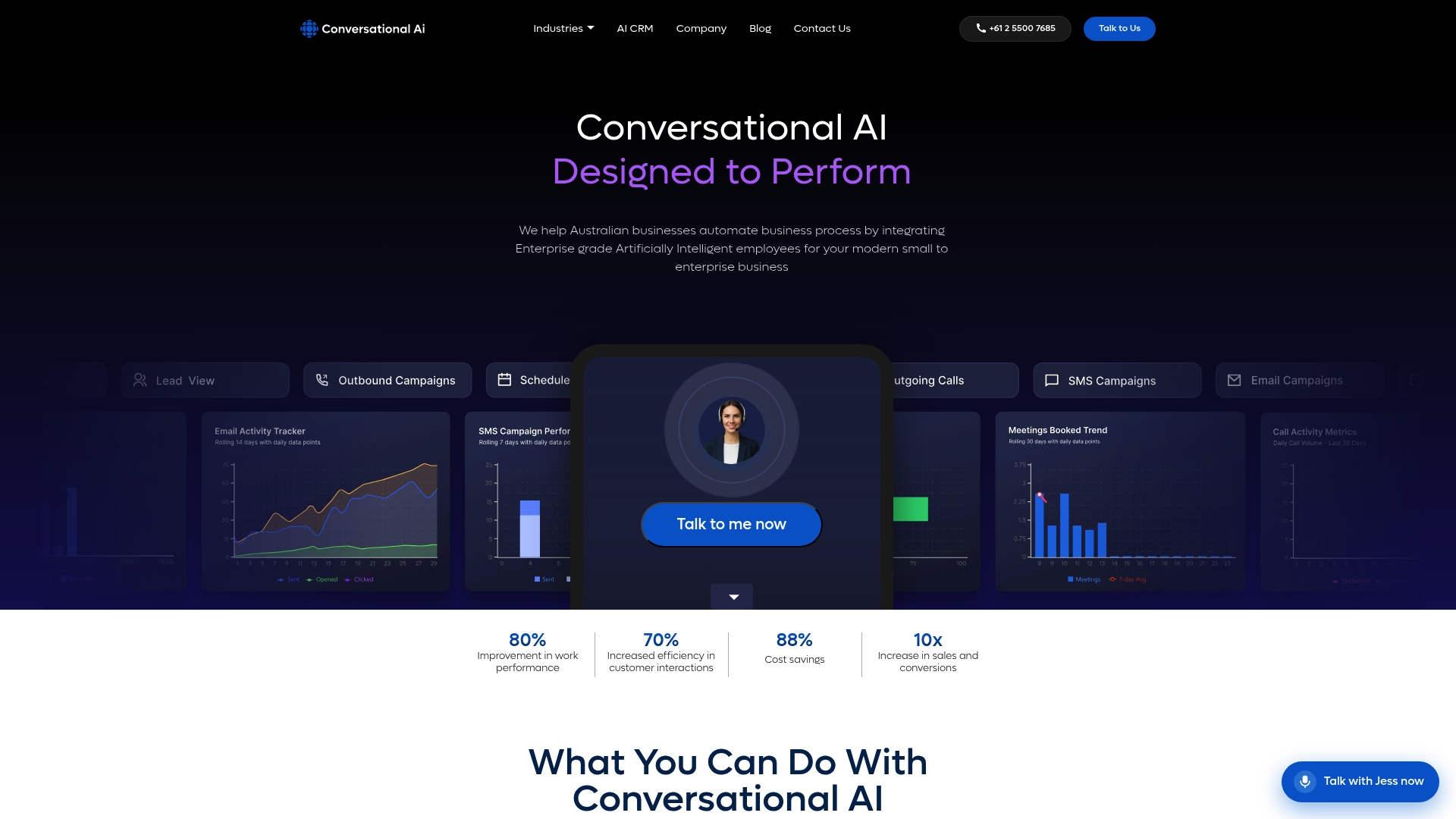
Certain platforms offer voice, SMS, email, and live chat agents from an Australia-hosted environment, including contextual memory and audit logging features that can help address access and audit-trail considerations during a PIA. For sectors carrying the sharpest privacy exposure, healthcare, banking and finance, and debt collection, that matters more than any feature comparison. Organisations needing the strictest data residency guarantees can also run the platform via on-premises deployment, keeping infrastructure entirely within their own environment.
If you’re currently running a PIA or reviewing an existing chatbot deployment against OAIC expectations, the practical next step is a readiness conversation: bring your PIA scope, and find out where a conversational AI CRM built for Australian compliance requirements can close the gaps a public tool leaves open.
This article is general information, not a substitute for advice from a qualified lawyer. Consult a qualified legal professional about your own circumstances before acting on anything here.
FAQ
Does OAIC guidance ban chatbots for Australian businesses?
No. The OAIC doesn’t ban chatbots; it requires organisations to assess privacy risk and apply appropriate controls, favouring enterprise or private deployments for sensitive data rather than banning AI outright, as set out in its guidance on commercially available AI products.
When does my organisation need a Privacy Impact Assessment for a chatbot?
A PIA is recommended before deploying any chatbot that collects, stores, or processes personal information, particularly if the tool is public-facing or handles sensitive categories like health or financial data. The OAIC’s checklist PDF sets out the specific trigger questions to scope one properly.
Can a chatbot’s generated answer breach the Privacy Act even if no one typed personal data in?
Yes. If a chatbot infers or generates information about a specific individual, that output is treated as personal information under Australian Privacy Principles, carrying the same accuracy and security obligations as directly collected data.
What’s the difference between the OAIC’s two AI guidance documents?
One guide addresses organisations deploying existing AI products like chatbots, focused on usage risks and PIAs. The other addresses developers building or training generative AI models, focused on dataset selection and accuracy obligations under APP 10.
Does Conversational AI help meet OAIC privacy expectations?
Some conversational AI providers offer Australia-hosted private cloud infrastructure with audit logging and options to opt out of third-party training on customer data, aligning with enterprise-grade controls recommended for privacy-sensitive deployments. Current pricing and plan details are available directly on the Conversational AI site.