How voice and chat AI differ: a 2026 enterprise guide
Discover how voice and chat AI differ. Learn which channel to choose for cost-effective engagement and improved customer experience.

Conversational AI is the intelligence behind both voice and chat AI, but the two interfaces work in fundamentally different ways. Voice AI converts spoken language into text, processes it, and delivers a spoken response in real time. Chat AI processes written input and returns text through messaging platforms, web chat, or SMS. Understanding how voice and chat AI differ is not an academic exercise. It directly shapes which channel you deploy, what it costs, and how your customers feel after every interaction.
How voice and chat AI differ technically
Voice AI runs through a four-stage pipeline. The process starts with automatic speech recognition, which converts spoken audio into text. That text passes through natural language understanding (NLU) to extract intent and context. A large language model (LLM) generates the response, and text-to-speech (TTS) synthesis delivers it back as spoken audio. Voice AI integrates all four stages for full real-time interaction, which is what makes it technically demanding.
Latency is the defining constraint in voice AI. Voice agents operate under 500ms latency, with advanced TTS delivering human-like speech complete with emotion cues. Any delay beyond that threshold breaks the natural rhythm of conversation and erodes trust.
Chat AI skips the speech layers entirely. It processes text input directly through NLU and dialogue management, then returns a written response. Chat AI supports asynchronous, multi-session interactions with richer multimedia sharing capabilities. A customer can start a chat, close the browser, and resume hours later without losing context. Voice AI cannot offer that same flexibility.

The interface difference creates distinct technical challenges. Voice AI must handle background noise, accents, and speech disfluencies. Chat AI must parse ambiguous written language, abbreviations, and emoji. Neither is inherently superior. Each is optimised for its medium.
Pro Tip: When evaluating voice AI vendors, ask specifically about their ASR accuracy rates in Australian English. Accents and regional vocabulary can significantly affect recognition quality, and not all platforms are trained on local speech data.
Performance and cost: voice AI vs chat AI compared
The performance gap between voice and chat AI is measurable and significant. Voice AI converts inbound calls to booked appointments at 35–55%, while chatbots convert at 18–35%. That gap reflects the persuasive power of spoken dialogue in high-intent interactions.
Cost tells a different story. Voice AI infrastructure costs 4–8 times more per interaction than chatbots. Despite that premium, voice AI still delivers significant savings over human agents. Enterprise voice AI deployments reduced costs to approximately $0.40 per call, compared to $7–$12 for a human agent handling the same call. The economics favour voice AI for high-value interactions, and chat AI for volume.
Scalability also differs sharply. Chatbots handle thousands of concurrent conversations without degradation. Voice agents handle far fewer concurrent calls due to telephony infrastructure constraints. That makes chat AI the natural choice for high-volume, routine enquiries.
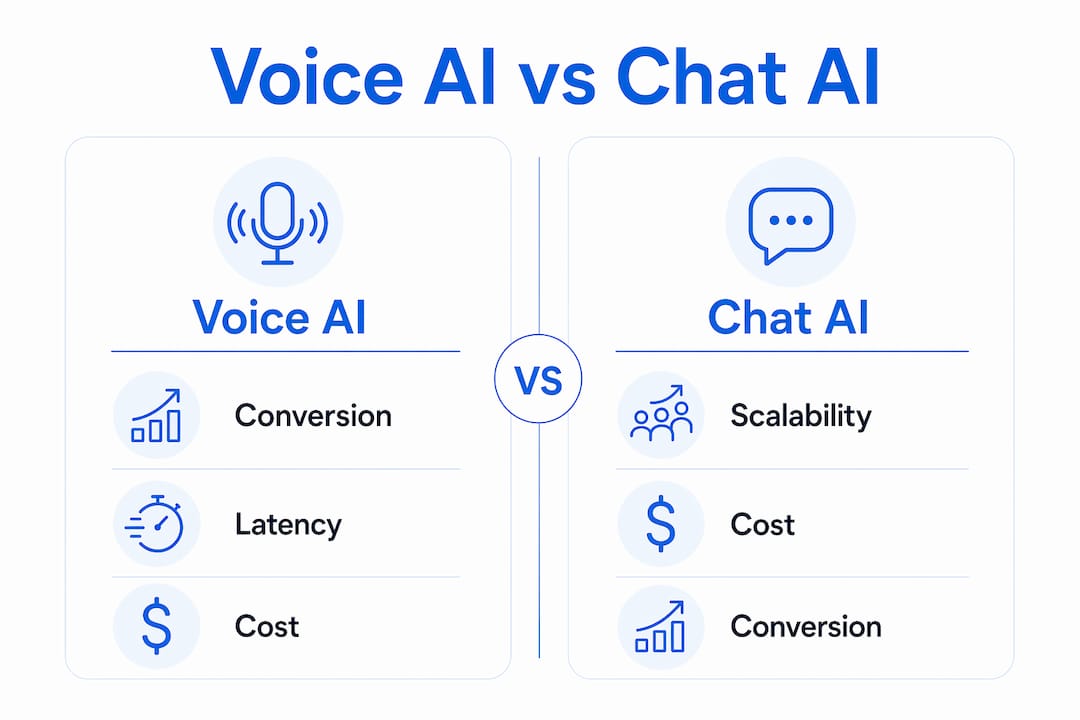
| Factor | Voice AI | Chat AI |
|---|---|---|
| Conversion rate | 35–55% (appointments) | 18–35% (appointments) |
| Cost per interaction | ~$0.40 (vs $7–$12 human) | Significantly lower than voice |
| Concurrent capacity | Limited by telephony | Thousands simultaneously |
| Latency requirement | Under 500ms | Asynchronous, flexible |
| Best use case | Inbound calls, complex queries | Web chat, routine enquiries |
Pro Tip: Do not judge voice AI purely on cost per interaction. Factor in conversion rate and lifetime customer value. A higher cost per call that converts at 50% often outperforms a cheaper chatbot converting at 20%.
When to use voice AI and when to use chat AI
Customer preference data makes the deployment decision clearer. 57% of customers prefer voice for complex issues, while 69% prefer chat for simple queries. That split is not arbitrary. It reflects how people naturally communicate depending on urgency and complexity.
Voice AI excels in specific situations:
- Inbound calls with high intent. A customer calling to book a medical appointment or report a financial issue wants a spoken resolution, not a text thread.
- Urgent or emotionally charged interactions. Voice AI detects frustration and satisfaction with 75–85% accuracy, enabling appropriate call routing before the situation escalates.
- Hands-free contexts. Drivers, tradespeople, and patients in clinical settings cannot type. Voice is the only viable channel.
- Older demographics. Customers who are less comfortable with digital interfaces respond better to spoken dialogue.
Chat AI suits a different set of scenarios:
- Browsing and research phases. A prospect comparing products over several days benefits from asynchronous chat that preserves conversation history.
- High-volume routine enquiries. Password resets, order tracking, and FAQ responses are faster and cheaper through chat.
- Younger, digitally native customers. This group prefers messaging over phone calls and expects instant written responses.
- Workflows requiring documentation. Chat creates a written record automatically, which suits compliance-heavy industries like finance and healthcare.
Voice AI does carry operational challenges. Background noise degrades ASR accuracy. Telephony infrastructure adds complexity and cost. Chat AI is more scalable but less personal. Neither channel replaces the other. The strongest enterprise deployments use both.
Best practices for integrating voice and chat AI in enterprise
The most effective enterprise communication strategies treat voice and chat AI as complementary channels, not competing ones. Conversational AI is the brain, while voice or chat is the interface. Effective strategies use a unified backend so context transfers across channels without the customer repeating themselves.
Here is how to build that integration effectively:
-
Build a shared knowledge base. Shared knowledge bases enable context transfer between chat and voice channels in multi-modal systems. A customer who starts a chat enquiry about a billing dispute should not have to re-explain the issue when the conversation escalates to a voice call.
-
Assign channels by interaction type. Deploy voice AI for inbound calls, escalations, and high-intent conversions. Deploy chat AI for web traffic, SMS follow-ups, and routine self-service. This matches the channel to the customer’s natural behaviour at each stage of their interaction.
-
Plan for channel switching. Multi-modal AI systems let customers start in text chat and switch to voice while preserving full context. A customer who begins a complex insurance claim via web chat can transition to a voice call without losing any prior information. This capability is now a baseline expectation in enterprise deployments.
-
Align investment with volume and value. High-value, low-volume interactions justify the higher cost of voice AI. High-volume, low-complexity interactions belong in chat. Misaligning these is the most common and costly mistake in enterprise AI deployments.
-
Monitor performance by channel separately. Conversion rates, resolution times, and satisfaction scores behave differently across voice and chat. Aggregating them masks underperformance in one channel. Track each independently and optimise accordingly.
Combining voice, SMS, and email automation within a single orchestration layer gives enterprises the clearest view of customer behaviour across every touchpoint. The role of AI in communication orchestration is to ensure no interaction falls through the gaps between channels.
Key takeaways
Voice AI and chat AI serve different interaction needs, and the strongest enterprise deployments use both channels with a unified conversational AI backend.
| Point | Details |
|---|---|
| Voice AI suits complex, high-intent interactions | Conversion rates of 35–55% make voice AI the stronger channel for appointment booking and escalations. |
| Chat AI wins on volume and cost | Chatbots handle thousands of concurrent conversations at a fraction of the cost of voice AI per interaction. |
| Customer preference drives channel choice | 57% prefer voice for complex issues; 69% prefer chat for simple queries. |
| Shared knowledge base is non-negotiable | Context must transfer between voice and chat channels or customers repeat themselves and satisfaction drops. |
| Multi-modal deployment is the future | Systems that let customers switch between voice and chat mid-interaction are now an enterprise baseline expectation. |
The case for treating voice and chat AI as a single strategy
The biggest mistake I see enterprises make is treating voice AI and chat AI as separate procurement decisions. They buy a chatbot for the website and a voice agent for the contact centre, then wonder why the customer experience feels disjointed. The two channels share the same underlying conversational intelligence. Separating them at the infrastructure level creates data silos, inconsistent responses, and frustrated customers who feel like they are starting from scratch every time they switch channels.
Voice AI’s ability to detect emotion and deliver human-like speech makes it irreplaceable for high-stakes interactions. No chatbot can replicate the reassurance of a calm, clear voice when a customer is anxious about a medical result or a financial dispute. That emotional dimension is not a nice-to-have. It is a measurable driver of customer retention and trust.
Chat AI’s scalability is equally irreplaceable. You cannot staff a voice channel to handle 10,000 simultaneous routine enquiries cost-effectively. Chat AI handles that volume without breaking a sweat, freeing your voice capacity for the interactions that genuinely need it.
The enterprises getting this right in 2026 are the ones that have invested in a unified conversational AI backend. They route by intent, not by channel preference. They measure outcomes, not just activity. And they treat every interaction, whether spoken or written, as part of a single continuous customer relationship.
The pitfall to avoid is deploying voice AI as a cost-cutting measure alone. If the voice experience is robotic, slow, or unable to handle anything beyond a narrow script, it damages your brand more than it saves. The same applies to chat. A chatbot that deflects rather than resolves is not a solution. It is a liability.
— Sowrabh
How Conversational AI supports both voice and chat AI deployment
Australian enterprises need more than a generic AI platform. They need one built for local compliance, local data sovereignty, and the specific communication patterns of Australian customers.
Conversational AI delivers AI agents for Australian businesses that support voice, chat, SMS, and email within a single platform. The shared knowledge base means context travels with the customer across every channel. Whether you are handling inbound calls in healthcare, lead qualification in financial services, or after-hours support in professional services, the platform handles it without routing customers into dead ends. If you are ready to deploy voice and chat AI together with a unified backend, Conversational AI is built for exactly that.
FAQ
What is the core difference between voice AI and chat AI?
Voice AI processes spoken language through speech recognition and text-to-speech synthesis, while chat AI processes written text through messaging interfaces. Both use the same conversational AI intelligence underneath, but the interaction medium is entirely different.
Which converts better: voice AI or chatbots?
Voice AI converts inbound calls to booked appointments at 35–55%, compared to 18–35% for chatbots. Voice AI performs better in high-intent, complex interactions where spoken dialogue builds trust faster.
Is voice AI more expensive than chat AI?
Voice AI infrastructure costs 4–8 times more per interaction than chatbots. However, voice AI at approximately $0.40 per call still delivers major savings compared to human agents at $7–$12 per call.
When should an enterprise use chat AI instead of voice AI?
Chat AI suits high-volume, routine enquiries, asynchronous multi-session interactions, and digitally native customers. It handles thousands of concurrent conversations and supports multimedia sharing, making it the right choice for web and messaging traffic.
Can voice and chat AI work together in the same customer journey?
Multi-modal AI systems let customers start in text chat and switch to voice while preserving full context. A shared knowledge base is the critical enabler, ensuring no information is lost when a customer moves between channels.