How to handle high volume inquiries with AI in 2026
Discover how to handle high volume inquiries with AI efficiently. Transform customer service and save time with automated, accurate responses.

How AI efficiently handles high volume customer inquiries
AI handles high volume customer inquiries by connecting directly to your CRM, retrieving live data for each person asking, and returning a specific, accurate answer rather than a generic FAQ response. That distinction matters in practice. A basic chatbot matches keywords to pre-written replies. An AI agent pulls live CRM data and tells a customer exactly where their order is, what stage their application is at, or whether their payment has cleared.
The volume problem is real for most Australian businesses. Routine inquiries, order status, appointment confirmations, billing questions, arrive scattered across phone lines, email inboxes, and contact forms. Individually, each one takes only minutes to answer. At 30 or 50 a week, they consume hours of your team’s time and pull focus away from work that genuinely needs a human.
Here is what a well-built AI inquiry system actually does:
- Automates routine requests so your team stops acting as a go-between for data that already lives in your system
- Retrieves live, personalised data from your CRM for each customer, rather than serving a one-size-fits-all response
- Translates internal codes into plain language. A status flag like “Stage 4B” becomes “your application is still under review and you can expect to hear from us within one to two weeks”
- Routes complex cases to a human agent with full conversation history attached, so the customer never has to repeat themselves
- Operates across multiple channels including voice, SMS, email, and live chat, from a single configuration
- Delivers measurable results including faster response times, lower operational costs, and improved customer satisfaction scores
The translation layer is often the piece businesses underestimate. Internal CRM codes converted into customer-friendly messages are what separates an AI agent that builds trust from one that confuses or alarms the people it is meant to help.
Key AI technologies that power efficient inquiry management
Understanding what sits under the hood helps you ask better questions when evaluating platforms and avoid buying capability you do not need.
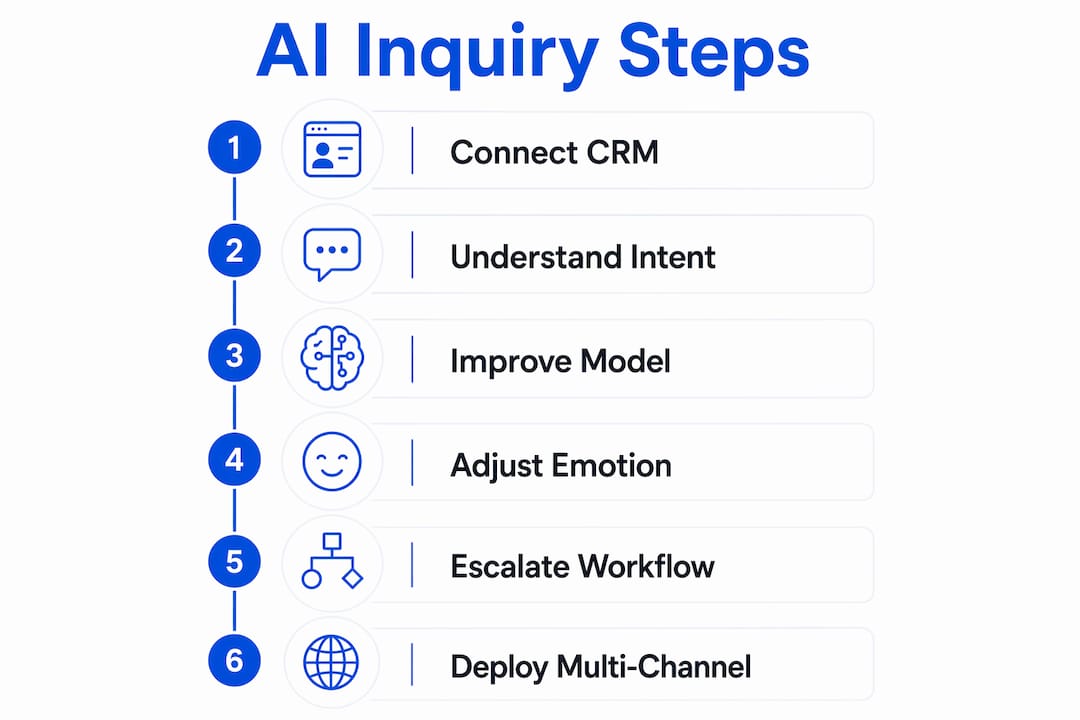
1. Natural language processing
Natural language processing, or NLP, is the technology that lets an AI agent understand what a customer actually means, not just the words they typed. A customer who writes “where’s my stuff?” and one who writes “can you provide an update on my delivery?” are asking the same question. NLP maps both to the same intent and triggers the same data retrieval.
2. Machine learning models that improve over time
Machine learning allows AI models to get more accurate as they process more interactions. Early deployments will misclassify some inquiries or produce responses that need refinement. A well-configured system logs those gaps and uses them to improve. The practical implication is that your AI agent in month six should outperform the one you launched in month one, without a rebuild.

3. Real-time CRM and backend integration
This is the capability that separates AI agents from basic chatbots. Live integration means the agent queries your CRM at the moment of the conversation, not a cached snapshot from yesterday. For industries like healthcare and finance, where data changes frequently, this is the difference between an accurate answer and a misleading one.
4. Emotionally aware conversational AI
Emotionally aware AI reads customer sentiment during a conversation and adjusts its tone accordingly. A customer who is frustrated gets a different response cadence than one making a routine enquiry. This capability builds customer trust and de-escalates pressure during peak inquiry periods, which is when your team needs the most relief.
5. Automated workflow and escalation management
Escalation rules define when the AI hands off to a human. You set the conditions: inquiry complexity, customer priority status, topics the agent should not handle alone. When those conditions are met, the agent creates a case in your system and routes it with full context attached. Designing these rules well is as important as the AI itself.
6. Multi-channel deployment
Modern AI platforms let you deploy across voice, SMS, email, and chat from a single configuration. That means consistent responses regardless of which channel a customer uses, and no duplicated setup work when you expand to a new channel.
Benefits and real-world use cases across Australian industries
The operational case for AI-based inquiry management is straightforward. Chatbots handle up to 80% of routine customer questions independently, which means your human agents spend the majority of their time on work that actually requires their judgement.
67% of customers expect their support ticket resolved within three hours. Meeting that expectation with human agents alone, particularly during peak periods, requires headcount growth that most Australian businesses cannot sustain. AI closes that gap without adding staff.
Use cases where AI delivers the clearest results:
- Order and shipment status in e-commerce and logistics, where the same question arrives hundreds of times a week and the answer lives in a fulfilment system
- Appointment confirmations and rescheduling in healthcare, where reception teams are already stretched and after-hours enquiries go unanswered until the next morning
- Billing and payment enquiries in financial services, where customers want a specific answer about their account, not a referral to a help page
- Subscription changes including pauses, skips, and cancellations, where the workflow is predictable enough to automate end-to-end
- Application status updates in professional services and recruitment, where candidates ask the same question repeatedly and the answer requires only a CRM lookup
Emotionally aware AI also improves customer satisfaction scores during high-volume periods, precisely when manual handling tends to produce the most inconsistency. When your team is under pressure, response quality varies. AI does not have that problem.
The insight worth holding onto: AI agents work best when you treat them as intelligent operators that build trust, not just tools that deflect calls. The businesses that get the most from AI inquiry management are the ones that invest in the translation layer and the escalation design, not just the technology.
Statistics that show AI’s impact on customer service
The numbers behind AI-augmented customer service are consistent across industries and markets.
| Metric | Traditional support | AI-augmented support |
|---|---|---|
| Routine inquiry resolution | Handled manually by agents | Up to 80% resolved by AI without human involvement |
| Operational cost per inquiry | Full agent cost per interaction | Up to 30% reduction in overall support costs |
| Response time | Dependent on queue and staffing | Instant acknowledgement; automated resolution for routine cases |
| After-hours coverage | Limited or unavailable | Available across all channels |
| Agent workload | High volume of Tier 1 tasks | Tier 1 automated; agents focus on complex cases |
| CSAT during peak periods | Drops as wait times increase | Maintained by consistent AI responses |
| Scalability | Requires additional headcount | Scales without hiring by standardising workflows |
The cost reduction figure deserves context. AI agents reduce support costs by up to 30% not just by replacing agent time on routine tasks, but by reducing errors, cutting transfer rates, and speeding resolution. Each of those factors carries its own cost when left unaddressed.
Agent wellbeing is a less-discussed benefit. Teams using AI and automation report feeling less overwhelmed and view the technology as a way to take on more meaningful work, not a threat to their roles. Removing repetitive Tier 1 tasks is one of the most direct ways to reduce burnout in a customer service team.
Automated routing also reduces the number of times a customer gets transferred between agents, which is one of the strongest predictors of a poor customer experience. Matching the right inquiry to the right resource from the first contact changes the outcome for both the customer and the agent.
Conversational AI solutions built for Australian businesses
Australian businesses face compliance requirements and data sovereignty expectations that generic offshore platforms were not built to address. The Privacy Act 1988 and the Australian Privacy Principles govern how customer data must be stored, accessed, and handled. For sectors like healthcare and financial services, those obligations are not optional, and they extend to every system that touches customer data, including your AI platform.
Conversational AI is built specifically for this environment. The platform hosts entirely within Australia, which means your customer data never leaves Australian jurisdiction. That matters for compliance, and it matters for the trust your customers place in you when they share personal information through an automated channel.
What Conversational AI delivers for Australian operations:
- Multi-channel AI agents across voice, SMS, email, and live chat, configured once and deployed consistently across all channels
- Deep CRM integration that retrieves live data at the moment of each conversation, not a cached snapshot
- Emotionally intelligent responses that adapt to customer sentiment and de-escalate difficult interactions
- Modular automation covering lead qualification, appointment booking, billing enquiries, and collections
- Real-time analytics so you can see exactly how your AI agents are performing and where to improve
The AI live chat integration capability is particularly relevant for businesses that already have a live chat presence and want to add AI handling without rebuilding their customer-facing interface.
Pro Tip: Start with a single channel and a narrow set of inquiries. Define the five to ten questions your team answers most frequently, map the data fields required to answer them, build the translation layer for any internal codes, and set your escalation rules before you go live. A phased AI deployment that works well on one channel is far more valuable than a broad rollout that produces inconsistent results across all of them.
For teams migrating from legacy systems, the transition to conversational AI does not require a full infrastructure rebuild. Conversational AI integrates with existing CRM systems and workflows, which means you can automate inquiry handling without disrupting the systems your team already relies on.
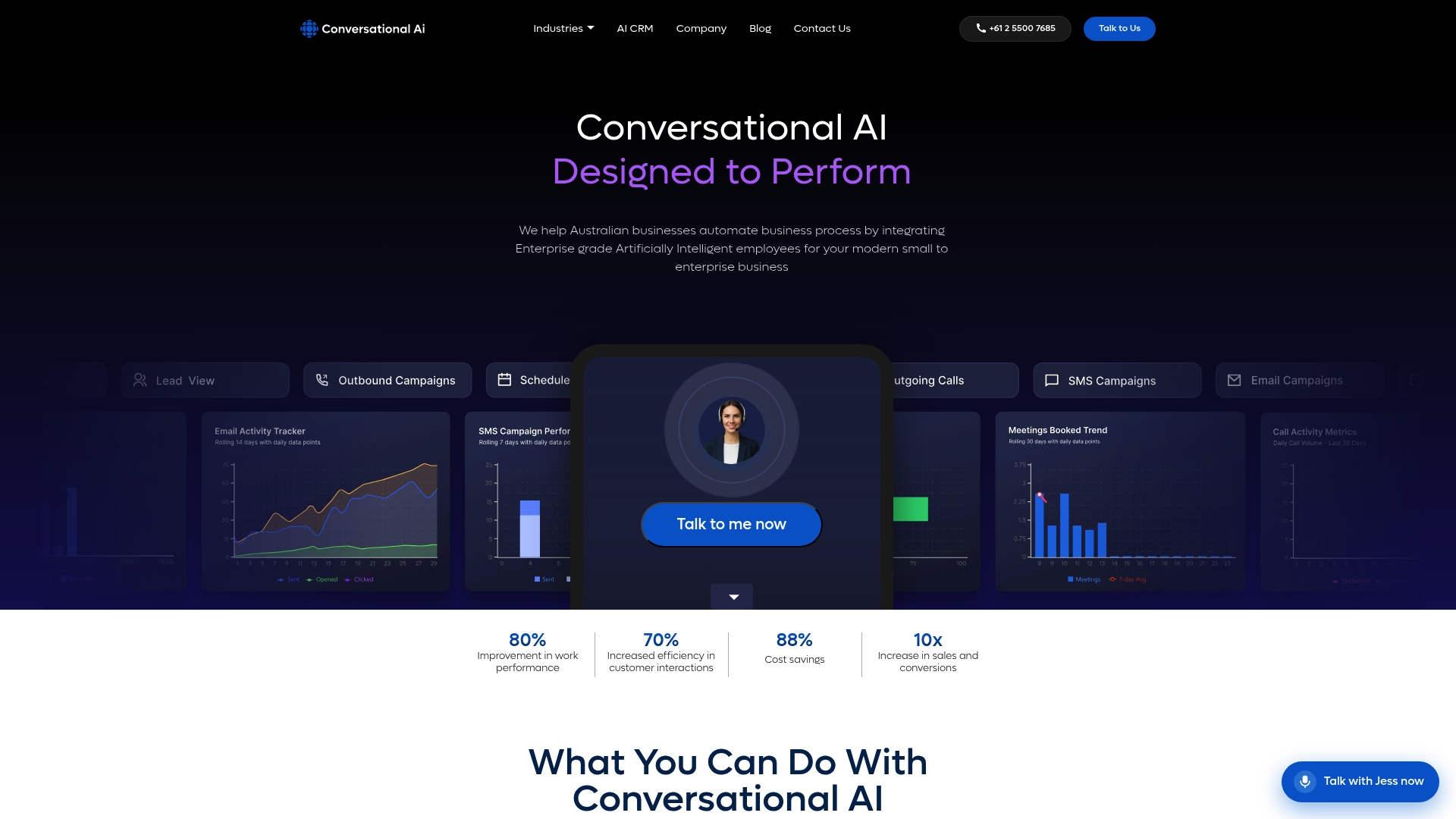
Australian businesses managing high inquiry volumes deserve a platform built for their compliance environment, not one adapted from an overseas product. Conversational AI gives you private, locally hosted AI agents that integrate with your existing systems and handle customer enquiries across every channel, around the clock. See how it works and find out what a deployment could look like for your operation.
Key takeaways
AI-based inquiry management reduces operational costs significantly, automates a majority of routine customer questions, and scales support capacity without requiring additional headcount.
| Point | Details |
|---|---|
| AI resolves routine inquiries automatically | Chatbots handle up to 80% of routine questions, freeing agents for complex cases. |
| Cost reduction is measurable | AI agents reduce customer support costs by up to 30%, cutting errors, transfers, and handling time. |
| Translation layers are critical | Converting internal CRM codes into plain language responses is what makes AI trustworthy to customers. |
| Phased deployment reduces risk | Start with one channel and a defined set of inquiries before expanding to avoid inconsistent results. |
| Australian compliance requires local hosting | Platforms hosted within Australia protect data sovereignty and satisfy Privacy Act obligations. |