Contact centre AI cost: pricing models and budget guide
Discover effective pricing models for contact centre AI to optimize your budget. Learn key factors before making a decision.

Expect to pay a modest per-minute rate for bundled voice AI, or a seat-based licence with a monthly fee per agent if you’re automating chat and email rather than live calls. Most mid-sized contact centres land on a hybrid model: a platform or seat fee covering the core system, with consumption-based charges layered on for actual call or message volume.
If you run high, predictable volume, seat-based pricing usually wins on cost control. If your volume is spiky or you’re still proving the business case, per-minute or consumption pricing limits your downside.
Before you sign anything, check three things on the quote:
- Billing basis — is voice billed on audio length or session duration (including idle time)?
- Channel multipliers — does adding SMS or email double-count against the same usage pool?
- Add-on stacking — do features like diarisation or summarisation sit on top of the base rate, or inside it?
Quick reference: Voice-agent APIs commonly bundle speech-to-text, inference and text-to-speech into one per-minute session rate, which simplifies comparison but hides where the real cost sits.
Key Takeaways
Contact centre AI cost depends less on the headline rate than on billing basis, session behaviour, and how many hidden line items you catch before signing.
| Point | Details |
|---|---|
| Get itemised quotes | Demand separate line items for platform, voice stack, telephony, integration and compliance. |
| Match model to volume | Steady volume favours seat-based pricing; variable volume favours consumption with a spend cap. |
| Watch session billing | Streaming voice bills from connection open to close, so idle time inflates cost. |
| Budget hidden costs | Onboarding, data prep, testing and governance add real cost beyond the platform fee. |
| Run a sensitivity test | Vary automation coverage by 10 points to see which assumption moves payback fastest. |
| Consider unified platforms | Conversational AI bundles voice, SMS, email and chat under one Australia-hosted contract with built-in CRM connectors. |
Table of Contents
- What does contact centre AI cost actually include?
- Which pricing model suits your contact centre?
- What actually drives your AI contact centre bill?
- What hidden costs catch contact centres off guard?
- How do you calculate ROI on contact centre AI?
- What should you ask vendors before signing?
- How does Australia-hosted infrastructure affect your budget?
- What should you do next?
- What procurement teams get wrong about AI budgeting
- How Conversational AI prices its contact centre platform
- Frequently asked questions about contact centre AI cost
- Sources
What does contact centre AI cost actually include?
A vendor quote for contact centre AI cost rarely arrives as one number. It’s a stack of line items, and where you get burned is when one of them is missing from the initial conversation and shows up at contract renewal.
Here’s what should be on every quote you review:
- Platform fees, licences and seats. Most platforms charge a base subscription per agent seat or per organisation, covering the admin console, reporting, and core orchestration layer. This is your floor cost even before a single call runs.
- Voice stack components. Speech-to-text (STT), text-to-speech (TTS), and the underlying language model each carry a cost. Some vendors, including Deepgram, publish separate per-minute STT and TTS rates with volume-based tiers. Others bundle everything into one voice-agent rate.
- LLM inference billing. This is charged either per token (input and output separately) or folded into a flat per-minute voice-agent rate. Token billing rewards short, efficient prompts; bundled rates reward simplicity over precision.
- Telephony and carrier costs. Inbound and outbound minutes, number leasing, and carrier fees sit outside the AI platform fee entirely and get invoiced separately by your telco or a pass-through provider.
- Integration and middleware. Connecting the AI layer to your CRM, ticketing system, or telephony stack is rarely free. Expect a one-off integration fee, and sometimes an ongoing middleware licence if a connector platform sits in between.
- Hosting, security and compliance. Where your data lives, and under what jurisdiction, changes your compliance burden. Locally hosted platforms can reduce the legal review and data-handling documentation your compliance team has to produce for every renewal.
Ask for each of these itemised separately. A single bundled number looks tidy on a proposal but makes it near impossible to compare two vendors properly.
Which pricing model suits your contact centre?
The pricing model matters more than the headline rate. Two vendors quoting similar numbers can produce wildly different bills depending on how your volume behaves month to month.
- Seat-based or subscription pricing charges per agent or per licensed user, regardless of usage. This suits contact centres with steady, predictable volume, because your monthly cost doesn’t move even if call numbers spike during a promotion or an outage.
- Per-minute and per-call pricing charges for actual usage, which fits lower-volume or seasonal operations well but exposes you to overage risk the moment volume climbs unexpectedly. Read the fine print on what counts as a “minute” before you commit.
- Consumption and token-based pricing bills against actual compute used, whether that’s tokens processed or session time consumed. This model rewards efficient engineering but punishes idle concurrency and unclosed sessions, since session billing runs from connection open to close, not just when someone’s actually talking.
- Outcome-based pricing ties fees to results, such as resolved tickets or successful bookings. It sounds appealing, but defining “resolved” in a way both sides agree on is genuinely difficult, and it works best for narrow, well-defined use cases like appointment confirmation rather than open-ended support.
- Hybrid models combine a base seat or platform fee with consumption charges on top. This is where most contact centres end up as they scale, and it’s worth negotiating a migration path from pure seat pricing to hybrid as volume grows, so you’re not renegotiating from scratch.
McKinsey’s analysis of software economics points to a broader shift toward usage and outcome-based pricing across the software industry, driven by AI’s variable cost structure. Expect more hybrid offers over the next few contract cycles, not fewer.
What actually drives your AI contact centre bill?
Volume and average handle time (AHT) are the obvious drivers: more calls, longer calls, higher cost. But the levers that actually move your bill are often technical, not commercial.
Session billing is the biggest hidden driver. Streaming voice sessions are billed from the moment a connection opens until it closes, meaning idle time between a customer going quiet and the system timing out gets billed the same as active conversation. Concurrency limits compound this: if your platform caps simultaneous sessions, you either pay for a higher tier or watch calls queue during peak periods.
Model choice is a genuine trade-off, not a technicality. A premium language model costs more per token or per minute but often reduces handle time and escalation rates, which can net out cheaper overall. A cheaper model that requires more back-and-forth to resolve a query can cost more in the end.
Add-on features stack fast. Speaker diarisation, call summarisation, sentiment analysis and advanced reporting are frequently priced separately from the base voice rate, and they add up quickly across high volume.
Pro Tip: Ask your engineering team to close idle WebSocket connections automatically after a set silence threshold. It’s a small configuration change that directly cuts session-billed minutes, and most platforms support it out of the box.
Practical controls worth building into your operations:
- Set aggressive idle-timeout thresholds on voice sessions.
- Cache repeated prompts and responses where the conversation allows it.
- Batch non-urgent processing (like post-call summarisation) rather than running it in real time.
What hidden costs catch contact centres off guard?
The quoted rate is rarely the full cost of getting an AI system live and keeping it running. The gap between the sales quote and the first invoice is where most budget blowouts happen.
- Onboarding and professional services. Initial setup, workflow configuration, and staff training are frequently billed as a separate professional services fee, on top of the platform subscription.
- Data preparation and compliance checks. Cleaning historical call transcripts, labelling intents, and running privacy reviews before data can train or inform the system takes real time from your team or the vendor’s, and it’s billed accordingly.
- Pilot and testing costs. User acceptance testing, tuning against your actual call patterns, and real-world validation before go-live all carry cost, even when the pilot itself is discounted.
- Ongoing maintenance. Retraining the system as your products or policies change, updating knowledge content, and monitoring performance drift are recurring costs that don’t disappear once you’re live.
- Governance failure costs. Skipping proper data governance or compliance sign-off during setup often means expensive rework later, particularly in regulated sectors where a compliance gap discovered post-launch can halt a rollout entirely.
Build a line for each of these into your first-year budget, even if the number is an estimate. A quote that only covers the platform fee is, at best, half the real cost.
How do you calculate ROI on contact centre AI?
Most ROI conversations fail before they start because organisations struggle to tie AI initiatives to measurable outcomes, leaning on vague productivity claims instead of a defensible number. A proper model needs five inputs and a conservative hand on the automation coverage assumption.
Step 1: Gather your baseline inputs.
- Fully loaded hourly cost per agent (wages, on-costs, overheads).
- Average calls handled per day, per agent.
- Average handle time (AHT) in minutes.
- Expected automation coverage: the percentage of calls the AI can fully resolve without human handoff.
- Expected uplift in first-contact resolution (FCR) for calls that stay with human agents, if any.
Step 2: Calculate cost-per-call before AI. Divide the fully loaded hourly cost by calls handled per hour to get a baseline cost-per-call.
Step 3: Calculate cost-per-call after AI. Apply the AI platform’s per-minute or per-call rate to the automated share of volume, and the original agent cost to the remaining share, then blend the two into a new average.

Step 4: Layer in soft benefits conservatively. FCR uplift, reduced customer churn, and after-hours coverage are real value but hard to isolate. Model them at half your expected uplift in the first pass, then revise once pilot data comes in.
Step 5: Run a sensitivity test. Vary your automation coverage assumption up and down by 10 percentage points. This single variable usually moves payback timing faster than any other input in the model.
Illustrative scenario (assumptions clearly marked, not a guarantee): assume a 50-seat centre with an average fully loaded agent cost of $45/hour, handling 8 calls/hour per agent, so roughly $5.63 per call. The real payback period depends entirely on your actual coverage and uplift figures once a pilot runs.
What should you ask vendors before signing?
The contract terms matter as much as the headline rate, because that’s where cost volatility either gets controlled or gets ignored until the first overage invoice arrives.
Questions to put to every vendor in writing:
- Is voice billed on audio length or full session duration, including idle time?
- Do multiple channels (voice, SMS, chat) draw from one usage pool, or are they billed separately with multipliers?
- Which features are bundled into the base rate, and which are metered add-ons?
- What are the SLA commitments on uptime and response time, and what’s the remedy if they’re missed?
- What happens to concurrency limits and pricing if volume doubles inside the contract term?
- Who owns the conversation data and transcripts generated during use?
On negotiation, push for committed-spend discounts if your volume is predictable, tiered pricing that steps down automatically past agreed thresholds, and rollover of unused minutes rather than forfeiting them monthly. Structure your pilot with an explicit conversion clause: the production pricing tier should be disclosed and locked in before the pilot starts, not negotiated fresh once you’re already dependent on the system. The AI deployment project management guide covers how to structure that pilot-to-production handover without losing negotiating leverage.
How does Australia-hosted infrastructure affect your budget?
Where your data lives changes your compliance workload, and compliance workload is a real, recurring cost most budgets underestimate. A platform hosted entirely within Australia removes an entire category of legal review that cross-border hosting arrangements typically require.
Conversational AI’s platform is built around this specifically:
- Voice, SMS, email and live chat run through one billing relationship rather than separate vendor contracts for each channel.
- CRM connectors and contextual memory reduce the custom integration work that usually shows up as a professional services line item.
- Data sovereignty compliance is built into the hosting model, cutting the legal review typically needed before go-live in regulated sectors like healthcare and finance.
- Agentic reporting and analytics come bundled rather than metered as a separate add-on.
Full detail on how these connectors reduce integration cost sits in the contact centre AI integration guide, which walks through typical connection patterns and implementation timeframes for CRM and telephony systems.
What should you do next?
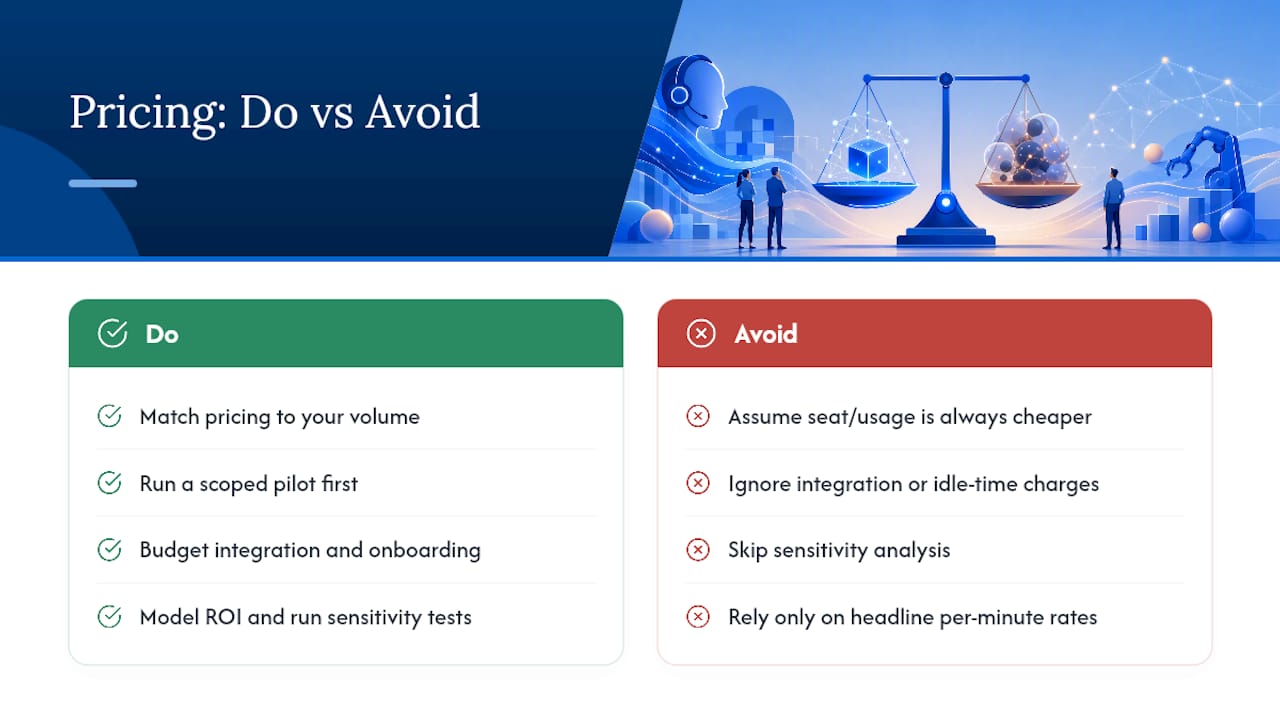
If your volume is steady, start with seat-based or hybrid pricing and negotiate a consumption ceiling. If it’s variable, start with consumption pricing and cap your exposure with a committed-spend discount once you’ve got three months of real data.
Demand an itemised quote covering platform fees, voice stack costs, telephony, integration and compliance separately. Run a pilot scoped to a single use case, measured against cost-per-call and FCR uplift before you commit to a full rollout.
What procurement teams get wrong about AI budgeting
The most common mistake is treating the headline per-minute rate as the total cost, then discovering integration and governance fees six weeks into implementation. The fix is simple: demand every line item itemised before signing, not bundled into one number.
The second mistake is skipping sensitivity testing on automation coverage.
How Conversational AI prices its contact centre platform
There are other ways to piece together a contact centre AI stack: separate STT, TTS and LLM vendors bolted together, or a generic chatbot platform stretched to cover voice. Both routes work, but they leave you managing multiple contracts, multiple billing bases, and the integration risk of making them talk to each other.
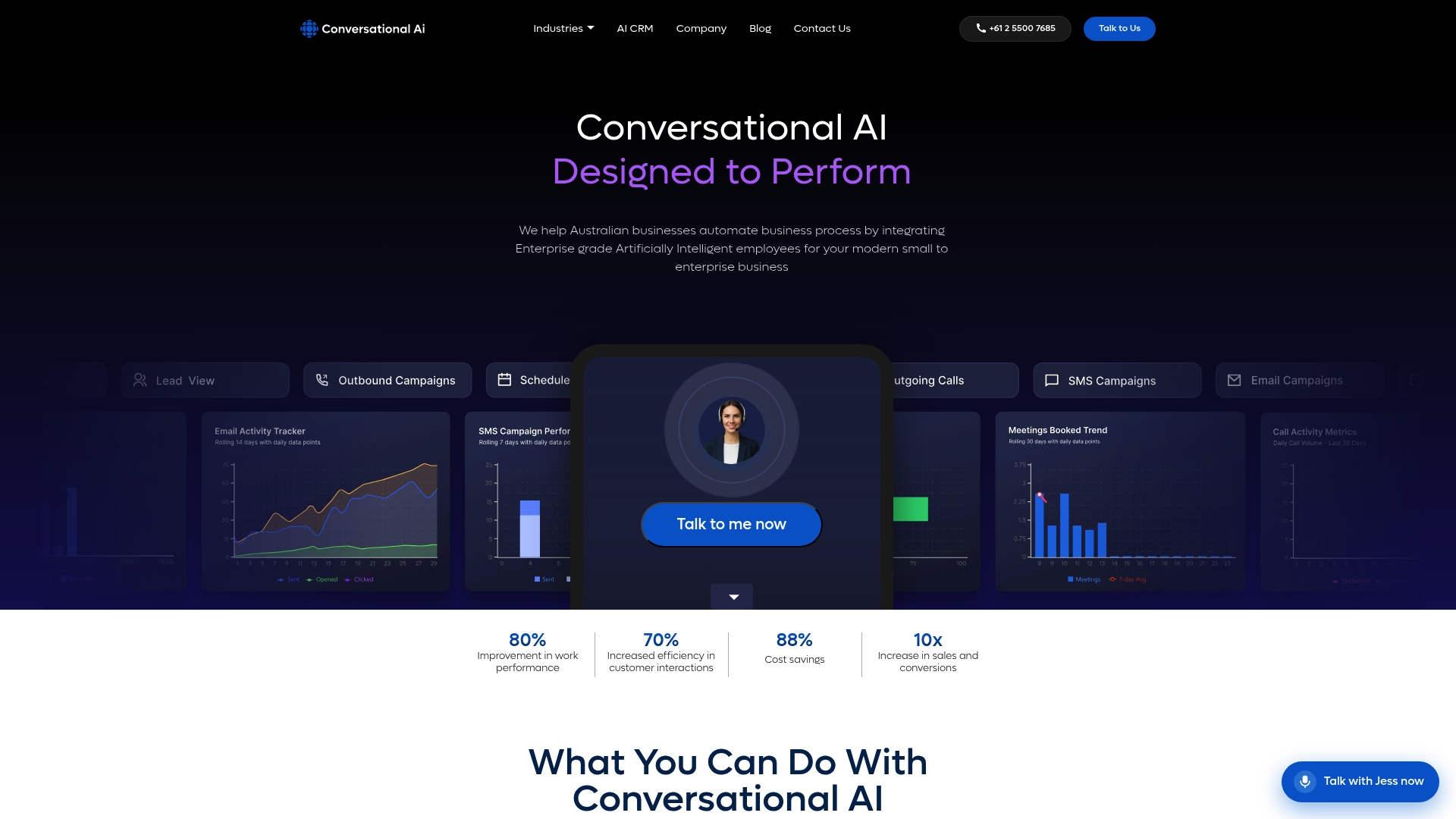
Conversational AI runs voice, SMS, email and live chat under one contract, hosted entirely within Australia, so your compliance team reviews one data-handling arrangement instead of three or four. Billing is structured around predictable per-channel components rather than a maze of token rates and session multipliers, and CRM connectors come built in rather than billed as custom integration work.
If you’re building a business case, ask for a pilot quote that includes platform fees, voice-agent minute rates, and integration scope in one document, with the production pricing tier disclosed upfront. You can start that conversation on the Conversational AI site and get a quote scoped to your actual call volume and channel mix.
Frequently asked questions about contact centre AI cost
What is a typical contact centre AI cost per minute? Bundled voice-agent rates commonly sit between $0.05 and $0.15 per minute, though rates vary by vendor tier and volume commitment, with some providers publishing per-minute session rates around $0.075 as an all-inclusive figure.
Is seat-based or usage-based pricing cheaper? Neither is inherently cheaper. Seat-based pricing suits steady, predictable volume, while usage-based pricing suits variable volume, because you only pay for what you actually use.
What’s the biggest hidden cost in AI contact centre pricing? Integration and onboarding fees are the most commonly missed cost, followed by session-based billing quirks where idle connection time gets charged the same as active conversation.
How long does implementation typically take? A scoped pilot with a single use case can go live in a matter of weeks, while a full multichannel rollout with CRM integration and compliance sign-off typically runs several months from decision to full deployment.
How do I model ROI before signing a contract? Calculate your current cost-per-call, apply a conservative automation coverage percentage to estimate the post-AI blended cost, and run a sensitivity test on that coverage assumption before committing to a contract term.
Sources
For deeper detail on billing mechanics, see AssemblyAI’s pricing structure, Deepgram’s tiered rates, and Quo’s breakdown of voice AI cost ranges. For ROI framing, read Contact Centre Magazine’s ROI analysis.
- AssemblyAI pricing
- Deepgram Pricing | Scalable Speech-to-Text, Text-to-Speech & Voice Agent APIs
- Finding the ROI on AI in your contact centre
- The AI-centric imperative (McKinsey)
Recommended
- Contact centre AI integration: a 2026 enterprise guide - Conversational AI
- AI sentiment analysis for customer calls: CX manager’s guide - Conversational AI
- AI platform ROI explained: a practical guide for Australian enterprise leaders - Conversational AI
- How to handle high volume inquiries with AI in 2026 - Conversational AI