48–72 Hour PIA and 9 Step Chatbot Security Playbook for Australian IT
For Australian IT teams: run a 48–72 hour PIA, apply a 7 layer chatbot security model, and map controls to OAIC, OWASP GenAI and NIST.

Treat every chatbot as a privileged application component, not a friendly UI layer. The non-negotiable controls are strong per-agent identity, least-privilege access, input and output sanitisation, encryption in transit and at rest, and mandatory human approval for any irreversible action. Continuous red teaming and monitoring close the loop. These priorities map directly to guidance from the OAIC, OWASP GenAI, and the NIST AI RMF.
TL;DR:
- Most chatbot security risks stem from prompt injection, data exfiltration, privilege abuse, misinformation, third-party compromises, and scraping, with many plugin deployments failing to isolate conversation history properly.
- A layered, zero-trust architecture requires policy enforcement at each pipeline stage, including identity, gateway, retrieval, prompt, output, action, and access layers, to limit attack surfaces.
- Organizations must conduct privacy impact assessments before deployment, minimize data collection, and enforce strict access controls with ephemeral credentials to comply with Australian Privacy Principles.
- Protect retrieval and external data sources by separating prompts, tagging sources, and validating document integrity, as many breaches exploit unverified third-party content.
- Regular testing, red teaming, incident monitoring, and strict operational checklists prevent exploitation, ensure rapid response, and promote secure AI chatbot implementations in regulated sectors.
Table of Contents
- Chatbot security risks: the attack modes you must design against
- Layered security model: architecture and defensive patterns
- Data protection and privacy obligations under the Privacy Act
- Access control, identity and credential management for chatbots
- Prompt injection and RAG protections engineers should apply
- Secure integrations and supply-chain controls for third-party APIs and SDKs
- Chatbot penetration testing, red teaming and verification
- Monitoring, logging and incident response for AI-driven incidents
- Operational checklist: an ordered playbook for deployment and audit readiness
- Australia-hosted private-cloud platforms as a compliance-focused example
- Author perspective and first actions for security teams
- How Conversational AI supports a compliance-first chatbot rollout
- Sources
- FAQ
Chatbot security risks: the attack modes you must design against
Every control on your checklist should trace back to a real attack path. Here’s what’s actually hitting chatbots in production right now:
- Prompt injection, both direct (a user typing malicious instructions) and indirect (hidden instructions buried in a retrieved document or webpage that hijack the model’s behaviour).
- Data exfiltration from retrieval-augmented generation (RAG) layers, where a poorly scoped query pulls records the user was never authorised to see.
- Over-privileged action abuse, where an agent with broad API access executes a refund, a password reset, or an account change it should never have been trusted to perform alone.
- Hallucination-driven misinformation, particularly damaging when a chatbot confidently states a false policy, price, or compliance position to a customer.
- Plugin and supply-chain compromises introduced through third-party connectors.
- Denial-of-wallet attacks and scraping abuse, where automated traffic drives up your API spend or harvests your knowledge base wholesale.
A large-scale study of chatbot plugins deployed across more than 10,000 websites found that most failed to properly isolate conversation history from untrusted third-party content, a gap that dramatically raises the success rate of prompt injection attacks.
Layered security model: architecture and defensive patterns
Bolting a filter onto an existing chatbot doesn’t work. You need policy enforcement points at every layer of the pipeline, so a failure in one doesn’t cascade into a full compromise. Think of it as concentric rings, each one narrowing what an attacker can reach even if the outer ring fails.
- Identity layer — every chatbot instance runs as a non-human account with its own credentials, never inheriting a shared service account.
- Gateway layer — an LLM gateway centralises policy enforcement, rate limiting, and logging before requests reach the model.
- Retrieval layer — RAG queries carry tenant and object-level authorisation checks, so the model can never fetch a document the requesting user couldn’t access directly.
- Prompt layer — system prompts are pinned, versioned, and isolated from user input so injected text can’t overwrite instructions.
- Output layer — responses are validated and sensitive fields redacted before they reach the user or downstream system.
- Action layer — any high-impact or irreversible action routes through a human approval gate.
- Access layer — ephemeral, just-in-time tokens replace long-lived API keys wherever agents call internal systems.
This is zero-trust design applied to a conversational pipeline: assume every layer might be compromised and limit the blast radius accordingly. Practitioner checklists built for production chatbot deployments consistently point to authorisation-at-retrieval and separated system instructions as the two controls most often skipped.
Pro Tip: Map each layer to a named owner in your team before deployment. “Everyone’s responsible for security” usually means no one checks the retrieval layer’s authorisation logic until an incident forces the question.
Data protection and privacy obligations under the Privacy Act
Any personal information a chatbot ingests or outputs stays subject to the Australian Privacy Principles, regardless of whether a human or a model is doing the processing. The OAIC’s guidance on commercially available AI products is explicit: run a privacy impact assessment before deployment, not after a complaint.
Practical steps that actually satisfy this obligation:
- Minimise what the chatbot collects and de-identify wherever the use case allows it.
- Favour in-country hosting or, where that’s not possible, contractual safeguards covering offshore data handling.
- Update your privacy notice to name the AI system and what it does with inputs.
- Disable “train on my data” settings by default rather than requiring customers to opt out.
- Give staff a short, mandatory briefing on what customer information should never be typed into a public chatbot testing environment.
Retention minimisation matters here too. Keeping six months of raw conversation logs “just in case” turns your chatbot into a much bigger liability than it needs to be.
Access control, identity and credential management for chatbots
User authentication and authorisation for chatbots can’t ride on the same session token as the surrounding web app. Give each agent its own scoped identity, and issue short-lived, just-in-time credentials rather than long-lived API keys that sit in a config file for months. Binding ephemeral credentials to a signed intent envelope prevents token reuse if a key does leak.
Mutual TLS and certificate pinning stop a compromised network hop from impersonating your gateway. Authorisation checks need to happen again at retrieval time, not just at login, because a valid session doesn’t mean every document in your knowledge base should be fair game. Apply role-based or attribute-based access control to every action the chatbot can trigger, rotate keys on a fixed schedule, and redact secrets from logs automatically rather than trusting engineers to remember.

Prompt injection and RAG protections engineers should apply

Treat every piece of retrieved content as untrusted, full stop. That includes documents pulled from your own knowledge base if they were ever editable by a customer, a partner, or an external feed. Indirect prompt injection succeeds precisely because engineers assume retrieved text is safe just because it came from an internal system.
Concrete hardening steps:
- Keep system prompts separate from user and retrieved content, and pin them under version control so a drift in behaviour is detectable.
- Fingerprint RAG sources so a forged or altered document can’t silently pose as a trusted one.
- Use content-role isolation, tagging retrieved text so the model treats it as data to summarise, never as instructions to follow.
- Apply low-privilege roles to any connector pulling external data, so a compromised source can’t reach further than intended.
The numbers behind this: researchers examining 17 widely deployed chatbot plugins found eight failed to protect conversation history integrity, and 15 ingested untrusted third-party content without validation, a combination that significantly raises injection success rates in production.
Secure integrations and supply-chain controls for third-party APIs and SDKs
Plugins and connectors are where most chatbot compromises actually happen, not the model itself. Trend Micro’s research on chatbot backdoors found that insecure data-store integrations let attackers pivot from a compromised chatbot into the microservices behind it.
Build a software bill of materials (or AI bill of materials) for every plugin and dependency, pin versions rather than tracking “latest,” and verify provenance before anything ships. Sandbox execution for third-party code, apply strict egress controls so a compromised plugin can’t phone home, and keep a supply-chain kill switch ready to disable a connector instantly. Your procurement process should demand a signed security attestation from every vendor before a contract is signed, not after.
Chatbot penetration testing, red teaming and verification
Testing an AI-powered chatbot isn’t the same as testing a web form. You’re not just checking for SQL injection; you’re checking whether a cleverly worded sentence can convince the model to override its own instructions.
- Run structured red teaming against prompt injection and tool-chaining attacks, where one compromised step is used to trigger a second, unintended one.
- Conduct standard penetration testing against the APIs and plugins surrounding the model, since that’s where most real breaches occur.
- Build prompt regression tests into your CI pipeline so a model or prompt update doesn’t silently reopen a fixed vulnerability.
- Use staged rollouts with canaries, exposing new prompt versions to a small user segment before a full release.
- Set acceptance criteria and remediation SLAs up front, so a finding doesn’t just sit in a backlog with no deadline.
Every finding needs to feed directly into your incident response and change-management process. A red team report nobody actions is worse than not testing at all, because it creates a false sense of coverage.
Monitoring, logging and incident response for AI-driven incidents
Immutable logs of every action and intent a chatbot takes are your only real defence when something goes wrong at 2am. Stable goal identifiers and unchangeable transition logs make behavioural drift detectable rather than something you discover after the fact.
Behavioural baselining flags when an agent starts calling tools in a sequence it’s never used before. Layer anomaly detection on top for unusual tool-chaining and data-loss patterns, and wire alerts directly into your SIEM or SOAR platform so a human sees it within minutes, not days. Every runbook needs a documented “pause the agent” step, a safe-shutdown procedure that doesn’t require an engineer to manually revoke five different tokens under pressure, and a clear trigger for regulatory breach notification. Minimise log retention to what’s operationally necessary, since a year of raw conversation transcripts is a bigger risk than a benefit.
Operational checklist: an ordered playbook for deployment and audit readiness
Run through this sequence before any chatbot goes live, and again before every major update:
- Discovery and scoping — document every data source, action, and integration the chatbot can touch.
- Risk assessment and PIA — complete a privacy impact assessment aligned to APP obligations.
- Architecture changes — implement the layered controls covered above.
- Identity and retrieval controls — confirm per-agent credentials and object-level authorisation.
- Prompt hardening — pin system prompts and isolate retrieved content.
- Red-team pass — run adversarial testing against the specific deployment, not a generic benchmark.
- Monitoring and KPIs — set alert thresholds and a baseline before launch, not after.
- Contractual and policy updates — update vendor SOWs and privacy notices.
- Go/no-go decision — a named security owner signs off, with documented acceptance criteria.
Pro Tip: Track a small, honest set of KPIs, injection attempts blocked, mean time to detect an anomaly, and percentage of actions requiring approval that actually got it. Vanity metrics like “conversations handled” tell you nothing about your security posture.
Australia-hosted private-cloud platforms as a compliance-focused example
An Australia-hosted, private-cloud conversational AI deployment illustrates several of these controls in practice: hosting entirely within Australia reduces cross-border data exposure risk that the OAIC flags as a factor in privacy assessments, while CRM integrations with tenant isolation limit what any single connector can reach. Sectors like healthcare and finance, where data residency and audit trails matter most, benefit directly from this architecture.
Author perspective and first actions for security teams
Most organisations delay chatbot security work until after launch, which is backwards. Run a 48 to 72 hour rapid privacy impact assessment and threat-modelling workshop before you build anything else, with security, DevOps, your privacy officer, and legal in the room together. One rule cuts through most disputes: pause any agentic action with irreversible effects until an approval gate exists. Reach out if your team needs a hand implementing this.
— Sowrabh
How Conversational AI supports a compliance-first chatbot rollout
Some platforms are hosted offshore or on shared multi-tenant infrastructure. Some organisations need to keep every conversation, integration, and log entirely within Australian borders. Some platforms are built as private clouds, hosted entirely in Australia, with CRM integration designed around tenant isolation rather than bolted on afterwards.
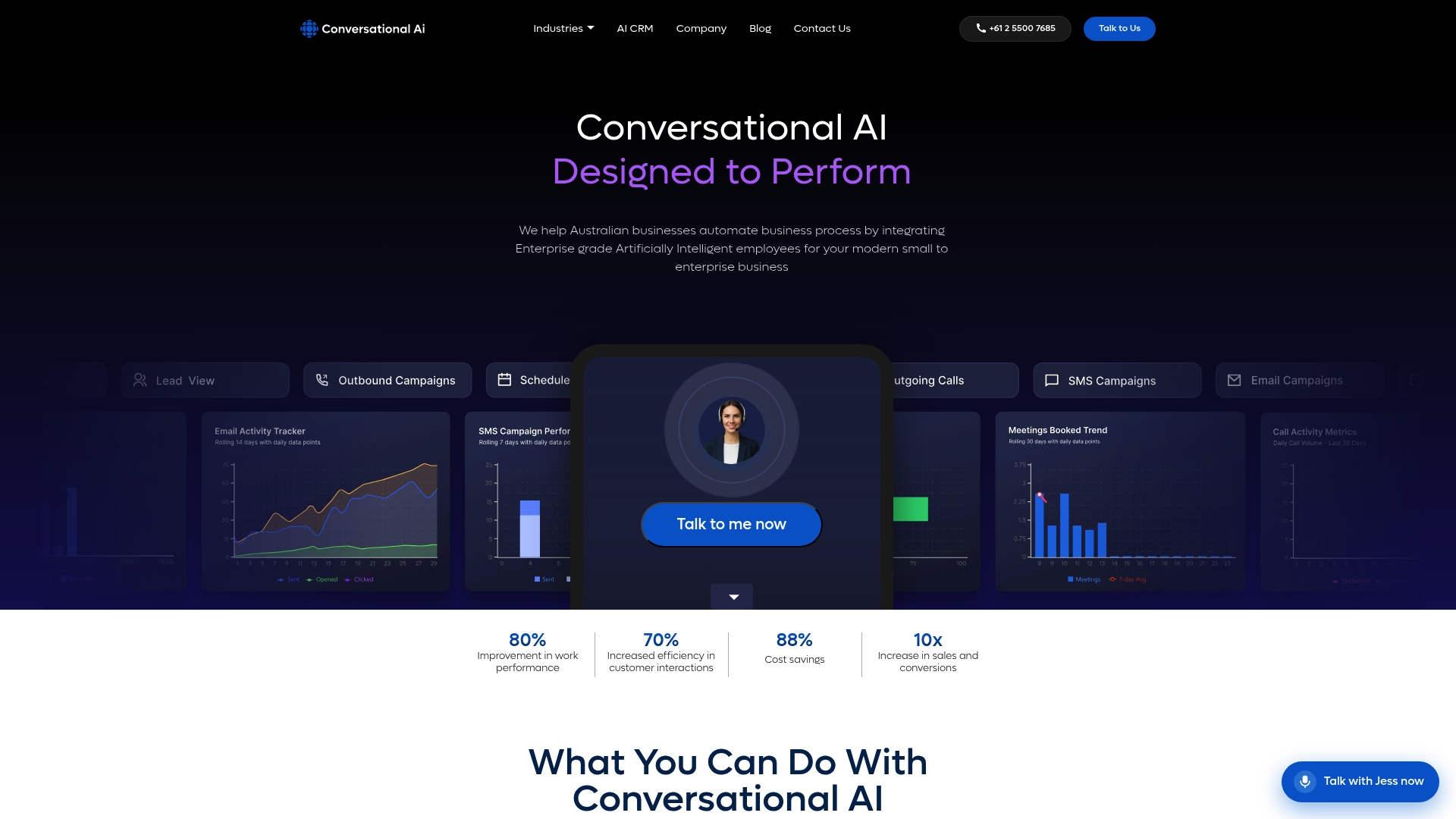
For regulated sectors, that matters more than a feature list. Conversational AI for Healthcare and Conversational AI for Banking and Finance are built around the same data-sovereignty principle covered throughout this checklist, and organisations with the strictest residency requirements can evaluate on-premises deployment directly. If your infrastructure already runs on a CRM, the Conversational AI CRM is worth a look before you commit to a rebuild. Organisations weighing the broader business case for AI adoption can also see what productivity gains other agencies report from getting the deployment right the first time. Book a walkthrough to see how the platform maps to the layered controls covered in this checklist.
Sources
For ongoing reference, the OAIC’s AI guidance covers Privacy Act obligations for any system handling personal information. OWASP’s Top 10 for Agentic Applications maps the newest agentic-specific threats. The NIST AI Risk Management Framework sets out governance and testing structure, while the arXiv study on chatbot plugin risks gives the empirical evidence behind the prompt-injection statistics cited above.
- OWASP Gen AI Security Project Top 10 for Agentic Applications
- When AI meets the web: prompt injection risks in third-party chatbot plugins (arXiv)
- Guidance on privacy and the use of commercially available AI products | OAIC
- NIST AI Risk Management Framework and companion resources
- AI Chatbot security best practices: production checklist for 2026 | SecureCodeReviews
FAQ
How do you secure an AI chatbot?
Start by treating it as a privileged application: enforce per-agent identity and least-privilege access, sanitise inputs and outputs, encrypt data in transit and at rest, and require human approval for any irreversible action. Layer in continuous red teaming and monitoring so new vulnerabilities get caught before they’re exploited, following the structure in the OWASP GenAI Top 10.
What are the best practices for AI security more broadly?
The strongest programs integrate AI risk management into existing enterprise security processes rather than running it as a separate silo, a principle the NIST AI RMF builds its entire framework around. That means the same incident response, access control, and audit processes covering your other systems should extend to chatbots, enhancing accountability and remediation speed.
What shouldn’t you type into a chatbot?
Avoid entering sensitive personal information, financial account details, health records, or confidential business data into any public-facing chatbot, since the OAIC confirms this data remains subject to Privacy Act obligations regardless of the platform. Passwords, API keys, and anything you wouldn’t want appearing in a training dataset also belong on that list.
What are five things to avoid discussing with a chatbot?
Steer clear of full financial account numbers, medical diagnoses tied to an identifiable person, workplace disciplinary details, login credentials, and anything covered by a confidentiality agreement. Each of these sits squarely inside the personal or sensitive information categories the Australian Privacy Principles were designed to protect.
Are there private, Australia-hosted conversational AI options available?
Yes. Conversational AI runs as a private cloud platform hosted entirely within Australia, with an on-premises deployment option for organisations needing full data residency control. Current pricing for such platforms is available directly on the respective company websites.