AI live chat integration benefits for enterprise teams
Discover the ai live chat integration benefits for enterprise teams. Enhance customer support and reduce agent workload effectively.

AI live chat integration is defined as the combination of AI-powered chatbots with live human agents to deliver fast, intelligent customer support and sales interactions across multiple channels. The advantages of AI chatbots working alongside human agents are well established: 91% of companies with 50 or more staff now use hybrid AI and live chat models, reducing agent workload by up to 80%. That figure tells you this is no longer an emerging experiment. For customer experience professionals evaluating AI chat solutions for businesses, the question is not whether to integrate, but how to do it well. Conversational AI sits at the centre of this shift, providing the foundational technology that makes hybrid chat work at enterprise scale.
How AI live chat integration benefits customer engagement
Real-time customer engagement improves dramatically when AI handles the first layer of every conversation. Chatbots respond in under 3 seconds, and 73% of customers expect instant responses and leave sites when delayed. That means every second of wait time carries a measurable cost in lost engagement.
The benefits of chatbot integration extend well beyond speed. AI systems draw on customer data to personalise interactions, referencing past purchases, account status, and browsing behaviour to make each conversation feel relevant. Customers notice the difference between a generic scripted reply and a response that actually reflects their situation.

Multichannel presence is another core advantage. Omnichannel AI platforms support 15 or more messaging channels, including WhatsApp, SMS, Apple Messages for Business, and Instagram. Customers connect on the platform they already use, which removes friction from the first point of contact.
Proactive chat triggers are one of the most underused tools in live chat automation. When a visitor spends a set amount of time on a pricing page or adds items to a cart without checking out, behaviour-triggered chat greetings initiate a conversation before the customer walks away. That shift from reactive to proactive support changes the entire dynamic of the interaction.
- Instant response: AI replies in under 3 seconds, meeting the expectation of 73% of customers.
- Personalisation: Customer data platforms feed AI with context, making each reply relevant to the individual.
- Multichannel reach: Deploy across 15+ channels so customers engage on their preferred platform.
- Proactive triggers: Behaviour-based chat prompts start conversations at the moment of highest intent.
Pro Tip: Set proactive chat triggers to fire after 45 seconds on high-intent pages like pricing or checkout. Earlier triggers often feel intrusive; later ones miss the window entirely.
Operational efficiency and cost benefits of AI live chat integration
AI customer support benefits are most visible in the numbers. Businesses using chatbots report a 33% reduction in customer service costs while maintaining support quality. That reduction comes from automating the high-volume, low-complexity queries that currently consume most of your team’s time.
Modern AI chatbots resolve 78–85% of customer queries without any human intervention. The remaining 15–22% are the complex, high-value cases where a skilled agent genuinely adds value. That split is the operational efficiency argument in a single statistic.
The cost benefits compound when you factor in 24/7 availability. AI runs continuously without overtime, shift penalties, or rostering gaps. For Australian enterprises operating across time zones or serving customers outside business hours, this removes a structural cost that human-only teams cannot avoid.
- Automate routine queries first. Identify the top 20 query types by volume and automate those before anything else.
- Redirect agent time. With AI handling repetitive tickets, agents focus on escalations that directly affect revenue and retention.
- Eliminate after-hours staffing costs. AI covers nights, weekends, and public holidays without additional headcount.
- Reduce average handle time. AI pre-qualifies and categorises each query before handoff, so agents start with full context.
- Scale without proportional hiring. Volume spikes during campaigns or peak seasons are absorbed by AI, not by emergency recruitment.
Stat to know: Hybrid AI and live chat systems reduce support costs by up to 30% while improving response times. That combination of cost reduction and speed improvement is what makes the business case straightforward for most enterprises.
Boosting sales and conversions with hybrid AI and live chat
Adding live chat to a website boosts conversions by 20% on average. That figure alone justifies the investment for most enterprise sales teams. The mechanism is simple: customers who get answers during the decision-making moment are far more likely to complete a purchase.
The spending behaviour of live chat users reinforces this point. Live chat customers spend 60% more and are 2.8 times more likely to convert than those who do not engage with chat. These are not marginal improvements. They represent a structural shift in how customers move through a purchase funnel when support is available at the right moment.
AI also improves the quality of leads reaching your sales team. Companies using chatbot-based lead qualification report 67% more qualified leads. AI screens intent, collects key information, and routes only the most promising conversations to human agents. That means your sales team spends time on conversations that are already warm.
Cart abandonment is one of the clearest revenue leakage points in e-commerce and enterprise self-service portals. Proactive live chat during checkout reduces cart abandonment by 25–30%. A well-timed message asking “Can I help you complete this?” converts hesitation into action.
“The best AI and live chat models combine instant AI responses with human empathy for complex, high-value interactions. Neither alone delivers the full result.”
- Conversion uplift: Live chat integration lifts conversion rates by 20% on average across industries.
- Higher spend per customer: Chat users spend 60% more, making engagement a direct revenue driver.
- Lead quality improvement: AI qualification produces 67% more sales-ready leads before human handoff.
- Cart recovery: Proactive checkout chat reduces abandonment by up to 30%.
Key features to look for in AI live chat tools
The most critical feature in any AI live chat tool is context-preserving escalation. When a customer moves from AI to a human agent, full conversation context including issue history, account details, and prior responses must transfer instantly. Customers who repeat themselves to a new agent lose confidence in the entire support experience.
Omnichannel deployment is equally non-negotiable for enterprise teams. A platform that only works on web chat creates gaps wherever your customers prefer to engage. The strongest AI chat solutions for businesses deploy across web, SMS, email, voice, and major messaging apps from a single management interface.
AI training capability separates entry-level tools from enterprise-grade platforms. Systems that continuously learn from historical ticket data improve resolution rates over time. High-performing teams train AI on complex past cases to shift routine tickets to automation and prioritise nuanced agent interactions for revenue impact.
| Feature | What to look for |
|---|---|
| Escalation with context | Full chat history and account data transferred to agent instantly |
| Omnichannel deployment | Web, SMS, voice, WhatsApp, and email from one platform |
| AI training from ticket data | Continuous learning from resolved cases to improve future resolution |
| Customer data integration | Connection to CRM or CDP for personalised, context-aware responses |
| Analytics and reporting | Real-time dashboards tracking resolution rate, handoff rate, and CSAT |
Pro Tip: Ask vendors to demonstrate a live escalation during evaluation. Watch whether the agent receives full context or starts from scratch. That single test reveals more about platform quality than any feature checklist.
When and how to implement AI live chat integration successfully
Successful implementation starts with a narrow focus. Automate your highest-volume, lowest-complexity queries first. Trying to automate everything at once produces a fragile system that frustrates customers and overwhelms your team during rollout.
Continuous AI training is the difference between a system that plateaus and one that keeps improving. Feed the AI with real resolved tickets regularly, including the complex cases that initially required human intervention. Over time, the AI’s resolution rate climbs and the handoff threshold shifts upward. You can read more about this approach in the context of migrating legacy systems to AI-powered infrastructure.
Handoff quality determines whether customers trust the system. A clumsy transition where a customer must re-explain their issue from scratch undoes the goodwill built by fast AI responses. Build escalation protocols that transfer full context and set agent expectations before the conversation arrives.
- Start narrow: Automate the top 20 query types by volume before expanding scope.
- Train continuously: Update the AI with new resolved tickets monthly to maintain accuracy.
- Design handoffs carefully: Transfer full context and flag urgency level before the agent receives the chat.
- Monitor the right KPIs: Track resolution rate, average handle time, conversion rate, and customer satisfaction score together, not in isolation.
- Review escalation triggers regularly: As AI improves, recalibrate which queries it handles versus which it escalates.
For teams looking at AI automation and productivity gains at the enterprise level, the implementation sequence matters as much as the technology itself.
Key takeaways
AI live chat integration delivers measurable gains in conversion, cost reduction, and customer satisfaction when enterprises deploy a well-designed hybrid model that combines AI automation with skilled human escalation.
| Point | Details |
|---|---|
| Hybrid model adoption | 91% of companies with 50+ staff use AI and live chat together, cutting agent workload by up to 80%. |
| Cost reduction | Businesses report up to 33% lower customer service costs without sacrificing support quality. |
| Conversion impact | Live chat lifts conversions by 20% on average; chat users spend 60% more than non-chat customers. |
| Context-preserving escalation | Full conversation history must transfer at handoff to prevent customer frustration and repeat explanations. |
| Continuous AI training | Feeding resolved tickets back into the AI improves resolution rates and shifts complex cases to skilled agents over time. |
My take: AI chat integration is a revenue strategy, not a cost exercise
Most enterprise teams I speak with frame AI live chat integration as a cost-cutting project. That framing is understandable, and the cost case is real. But it misses the larger opportunity.
The AI chatbot satisfaction data consistently shows that the biggest revenue gains come from proactive engagement, faster qualification, and better handoffs to sales teams. Those are growth levers, not efficiency metrics. When you measure only cost reduction, you build a system optimised for deflection. When you measure conversion rate and revenue per chat session alongside resolution time, you build something genuinely different.
The enterprises getting the most from hybrid AI and live chat are the ones treating it as a customer experience investment. They are asking: how do we make every interaction faster, more relevant, and more likely to result in a satisfied customer or a closed sale? That question produces better outcomes than “how do we reduce ticket volume?”
Customer expectations have shifted permanently. Customers now expect a response in seconds, not minutes. They expect the agent to already know their history. They expect to engage on whatever channel they happen to be using. A hybrid AI and live chat model is the only architecture that meets all three expectations simultaneously. The teams that build it well will have a structural advantage over those still running human-only support queues.
— Sowrabh
AI agents built for Australian enterprises
Conversational AI delivers an enterprise-grade platform purpose-built for Australian businesses that need private, secure, and multi-channel AI chat capabilities.
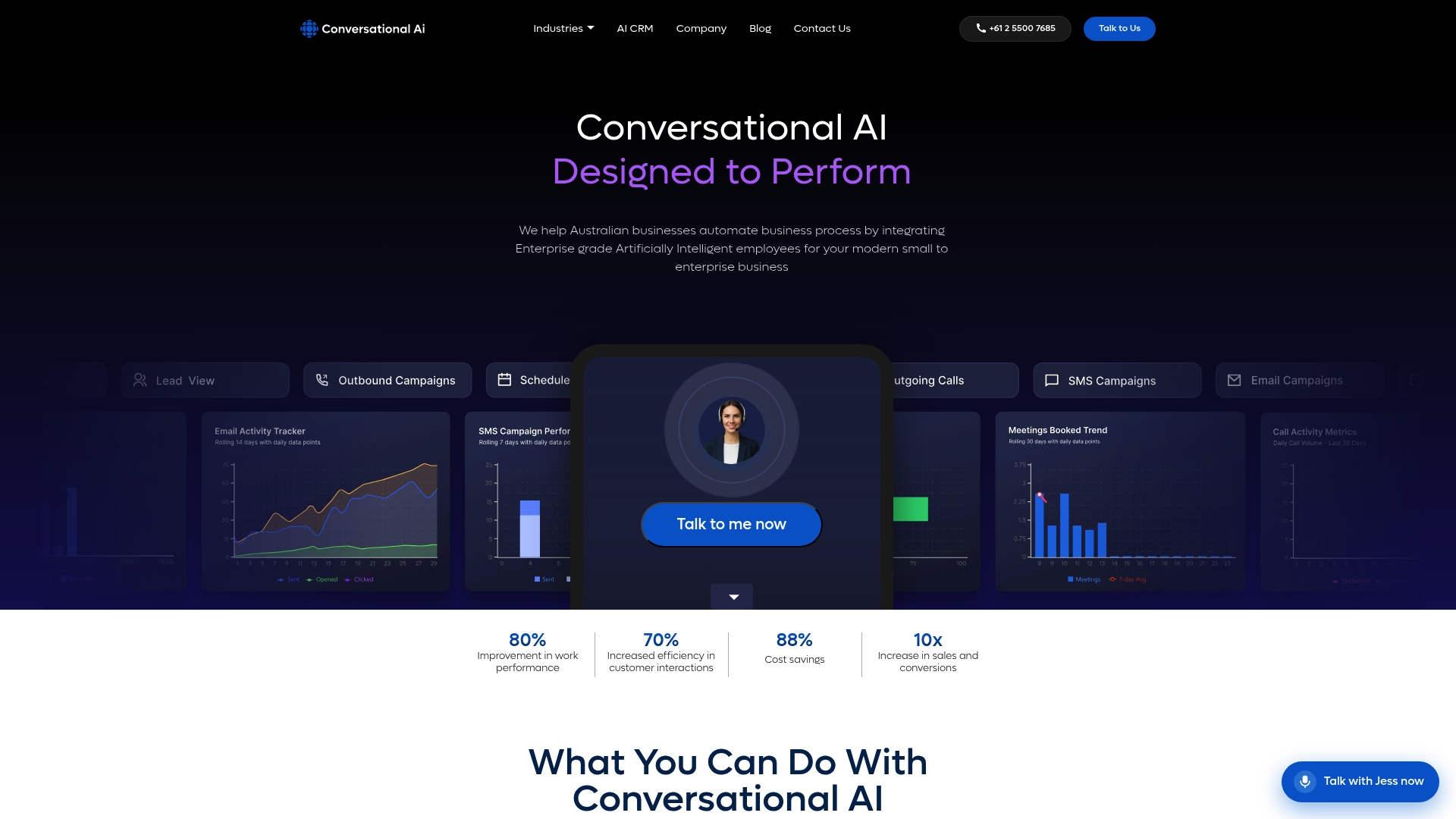
The AI Agents platform supports voice, SMS, email, and live chat from a single interface, with full CRM integration and data hosted entirely within Australia. That means your customer data never leaves Australian jurisdiction, which matters significantly for teams in finance, healthcare, and professional services. The hybrid AI and human agent model is built in from the start, with context-preserving escalation and real-time analytics included. Contact Conversational AI to arrange a consultation or demonstration tailored to your enterprise requirements.
FAQ
What is AI live chat integration?
AI live chat integration combines AI-powered chatbots with live human agents to handle customer support and sales conversations. AI manages routine queries instantly while escalating complex cases to human agents with full context transferred.
How much can AI live chat reduce support costs?
Businesses using hybrid AI and live chat systems report up to a 33% reduction in customer service costs. The saving comes from automating high-volume routine queries that previously required human agent time.
Does live chat actually improve conversion rates?
Adding live chat to a website lifts conversion rates by 20% on average. Live chat customers also spend 60% more and are 2.8 times more likely to convert than customers who do not engage with chat.
What should I look for in an AI live chat platform?
Prioritise context-preserving escalation, omnichannel deployment across 15 or more channels, continuous AI training from ticket data, and CRM integration for personalised responses. These four capabilities separate enterprise-grade platforms from entry-level tools.
How do I measure the success of AI live chat integration?
Track resolution rate, average handle time, conversion rate, and customer satisfaction score together. Measuring cost reduction alone misses the revenue impact that well-implemented hybrid chat delivers.