Safely Deploy AI Agents and Chatbots in Australia: 3 Key Disciplines
2026 guide for Australian tech leaders comparing AI agents and chatbots. Learn the three disciplines to move pilots to production with onshore privacy and...

AI agents execute multi-step tasks and act on systems; chatbots primarily handle conversation and information retrieval. Choose a chatbot for constrained, conversational jobs like answering FAQs or routing enquiries, and an agent when the task needs autonomous action across tools and systems. The trade-off is straightforward: as autonomy increases, so does the governance and integration work needed to keep it safe.
TL;DR:
- Start with a chatbot pilot because it ships faster and reveals demand; build an agent only for a defined multistep task and required system access.
- For customer support, let a chatbot resolve questions and route requests, then hand off to an agent only when a system change is required.
- Limit an agent’s API access to its assigned task, require human approval before irreversible actions, and retain timestamped records of every decision and action.
- Before production, define success tests, log actions and failures, confirm data residency, and prepare incident playbooks with tested rollback paths and human handoffs.
- Reject vendors that cannot provide complete action logs, human approval for high risk actions, documented hosting locations, and clear recovery behavior after tool failures.
Table of Contents
- How do AI agents and chatbots compare on the decisions that matter?
- What is a chatbot and where does it stop being useful?
- What is an AI agent and how does the agent loop actually work?
- Which jobs suit a chatbot, which suit an agent, and when should you combine both?
- What governance do agents need that chatbots don’t?
- What does an implementation-ready rollout actually require?
- How do you evaluate and shortlist an agent or chatbot vendor?
- How does a privacy-first platform approach agentic and chatbot projects?
- Why sequencing and ownership decide whether this works
- Ready to pilot a privacy-first agent or chatbot build?
- FAQ
- Sources
How do AI agents and chatbots compare on the decisions that matter?
The two technologies sit on different points of a spectrum, and the gap widens once you look past the chat window. A chatbot answers reactively, turn by turn, inside a conversation. An AI agent sets a goal, plans the steps to reach it, and acts on external systems without waiting for you to prompt every move.
That distinction plays out across several practical dimensions:
- Autonomy: chatbots are reactive and respond only within a conversation turn, while agents are goal-driven and can plan several steps ahead before checking back in.
- Tool access: chatbots mostly retrieve and present information, whereas agents call APIs, update records and schedule actions in other systems.
- Memory: chatbots typically hold short-lived conversation state, while agents draw on longer-term context and retrieval-augmented generation (RAG) to stay consistent across sessions.
- Blast radius: a chatbot’s worst mistake is a bad answer; an agent’s worst mistake can be an irreversible transaction, a cancelled booking or a changed record.
Agentic AI acts and makes decisions using tools, orchestrating multi-step workflows, while chatbots remain focused on engagement. Practitioners increasingly describe the two as complementary rather than competing, with chatbots handling the front door and agents managing the backend complexity.
Those architectural differences carry operational consequences. Agents tend to cost more to run because planning and tool calls add compute and latency, and they need stronger observability because a single bad decision can touch several systems before anyone notices. Chatbots are cheaper, faster to respond, and easier to monitor precisely because they do less. None of this makes one “better”: it makes them suited to different jobs, which is the point decision-makers keep missing when they shop for one technology to solve every problem.
What is a chatbot and where does it stop being useful?
A chatbot is a conversational interface built to interpret a message and return a response, either from a fixed rule set or from a language model. Rule-based chatbots match intents against scripted decision trees. They are predictable and cheap to audit, but brittle outside their scripted paths. LLM-backed chatbots understand free-form language far better and can hold a more natural conversation, though they still operate within a single exchange rather than pursuing a goal across multiple steps.
Both variants share the same structural ceiling: they respond, they don’t act. Chatbots are reactive, turn-based systems designed for conversational interaction, built around information retrieval and question answering rather than decision-making or task execution.
That constraint is also their strength. A well-scoped chatbot is:
- Predictable, because its response space is bounded by its training or scripting.
- Low-risk operationally, since it cannot change a record or trigger a payment on its own.
- Fast and cheap, with lower latency and compute cost than a planning agent.
The limitations show up quickly once expectations rise. A chatbot can’t chase down a multi-step account update, can’t hold durable context across weeks of interaction without extra engineering, and carries a particular risk mode: hallucination, where it states something confidently wrong rather than acting incorrectly. An agent’s risk mode is different and arguably higher stakes, because it can take the wrong action rather than just say the wrong thing.
In enterprise settings, chatbots earn their place on FAQ pages, first-line support triage, appointment reminders and simple routing to a human or a system. Anywhere the job is “answer or redirect,” a chatbot is usually the right-sized tool.
It usually does.*
What is an AI agent and how does the agent loop actually work?
An AI agent runs a loop rather than a single response: reason about the goal, act by calling a tool, observe the result, then re-plan if needed. This pattern, often called ReAct (reason and act), lets an agent chain several actions together to complete a task that a chatbot could only describe.
The mechanics worth understanding before you design or buy one:
- Reasoning and planning: the agent breaks a goal into steps and decides which tool or API to invoke next.
- Tool calling: the agent executes actions, such as looking up a customer record, updating a CRM field or triggering a workflow, rather than just describing them.
- Memory and retrieval: context persists across steps and sessions, often via RAG, so the agent stays grounded in current data rather than relying only on what it was trained on.
- Observation and re-planning: after each action, the agent checks the outcome and adjusts, which is what separates a true agent from a scripted automation.
Single-agent setups are simpler to build, test and debug, and they suit most first deployments. Multi-agent, orchestrator-worker patterns split a complex job across specialised agents working in parallel, which scales better for multi-domain tasks but adds coordination overhead and more places for something to go wrong. Stanford’s work on agent orchestration outlines these trade-offs clearly: ReAct, orchestrator-workers, parallelisation and evaluator-optimiser patterns each solve a different coordination problem, and single-agent systems still struggle once a task spans too many domains at once.
Protocols are starting to standardise how agents talk to tools and to each other, with emerging specifications for tool-calling (sometimes referenced as MCP) and agent-to-agent coordination (A2A) shaping how teams wire systems together. You don’t need to memorise every acronym, but you do need to know that these interoperability layers exist, because they determine how painful your integration work will be.
Debugging an agent is harder than debugging a chatbot, simply because there are more decision points to trace. Build in logging at every step of the loop from day one, not after the first incident.
Which jobs suit a chatbot, which suit an agent, and when should you combine both?
Matching the tool to the job prevents the two most common mistakes: overbuilding a chatbot into a fragile pseudo-agent, or deploying a full agent where a scripted flow would have done.
- Chatbot territory: FAQ answering, intent routing, appointment reminders and other low-risk, self-service interactions where the answer is the deliverable.
- Agent territory: multi-step account changes, end-to-end workflow automation (think claims processing or onboarding), and copilot-style tasks where a person still reviews the outcome.
- Hybrid territory: a chatbot handles the conversation up front, then hands off to a backend agent to execute the action, which is often the most practical shape for customer-facing work.
A hybrid pattern suits most enterprises better than an all-or-nothing choice. A customer asks a question through a familiar chat interface, the system resolves it conversationally where possible, and only escalates to an agent when the request requires an actual system change, like updating a billing detail or rescheduling a service.
On cost and time-to-value, start with the chatbot pilot. It is faster to ship, easier to evaluate, and gives you a realistic read on volume and intent before you invest in the tooling, permissions and testing an agent demands. Reach for an agent build only once you can name the specific multi-step task it needs to automate and the systems it needs to touch.
What governance do agents need that chatbots don’t?
Blast radius is the concept that should drive every governance decision here. A chatbot’s mistake is a wrong sentence. An agent’s mistake can be a payment authorised, a record deleted or a booking cancelled, and some of those actions can’t be undone. Governance requirements increase with agent autonomy precisely because agents can take irreversible actions that chatbots structurally cannot.
The controls that matter scale with what the system is allowed to do:
- Permissioned tool scopes: an agent should only be able to call the specific APIs its task requires, nothing broader.
- Human-in-the-loop gates: any irreversible or high-value action should pause for human approval before it executes.
- Audit logs: every decision and action an agent takes needs a timestamped, reviewable trail.
- Validation layers: sanitise inputs and outputs so a bad prompt or a malformed response can’t trigger a bad action.
- Sandboxed testing and red-teaming: test agents against adversarial and edge-case scenarios before they touch production systems.
Australian policy increasingly backs this proportional approach. The National AI Plan recommends risk-based regulation scaled to the actual harm an AI system could cause, alongside investment in sovereign capability, which makes data residency and auditability practical procurement filters rather than nice-to-haves. On the measurement side, Stanford’s CDH work on chatbot harms argues that harms should be separated from mechanisms, so teams can target mitigations instead of applying blanket rules that under-protect agentic systems and over-restrict simple chatbots.
If you’re deploying in a regulated sector, our guide to meeting Australian financial-sector security and privacy requirements walks through how these controls map to specific compliance obligations.
What does an implementation-ready rollout actually require?
Getting from pilot to production reliably comes down to three disciplines: data, observability and operational readiness. Skipping any one of them is how a promising proof of concept stalls at scale.
- Set up RAG and data residency properly. Ground the system in current, accurate data and decide where that data lives, particularly if you operate in a sector with strict residency expectations.
- Apply least-privilege credential management. Give each tool integration only the access it needs, and rotate credentials as a matter of routine, not an afterthought.
- Build evals before you build features. Define what a correct outcome looks like and test against it continuously, not just at launch.
- Instrument for observability. Capture user telemetry, action logs and failure patterns so you can trace a bad outcome back to its cause.
- Write incident playbooks and rollback paths. Know exactly how to pause or revert an agent’s actions before you need to do it under pressure.
- Plan the human handover. Decide which actions always route to a person, who owns that queue and how escalation is measured.
Our guide to avoiding unapproved offshore data transfers covers the residency and credential piece in more detail for teams building this checklist into procurement.
Pro Tip: Treat your first eval suite as a living document. The questions you didn’t think to test for are exactly the ones that will surface in production.
Staffing matters too. Someone needs to own agent governance day to day, not just at sign-off, and ROI measurement should be baked in from the start rather than retrofitted once leadership asks for numbers.
How do you evaluate and shortlist an agent or chatbot vendor?
A good evaluation separates what a system must do from what would be nice if it did. Ask vendors directly about autonomy boundaries, integration depth, security posture, auditability and expected latency under load, and don’t accept vague answers on any of them.
- Can the system show a full audit trail for every action an agent takes, not just a summary?
- Does it support human-in-the-loop approval for actions above a defined risk threshold?
- Where is data hosted, and does that meet your sector’s residency requirements?
- What is the expected latency for a multi-step agent task versus a single chatbot response?
- How does the system handle a tool failure mid-workflow: does it retry, escalate or fail silently?
| Evaluation area | Must-have gate | Nice-to-have |
|---|---|---|
| Autonomy controls | Human approval for irreversible actions | Configurable risk thresholds per action type |
| Auditability | Full action-level audit log | Exportable logs for external compliance review |
| Data residency | Documented hosting location and compliance scope | Choice of hosting region |
| Integration | Native CRM and API connectors | Pre-built industry-specific workflows |
Red flags are easy to spot once you know what to look for: no audit logs, no human-in-the-loop pathway for high-value actions, and vague or shifting answers on where data actually resides. Any one of those should stop a procurement process until resolved.
How does a privacy-first platform approach agentic and chatbot projects?
Running agentic workloads for regulated industries starts with where the data lives and who can touch it. We host entirely within Australia, which helps keep data under local jurisdiction and supports compliance conversations with clients in sectors that require strict data residency.
The phased path we recommend mirrors what the risk literature suggests: begin with a scoped chatbot pilot to prove conversational accuracy and volume handling, move to a guarded agent pilot with tight tool scopes and human approval gates, then scale only once those controls hold under real traffic. Our sovereign AI compliance guide walks through the procurement considerations behind that sequencing in more depth.

Demos and proofs of concept we run typically cover audit trails, role-based access controls and tested CRM integrations, because those are the three things regulated buyers ask about first and the three things that are hardest to retrofit later.
Why sequencing and ownership decide whether this works
The organisations getting this right treat agent adoption as a governance project with a technology component, not the other way around. Start small, measure the actual impact against a baseline, and resist the pressure to scale before the controls have been tested under real load.
Ownership matters more than most rollout plans acknowledge. Someone, ideally a named operations or risk lead rather than a committee, should own agent governance day to day. Before any broad rollout, check five things: audit logs are complete, human-in-the-loop gates actually trigger, ROI is measurable against a real baseline, data residency is confirmed in writing, and a rollback path has been tested, not just documented.
— Sowrabh
Ready to pilot a privacy-first agent or chatbot build?
We built our platform around the sequencing this article describes: a scoped chatbot pilot, a guarded agent trial, then controlled scale, all on Australian-hosted infrastructure. That means healthcare, finance and real estate teams can run multichannel Voice AI Agents, Live Chat AI Agents, SMS AI Agents and more without sending data offshore to get there.
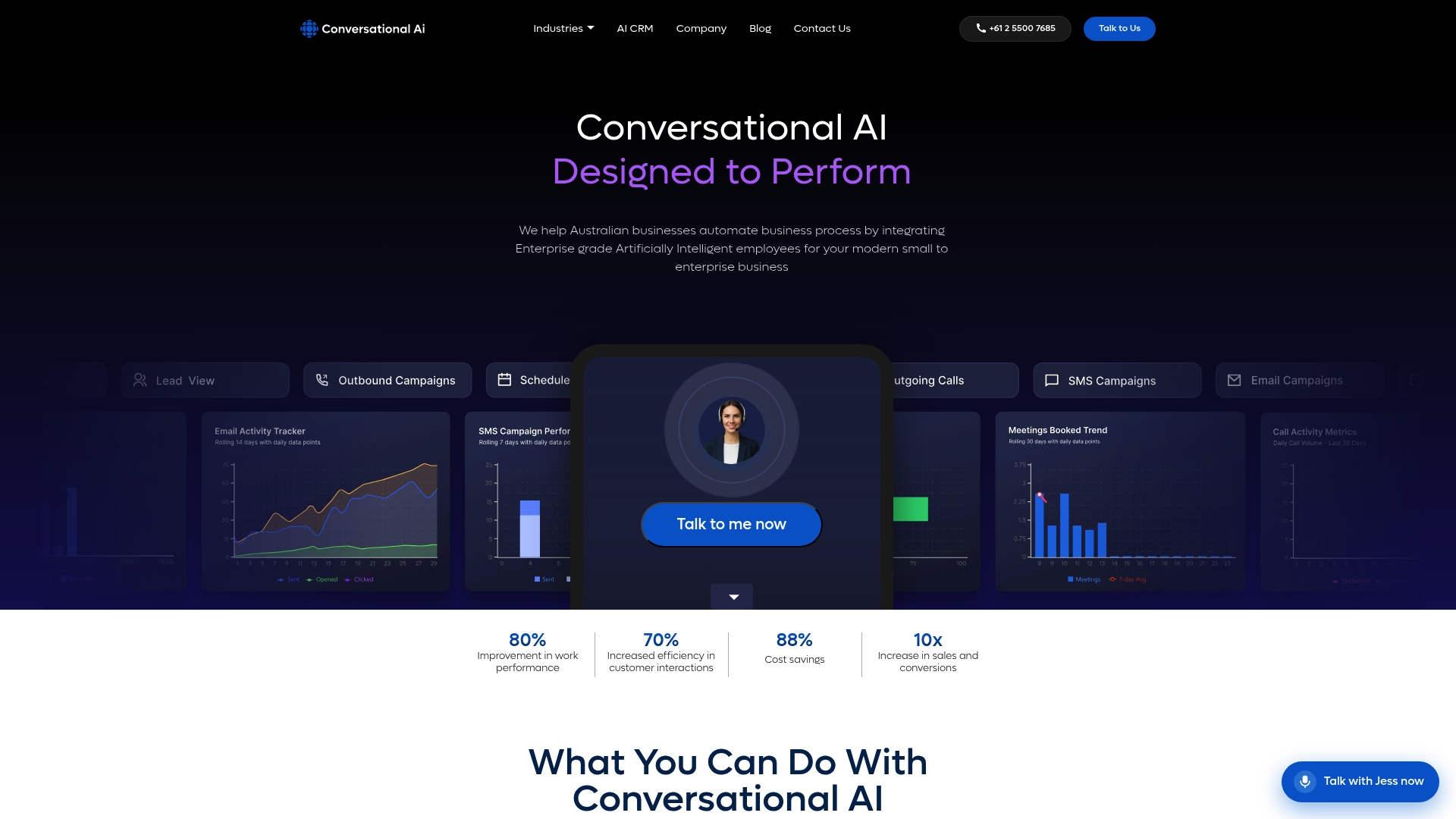
If you’re scoping a pilot, our Conversational AI CRM integrates with existing systems so your audit trails and role-based access controls are in place before the first agent action goes live. Get in touch to scope a compliance checklist and book an enterprise demo.
FAQ
Is ChatGPT a bot or agent?
ChatGPT operates primarily as a conversational chatbot, responding to prompts within a session rather than autonomously executing multi-step tasks across external systems. Some ChatGPT products add agentic features like tool use and browsing, which blurs the line, but its core mode remains conversational response rather than independent action.
What are the 7 types of AI agents?
Definitions vary across sources, and no single authoritative list of exactly seven types is settled in the research cited here. Common categories referenced in practitioner literature include reactive agents, goal-based agents, utility-based agents, learning agents, and multi-agent orchestration patterns such as orchestrator-workers, each suited to different levels of task complexity.
Who are the big 4 AI agents?
There’s no agreed industry standard naming four specific agents as the leading set, and market rankings shift too quickly to state reliably. What’s consistent across the sources here is the architectural distinction between single-agent and multi-agent systems, which matters more for your evaluation than any particular vendor list.
Are AI agents just bots?
No. Chatbots are reactive, turn-based systems built for conversation, while AI agents are goal-driven systems that plan, reason and execute multi-step actions across external tools and systems without constant human prompting. The practical difference shows up in what each can actually do once deployed, not just how they talk.
Do AI agents and chatbots work well together?
Yes. Practitioners increasingly treat them as complementary rather than competing technologies, with chatbots handling user-facing conversation and agents managing the backend workflows and tool calls that conversation triggers.
Sources
- AI agent vs chatbot — Redis blog
- Agentic AI, explained | MIT Sloan
- Defining and measuring potential harms of chatbots — Stanford CDH
- Australia’s National AI Plan — Department of Industry, Science and Resources