Why channel silos hurt businesses and how to fix them
Discover how channel silos cost you revenue and trust. Learn practical solutions to unify your marketing efforts and improve customer journeys.

Channel silos cost you revenue, they waste ad spend, and they wreck the customer journey you’re trying to build. Forrester has flagged it as one of the most persistent, self-inflicted problems in marketing, and platforms like Conversational AI exist largely because businesses got tired of paying for it. The damage tends to show up in three places:
- Wasted ad spend from teams bidding against each other for the same customer
- Broken attribution that hides which channel actually drove the sale
- Inconsistent customer journeys that erode trust before a deal even closes
Key Takeaways
Channel silos hurt businesses by fragmenting measurement, duplicating spend, and delivering inconsistent customer journeys that cost revenue and trust.
| Point | Details |
|---|---|
| Silos waste real money | Industry estimates cite around 23% of programmatic spend wasted when channels don’t coordinate. |
| Partner channels are often separate | Only 43% of channel marketers report into marketing, which drives inconsistent partner experiences. |
| Fix planning before restructuring | Audience-centric planning forces shared outcomes without a full reorganisation. |
| Measure contribution, not channel wins | Use incremental contribution and distributed attribution instead of last-click counts. |
| Conversational AI supports the rollout | Its CRM-synced, multi-channel platform with Australian private-cloud hosting backs the measurement and governance steps in the roadmap. |
Table of Contents
- What channel silos actually are
- The real cost: customer experience, measurement and the bottom line
- Why silos are so hard to shift
- A practical way to break the silos
- What to measure to know it’s working
- What to look for in supporting technology
- Where a multichannel AI platform fits the picture
- How Conversational AI supports your de-siloing programme
- Frequently asked questions
- Sources
What channel silos actually are
A channel silo happens when your teams, tools, or metrics separate customer interactions by platform rather than by the person on the other end. Email doesn’t know what SMS said yesterday. Your paid search team optimises for clicks while your partner channel optimises for something else entirely, and nobody in the business owns the whole customer relationship.
Think of it like a set of roads with no shared traffic signals. Each street runs perfectly on its own logic, but the intersections are where everything crashes. Customers don’t experience your channels one at a time. They experience your business as a single, continuous conversation, and that’s exactly where a technology category like Conversational AI becomes relevant. It exists to stitch that conversation back together across voice, SMS, email, and chat.
Channel silos aren’t a tooling problem first. They’re a planning problem that tooling later makes worse.
- Organisational silos: separate teams, separate KPIs, separate budgets
- Tooling silos: platforms that don’t talk to each other or to your CRM
The real cost: customer experience, measurement and the bottom line
Silos hit you in three places at once: what you spend, what you can measure, and what the customer actually experiences.
Start with spend. When channels aren’t coordinated, teams end up bidding against their own colleagues for the same customer, and margin gets cannibalised in the process. Geekspeak’s analysis points to a common failure mode: a promotion launched in one channel pulls sales away from a full-margin transaction that was already happening in another, and nobody notices because nobody is watching both.
Measurement breaks down next. Forbes points out that platform-specific reporting, combined with the decline of third-party tracking, means each channel now reports its own version of success. Agencies and platforms routinely claim overlapping conversions for the same customer, so your dashboards look healthy while your actual revenue tells a different story.
Then there’s the customer. Inconsistent messaging across touchpoints, duplicated outreach, and conflicting offers all lower conversion and slow the sales cycle. ALMCORP’s breakdown of channel-by-channel marketing describes exactly this: insight gets trapped inside individual teams, so the same customer receives contradictory messages depending on which channel touched them last.
By the numbers: Industry estimates cited by Breef, drawing on figures from the Association of National Advertisers, put wasted programmatic open-web spend at around 23% where channels don’t coordinate. That’s close to a quarter of a media budget lost to fragmentation, not poor creative or weak offers.
- Wasted spend and self-bidding across channels
- Margin cannibalisation from uncoordinated promotions
- Inconsistent messaging that drags down conversion
- Broken attribution that hides upper-funnel contribution
- Slower sales cycles from duplicated outreach
Why silos are so hard to shift
Silos persist because they’re rational at the team level, even when they’re costly at the business level.
- Separate P&Ls and incentives reward channel performance, not customer outcomes
- Specialised teams get measured on channel KPIs, so they optimise for those, not the whole funnel
- Multiple agency relationships and fragmented martech mean nobody has the full picture
- Planning cycles run inside subfunctions rather than around audiences
Partner and channel ecosystems make this worse. Forrester’s research found only 43% of channel marketers report into the marketing department at all, and just 14% had a formal programme for curating partner content. Most partner teams run their own sales, marketing, and finance functions with their own rules of engagement, which is a structural reason consistent customer experience is so hard to deliver across direct and indirect channels.
Here’s the trap leaders fall into: they assume fixing this means a full reorganisation. It usually doesn’t.
A practical way to break the silos
You don’t need to blow up your org chart to fix this. Forrester’s own guidance is that the quiet fix is changing how planning works, not who reports to whom.
- Define business-level outcomes and audience segments before any channel-level planning starts.
- Mandate shared objectives and cross-channel briefs so every campaign has to show which audience segment it serves and how.
- Build shared measurement and suppression logic with a unified audience view, so channels stop targeting customers who already converted.
- Align incentives and budget decisions to contribution, not channel-level KPIs, so teams stop competing for the same credit.
- Curate and reuse content across channels and partners, rather than letting each team brief its own agency from scratch.
- Pilot unified attribution on one high-value segment, prove the lift, then scale the governance changes across the business.
A pragmatic pilot usually runs 8 to 12 weeks, with governance changes rolling out across 3 to 6 months once the pilot proves its case. Costs are mostly people and time. Someone needs to own cross-channel governance, and you may need modest integration work between existing platforms rather than a wholesale technology replacement.
Pro Tip: Require every new campaign brief to state which existing audience segment it targets and which shared business outcome it supports. It costs nothing to implement, and it forces silo thinking into the open before budget gets committed.

None of this demands new headcount out of the gate. Breef’s analysis of brands that fixed their silo problems found the fix was rarely more budget. It was reconnecting channels that already existed, with shared metrics and consistent messaging doing the heavy lifting.
What to measure to know it’s working
Track the right signals or you’ll optimise your way straight back into a silo, just with better dashboards.
- Incremental contribution, measured through controlled experiments rather than platform-reported conversions
- Marketing efficiency ratio, revenue generated per dollar of marketing spend across all channels combined
- Revenue per touchpoint, to see which interactions genuinely move a customer forward
- Cross-channel customer lifetime value, tracked at the customer level, not the channel level
- Duplication rate, the percentage of paid impressions served to customers who already converted
- Partner-influenced revenue share, to finally credit indirect channels properly
Get analytics, finance, and channel leads in the same room to agree on these definitions once, or each team will keep its own version. Forbes argues that privacy changes and the decline of third-party tracking make experiment-driven lift analysis a genuine advantage now, not a nice-to-have. Favour distributed-credit attribution models over last-click counts from any single platform, since last-click always flatters whichever channel happens to close.
What to look for in supporting technology
You don’t necessarily need a new platform to fix this. Often it’s integration and governance changes that unlock most of the value. But when tooling genuinely is the gap, look for:
- A unified customer view, ideally synchronised directly with your CRM
- Shared audience and suppression logic that works across every channel you run
- Open APIs for integrating with the channels and agencies you already use
- Experiment and lift-measurement support built in, not bolted on
- Privacy-preserving first-party data handling, with hosting options that meet your sovereignty requirements
When you’re evaluating vendors, weigh integration risk, data governance, measurement support, how well it plays with your existing partner agencies, and whether it scales past the pilot.
Where a multichannel AI platform fits the picture
A platform built for multi-channel deployment across voice, SMS, email, and live chat maps directly onto the roadmap above. It gives you one system talking to the customer regardless of channel, with contextual memory so a conversation that starts on chat doesn’t reset when it moves to a phone call.
- CRM synchronisation for a genuinely unified customer view
- Contextual memory that carries context between channels
- Real-time analytics that support the unified measurement covered earlier
For regulated sectors, hosting matters as much as features. Conversational AI runs as a private cloud hosted entirely within Australia, built for data sovereignty and compliance in sectors like healthcare and finance.
Data sovereignty isn’t a compliance checkbox for regulated businesses. It’s the difference between a platform you can actually deploy and one legal will block for a year.
A practitioner’s note on getting started
The businesses that make real progress here don’t wait for a perfect plan. They pick one audience segment, fix the measurement, and let the early wins build the case for the rest. Treat de-siloing as an ongoing programme, not a project with an end date.
How Conversational AI supports your de-siloing programme
Most of the roadmap above hinges on one thing: a system that treats the customer as a single relationship across every channel they use. That’s the specific gap Conversational AI closes. It gives you multi-channel agents that already share CRM data, contextual memory, and real-time reporting, so the “shared measurement” step in your pilot doesn’t need to be built from scratch. For regulated industries, the whole platform runs on Australian-hosted private cloud infrastructure, which matters when data sovereignty is a condition of deployment, not a preference.

If you’re planning a pilot on a high-value audience segment, the sensible first step is a discovery call to map your existing channels and CRM against the platform’s deployment approach before committing to a full rollout. That conversation costs you nothing and tells you within a week whether the integration risk is as low as it looks on paper.
- Book a discovery call to scope your pilot segment and integration requirements
Frequently asked questions
Why do channel silos hurt businesses so much? Channel silos hurt businesses because they cause teams to compete for the same customer, hide which channel actually drove the sale, and deliver inconsistent messaging that lowers conversion and slows the sales cycle.
What’s the fastest way to start overcoming channel silos? Start with planning, not restructuring. Mandate that every campaign brief show which audience segment it targets and which shared business outcome it supports, then pilot unified measurement on one high-value segment.
Do we need new technology to fix channel silos? Not necessarily. Integration and governance changes to your existing tools often unlock most of the value; new technology only becomes essential when your current systems genuinely can’t share a customer view or measurement data.
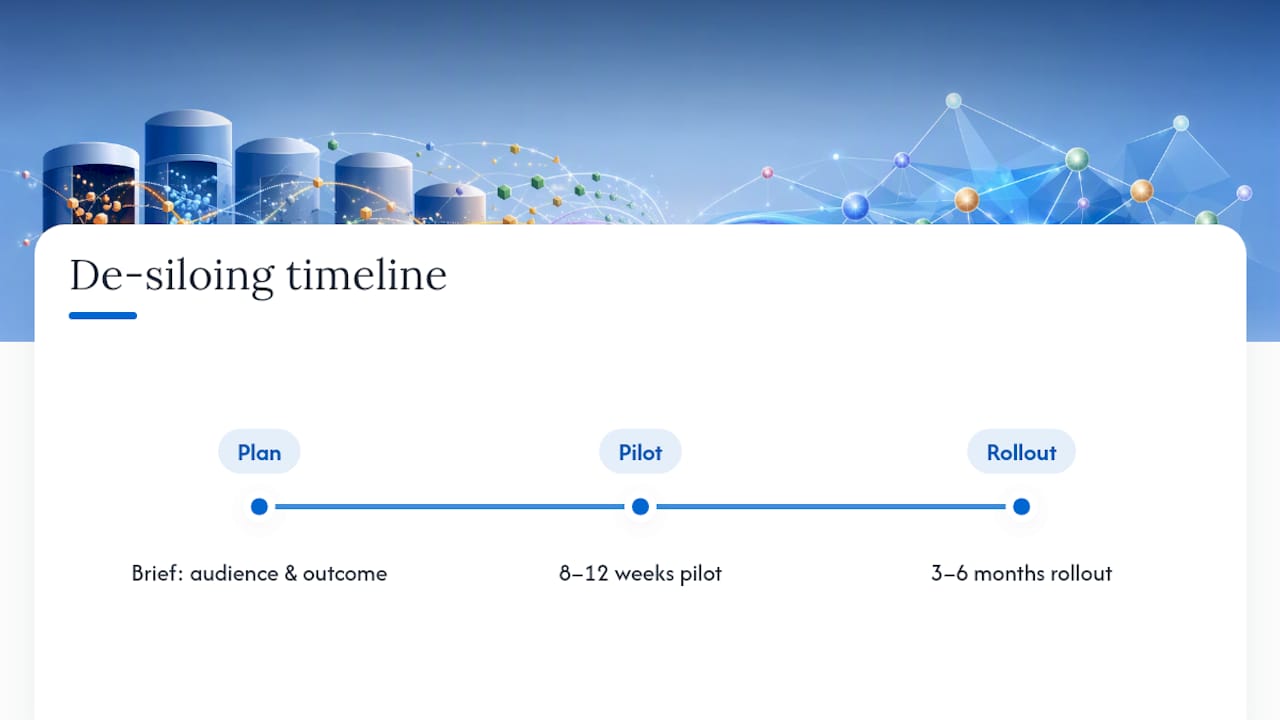
How long does a de-siloing programme take? A pragmatic pilot typically runs 8 to 12 weeks, with the broader governance changes rolling out across 3 to 6 months as the pilot’s results prove the case for wider adoption.
Sources
- The Quiet Fix For Silos — Frontline Marketing’s Biggest Self‑Inflicted Problem
- The hidden cost of marketing silos — why channel-level analysis isn’t enough
- Why channel silos are killing your marketing ROI
- The Channel Mix Problem: Why Most Brands Are Optimising in Silos
Recommended
- Multichannel customer communication examples for Australian businesses - Conversational AI
- What is multi-channel AI? A guide for Australian businesses - Conversational AI
- Multichannel automation ROI examples for Australian enterprises - Conversational AI
- Multichannel AI agent deployment guide for enterprises - Conversational AI