Voice, SMS, and Email Automation Best Practices
Discover essential voice SMS email automation best practices to enhance compliance and customer engagement. Optimize your multi-channel strategy today!

Multi-channel automation best practices for voice, SMS, and email are defined as the set of compliance, orchestration, and technical protocols that govern how enterprises send automated messages across all three channels without triggering legal risk or customer fatigue. The discipline spans tools like Twilio for voice and SMS delivery, Klaviyo and major ESPs for email, and CRM platforms that unify conversation history. Getting these practices right requires three things working together: strict consent compliance under frameworks like the TCPA, authenticated email infrastructure using SPF, DKIM, and DMARC, and a shared customer context that prevents every channel from operating in its own silo.
1. What are the core voice SMS email automation best practices for compliance?
Compliance is the foundation of any multi-channel automation program. A single misstep with outbound voice or SMS can expose your organization to significant legal liability under the Telephone Consumer Protection Act (TCPA).
The TCPA requires express written consent for AI-powered outbound calls and marketing texts. That consent must be signed, electronic signatures are acceptable, and must include clear authorization for automated or prerecorded calls. Your consent records must capture the exact consent language, a timestamp, the consumer’s response, and the device used. General contact consent does not cover auto-dialing or prerecorded voice delivery.
Key compliance requirements for voice and SMS automation:
- Obtain express written consent before any automated outbound voice or SMS contact
- Store consent records with timestamp, device identifier, and exact disclosure language
- Apply state-specific rules on top of federal TCPA minimums, since states like Florida and Oklahoma have stricter requirements
- Automate your audit trail so consent records are retrievable on demand
- Include opt-out instructions in every SMS, such as “Reply STOP to unsubscribe”
For email, the compliance layer shifts to authentication. DMARC enforcement requires alignment between your visible From domain and either your SPF or DKIM signing domain. A common failure point is when your ESP signs outbound mail with its own domain rather than yours. That misalignment causes deliverability problems even when SPF and DKIM individually pass. Deploy DMARC in stages: start at policy “none” to collect reports, move to “quarantine,” then advance to “reject” only after your sending infrastructure is fully aligned.
Pro Tip: Automate your DMARC aggregate report analysis using a tool like Dmarcian or Valimail. Manual review of XML reports is error-prone and rarely happens consistently at enterprise scale.
2. How to maintain unified customer context across channels
Unified context is the single biggest operational gap in most enterprise multi-channel programs. When your voice system, SMS platform, and email tool each maintain separate customer records, customers repeat themselves, agents lose time, and your automation logic contradicts itself.
A unified conversation log synced with your CRM allows every channel to read and write the same customer state. That means a customer who confirmed their appointment via SMS will not receive a redundant voice reminder asking the same question. It also means a live agent picking up after an automated voice call can see the full prior exchange without asking the customer to start over.
Steps to build real context continuity:
- Treat channel context synchronization as a data contract. Every automation engine, voice, SMS, and email, must read from and write to the same conversation object in real time.
- Sync intent signals, not just message history. If a customer clicked a pricing link in your email, that signal should be visible to your SMS and voice flows.
- Include consent status in the shared record. A customer who opted out of SMS must be suppressed across all channels, not just the SMS queue.
- Design consistent persona and tone across channels. A formal email followed by a casual SMS creates a disjointed experience.
- Build clean AI-to-human handoff protocols. The live agent should receive a summary of the automated conversation before the call connects.
Context continuity must be real-time and bidirectional. One-way syncs that run on a delay create race conditions where a customer receives a message based on outdated state. That is the kind of error that generates complaints and opt-outs.
Pro Tip: Map your CRM fields to each channel’s data model before you build any automation. Retrofitting a shared context layer after deployment is far more expensive than designing it upfront.

3. What are the best practices for orchestrating multi-channel campaigns?
Orchestration is not the same as duplication. Sending the same message across email, SMS, and voice is not a multi-channel strategy. It is a fast path to opt-outs and spam complaints.
Cross-channel suppression reduces message fatigue. Enterprise journey tools prioritize channel coordination and behavioral suppression over independent per-channel caps. The right model treats your total contact frequency as a single budget shared across all channels, not three separate limits.
| Channel | Best use case | Escalation trigger |
|---|---|---|
| Detailed information, nurture sequences | No open after 48–72 hours | |
| SMS | Urgent alerts, confirmations, short prompts | No response after 24 hours |
| Voice | High-intent follow-up, complex resolution | Stalled deal or missed appointment |
Orchestration best practices for enterprise campaigns:
- Design customer journeys where each channel adds new context, not the same message in a different format
- Use behavioral signals, such as email opens, link clicks, and SMS replies, to trigger channel escalation
- Apply overlap suppression so a customer who responds to email is removed from the pending SMS and voice queue
- Set exit rules that stop the sequence when the desired action is completed
- Prioritize SMS and voice for urgent or high-intent contacts, and reserve email for informational or nurture content
Frequency budgets work best when treated as a prioritization problem. Rank contacts by behavioral triggers, recent engagement, and intent level rather than applying rigid numeric limits to each channel independently. A customer who opened your last three emails and clicked a pricing page deserves a faster escalation than someone who has been dormant for 60 days.
4. Which technical and content strategies maximize deliverability and engagement?
Message format and technical setup directly affect whether your automation reaches customers at all. Poor configuration at the infrastructure level wastes every dollar spent on content and timing.
For SMS, keep messages at or under 160 characters to avoid splitting a single message into multiple segments. Each segment incurs a separate cost and creates a fragmented reading experience. Include opt-out instructions like “Reply STOP” in every marketing SMS. Personalize with the customer’s name and a specific reference to their account or recent action.
For email, use a custom DKIM signing domain aligned to your From address. Configure your return-path to match your sending domain, not your ESP’s default. These two steps alone resolve the majority of DMARC alignment failures that cause enterprise email to land in spam.
Technical and content best practices by channel:
- SMS: Under 160 characters, personalized sender name, opt-out instruction included, sent during business hours
- Email: Custom DKIM, aligned return-path, plain-text version included, subject line under 50 characters
- Voice: Use play-and-hang-up design for announcements to reduce failure modes; reserve interactive AI for flows that require input
For voice automation, the play-and-hang-up pattern is underused. Automated voice appointment reminders do not need to wait for a keypress. Playing a clear, pre-recorded message and ending the call reduces call duration, lowers cost, and avoids the awkward silence that causes customers to hang up before the message completes.
Pro Tip: Test your email authentication setup with a tool like MXToolbox or Mail Tester before launching any large campaign. Authentication errors that look minor in testing cause significant deliverability damage at volume.
5. How do enterprise scenarios shape automation implementation?
The right automation setup depends heavily on what you are trying to accomplish. Lead generation, customer support, and appointment management each call for different channel logic and escalation rules.
For appointment reminders, start with email 48 hours before the appointment, follow with an SMS reminder 24 hours out, and trigger a voice call only if the customer has not confirmed. This sequence respects the customer’s preference for less intrusive channels while escalating to voice when a response is genuinely needed.
For sales follow-ups, use email for detailed proposals and case studies, then escalate to SMS when a deal has gone quiet for more than two business days. Reserve voice for high-value prospects where a personal conversation is likely to move the deal forward. Automating voice messages at this stage works best when the AI can hand off to a live rep mid-call if the prospect engages.
Practical guidance for enterprise automation scenarios:
- Align channel selection with customer intent and urgency, not just what is cheapest to send
- Build human handoff triggers into every automated flow, especially for support and sales
- Collaborate across marketing and operations teams to set shared suppression and frequency rules
- Audit automation workflows quarterly to remove outdated sequences and update consent language
- Match your automation platform’s capabilities to your actual use case before committing to a vendor
Budget is a real constraint. Simpler platforms handle single-channel automation well but struggle with unified context across voice, SMS, and email. Enterprise-grade solutions cost more upfront, but the reduction in compliance risk and customer churn typically justifies the investment.
Key takeaways
Effective multi-channel automation requires compliance, unified context, and coordinated orchestration working together, not independently.
| Point | Details |
|---|---|
| Compliance comes first | TCPA express written consent and DMARC authentication protect deliverability and reduce legal risk. |
| Unified context prevents repetition | A shared CRM-linked conversation log stops customers from repeating themselves across channels. |
| Orchestrate, do not duplicate | Each channel should add new context, not resend the same message in a different format. |
| Format affects deliverability | SMS under 160 characters and custom DKIM signing are non-negotiable for enterprise sends. |
| Escalation should follow behavior | Trigger channel escalation based on engagement signals, not fixed time schedules. |
What I’ve learned from watching multi-channel automation go wrong
The compliance piece is where I see the most expensive mistakes. Teams spend months building sophisticated orchestration logic, then get hit with a TCPA complaint because their consent records did not capture the right disclosure language. The regulation is specific: general contact consent does not authorize auto-dialed calls or prerecorded messages. That distinction is not a technicality. It is the difference between a defensible record and a lawsuit.
The second pattern I see constantly is the siloed channel problem. Marketing owns email, operations owns voice, and a third team manages SMS. Nobody owns the shared context layer, so customers get called about an issue they already resolved via email that morning. That is not just a bad experience. It signals to the customer that your organization does not actually know them, which erodes trust faster than any single bad interaction.
The trend I am watching most closely is AI-powered orchestration that adjusts channel sequencing in real time based on predicted engagement. The tools are maturing quickly. But the organizations that will benefit most are the ones that have already done the hard work of unifying their consent records, CRM data, and authentication infrastructure. The AI layer amplifies what is already there. If the foundation is broken, the AI just makes the mistakes faster.
My honest advice: fix the data contract first. Get your consent records clean, your DMARC aligned, and your CRM fields mapped to every channel. Then build the orchestration on top of that foundation.
— Sowrabh
How Conversational AI supports enterprise multi-channel automation
Conversational AI is built for Australian enterprises that need voice, SMS, and email automation to work as a single coordinated system, not three separate tools.
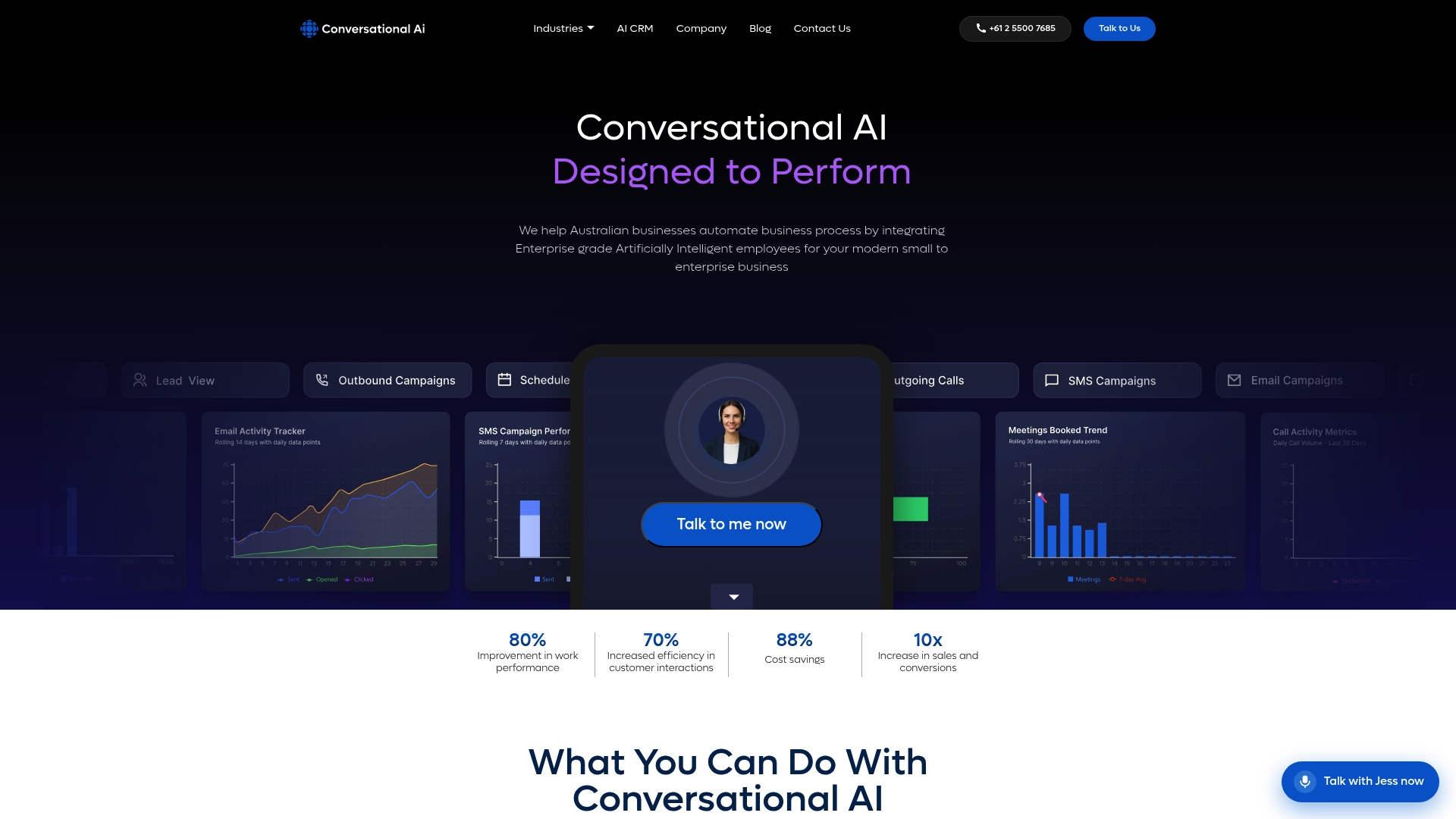
The platform runs entirely within Australia, which means your consent records, conversation logs, and customer data stay under Australian data sovereignty rules. Conversational AI’s AI-powered agents handle voice, SMS, and email from a unified context layer, so customers never repeat themselves and your team always has a complete interaction history. The platform includes built-in escalation logic, CRM integration, and compliance-aware automation flows designed for healthcare, finance, and professional services. If you are building or rebuilding your multi-channel automation program, it is worth seeing what a purpose-built, privacy-first platform looks like in practice.
FAQ
What is TCPA express written consent for automated calls?
TCPA express written consent is a signed authorization, electronic signatures are valid, that explicitly permits automated or prerecorded calls and texts to a specific phone number. General contact consent does not satisfy this requirement.
How do SPF, DKIM, and DMARC work together for email deliverability?
SPF authorizes sending servers, DKIM signs message content, and DMARC ties both to your visible From domain. All three must be aligned for enterprise email to consistently reach the inbox.
What is the best SMS message length for automation?
Keep automated SMS messages at or under 160 characters. Messages above that threshold split into multiple segments, increasing cost and reducing readability.
How do you prevent customer fatigue in multi-channel campaigns?
Treat total contact frequency as a single cross-channel budget rather than separate limits per channel. Use behavioral signals to suppress contacts who have already responded and exit them from pending sequences.
When should voice automation escalate from SMS or email?
Escalate to voice when a customer has not responded to email or SMS within your defined window, or when the interaction requires personal explanation, such as a stalled sales deal or a missed appointment confirmation.