AI Automation Team Productivity Examples for Enterprises
Discover impactful ai automation team productivity examples from leading companies. Unlock efficiency and transform how your teams operate.

AI automation is defined as the use of specialized software agents and deterministic workflows to complete repeatable business tasks without human intervention. The best ai automation team productivity examples from companies like Profound, Rakuten, and Anthropic show that the right deployment does not just save time. It fundamentally changes how teams operate, with 1,800+ hours reclaimed monthly and release cycles cut from quarterly to biweekly. Tools like Dust, Claude Managed Agents, and Claude Code are driving these results right now across sales, engineering, and support teams.
1. Top AI automation team productivity examples from enterprise case studies
The most credible evidence for AI automation’s impact comes from companies that have published their numbers. These are not pilot programs. They are production deployments with measurable outcomes.
Profound: 1,800 hours reclaimed every month
Profound’s post-sales team of 20 people was drowning in manual customer success work. After deploying AI agents built on Claude, the team reclaimed over 1,800 hours every month. That is the equivalent of adding roughly 11 full-time employees without hiring anyone. New hire ramp time dropped from months to days because the AI agents carry institutional knowledge that previously lived only in senior team members’ heads.
Key outcomes from Profound’s deployment:
- Post-sales workload reduced without adding headcount
- New hire onboarding accelerated from months to days
- Institutional knowledge captured and made accessible through AI agents
- Customer success managers freed to focus on relationship work
Rakuten: engineering velocity transformed
Rakuten used Claude Managed Agents to overhaul its software release process. Release cycles compressed from quarterly to biweekly. Feature delivery time dropped from 24 days to 5 days. Critical errors fell by 97%. Those three numbers together represent a complete transformation of engineering team output, not a marginal improvement.

The Rakuten case proves that AI automation in engineering is not just about writing code faster. It is about removing the coordination overhead, review bottlenecks, and error-correction cycles that slow every release.
Anthropic: sales and support at scale
Anthropic’s own go-to-market team deployed AI plugins across their sales function and saw 80% team adoption within the first rollout period. Email personalization time dropped by 80%. Over three months, AI agents auto-resolved more than 1,000 support tickets without human involvement. That last number matters most. Resolving 1,000 tickets automatically means your support team handles only the complex, high-value cases that actually need human judgment.
Otter.ai and Vendasta: support and sales recovery
Otter.ai deployed AI-powered ticket triage to sort and route incoming support requests automatically. The result is faster first-response times and fewer tickets escalated to senior agents. Vendasta used AI automation to recover sales admin time, giving account executives back hours previously lost to data entry, follow-up scheduling, and CRM updates. Both cases show that AI automation’s productivity gains are not limited to engineering or post-sales. They apply across every team function that handles repetitive, structured work.
Pro Tip: Before building any automation, spend one week shadowing the actual workflow. Watch where your team pauses, switches tabs, or copies data between systems. Those friction points are your highest-value automation targets.
2. How AI automation workflows combine generative AI and deterministic automation
Generative AI alone does not produce reliable enterprise automation. The most effective deployments combine AI reasoning with deterministic automation, where specific rules and logic govern outcomes that cannot be left to probabilistic judgment.
Zapier’s analysis of AI automation confirms this directly: successful AI automation combines generative AI with deterministic automation to produce consistent, reliable outcomes. Deterministic steps handle data validation, routing logic, and compliance checks. Generative AI handles language tasks, summarization, and decision support. Neither works as well without the other.
“The industry trend is toward autonomous agents that manage high-level goals end-to-end rather than human-in-the-loop task management.” — Anthropic’s approach to goal delegation
This shift from task automation to goal delegation is the most important strategic change in enterprise AI adoption right now. Instead of automating individual steps, you assign an agent a goal and let it manage the full workflow. Anthropic’s own teams operate this way, with agents handling entire end-to-end processes from intake to resolution. The practical benefit is that your team stops managing automation steps and starts reviewing outcomes.
Applied’s work with enterprise clients reinforces the same point. Workflow design and error handling are not afterthoughts. They are the foundation. An automation that fails silently is worse than no automation at all, because it creates errors that compound before anyone notices.
3. Comparing AI automation tools used by leading enterprises
Different tools suit different team functions and maturity levels. The table below compares the primary platforms appearing in documented enterprise case studies.
| Tool | Primary use case | Key strength | Best for |
|---|---|---|---|
| Claude Managed Agents | Engineering and release automation | End-to-end workflow execution with low error rates | Engineering teams with complex release cycles |
| Dust | Sales and customer success automation | Multi-agent coordination and knowledge retrieval | Post-sales and GTM teams |
| Claude Code | Software development acceleration | Code generation, review, and testing integration | Developer productivity at scale |
| Zapier AI workflows | Cross-functional task automation | Deterministic and generative AI combination | Operations and admin teams |
| Otter.ai | Meeting notes and ticket triage | Real-time transcription and routing | Support and sales teams |
Two architectural decisions separate high-performing deployments from average ones.
The first is modular agent design. A global consumer packaged goods company with 144,000 employees deployed 10+ automations across finance, supply chain, sales, and HR using a modular agent framework. Each agent handles one domain. They do not overlap. This prevents conflicts and makes quality control manageable.
The second is the hybrid heartbeat model. Fast, low-cost agent models run frequent status checks. Slower, more powerful models handle complex computation only when needed. Claude Sonnet handles heartbeats; Claude Opus handles deep work. This approach keeps costs controlled while maintaining 24/7 operation.
4. Best practices for scaling AI automation across enterprise teams
Scaling AI automation without a framework produces inconsistent results and erodes team trust. The companies with the best outcomes follow a repeatable deployment model.
-
Shadow the workflow first. Spend time observing the actual process before writing a single line of automation logic. Workflow shadowing reveals real friction points that process documentation always misses. You will find manual steps that no one documented because they became habit.
-
Build a narrow pilot. Start with one workflow, one team, and one measurable outcome. Profound started with post-sales CSM work. Rakuten started with one release pipeline. Narrow scope makes evaluation clean.
-
Evaluate before expanding. Build automated tests into the pilot from day one. The global CPG company used continuous evaluation and quality control checkpoints before rolling each automation to additional regions or departments.
-
Mirror human team structures in your agent design. Multi-agent systems that assign specialized roles, such as Tech Lead, Developer, and QA, to separate agents communicate more reliably than monolithic systems. Structured handoffs between agents reduce errors and make failures easier to diagnose.
-
Expand based on evidence, not enthusiasm. Every expansion decision should be tied to a metric from the pilot. Hours saved, error rate reduction, or cycle time improvement all qualify. Gut feel does not.
Pro Tip: Build your evaluation criteria before you build the automation. If you cannot define what success looks like in measurable terms, you are not ready to deploy.
Key takeaways
AI automation delivers its greatest productivity gains when enterprises combine generative AI reasoning with deterministic workflow logic, deploy in narrow pilots, and expand only on measured evidence.
| Point | Details |
|---|---|
| Start with workflow shadowing | Observe real processes to find friction before building automation. |
| Combine AI and deterministic logic | Generative AI alone is unreliable; pair it with structured rules for consistent outcomes. |
| Pilot narrow, then expand | Start with one team and one metric before scaling across departments. |
| Use modular, specialized agents | Separate agents for separate roles reduce conflicts and improve reliability. |
| Measure adoption and outcomes | Track hours saved, error rates, and cycle times to justify every expansion decision. |
What I have learned from watching enterprises deploy AI automation
The gap between pilots and production is where most programs fail
I have watched enterprise teams run impressive pilots and then stall completely when they try to scale. The pattern is consistent. The pilot works because one person owns it, the scope is tight, and everyone is paying attention. Then the team tries to expand, ownership gets diffuse, and the automation starts producing errors that no one catches quickly enough.
The companies that scale successfully treat evaluation as a permanent function, not a launch phase. The global CPG case is instructive here. They did not deploy 10+ automations simultaneously. They built a framework for continuous quality control and applied it to each new automation before it went live. That discipline is what separates a 20-person pilot success from a 144,000-employee deployment.
The other thing I would push back on is the instinct to automate everything at once. Profound’s results are extraordinary, but they came from a focused decision to automate one team’s workflow deeply rather than spreading automation thinly across many functions. Depth beats breadth in the early stages. You get better data, faster learning, and a clearer case for the next investment.
Human oversight still matters, even in highly automated systems. The goal is not to remove humans from the loop entirely. It is to move humans to the decisions that actually require judgment. When Anthropic’s support team auto-resolved 1,000 tickets, the agents handled the routine cases. The humans handled the ones that needed context, empathy, or escalation authority. That division of labor is the model worth copying.
— Sowrabh
Ready to put AI agents to work for your enterprise team?
Conversational AI builds enterprise-grade AI agent solutions for Australian businesses that need private, secure, and production-ready automation. The platform supports multi-channel agents across voice, SMS, email, and live chat, with persistent memory and real-time analytics built in.
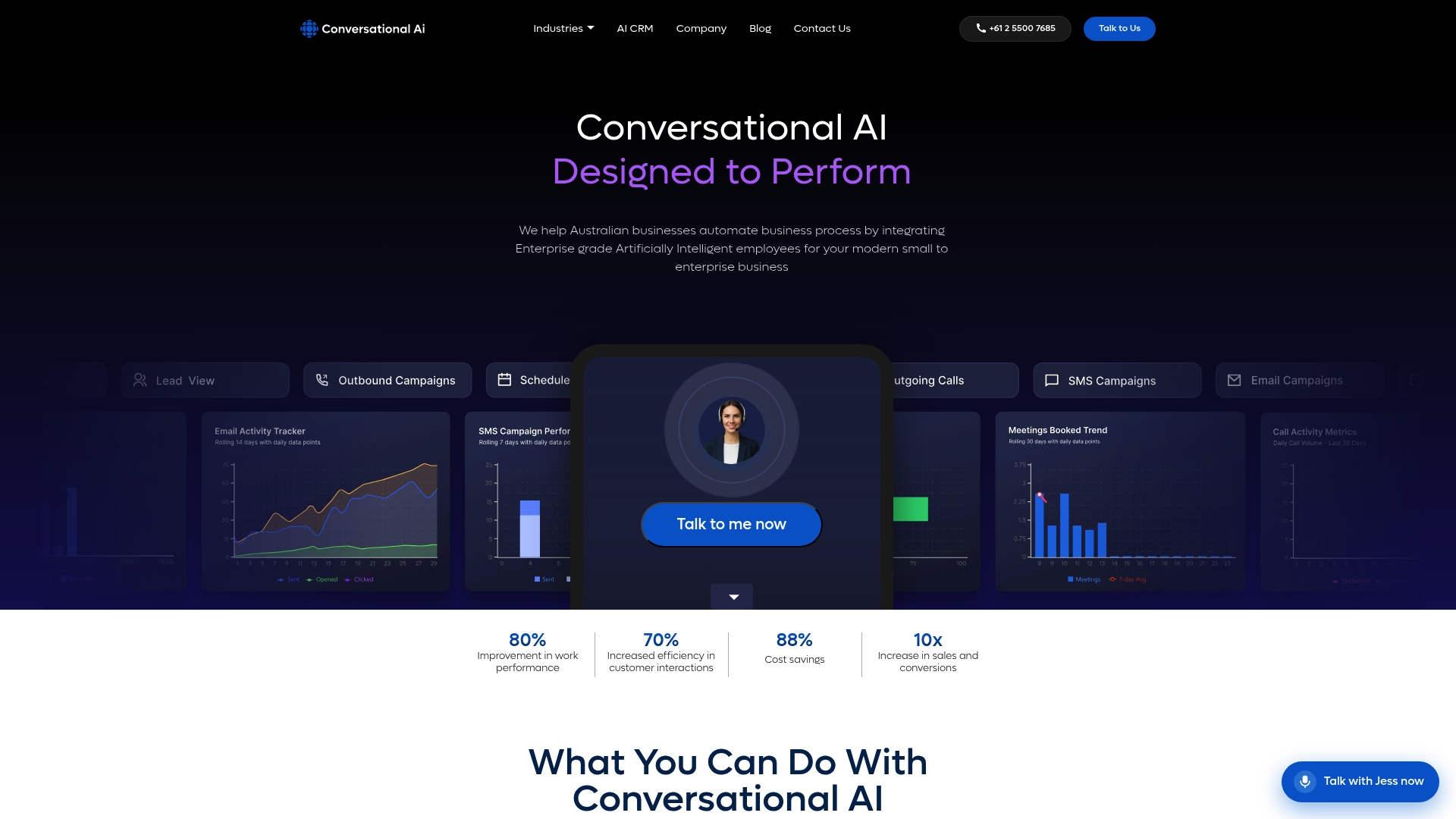
If your team is losing hours to repetitive customer interactions, support triage, or sales admin, Conversational AI’s agents integrate directly with your existing CRM and infrastructure. Every deployment runs on Australian-hosted infrastructure, so your data never leaves the country. Explore enterprise AI agent solutions to see how the platform handles end-to-end workflow automation at scale.
FAQ
What are the best AI automation team productivity examples?
Profound reclaimed 1,800+ hours monthly for a 20-person post-sales team. Rakuten cut software release cycles from quarterly to biweekly and reduced critical errors by 97% using Claude Managed Agents.
How does AI automation improve team efficiency?
AI automation removes repetitive, structured tasks from human workloads so team members focus on high-judgment work. Anthropic’s sales team cut email personalization time by 80% and auto-resolved 1,000+ support tickets in three months.
What is the difference between task automation and goal delegation?
Task automation handles individual steps in a process. Goal delegation assigns an entire end-to-end workflow to an AI agent, which manages each step autonomously and reports outcomes rather than waiting for human direction at each stage.
How should enterprises start with AI automation?
Start by shadowing one workflow to identify real friction points, then build a narrow pilot with clear success metrics. Expand only after the pilot produces measurable results in hours saved, error reduction, or cycle time improvement.
Which AI tools do enterprises use for team productivity?
Leading enterprises use Claude Managed Agents for engineering workflows, Dust for sales and customer success, Claude Code for developer productivity, and Zapier AI workflows for cross-functional operations automation.