AI Natural Language Customer Support for Australian Businesses
Discover how AI natural language customer support can transform Australian businesses. Learn to implement it effectively while ensuring compliance.

AI natural language customer support is the use of natural language processing (NLP), machine learning, and conversational AI agents to understand and respond to customer inquiries automatically across multiple channels. The industry term is “conversational AI,” and it covers everything from AI chat support to voice agents and automated email triage. For Australian businesses, this technology carries an extra layer of responsibility: local privacy law, data sovereignty, and new automated decision-making (ADM) transparency rules effective december 2026 all shape how you build and run these systems. This guide covers what you need, how to deploy it, and how to avoid the pitfalls that trip up most implementations.
What is AI natural language customer support?
AI natural language customer support combines three core technologies: NLP, machine learning, and conversational AI. NLP enables machines to interpret, analyze, and respond to human speech and text, underpinning tools like Amazon Alexa and Apple Siri. Machine learning trains models on historical support data so they improve with every interaction. Conversational AI ties these together into agents that hold context across a conversation, not just answer one question at a time.
The practical result is a system that reads a customer’s message, identifies their intent, extracts relevant details like account numbers or dates, and generates a response grounded in your knowledge base. This is fundamentally different from a rule-based chatbot that matches keywords to scripted replies. NLP-powered systems handle ambiguous phrasing, spelling errors, and multi-part questions that would break a simple decision tree.

For Australian businesses, platforms like Microsoft Dynamics 365 and Atlassian’s AI chat tools represent the enterprise end of this market. Conversational AI, built specifically for Australian enterprises, adds data sovereignty by hosting entirely within Australia, which matters when your customers share sensitive personal information through support channels.
What are the prerequisites and tools for deploying AI chat support?
Before you write a single line of configuration, you need three things in place: a clean knowledge base, a compliant data architecture, and the right NLP engine for your use case.
Choosing the right NLP engine and platform
The NLP engine is the core of any automated customer support AI system. Your options range from general-purpose large language models (LLMs) to domain-specific models fine-tuned on support data. The table below compares key platform characteristics relevant to Australian deployments.
| Platform | Deployment model | ADM transparency support | Australian data hosting |
|---|---|---|---|
| Microsoft Dynamics 365 | Cloud, hybrid | Partial | Via Azure Australia regions |
| Atlassian AI chat | Cloud only | Partial | Not guaranteed locally |
| Conversational AI | Private cloud | Built-in compliance focus | Yes, fully Australian hosted |
Data requirements matter as much as the engine itself. Your knowledge base must be structured, version-controlled, and regularly audited. Gaps in the knowledge base are the primary cause of hallucinations, not model weakness.
Privacy and governance requirements under Australian law
Australia’s Privacy Act requires that AI systems handling customer data collect only information that is reasonably necessary for the stated purpose. APP 3 enforces consent requirements and special handling rules for sensitive data collected through AI chatbots. This means your intake flows must be designed to minimize data collection from the start, not patched for compliance after launch.
From december 10, 2026, covered organizations must disclose ADM practices in their privacy policies under APP 1.7 to 1.9 amendments. That disclosure must detail what automated decisions are made, their scope, and their impact on individuals. Organizations that deploy AI support agents making eligibility or routing decisions need to inventory those decision points now.
Pro Tip: Select platforms with retrieval-based grounding built in, not bolted on. Grounding forces the AI to answer only from your verified knowledge base, which is your first and most effective defense against incorrect responses.
How to implement AI natural language customer support step by step
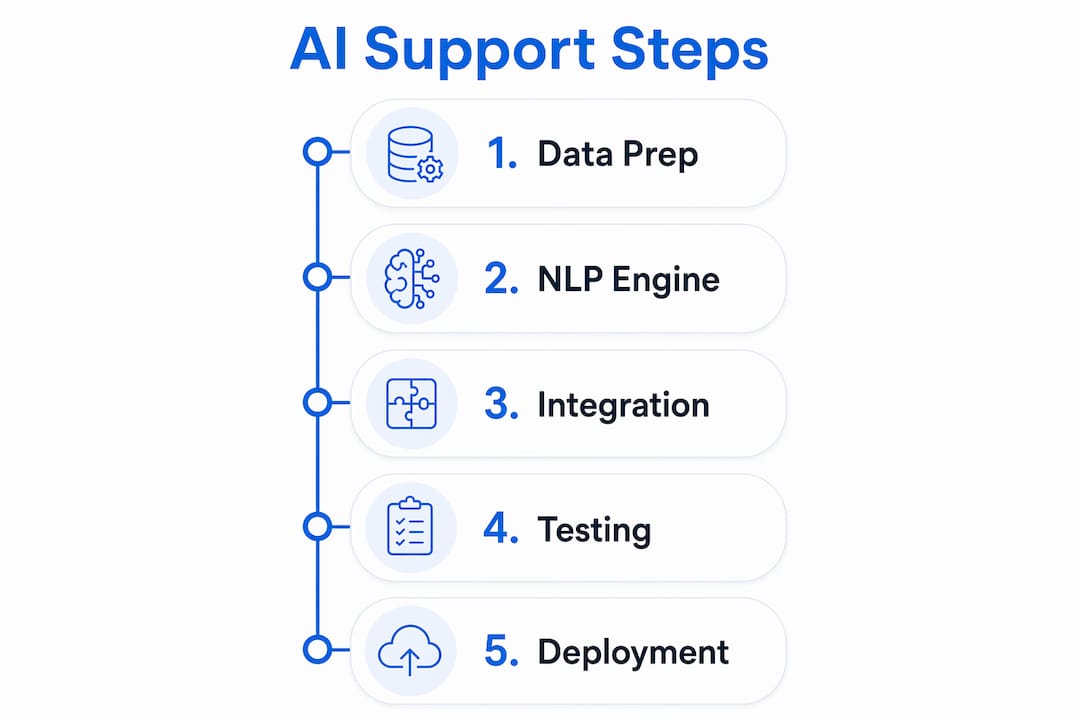
Implementation follows a clear sequence. Skipping steps, particularly validation and escalation design, is where most projects fail.
-
Define intent taxonomy. Map every customer inquiry type your support team handles today. Group them into intents: billing questions, technical issues, account changes, complaints. This taxonomy becomes the training target for your NLP model.
-
Build and structure your knowledge base. Every response the AI generates must trace back to a verified source in your knowledge base. Retrieval-first architectures combined with escalation protocols significantly reduce hallucination risk. Structure your content in short, factual chunks rather than long documents.
-
Configure confidence thresholds. Start your confidence threshold at approximately 0.55 and run post-generation validation on output logs. This keeps hallucination incidents below 0.5% per month. Tune upward as your model matures and your knowledge base grows.
-
Design escalation paths. Every intent that touches sensitive workflows, such as refunds, cancellations, or account closures, needs a deterministic business rule check before the AI acts. Free-text generation must never directly trigger sensitive workflows. Eligibility is checked by hard-coded business logic, not by the AI’s interpretation.
-
Integrate human fallback with full context. When a conversation escalates to a human agent, the agent needs the full conversation history. Maintaining conversational history through escalations reduces customer frustration and eliminates the need for customers to repeat themselves. Atlassian’s AI chat system, for example, attaches the full chat history to the support ticket on escalation.
-
Run pre-launch testing across edge cases. Test with real customer language, including misspellings, slang, and multi-part questions. Measure hallucination rate, escalation rate, and resolution rate before going live.
Pro Tip: Build a “golden set” of 200 to 300 test conversations covering your highest-volume intents. Run this set after every knowledge base update to catch regressions before customers do.
What are the best practices and common challenges in AI natural language for customer support?
The biggest operational risk in automated customer support AI is hallucination. Ungrounded LLMs in customer support systems have hallucination rates between 15% and 30% in pre-launch evaluations. That means roughly one in five to one in seven responses could be factually wrong before you add any mitigation. Multi-layer defenses can reduce that rate to below 1%.
The four-layer defense against hallucinations
Architectural mitigation is more effective than prompt engineering alone. The four layers are:
- Retrieval grounding: The AI answers only from documents in your knowledge base. No knowledge base match means no free-text answer.
- Confidence thresholding: Responses below your confidence threshold route to a human agent rather than generating a guess.
- Post-generation validation: Output logs are checked against source documents automatically before the response is sent.
- Human escalation: Any response flagged by validation goes to a human agent with full context attached.
Systems that enforce an escalation path rather than free-text generation lower hallucination to below 0.5% flagged incidents per month. That is a meaningful operational target, not a theoretical benchmark.
Privacy pitfalls and compliance obligations
Privacy regulation treats AI as a privacy matter with no special exemptions. Your NLP system collects personal information the moment a customer types their name or account number into a chat window, so APP 3 applies immediately. Collection minimization means your intake form should ask only for what the AI needs to resolve the specific inquiry.
“Leaders are advised to update governance frameworks and manage AI impact assessments per new ADM transparency rules effective december 2026.” — Pinsent Masons, ADM transparency obligations guidance
Building an ADM inventory for your AI support journeys is now a compliance requirement, not optional governance hygiene. Document every point where the AI makes a decision that affects a customer, from routing to eligibility checks.
Common pitfalls to avoid:
- Launching without a tested escalation path, leaving customers stuck in loops
- Storing conversation data beyond what your retention policy allows
- Failing to disclose ADM practices in your privacy policy before december 2026
- Using free-text generation for refund or cancellation eligibility decisions
- Skipping post-launch monitoring of confidence scores and flagged incidents
How does AI enhance customer service across multiple channels?
Natural language processing in customer service works across chat, email, voice, and social media because the underlying intent recognition is channel-agnostic. The same model that reads a chat message can parse an inbound email or transcribe a voice call. What changes is the response format and the latency expectation.
Conversational AI maintains context across channels. A customer who starts a query on live chat and follows up by email does not need to repeat their account details if the system is built to share session context. This cross-channel memory is what separates AI conversation tools for support from basic chatbots. It also reduces average handle time for human agents who pick up escalated cases.
NLP-powered analytics add a layer of insight that manual reporting cannot match. Sentiment detection identifies frustrated customers before they escalate. Topic clustering reveals which issues spike after a product update. These signals let your support team act on patterns, not just individual tickets.
Australian businesses in healthcare, finance, and professional services gain the most from multi-channel AI support because their customers interact across multiple touchpoints and expect consistent, accurate answers regardless of channel. Conversational AI’s multi-channel AI agents cover voice, SMS, email, and live chat within a single platform hosted in Australia.
Pro Tip: Set up unified conversation IDs that persist across channels from day one. Retrofitting cross-channel context into a system that was built channel-by-channel is significantly harder than designing for it upfront.
Key takeaways
AI natural language customer support delivers reliable results only when grounding, privacy compliance, and escalation design are built into the system from the start, not added after launch.
| Point | Details |
|---|---|
| Ground every response | Use retrieval-first architecture so the AI answers only from your verified knowledge base. |
| Set confidence thresholds early | Start at 0.55 and tune upward; this keeps hallucination incidents below 0.5% per month. |
| Comply with APP 3 and ADM rules | Collect only necessary data and disclose automated decisions in your privacy policy before december 2026. |
| Preserve context through escalations | Attach full conversation history to tickets so human agents never start from scratch. |
| Monitor continuously post-launch | Track confidence scores, flagged incidents, and escalation rates to catch regressions early. |
Why grounding and governance are the real differentiators
I’ve reviewed a lot of AI support deployments, and the ones that fail share a common pattern: the team spent months on the conversational design and almost no time on what happens when the AI gets it wrong. Hallucination rates of 15% to 30% in pre-launch testing are not a model problem. They are a knowledge base and architecture problem. You can have the most sophisticated NLP engine on the market, and it will still fabricate answers if it has nowhere reliable to look.
The Australian regulatory context actually makes this easier to get right, not harder. APP 3’s minimization requirement forces you to think carefully about what data you collect, which in turn limits the surface area for errors. The ADM transparency rules coming in december 2026 push you to document your decision points, which is exactly the kind of governance discipline that produces trustworthy AI systems.
My honest advice: treat privacy compliance as your architecture constraint, not your legal team’s problem. When you design your NLP system around what you are allowed to collect and what decisions you are required to disclose, you end up with a cleaner, more auditable system that customers actually trust. That trust is a competitive advantage in markets like healthcare and finance where customers are already skeptical of automated systems.
Adopt an iterative approach. Launch with a narrow intent scope, measure everything, and expand only when your confidence scores and escalation rates are stable. The businesses that try to automate everything at once are the ones calling their vendors six months later to fix a hallucination problem that was entirely predictable.
— Sowrabh
AI agents built for Australian businesses
Australian enterprises need AI support solutions that meet local privacy standards without sacrificing capability. Conversational AI delivers multi-channel AI agents covering voice, SMS, email, and live chat, all hosted within Australia for full data sovereignty.
The platform includes natural language understanding, contextual memory across channels, automated follow-ups, and real-time analytics. It is built for industries where privacy and accuracy are non-negotiable, including healthcare, finance, and professional services. If you are ready to move from evaluation to deployment, the team at Conversational AI offers consultations and live demos tailored to your support environment and compliance requirements.
FAQ
What is AI natural language customer support?
AI natural language customer support uses NLP, machine learning, and conversational AI agents to understand and respond to customer inquiries automatically across channels like chat, email, and voice. It differs from rule-based chatbots by handling ambiguous language and maintaining context across a conversation.
How does NLP reduce hallucinations in AI customer support?
NLP alone does not prevent hallucinations. Retrieval-based grounding, confidence thresholding, and post-generation validation work together to reduce hallucination rates from 15–30% in ungrounded systems to below 0.5% per month in well-architected deployments.
What Australian privacy laws apply to AI chat support?
Australia’s Privacy Act and APP 3 require that AI systems collect only reasonably necessary personal information, with explicit consent for sensitive data. From december 2026, APP 1.7 to 1.9 amendments also require organizations to disclose automated decision-making practices in their privacy policies.
How should escalation from AI to human agents work?
The AI should attach the full conversation history to the support ticket when escalating, so the human agent has complete context. This eliminates customer frustration from repeating information and reduces average handle time for the agent.
What confidence threshold should I start with for AI support responses?
Start your confidence threshold at approximately 0.55 and adjust based on your post-launch monitoring data. Responses below the threshold should route to a human agent rather than generating a low-confidence answer.