How to scale AI automation enterprise wide in 2026
Discover how to scale AI automation enterprise wide in 2026. Achieve cost savings, faster responses, and seamless multi-channel deployment.

The single most effective approach to scaling conversational AI automation across an enterprise is to treat it as a governed portfolio: start with high-volume, reversible workflows, prove reliability under tiered human oversight, then replicate systematically. Approve one pilot now, under MLOps/LLMOps controls, with Australian Privacy Principles (APPs) compliance built in from day one. Platforms like Conversational AI are designed precisely for this path, combining Australia-hosted data sovereignty with multi-channel agents that can expand from a single use case to enterprise-wide deployment without rebuilding from scratch.
Table of Contents
- Why should you scale conversational AI across the enterprise?
- Which workflows should you automate first?
- How do you govern automation and manage risk at scale?
- What does a multi-channel AI architecture look like?
- What security and compliance controls does an Australian enterprise need?
- What does a pilot-to-scale roadmap look like?
- Who owns conversational AI operations at scale?
- Where does conversational AI deliver the fastest enterprise value?
- Key takeaways
- The case for restraint early
- Conversational AI: Australia-hosted agents built for enterprise scale
- Useful sources for technical and governance teams
Why should you scale conversational AI across the enterprise?
The business case is measurable. Enterprises that deploy conversational AI at scale typically see meaningful reductions in cost-per-contact, faster response times across voice, SMS, email, and chat, and the ability to absorb volume growth without proportional headcount increases. The enterprise benefits compound quickly once the first workflow has been proven.
Key outcomes to track at the board level:
- Deflection rate: the proportion of enquiries resolved without a human agent
- Average handling time (AHT): reduction in minutes per interaction
- Response SLA compliance: percentage of contacts answered within agreed timeframes
- Cost per interaction: total operational cost divided by contact volume
- Capacity headroom: volume the platform absorbs without additional staffing
Framed for the board, these translate to total cost of ownership (TCO) reduction, productivity gains, and measurable customer experience improvement. Pilots that measure in business terms — reduced AHT, faster lead response — convert technical metrics into the financial language executives need to approve the next stage.
Which workflows should you automate first?
Start with high-volume, repetitive, rules-based tasks that are reversible. That single principle eliminates most of the risk in early automation decisions.
Score each candidate workflow against five criteria:
- Volume: does this task occur hundreds of times per week?
- Repetitiveness: is the process largely the same each time?
- Rules-based nature: can the logic be documented without ambiguity?
- Reversibility: if the AI makes an error, can it be corrected without lasting harm?
- Measurable outcome: is there a clear KPI to prove success?
A simple scoring matrix weights volume and reversibility highest (30% each), with value, rules clarity, and integration ease sharing the remainder. Prioritise workflows that meet most criteria for safe pilot selection; revisit lower-scoring candidates once the platform has a track record.
Pro Tip: Resist automating a workflow simply because it is technically possible. Low-volume or high-judgement tasks rarely justify the cost and risk. Automation for novelty is how programmes stall. For practical guidance on selecting initial candidates, the AI automation for Australian businesses guide is a useful starting point.

How do you govern automation and manage risk at scale?
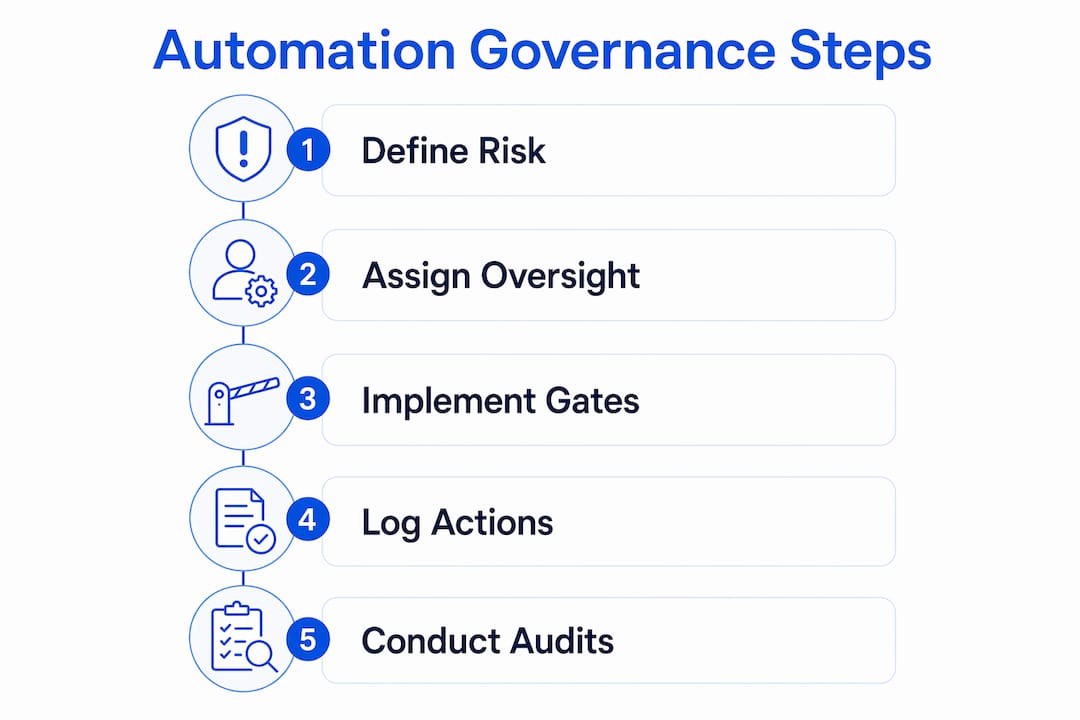
The goal is optimal autonomy, not maximum automation. Human intervention should be calibrated to downside risk and reversibility, not to what the technology can theoretically handle.
| Risk tier | Task profile | Governance gate |
|---|---|---|
| Low | High-volume, reversible, rules-based | Full autonomy with logging and sampling |
| Medium | Moderate stakes, some variability | Propose-then-approve; human reviews flagged cases |
| High | Consequential, irreversible, regulated | Human decision required; AI provides recommendation only |
Every automated action must be logged with a timestamp, agent ID, input data, and output decision. Governance gates should include performance documentation, explainability notes, and an auditable escalation path. For medium-tier workflows, set an approval SLA (typically four business hours) so the human-in-the-loop step does not become a bottleneck. Sampling at least 5–10% of low-tier interactions for quality review keeps the system honest without adding significant overhead. Rollback procedures must be documented before go-live, not after an incident.
Granular permissions and audit trails are non-negotiable for regulated sectors. In healthcare and finance, every automated decision touching a customer record needs a retrievable audit trail that satisfies both internal governance and external regulators.
What does a multi-channel AI architecture look like?
A private, multi-channel agent architecture for Australian enterprises has three layers: an edge/channel layer, an orchestration layer, and an enterprise data layer.
Edge/channel layer handles inbound and outbound contacts across voice, SMS, email, and live chat. Each channel has different latency requirements (voice demands sub-300ms response; email tolerates seconds) and different data structures (voice is unstructured audio; SMS is short-form text). Conversational context must persist across channels so a customer who starts on chat and calls back does not repeat themselves.
Orchestration layer coordinates agent actions, routes escalations, and manages the human-in-the-loop handoff. Reusable prompt and model libraries at this layer prevent each new use case from being built from scratch, which is what separates a scalable agent factory from a collection of one-off bots.
Enterprise data layer connects to CRM, ERP, ticketing systems, and document stores. Integration checklist for this layer:
- Authentication: OAuth 2.0 or SAML for every system connection
- Field mapping: confirm data types and naming conventions before go-live
- Throughput limits: document API rate limits and build back-pressure handling
- CRM synchronisation: agent outputs must write back to the CRM in real time
For detailed integration patterns, the enterprise AI integration architectures guide covers the technical specifics. Enterprise platforms deployed into private VPCs give complete data control while still integrating with existing ERP and CRM investments.
What security and compliance controls does an Australian enterprise need?
Australian enterprises must satisfy the Australian Privacy Principles (APPs) under the Privacy Act 1988 and the Notifiable Data Breaches (NDB) scheme. Healthcare organisations also carry obligations under the My Health Records Act; financial services firms must meet APRA CPS 234 information security requirements.
Minimum security controls to require in any RFP:
- Encryption at rest (AES-256) and in transit (TLS 1.2 or higher)
- Role-based access control (RBAC) with least-privilege defaults
- Private tenancy or VPC deployment within Australian data centres
- Audit trails retained for a minimum of seven years in regulated sectors
- Breach detection and a documented incident response plan aligned to NDB obligations
Australia-hosting is not a preference for regulated sectors — it is a procurement requirement. Data leaving Australian borders triggers cross-border disclosure obligations under APP 8, which adds legal complexity and risk. Requiring Australian hosting in your RFP language removes that exposure entirely. For a detailed breakdown of private AI deployment controls, that guide covers VPC architecture and data residency specifics.
What does a pilot-to-scale roadmap look like?
Most AI pilots do not reach production. The fix is a structured gate process, not better technology.
Phased rollout:
- Pilot (weeks 1–12): single workflow, supervised mode, human approves all outputs
- Minimum viable deployment (weeks 8–16): autonomy widened on low-risk interactions; sampling in place
- Governance gate: formal review against acceptance criteria before broader rollout
- Enterprise rollout: quarterly replication cadence, one new workflow or business unit per quarter
Pilot acceptance criteria:
- Data access confirmed and tested end-to-end
- Integration stress test passed at 2x expected peak volume
- Human review pass rate above agreed threshold
- Business KPI lift confirmed against baseline
| KPI | Measurement method | Scale threshold |
|---|---|---|
| Accuracy / intent recognition | Sampled interaction review | ≥90% correct |
| Deflection rate | Contacts resolved without agent | — |
| Cost per interaction | Total cost ÷ contact volume | Reduction vs. pre-pilot baseline |
| Time to resolution | Average minutes from contact to close | — |
A 90-day practical rollout for the first pilot is achievable when the workflow is well-scoped and data access is confirmed in week one.
Who owns conversational AI operations at scale?
Four roles are needed. A product owner holds the business case, prioritises the workflow backlog, and reports KPIs to the executive sponsor. An ML/LLM ops engineer manages model performance, monitors for data drift, and runs retraining cycles. A platform engineer owns integrations, uptime, and the CI/CD pipeline for agent updates. A governance sponsor at executive level holds authority to approve tier changes and sign off on new use cases.
Incident management needs a documented SLA: if an agent fails or produces an anomalous output, a human must be able to take over within a defined window (typically 15 minutes for customer-facing interactions). Rollback to the previous agent version must be executable in under one hour. For operations and contact centre teams, change management is as important as the technology. Agents that handle high-volume enquiries work best when frontline staff understand the escalation triggers and trust the handoff process.
Where does conversational AI deliver the fastest enterprise value?
The highest-return use cases share a common profile: high contact volume, structured data, clear resolution criteria, and a human handoff point that is easy to define.
- Customer service triage: agent handles FAQs, account status, and policy questions; escalates complaints or complex queries to a human. Track deflection rate and AHT. Integration complexity: low to medium (CRM read access required).
- Lead qualification: agent contacts inbound leads via SMS or email within minutes of enquiry, qualifies against set criteria, and books a callback or meeting. Track lead response time and qualified-to-meeting conversion. The customer service automation playbook covers this workflow in detail.
- Appointment booking: agent checks availability, confirms bookings, and sends reminders across SMS and email. Track no-show rate and booking completion rate. Integration complexity: medium (calendar and CRM write access required).
- Collections and payment reminders: agent sends structured payment reminders, accepts payment intent, and escalates disputed accounts to a human. Track promise-to-pay rate and days sales outstanding. Compliance review required before go-live in financial services.
- Multichannel follow-up: agent maintains context across voice, SMS, and email for ongoing cases. The multichannel agent deployment guide covers channel-specific configuration.
Templatised agents and cross-department context accelerate replication — once a workflow is proven, the template becomes the starting point for the next use case rather than a rebuild.
Key takeaways
Treating automation as a governed portfolio, with tiered human oversight and Australia-hosted data controls, is what separates enterprises that scale successfully from those stuck at the pilot stage.
| Point | Details |
|---|---|
| Start reversible | Prioritise high-volume, rules-based, reversible workflows and score them before committing to a pilot. |
| Gate every phase | Use formal acceptance criteria (accuracy, deflection rate, integration stress test) before widening autonomy. |
| Require Australia hosting | Data sovereignty under APPs and NDB obligations makes local hosting a procurement requirement, not a preference. |
| Assign four key roles | Product owner, ML/LLM ops, platform engineer, and governance sponsor must be named before go-live. |
| Conversational AI as your platform | Conversational AI provides Australia-hosted, multi-channel agents with CRM integration and audit trails suited to regulated sectors. |
The case for restraint early
The most common mistake in enterprise AI programmes is granting too much autonomy too soon. Organisations that scale successfully treat AI initiatives like capital investments with stage gates, embed governance early, and maintain an executive sponsor with real authority to pause or redirect. The technology is rarely the limiting factor. What stalls programmes is the absence of a clear owner, undefined escalation paths, and pilots that were never designed to be measured.
There is a counterintuitive advantage in starting narrow. A single, well-governed pilot on a reversible workflow builds the operational muscle — monitoring, sampling, rollback procedures — that makes the second and third deployments faster and safer. Organisations that skip this phase and push for wide-scale AI integration immediately tend to discover their data quality, integration, and change management gaps at the worst possible moment: after a customer-facing failure.
The right level of autonomy is determined by downside risk, not by what the platform can technically do. That discipline, applied consistently, is what turns a collection of automated tasks into a compounding operational advantage.
Conversational AI: Australia-hosted agents built for enterprise scale
Enterprises that need private, compliant, multi-channel automation without building the infrastructure themselves have a direct option in Conversational AI. The platform hosts entirely within Australia, satisfying APP and NDB requirements out of the box, and deploys agents across voice, SMS, email, and live chat with CRM integration and full audit trails.
Typical pilots run 8–12 weeks from scoping to go-live, with a single workflow as the starting point. From there, proven templates replicate across business units on a quarterly cadence. Security teams can request SOC 2 and ISO 27001 documentation during procurement. To start a pilot conversation or request a demo, visit Conversational AI and speak with the team about your first use case.
Useful sources for technical and governance teams
These sources are worth reading before drafting an RFP or designing pilot acceptance tests.
- AI Automation Strategy: What & How Far to Automate — best for governance sponsors and operations leads defining risk tiers and sequencing logic.
- Scaling AI from Pilots to Enterprise-Wide Deployment — best for architects and ML/LLM ops teams building MLOps pipelines and governance gates.
- How to Build an AI Automation Strategy — best for product owners translating technical metrics into financial outcomes for the board.
- AI Business Process Automation: Strategy and ROI — best for operations teams designing RBAC, audit trails, and replication templates.
- Conversational AI blog — best for contact centre and IT leads planning integration, channel configuration, and pilot KPIs in the Australian context.
- Chad Burmeister on scaling commercial processes — useful background for revenue and sales leaders aligning automation to commercial outcomes.
Recommended
- Types of enterprise AI integration architectures: 2026 guide - Conversational AI
- AI automation for Australian businesses explained - Conversational AI
- Private AI deployment explained for enterprise IT teams - Conversational AI
- Multichannel AI agent deployment guide for enterprises - Conversational AI