Enterprise RAG for chatbots: chunking, hybrid search, Precision@K
Practical enterprise guide to RAG chatbots: implement semantic chunking, fuse dense+BM25 retrieval, measure with Precision@K and grounded-answer rate, and...

Retrieval-augmented generation is the approach to use when a chatbot needs to answer from private, changing data instead of whatever the model memorised during training. Choose RAG when accuracy, citations, and fresh source material matter more than stylistic control over the model’s tone. Done well, it grounds every answer in retrieved evidence, which is the single biggest lever for cutting hallucinated responses in production.
TL;DR:
- Using semantic chunking with section-based splits and metadata tracking significantly reduces retrieval errors compared to fixed-size chunking.
- Hybrid retrieval combining dense embeddings and BM25 with RRF fusion improves both semantic understanding and exact matching, increasing answer accuracy.
- Prompt templates that enforce answer sourcing and citation insertion, coupled with pre-generation relevance grading, effectively prevent hallucinations.
- Managing infrastructure choices—managed services versus self-hosting—affects costs, data residency, and deployment speed, requiring deliberate selection.
- RAG deployment costs focus mainly on reranking latency and large language model token usage, making context size and query routing crucial for speed and expenses.
Table of Contents
- What is RAG for chatbots, technically?
- Architecture and production components
- How do you build the pipeline stage by stage?
- What chunking strategy actually improves retrieval?
- Dense, sparse or hybrid: which retrieval method wins?
- How should multi-turn conversations be handled?
- Which guardrails actually stop hallucinations?
- What metrics prove a RAG chatbot actually works?
- Practical stacks: embeddings, vector stores and orchestration
- What does deployment actually cost, and where does latency go?
- RAG or fine-tuning: which one first?
- What enterprise teams should check before going live
- Three mistakes that quietly sink RAG chatbot launches
- How Conversational AI supports enterprise RAG deployments
- Sources
What is RAG for chatbots, technically?
RAG for chatbots works as a five-stage pipeline: ingestion, indexing, retrieval, augmentation, and generation. Documents get pulled in and cleaned during ingestion, split and embedded during indexing, matched against a user’s query during retrieval, stitched into a prompt during augmentation, and finally passed to a large language model for generation.
The mechanics of augmentation matter more than people expect. Retrieved chunks aren’t just dumped above the question. They’re formatted with source labels, ranked by relevance, and often capped by token budget so the model sees the strongest evidence first. This is where grounding behaviours that refuse unsupported claims do their work: the model is instructed to answer only from what’s in the context window, and to say so plainly when nothing relevant was retrieved.
That refusal instruction is the difference between a RAG chatbot and a chatbot that happens to have RAG bolted on. Skip it, and the model will still guess when retrieval comes up empty.
Architecture and production components
A production RAG stack has more moving parts than the tutorial version. At minimum, you need: a document ingestion service, an embedding model, a vector store, optionally a sparse index (BM25), a retriever that queries both, a reranker, the LLM itself, a semantic cache, and telemetry wired through every hop.
Managed versus self-hosted is the first real decision. Managed vector databases and hosted embedding APIs get you to production faster and remove infrastructure toil, but they add per-call cost and, for regulated industries, raise data residency questions worth resolving before contract signature. Self-hosted stacks (FAISS or Qdrant behind your own API) cost more engineering time up front but keep every byte inside your own network boundary.
Log everything between stages, not just the final answer. Capture the raw query, the rewritten query, retrieved chunk IDs and scores, reranker scores, the assembled prompt, and the generated response with citations. When a chatbot gives a wrong answer, this trail is what tells you whether retrieval failed, ranking failed, or the model ignored good evidence.
How do you build the pipeline stage by stage?
Ingestion starts with extraction. PDFs need table-aware parsing (tools like pdfplumber handle this better than naive text dumps), and scanned documents need OCR before anything else can happen. Get this step wrong and every downstream stage inherits garbled text.
Indexing covers chunking, embedding, and metadata capture, covered in detail below.
Retrieval and augmentation run as one flow per query: embed the query, hit the vector store (and sparse index, if hybrid), rerank the candidates, then assemble a context block with clear source markers.
Generation relies on prompt templates that force citation insertion, tying each claim in the answer back to a specific retrieved chunk. A reproducible starter pattern using embeddings, a vector store, and simple orchestration is a solid way to prove the pipeline before adding reranking and grading layers.
What chunking strategy actually improves retrieval?
Fixed-size chunking (splitting every 500 characters regardless of content) is the fastest way to wreck retrieval quality. Semantic chunking, splitting along document sections or logical breaks, with roughly 900-character overlaps, consistently outperforms naive fixed-size splitting because it keeps related ideas together instead of severing a sentence mid-thought.
Procedures need special handling. A five-step troubleshooting guide split across two chunks means a chatbot might retrieve step 3 without step 2, and answer with a dangerously incomplete instruction. Chunk by section, not by character count, and keep numbered steps intact even if the chunk runs longer than your target size.
Metadata is what makes filtering possible later. At minimum, capture:
- Source document and section title (for citations and debugging)
last_updatedtimestamp (to avoid serving stale procedures)- Product area or category tag (to scope retrieval by context)
- Document version or revision ID (for audit trails in regulated industries)
Support teams that chunk by section and track last_updated metadata report far fewer wrong-step retrievals than teams relying on chunk size alone.
Dense, sparse or hybrid: which retrieval method wins?
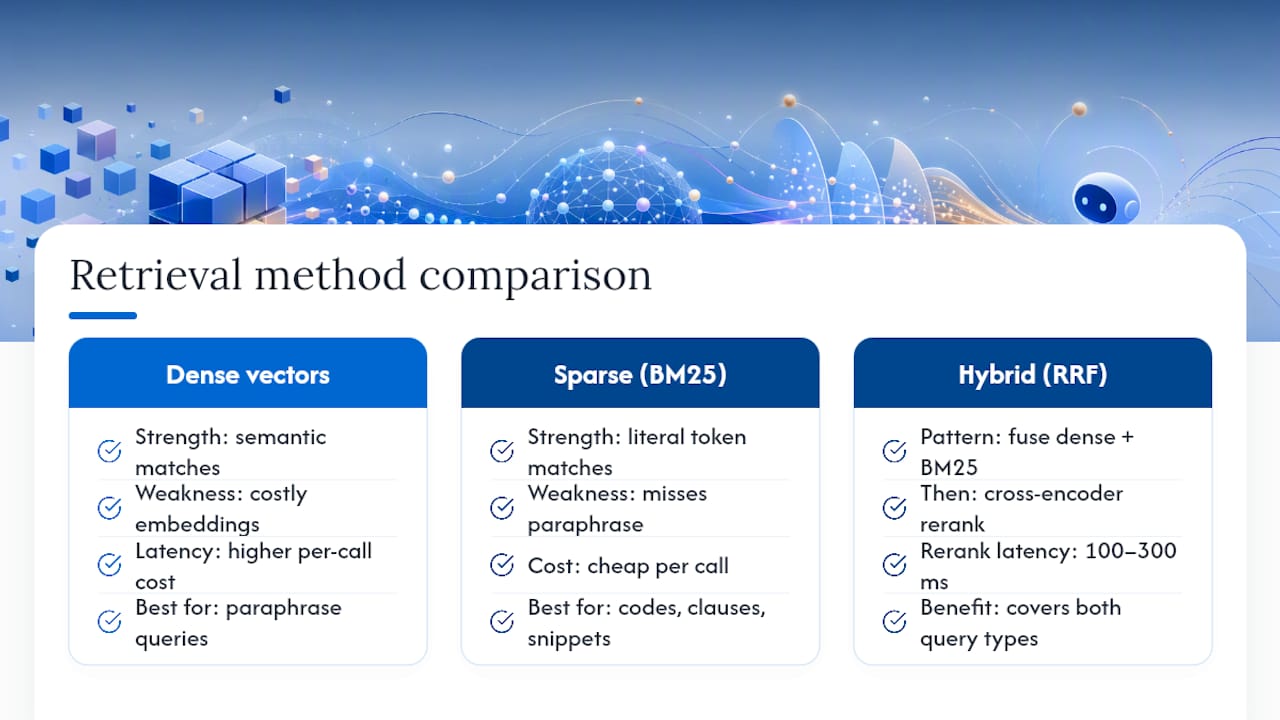
Dense vector search finds semantic matches: a query about “resetting a forgotten password” will surface a chunk titled “account recovery” even without shared keywords. The tradeoff sits in embedding model choice. Larger embedding models capture more nuance but cost more per call and add latency; smaller ones are cheaper and faster but miss subtler distinctions.
Sparse retrieval (BM25) does the opposite job well. It excels at literal token matches, exact error codes, regulatory clause numbers, or code snippets, cases where dense embeddings tend to blur precision in favour of general meaning.
Most production systems don’t pick one. They run both and fuse results using Reciprocal Rank Fusion (RRF), then pass the merged candidate list through a cross-encoder reranker for a final precision pass. This hybrid dense-plus-BM25 pattern fused via RRF captures literal queries that pure semantic search would miss, while still handling paraphrased questions dense retrieval alone would fumble on exact terminology.
Reranking adds latency, typically 100 to 300 milliseconds depending on candidate count and model size. It’s worth the cost when answer accuracy is the priority, but for low-latency channels like voice, budget for it explicitly rather than discovering the delay in production.
How should multi-turn conversations be handled?
A user asks, “What’s the refund window?” then follows with, “And for international orders?” Retrieved on its own, that second query returns nothing useful because it lacks the word “refund.” Query condensation solves this: rewrite the follow-up into a standalone query, “What’s the refund window for international orders?”, before it ever reaches the retriever.
Complex questions need the opposite treatment: decomposition. A question like “Compare the refund policy for digital and physical goods” splits into two sub-queries, retrieves evidence for each, then merges the results before generation.
Automated query-rewriting for multi-turn scenarios is increasingly handled by generating training labels automatically rather than relying on manual annotation, which matters once you’re maintaining this across dozens of conversation flows. Session-aware retrieval and semantic caching (storing recent query embeddings to skip redundant vector lookups) both cut latency on multi-turn threads.
Which guardrails actually stop hallucinations?
The single most effective guardrail is a prompt template that instructs the model to answer only from retrieved evidence and explicitly refuse when the context doesn’t support an answer. Pair that with citation insertion syntax so every claim traces back to a source chunk.
Before generation even happens, add a pre-LLM grading step. CRAG-style graders score retrieved context for relevance and correctness, and block ambiguous or incorrect contexts before they reach the model, which also cuts wasted LLM calls on queries that were never going to retrieve well.
Two more checks belong in every enterprise deployment: PII redaction on both ingested documents and user queries, and automatic escalation to a human agent when confidence scores drop below a set threshold or the topic touches health, legal, or financial advice. Pro Tip: Set your confidence threshold deliberately high for regulated topics; a false refusal costs you a slightly annoyed user, but a falsely confident answer costs you a compliance incident.
What metrics prove a RAG chatbot actually works?
Retrieval quality and answer quality are two separate measurements, and conflating them is the most common evaluation mistake. Track retrieval with Precision@K (of the top K chunks retrieved, how many are relevant), Recall@K, Mean Reciprocal Rank (MRR), and evidence hit rate (how often at least one genuinely relevant chunk appears at all).
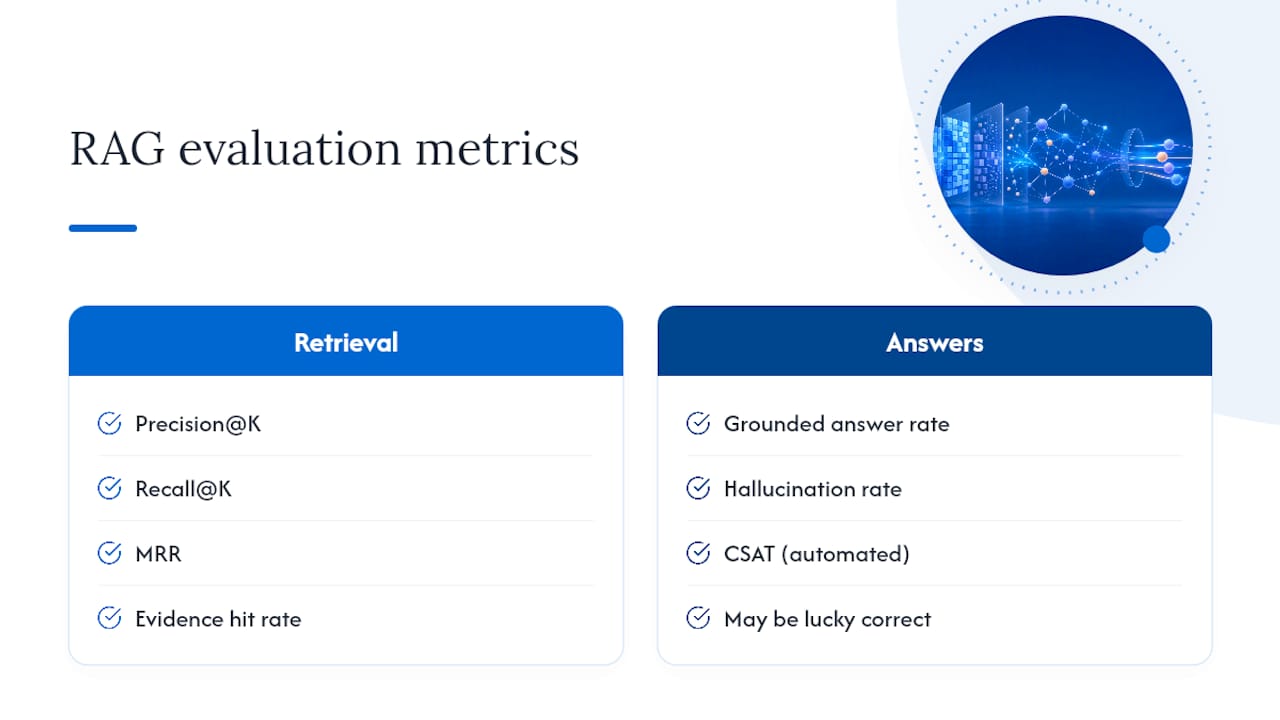
Answer quality can be tracked by grounded answer rate (answers supported by retrieved evidence), hallucination rate, and customer satisfaction (CSAT) specifically for automated responses.
The combined evidence hit rate and grounded answer rate approach matters because a system can retrieve perfectly and still generate an ungrounded answer if the model ignores the context, or retrieve poorly and still generate a lucky correct answer. Either failure mode looks fine if you only track one metric.
A practical workflow: generate synthetic test questions from your document set, run automated Precision@K and MRR scoring, then layer an LLM-as-judge pass (RAGAS or similar) before final human review on a sample of live conversations.
Practical stacks: embeddings, vector stores and orchestration
For embeddings, sentence-transformers models run cheaply on your own infrastructure and suit teams prioritising cost and data control. Hosted embedding APIs cost more per call but need zero infrastructure and often outperform on nuanced semantic matches.
Vector store choice depends on scale and hosting preference. FAISS suits smaller, self-managed deployments with no need for a hosted service. Qdrant and pgvector (running inside Postgres you already operate) both support production hybrid search without adding a wholly new database to your stack.
Orchestration frameworks like LangChain and LlamaIndex speed up prototyping considerably, handling chunking, retrieval chaining, and prompt assembly out of the box. For teams that want tighter control over latency and fewer abstraction layers, a minimal custom SDK wrapping just the embedding call, vector query, and LLM call is often easier to debug in production.
Configuration knobs worth tuning early: retrieval_k (how many chunks to fetch before reranking, typically 10 to 20), reranker score thresholds (below which a chunk gets dropped regardless of rank), and semantic-cache TTL (how long a cached query embedding stays valid before re-querying).
What does deployment actually cost, and where does latency go?
Reranking is usually the single biggest latency add, followed by the LLM generation call itself. Budget your total response-time target first, then work backwards: if voice channels demand sub-second responses, you may need to skip reranking on short, high-confidence queries and reserve it for ambiguous ones.
Cost drivers rank in this order for most teams: LLM generation tokens (especially with large retrieved contexts padding every prompt), embedding calls, and vector store hosting. Trimming retrieved context to only the top few reranked chunks, rather than passing everything retrieved, is the fastest cost lever available.
Hosting location matters for regulated sectors. Data sovereignty requirements mean some organisations can’t send documents or queries to infrastructure outside their own country, which rules out certain managed services outright. Enterprise deployments should confirm hosting location, audit logging, and encryption-at-rest before signing anything.
RAG or fine-tuning: which one first?
RAG wins when data changes often, when answers need citations, and when you can’t afford the retraining cycle every time a policy updates. Fine-tuning wins when you need consistent behaviour or tone baked into the model itself, and the underlying facts rarely change.
Most mature systems end up hybrid: RAG handles the volatile knowledge base, fine-tuning shapes how the model phrases and structures answers. A sensible start is RAG only, then mine your query logs for the highest-volume question patterns and fine-tune against those once you have real usage data. Retrieval combined with fine-tuning shows cumulative accuracy gains over either approach alone.
What enterprise teams should check before going live
Enterprise RAG deployments live or die on hosting and compliance detail, not model choice. Confirm private hosting and data sovereignty commitments in writing, and look for audit logs, CRM integration, and contextual memory across sessions as baseline enterprise features, not add ons.
Three mistakes that quietly sink RAG chatbot launches
The biggest pitfall isn’t the model. It’s skipping evaluation until after launch, chunking by character count instead of document structure, and forgetting that retrieval failure and generation failure look identical to an end user but need completely different fixes.
Start your MVP with a narrow document set, hybrid retrieval, and Precision@K tracking from day one. Loop in your compliance team before touching PII redaction logic, not after, and sandbox any refusal-behaviour changes against a held-out test set before they hit production traffic.
— Sowrabh
How Conversational AI supports enterprise RAG deployments
Conversational AI offers a platform solution for businesses seeking private hosting and multichannel deployment from day one, with features including contextual memory, CRM integration, and multichannel agents across voice, SMS, email, and live chat.
If you’re weighing whether to build a RAG pipeline in house or deploy one that already handles chunking, retrieval, grounding, and audit logging inside a compliant hosting environment, it’s worth comparing both paths before committing engineering time. Teams working through related automation questions may also find this enterprise guide to automating customer service operations useful for scoping what to automate first. Request a demo through Conversational AI to see how the platform handles grounded, cited answers across your existing CRM.
Sources
Start with the Databricks RAG vs fine-tuning guide and the retrieval ablation study on arXiv for deeper technical grounding.
- RAG for customer support — Meilisearch blog
- ai-chatbot-rag — GitHub
- RAG for customer support: Retrieval, chunking, metadata & answer grounding (Droven)
- Retrieval ablation study — arXiv