Avoid Full Rebuild: Omnichannel vs Multichannel for Marketing Leaders
Practical framework for marketing leaders: map key journeys, assess CRM and integration readiness, then pilot omnichannel with multichannel AI, no full...

Omnichannel creates one integrated, customer-centred experience across every touchpoint; multichannel simply runs multiple channels independently, each with its own data and rules. Choose omnichannel when customers move between devices and channels mid-journey and your systems can be integrated. Choose multichannel when you’re testing new channels or working with limited resources. The rest of this guide unpacks the differences, shows real examples, and walks through how to implement either one.
TL;DR:
- Omnichannel requires real-time inventory sync, unified customer profiles, and analytics that track a customer’s complete journey across all touchpoints.
- Multichannel operates independently on each channel without necessarily sharing data, making it simpler but less consistent for customer experience.
- Companies should start with a pilot on high-value journeys before expanding omnichannel infrastructure, focusing on measurable KPIs like customer lifetime value.
- Choosing between models depends on customer behavior, existing system maturity, available budget, and product distribution complexity.
- Multichannel AI agents enable seamless cross-channel interactions using a shared contextual memory, supporting partial omnichannel implementation without system overhauls.
Table of Contents
- Omnichannel vs multichannel: what omnichannel actually means
- What is multichannel marketing, and when is it the right call?
- Omnichannel vs multichannel marketing: the differences that actually matter
- Omnichannel vs multichannel marketing in practice: six real scenarios
- Weighing the benefits and drawbacks of each approach
- How to choose between omnichannel and multichannel for your organisation
- A realistic roadmap for implementing omnichannel
- How multichannel AI agents support omnichannel delivery
- Where the real advantage sits in this debate
- Build omnichannel consistency with multichannel AI agents
- Sources
Omnichannel vs multichannel: what omnichannel actually means
Omnichannel marketing links every customer touchpoint (website, app, store, phone, chat) into a single, connected experience built on one unified view of the customer. A shopper who browses on their phone, gets a follow-up SMS, and finishes the purchase in-store should feel like they’re dealing with one seamless brand, not three disconnected systems that happen to share a logo.
That connection isn’t a design choice. It’s a data problem. Omnichannel depends on unified commerce, an architecture where inventory, orders, and customer profiles sync in real time across every channel, so a service agent can see a web cart, a warehouse can confirm stock instantly, and a support call doesn’t start with “can you repeat your order number?” Shopify’s guidance on connecting sales channels treats this unified architecture as the practical backbone of any omnichannel rollout, not an optional add-on.
The payoff is measurable. A Harvard Business Review study of 46,000 shoppers found that customers who engaged with a retailer across multiple integrated touchpoints spent more and engaged more deeply than those confined to a single channel. That’s the commercial case for the integration effort, not just a customer-experience nicety.
Before you can call a program “omnichannel,” a few things need to be true operationally:
- Real-time inventory synchronisation across every fulfilment point, online and physical
- CRM integration that gives every team, sales, support, marketing, the same customer record
- Analytics that track a customer’s journey across channels, not channel-by-channel in isolation
- A single customer view that follows the person, not the device or the session
Skip any of those and you get the appearance of omnichannel with none of the underlying consistency.
What is multichannel marketing, and when is it the right call?
Multichannel marketing means running your brand across several channels, email, social, a physical store, a marketplace listing, without necessarily connecting the data or experience between them. Each channel operates as its own lane. Adobe’s comparison of the two models frames multichannel as channel-centric: the goal is presence and reach on each platform, not a stitched-together journey.
That’s not automatically a weakness. Multichannel is often the right starting point, particularly for organisations with limited integration budget, smaller teams, or a genuine need to test which channels their audience responds to before committing to the infrastructure omnichannel demands. Running independent campaigns on Instagram, email, and in-store signage lets you learn fast without touching your CRM architecture.
The trade-off shows up in consistency. Wikipedia’s overview of multichannel marketing notes it requires solid supply chain and channel management discipline just to keep prices and stock levels aligned, since nothing forces that alignment automatically. Attribution gets messy too: without a shared data layer, you’re often left guessing which channel actually drove a sale.
Multichannel still works commercially. SAS research found that customers who engage across multiple channels tend to spend significantly more than single-channel customers, even when those channels aren’t formally connected. Reach itself has value, independent of integration.
Practical notes for running multichannel well:
- Keep pricing and stock information consistent across every channel, even without live sync
- Set clear attribution rules upfront so you know which channel gets credit for a conversion
- Treat each channel’s audience data separately, but review it together monthly to spot overlap
Omnichannel vs multichannel marketing: the differences that actually matter
The distinction between omnichannel and multichannel customer engagement comes down to one core question: is the strategy built around the customer or around the channel? Everything else follows from that.
Customer focus. Omnichannel starts with the customer’s journey and works backwards to the channels. Multichannel starts with the channel (a marketplace, an app, a physical branch) and builds a campaign for it. Wharton’s executive education program on omnichannel marketing fundamentals makes this the defining line: omnichannel demands alignment across sales, support, and marketing because the customer doesn’t experience your org chart, they just experience the brand.
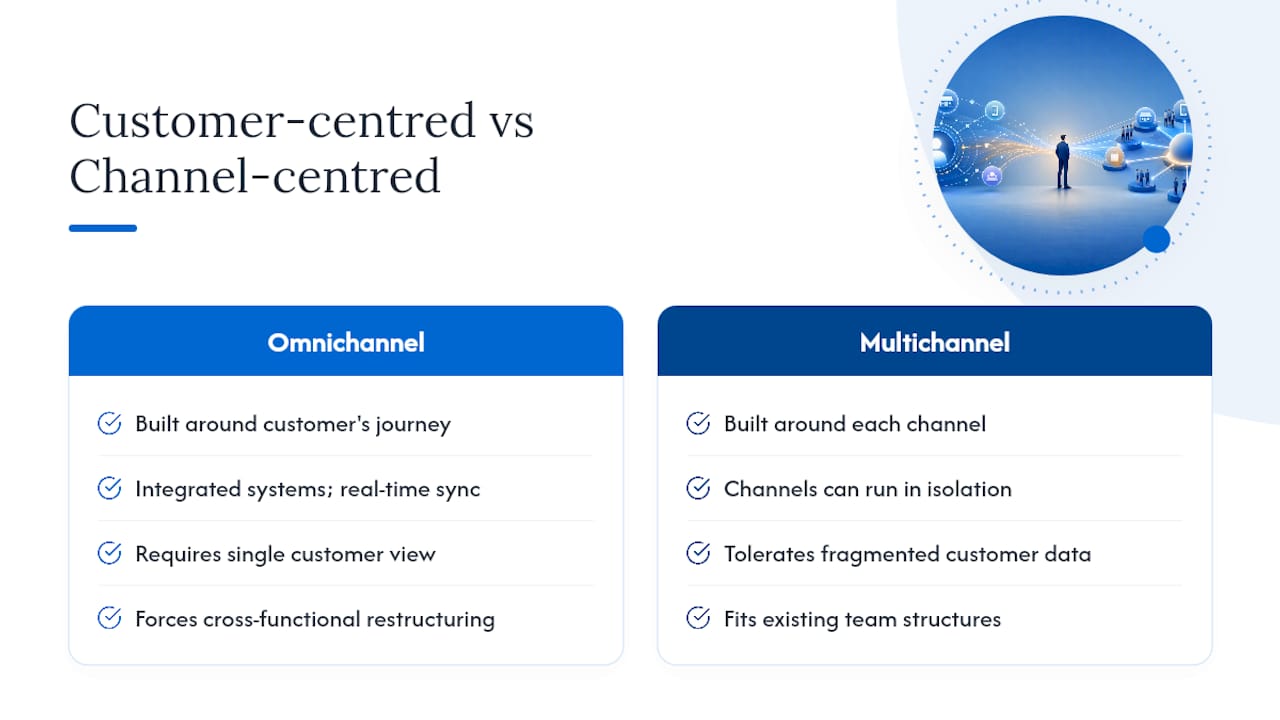
Integration level. Multichannel channels can run entirely in isolation, each with its own database, its own promotions, its own reporting. Omnichannel requires those systems to talk to each other constantly, which is why CRM integration and real-time inventory sync sit at the centre of any serious omnichannel build.
Data and unified view. This is the practical fork in the road. Multichannel tolerates fragmented customer data because each channel is judged on its own terms. Omnichannel cannot function without a single customer view. Without it, a customer who complains via chat about an order placed through the app just looks like two different people to your systems.
Organisational impact. Multichannel can usually run inside existing team structures. Omnichannel almost always forces cross-functional restructuring, because data and operations tend to be siloed by channel from the outset, and that silo has to be broken deliberately, not wished away.
KPIs. Multichannel is measured channel-by-channel: email open rates, in-store foot traffic, marketplace conversion. Omnichannel is measured on the whole journey: customer lifetime value, cross-channel retention, and consistency of experience across touchpoints.
The business case in one figure: in the HBR study of 46,000 shoppers, customers who used multiple integrated channels engaged more and spent more than those who stuck to one, giving omnichannel a direct revenue argument, not just a service-quality one.
Most businesses don’t have to pick one model forever. A hybrid, sometimes called cross-channel, lets you run genuinely omnichannel experiences for your highest-value journeys (say, post-purchase support) while leaving lower-priority channels to operate independently until the business case for integrating them is clear.
Omnichannel vs multichannel marketing in practice: six real scenarios
Seeing the two side by side in action makes the difference between channels click faster than any definition.
- Cross-device cart recovery (omnichannel). A customer adds items to their cart on mobile, abandons it, then receives a reminder that recognises the exact items when they open the desktop site later that day.
- In-store pickup with online history (omnichannel). A customer walks into a physical store and the staff member can see their entire online order and browsing history on a tablet, no re-explaining required.
- Personalised post-purchase follow-up (omnichannel). After a purchase, the customer gets a follow-up tailored to that specific order, delivered through whichever channel they’ve previously engaged with most.
- Separate social, email, and in-store promotions (multichannel). A retailer runs a discount code on Instagram, a different offer via email, and a third in-store flyer, each independent, each measured on its own.
- Marketplace plus website listings (multichannel). The same product sits on a marketplace and the brand’s own website, with separate pricing rules and separate stock counts for each.
- Print ad to promo code (multichannel). A print advertisement carries a unique promo code, letting the business track redemptions without connecting that data to any other channel.
The outcome to watch for isn’t which list looks more advanced. It’s whether repeat customers feel recognised (a sign of successful omnichannel execution) versus whether reach and channel-specific conversion are climbing (the multichannel win condition).
Weighing the benefits and drawbacks of each approach
Omnichannel’s upside is real: higher engagement and spend per the HBR data, stronger retention, and a customer experience that feels coherent rather than accidental. The cost is equally real. Building unified commerce, integrating CRM and inventory systems, and reorganising teams around customer journeys instead of channels takes budget, time, and executive buy-in that many organisations underestimate going in.
Multichannel’s upside is speed and low commitment. You can launch a new channel this month without touching your core systems, and SAS’s research confirms multichannel customers still outspend single-channel ones. The risk is inconsistency: mismatched pricing, conflicting promotions, and attribution guesswork that gets worse as you add channels.
Common failure points and how to manage them:
- Data quality decay. Fragmented systems drift out of sync fast; schedule regular data audits regardless of which model you run.
- Inconsistent offers across channels. Centralise promotion approval even if execution stays decentralised.
- Attribution disputes. Agree on attribution rules before launch, not after finance asks where the budget went.
Pro Tip: Don’t chase omnichannel maturity everywhere at once. Pick the one journey where inconsistency is costing you customers right now, fix that first, and let the rest of the business watch it work before asking for a bigger integration budget.
How to choose between omnichannel and multichannel for your organisation
Work through these questions before committing budget to either model:
- Do your customers move between channels mid-journey, or do they largely stick to one?
- How mature are your existing systems, does a CRM already sit at the centre, or is data scattered across disconnected tools?
- What’s your realistic integration budget for the next 12 months?
- How complex is your product distribution, single warehouse and website, or multiple marketplaces, regions, and fulfilment partners?
A simple way to map answers to a starting point:
- Customers cross channels regularly + mature systems + budget available → start building omnichannel now, beginning with your highest-value journey.
- Customers mostly single-channel + limited systems + tight budget → run multichannel, and revisit integration once you’ve proven which channels earn their place.
- Mixed signals across the board → pilot a hybrid: integrate one journey fully, leave the rest multichannel until the data tells you otherwise.
Track different metrics depending on the path. Omnichannel pilots should measure customer lifetime value, cross-channel retention, and consistency of service across touchpoints. Multichannel campaigns should track channel-specific conversion rate, cost per acquisition by channel, and reach growth. Neither model is measured correctly using the other’s scorecard.
A realistic roadmap for implementing omnichannel
Moving from multichannel to omnichannel is an infrastructure and governance project as much as a marketing one, and treating it purely as a campaign initiative is where most rollouts stall.
Start with a five-step sequence:
- Map the customer journey for your highest-value segment first, not every segment at once.
- Audit existing systems to find out what’s already connected and what’s genuinely siloed.
- Unify customer IDs across platforms so the same person is recognised everywhere they interact with you.
- Choose an integration pattern (API-first, middleware, or a unified commerce platform) that matches your existing tech stack.
- Pilot one use case end to end before expanding, measuring lift before you scale spend.
On the technology side, the checklist is fairly consistent across industries: CRM, point-of-sale systems, a product information management (PIM) tool, real-time inventory sync, a personalisation engine, and analytics that report on the full journey rather than isolated channel metrics. Guidance on connecting CRM systems to live chat AI is a useful reference point for the CRM layer specifically.
Organisationally, success depends on cross-functional KPIs (so sales and support aren’t optimising against each other) and clear data ownership, someone has to own the single customer view, or it drifts back into silos within a year. A structured AI deployment project management approach helps keep that governance intact through the pilot phase.
Pro Tip: Trying to integrate every channel simultaneously is the most common way omnichannel projects fail. Map the journeys first, then connect only the channels that deliver clear business value, expansion can wait.
How multichannel AI agents support omnichannel delivery
Conversational AI channel silos usually persist because voice, SMS, email, and live chat run on separate systems with separate customer records. A multichannel AI agent platform closes that gap by handling all four channels through one contextual memory layer, so a conversation that starts in chat and continues by phone doesn’t reset to zero.
For regulated sectors, healthcare, finance, and professional services, where a customer’s channel history often intersects with compliance) this matters as much as the customer experience angle:
- Contextual memory carries conversation history across voice, SMS, email, and chat
- CRM integration keeps the customer record consistent with whichever system already runs the business
- Automated follow-ups and appointment scheduling reduce the manual handoffs that break omnichannel consistency
- Australia-hosted infrastructure keeps data within Australian jurisdiction, relevant where data sovereignty is a compliance requirement, not just a preference
Conversational AI’s platform is built around exactly this multichannel agent structure, giving organisations a practical route toward omnichannel consistency without rebuilding every system from scratch.
Where the real advantage sits in this debate
Most of the debate over omnichannel versus multichannel treats it as a maturity ladder, as though every business should be climbing toward full omnichannel eventually. That’s not quite right. The organisations that get the most value are the ones that pick one high-value customer journey, integrate only what that journey needs, and prove the lift before spending another dollar on infrastructure.
The real blocker is rarely technology. It’s organisational: someone has to own the single customer view across departments that have never had to share data before, and that argument takes longer to win than any API integration. Start with a pilot, measure retention and spend against a clear KPI, and let the results make the case for wider investment.
— Sowrabh
Build omnichannel consistency with multichannel AI agents
Conversational AI gives you a direct route to the unified customer view that omnichannel strategies depend on, without the multi-year systems overhaul that scares most leadership teams off the idea. Its multichannel agents handle voice, SMS, email, and live chat through one contextual memory layer, integrate with your existing CRM, and run entirely on Australia-hosted infrastructure, which matters if you’re in healthcare, finance, or professional services and data sovereignty isn’t negotiable.
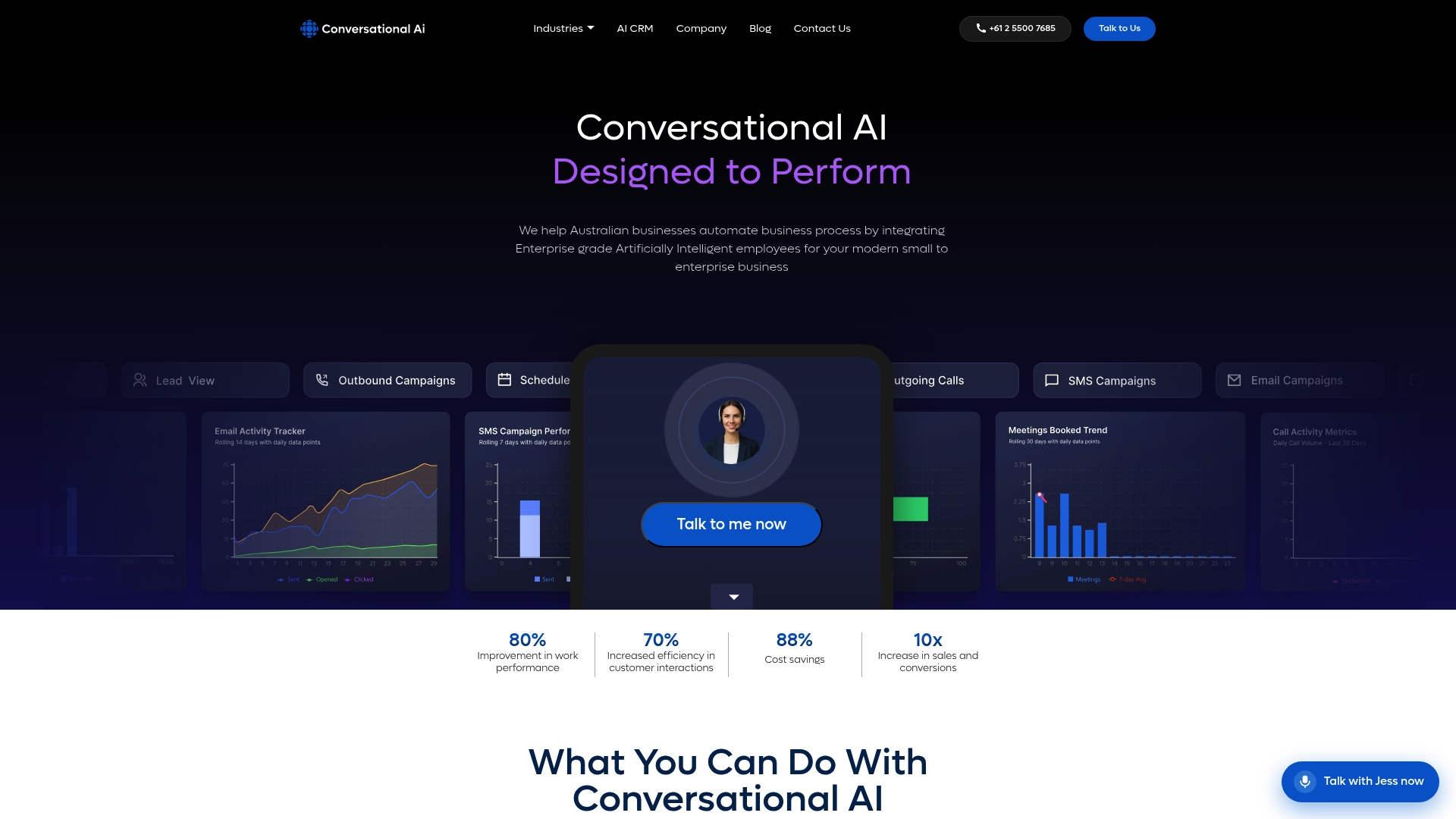
That combination suits exactly the pilot-first approach this guide recommends: lead qualification, appointment booking, or consistent follow-up across channels are all realistic starting journeys, not full omnichannel rebuilds. If you’re ready to test one high-value customer journey with measurable KPIs before committing further budget, explore the Conversational AI platform and see where a pilot fits your systems.
Sources
For deeper detail, see HBR’s 46,000-shopper study, Adobe’s comparison guide, and Babylovegrowth’s take on unifying customer experience.
- A study of 46,000 shoppers shows that omnichannel retailing works | HBR
- Omnichannel strategy: How To Connect Every Sales Channel in 2026 - Shopify
- Omnichannel vs. multichannel marketing (Adobe)
- Multichannel marketing: What it is and why it matters | SAS