AI appointment booking explained for Australian enterprises
Discover how AI appointment booking optimizes scheduling for Australian enterprises, improving efficiency and enhancing customer service.

AI appointment booking uses a conversational agent to handle the full scheduling cycle automatically: capturing intent, checking calendar availability, confirming a slot, sending reminders, and escalating to a human when needed. It goes well beyond a calendar link or a basic booking widget. The industry term for the broader category is automated scheduling, and AI booking is its most capable form.
This technology delivers the most value when your organisation handles high enquiry volumes, operates across multiple channels, or works in a regulated sector where audit trails and data residency matter. A single missed call at a busy clinic or a slow response to a finance enquiry can cost a booking. AI handles that gap without adding headcount.
The system elements that matter most:
- Channels: voice, web chat, SMS, and email, each with different UX and testing requirements
- Calendar sync: read and write access to your existing calendar infrastructure (Google Workspace, Microsoft 365, or a practice management system)
- CRM integration: two-way data exchange so every booking creates or updates a contact record
- Payment guardrails: a draft-then-checkout pattern that keeps fraud controls inside your existing payment platform
- Audit logs: timestamped records of every interaction, required for compliance in healthcare and finance
For Australian enterprises, the verdict is clear: if you are running multi-channel enquiries and your staff are still manually confirming appointments, an AI booking system will reduce handling time and improve calendar utilisation.
Key takeaways
AI appointment booking delivers measurable gains in handling time, calendar utilisation, and no-show rates when the system is properly integrated with your CRM, calendar, and payment infrastructure.
| Point | Details |
|---|---|
| Integration drives outcomes | AI booking succeeds only when connected to CRM, calendar, and payment systems — not as a standalone front end. |
| Draft booking prevents errors | Always use a held-reservation pattern; direct calendar writes without it are the leading cause of phantom bookings. |
| Data residency is the first filter | For Australian regulated sectors, contractual Australia-hosted infrastructure is a procurement requirement, not a preference. |
| Measure AHT, utilisation, and no-shows | These three KPIs give the clearest picture of ROI after deployment; baseline them before go-live. |
| Conversational AI for Australian compliance | Conversational AI provides Australia-hosted, multi-channel booking agents with audit logs and CRM integration for regulated enterprises. |
Table of Contents
- What does an AI appointment booking system actually do?
- How an AI scheduling assistant works, step by step
- Integration checklist and Australia-specific implementation notes
- What business benefits can you expect, and how do you measure them?
- Where does AI appointment booking deliver the most value in Australia?
- How to evaluate AI booking vendors before you commit
- What are the real limitations and how do you manage them?
- What we have learned from Australian deployments
- Conversational AI gives Australian enterprises a compliant, integrated booking platform
- Sources
What does an AI appointment booking system actually do?
A basic calendar link lets a customer pick a time. An AI booking system does considerably more. It guides the customer through service selection, collects intake data, checks real-time availability, confirms the slot, processes a deposit if needed, and sends automated reminders. When something falls outside the script — a complex clinical question, a payment dispute, an unusual service request — it hands off to a human agent with full context preserved.
The functional difference matters for procurement. A booking widget assumes the customer already knows what they want and when. An AI agent converses, qualifies, and adapts.
Core features to look for:
- Natural language understanding (NLU) for voice and text input
- Multi-channel support: voice (inbound and outbound), web chat, SMS, email
- Calendar read/write integration with conflict detection
- Client intake data collection and CRM write-back
- Automated confirmation, reminder, and rescheduling flows
- Draft booking with payment link handoff (not direct payment processing by the AI)
- Human escalation with full conversation context
- Reporting and analytics on booking conversion, handling time, and no-show rates
When a calendar link is enough vs when you need AI:
- Calendar link: single service, low volume, no intake required, no compliance obligations
- AI booking system: multiple services or staff, high enquiry volume, multi-channel inbound, regulated industry, or need for audit trails and CRM sync
The distinction is not just about convenience. In healthcare and finance, the AI’s ability to collect structured intake data and write it to a compliant record system is what makes the workflow defensible.
How an AI scheduling assistant works, step by step
Understanding the operational flow helps you identify where integration points are required and where errors are most likely to occur.
- Intent capture: The user contacts via voice, chat, SMS, or email. The agent identifies that a booking is the goal, either from explicit language (“I’d like to book an appointment”) or from context.
- NLU parsing: The conversational layer extracts service type, preferred date/time, staff preference, and any intake details. A voice-driven AI agent reads and writes booking information when correctly connected to backend calendar and booking engines.
- Availability read: The orchestration engine queries the calendar connector for open slots, applying business rules (buffer times, focus-time blocks, staff skills matching).
- Slot scoring: The system ranks available slots by preference rules. Auto-scheduling logic can factor in cost, compliance guardrails, and staff availability simultaneously, which is particularly useful for field services and rostered teams.
- Draft booking or direct confirm: The agent creates a held reservation rather than immediately writing a confirmed booking. This prevents overbooking if the customer abandons mid-flow.
- Payment handoff: If a deposit is required, the agent sends a secure checkout link. TripWorks documents this pattern clearly: the AI creates a held reservation, the customer completes payment through the platform’s standard checkout, and the booking confirms only on successful payment. Fraud controls stay inside the existing payment platform.
- Confirmation and reminders: On payment or direct confirmation, the system sends a confirmation message and schedules automated reminders via the customer’s preferred channel.
- Reporting and analytics: Every interaction is logged. Booking conversion rates, handling times, and no-show rates feed into your reporting dashboard.
Channel differences that affect the flow:
- Voice requires robust ASR (automatic speech recognition) tuning and recovery strategies for misheard input
- Chat benefits from visual affordances: quick-reply buttons, date pickers, and inline booking widgets
- SMS flows must be concise; long confirmation messages get truncated or ignored
- Email suits asynchronous intake collection and document-heavy services
Pro Tip: Always implement draft bookings rather than direct calendar writes. A draft holds the slot without confirming it, giving you a clean cancellation path if payment fails or the customer abandons. Direct writes without this pattern are the most common cause of phantom bookings in production deployments.
Integration checklist and Australia-specific implementation notes
The most common reason AI booking deployments underperform is treating the AI as a front-end layer rather than an integrated agent. Amadeus enterprise architects are direct on this point: AI delivers real value only when it interoperates reliably with CRM, calendar, and payment systems, not when it operates as a disconnected front end.
Core technical components:
- Conversational layer: NLU engine, dialogue management, channel adapters (voice/SIP, chat widget, SMS gateway, email parser)
- Orchestration engine: coordinates intent, availability checks, booking writes, and escalation logic
- Calendar connector: read/write API access to Google Calendar, Microsoft 365, or a practice management system
- CRM connector: bidirectional sync for contact creation, booking records, and follow-up tasks
- Telephony/SIP: for voice agents, a SIP trunk or cloud telephony integration (e.g. connecting to an existing PBX)
- Payment gateway: receives the checkout link handoff; the AI never touches card data directly
- Reporting and analytics: event logging, dashboard feeds, and audit trail storage
- Audit logs: immutable, timestamped records of every agent action
Integration checklist:
- OAuth 2.0 or SCIM for identity and access management
- Calendar API scopes: confirm read and write access are granted, not read-only
- Idempotency keys on booking writes to prevent duplicate records on retry
- Webhook endpoints for payment confirmation back to the booking engine
- CRM field mapping validated before go-live (not after)
- Conflict detection tested with concurrent booking scenarios
When native connectors are unavailable, Zapier’s appointment automation patterns provide a practical bridge between front-end AI agents and back-end systems. It is not a long-term architecture, but it is a reliable way to prove the workflow before investing in direct API integration.
Australia-specific compliance notes:
- Data residency: all booking data, conversation logs, and CRM records must be stored on Australia-hosted infrastructure to meet the Privacy Act 1988 and the Australian Privacy Principles (APPs)
- Healthcare: the My Health Records Act 2012 and state-based health records legislation impose additional obligations; clinical booking data must not transit overseas infrastructure
- Finance: APRA-regulated entities must satisfy CPS 234 (information security) and notify APRA of material incidents; booking systems that touch customer financial data fall within scope
- Encryption: AES-256 at rest and TLS 1.2+ in transit are the baseline; confirm your vendor meets both
- Access controls: role-based access, MFA for admin accounts, and separation of duties between booking agents and payment systems
Pro Tip: Run the system in shadow mode for two to four weeks before going live. Shadow mode lets the AI observe and log what it would have done without actually writing bookings. You catch NLU errors, stale availability reads, and integration failures before they affect real customers.
For CRM and AI synchronisation in enterprise deployments, the field mapping and write-back logic deserves as much attention as the conversational layer itself.
What business benefits can you expect, and how do you measure them?
The headline benefit is time saved. Amadeus reported a 76% reduction in handling time when AI was embedded into travel booking workflows during a multi-week pilot. That magnitude is not universal, but directionally it reflects what well-integrated deployments achieve across industries.
AI copilot workflows can cut time-to-book substantially by applying natural language and policy-aware recommendations across channels, reducing what used to take several minutes of back-and-forth to a matter of seconds for straightforward requests.
Beyond speed, the measurable outcomes include:
- Reduced no-show rates through automated reminders and easy rescheduling
- Higher calendar utilisation because the AI fills gaps that staff would not proactively chase
- Improved lead qualification in professional services, where intake questions filter out unsuitable enquiries before a slot is confirmed
- Lower cost per booking as manual handling time falls
KPIs to track after deployment:
| Benefit | KPI | How to measure |
|---|---|---|
| Time saved | Average handling time (AHT) | Compare pre/post agent time per booking |
| Booking volume | Bookings per enquiry (conversion rate) | Bookings confirmed ÷ total enquiries |
| No-show reduction | No-show rate | Missed appointments ÷ confirmed bookings |
| Revenue impact | Conversion to paid bookings | Paid confirmations ÷ total bookings created |
| Calendar efficiency | Calendar utilisation rate | Booked slots ÷ available slots per period |
| Customer experience | CSAT score | Post-booking survey or NPS |
| Cost efficiency | Cost per booking | Total system cost ÷ bookings processed |
Measure your baseline for at least four weeks before deployment. A phased or A/B rollout, where one channel goes live while another remains manual, gives you a clean comparison. For multi-channel funnels, tag bookings by originating channel so you can attribute outcomes accurately.
Where does AI appointment booking deliver the most value in Australia?
Some industries see outsized returns because their booking workflows are complex, high-volume, or compliance-sensitive. Here is where the technology earns its keep in the Australian context.
Healthcare and allied health: Clinics and specialist practices deal with phones ringing off the hook during peak periods. Clinical guides confirm that conversational AI can handle patient intake, calendar checks, and reminders, but must operate under strict privacy and clinical governance controls. Voice agents work well here because patients are accustomed to calling. Data must stay on Australian infrastructure.
Financial services and advice: Compliance obligations mean every client interaction needs an audit trail. AI booking collects structured intake data, records consent, and writes it to the CRM before the adviser even picks up the phone. APRA-regulated entities benefit from the immutable logging that a well-configured AI booking system provides.
Professional services (legal, accounting, consulting): Lead qualification is the primary gain. The AI asks intake questions, filters out enquiries that do not meet the firm’s criteria, and only confirms a slot when the lead clears the threshold. This is a natural fit for AI agents in professional services workflows.
Field services and trades: Slot scoring that accounts for technician location, skill set, and job duration reduces travel time and improves first-visit resolution. Voice is the dominant channel because field workers and customers both prefer a call.
Education and training providers: High-volume enrolment enquiries, orientation bookings, and one-on-one consultation scheduling are well-suited to chat and SMS agents. The AI handles the volume spike at enrolment periods without additional admin staff.
Hospitality and experience operators: The draft-then-payment pattern is standard here. The AI holds a table or tour slot, sends a payment link, and confirms only on receipt. No-show rates drop because customers have paid a deposit.
How to evaluate AI booking vendors before you commit
Procurement decisions in this space are often made too quickly, based on a demo that shows the happy path. Here is a checklist to stress-test vendors before you sign.
Evaluation checklist:
- Australia-hosted infrastructure with contractual data residency guarantees
- Native connectors for your calendar, CRM, and telephony stack (or documented API access)
- Security certifications: ISO 27001, SOC 2 Type II, or equivalent
- Multi-channel support: voice, chat, SMS, and email in a single platform
- Draft booking pattern with idempotency (not direct calendar writes)
- Human escalation with full conversation context passed to the agent
- Configurable analytics and audit log export
- Defined SLA for uptime and incident response
- Training loop: ability to retrain the NLU model on your domain vocabulary
Questions to copy into your RFP or vendor demo checklist:
- Where is all data stored, processed, and backed up? Can you provide a contractual data residency guarantee for Australian hosting?
- Does your system create draft bookings before confirming, and how does it handle payment failure mid-flow?
- How does the agent hand off to a human, and what context is passed at escalation?
- What is your process for retraining the NLU model after go-live, and how often does it occur?
- Can you provide audit log exports in a format compatible with our compliance reporting?
- What is your standard implementation timeline, and do you offer a shadow-mode or staged rollout option?
- How do you handle concurrent booking conflicts, and what is your idempotency approach?
Red flags to watch for:
- No audit trail or logs stored outside the vendor’s own system only
- Infrastructure hosted outside Australia with no contractual residency guarantee
- Direct calendar writes without a draft booking pattern
- No documented human escalation path
- Inability to export data in a standard format
Pro Tip: *Score vendors on four dimensions: technical fit (connectors, channels, draft booking), security and compliance (data residency, certifications, audit logs), total cost of ownership (implementation, licensing, ongoing support) and vendor experience in your sector.
For a broader view of AI deployment at enterprise scale, the same staged evaluation framework applies across automation categories.
What are the real limitations and how do you manage them?
AI appointment booking is not a set-and-forget system. Knowing where it fails helps you design the right guardrails.
Common failure modes:
- NLU misunderstanding: the agent misinterprets a service type or date, creating a booking for the wrong slot or the wrong staff member
- Stale availability: a lag between the calendar connector and the AI’s availability read causes double-bookings, particularly under high concurrency
- Payment failures mid-flow: the customer abandons after the draft is created, leaving held slots that are never released
- Edge-case exceptions: unusual requests (multi-service bookings, group bookings, accessibility requirements) fall outside the trained flow and confuse the agent
- Overtrust in agentic actions: the AI confirms a booking it should have escalated, particularly when the intake data is ambiguous
Mitigations:
- Use the draft booking pattern consistently. A held reservation with a defined expiry time releases automatically if payment is not completed.
- Set a maximum hold duration (typically 15–30 minutes) and test the release logic explicitly.
- Build a human-in-loop escalation for any booking that triggers an ambiguity flag or falls outside defined service parameters.
- Log every agent decision with the input that triggered it. This makes retraining targeted rather than speculative.
- Retrain the NLU model on real conversation data at least quarterly, focusing on misclassified intents and failed flows.
- Test voice agents with diverse accents and speech patterns; Australian English varies significantly across regions and demographics.
- Define escalation SLAs: if a human agent does not pick up an escalated conversation within a set time, the system should send a callback confirmation rather than leaving the customer waiting.
Operational readiness matters as much as the technology. Staff need to know what the AI handles, what it escalates, and how to pick up a handoff without asking the customer to repeat themselves. That requires training, not just a system configuration.
What we have learned from Australian deployments
Three patterns show up consistently in Australian enterprise deployments, and they are worth knowing before you start.
Start staged, not big-bang. Every deployment that went live across all channels simultaneously encountered problems that a phased rollout would have caught. Start with one channel, one service type, and one location. Prove the integration, measure the KPIs, then expand. The temptation to go wide quickly is real, but the cost of a failed full rollout is much higher than a slow staged one.
Data residency is non-negotiable, not a nice-to-have. In regulated sectors, a vendor who cannot provide a contractual guarantee of Australian hosting is not a viable option, regardless of how good the demo looks. The Privacy Act obligations and sector-specific requirements (APRA’s CPS 234, state health records legislation) create real legal exposure if data transits or is stored offshore. This should be the first filter in your vendor evaluation, not the last.
Integration-first, not AI-first. The conversational layer is the visible part of the system, but the integration layer is where deployments succeed or fail. Organisations that spent the first phase mapping their calendar, CRM, and telephony APIs, and validating field mappings before the AI went live, had significantly smoother go-lives. Those that treated integration as a post-launch task spent weeks firefighting data quality issues.
After a successful deployment, the measurable outcomes that appear most consistently are a reduction in manual booking handling time, an improvement in calendar utilisation, and a lower no-show rate driven by automated reminders. None of these require a perfect system; they require a well-integrated one.
Conversational AI gives Australian enterprises a compliant, integrated booking platform
Cutting manual booking handling time is one thing. Doing it without moving sensitive customer data offshore is another. Conversational AI delivers both, with an Australia-hosted private cloud platform that covers the full booking workflow: voice, SMS, email, and live chat agents; native CRM and telephony connectors; draft booking with secure payment handoff; immutable audit logs; and real-time analytics.
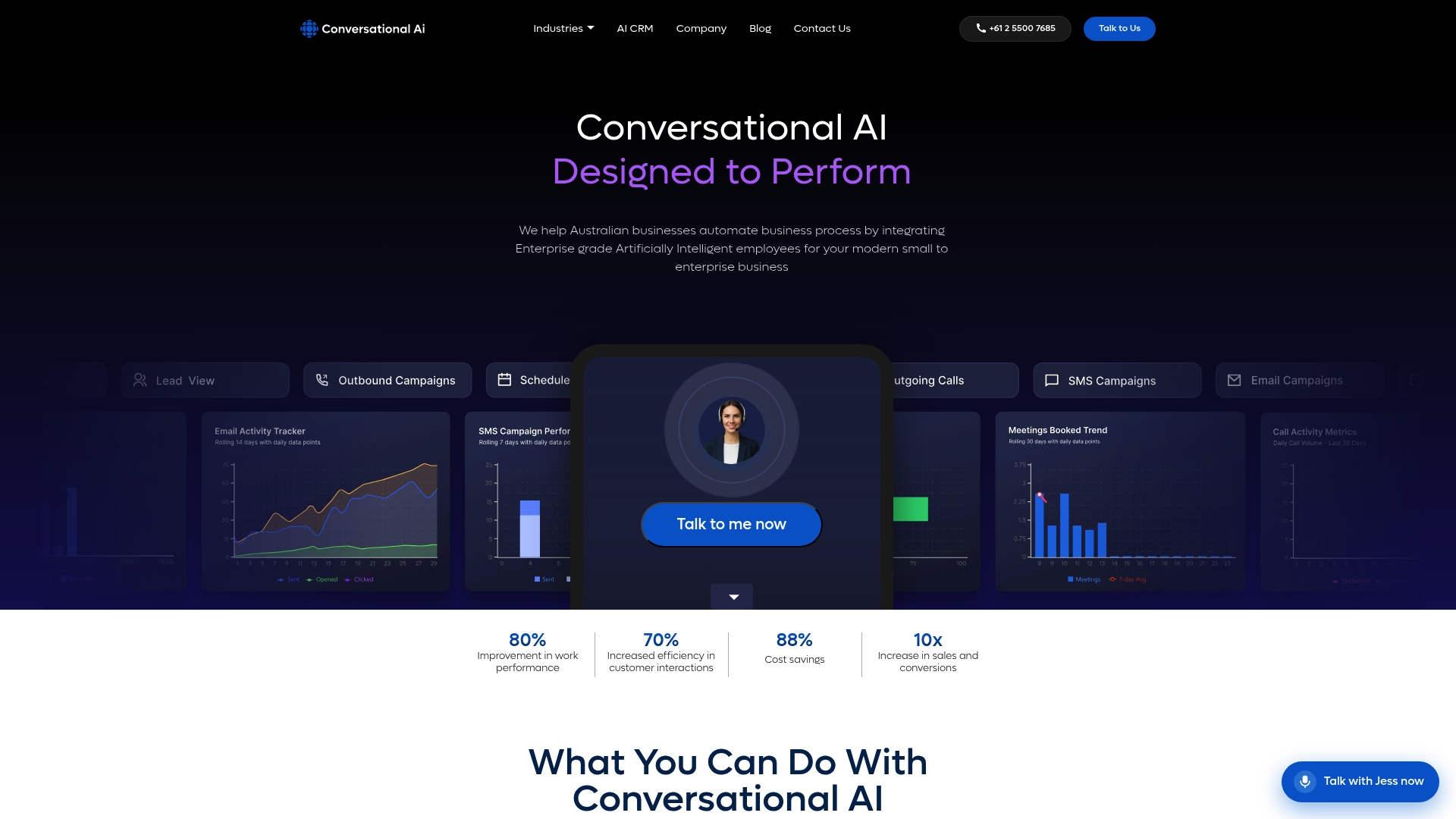
The platform is built for regulated sectors. Healthcare, finance, and professional services organisations get data sovereignty by design, not as an add-on. Implementation follows a staged rollout model with shadow-mode testing, integration validation, and staff training built into the timeline. Enterprise contracts include defined SLAs and ongoing NLU retraining support.
If your team is evaluating AI automation for Australian businesses and needs a platform that meets both the technical and compliance bar, book a consultation with the Conversational AI team to map your current booking workflow against the integration checklist.
Sources
The sources below back the claims in this article and are worth reading directly if you are building a business case or preparing an RFP.
- AI in Travel: From Experimentation to Execution | Amadeus
- How AI bookings work - TripWorks
- AI-Powered Appointment Booking Software: What It Is, How It Works, and Whether You Need It
- Zapier
- HOME features auto scheduling — Deputy