What is sentiment analysis AI, and how does it actually work?
Discover how sentiment analysis AI interprets text emotions, transforming them into actionable insights with accuracy and scale.

Sentiment analysis AI is a natural language processing process that reads unstructured text and converts it into a sentiment label and a numeric score, for example “Positive / 0.78” or “Negative / 0.91.” That score reflects how confident the model is in the assigned polarity, not how “strong” the emotion is, a distinction that trips up a lot of first-time users. As of 2026, this task sits inside a broader field that blends machine learning, computational linguistics and generative AI to interpret tone at scale. Three method families do the heavy lifting: rule and lexicon systems, classical machine learning, and deep learning transformers, plus hybrid stacks that combine all three for reliability.
Key Takeaways
Effective AI-driven sentiment analysis depends more on rigorous preprocessing and evaluation than on which model family ultimately does the scoring.
| Point | Details |
|---|---|
| Definition is deployable | Sentiment analysis AI maps text to a label and numeric score, such as “Positive / 0.78.” |
| Three method families | Rule-based/lexicon, classical ML and transformer deep learning each suit different data and interpretability needs. |
| Preprocessing drives accuracy | Negation handling and emoji normalisation often matter more than choice of classifier. |
| F1 beats accuracy on imbalanced data | Precision, recall and F1 per class reveal errors that plain accuracy hides. |
| Hybrids are the enterprise norm | Cascading or ensemble stacks combine lexicon rules, ML and transformers for robustness. |
| Data sovereignty shapes tool choice | Open-source libraries in a private cloud suit regulated sectors better than external cloud APIs. |
Table of Contents
- What is sentiment analysis AI, exactly, and where are its edges?
- Why do organisations invest in AI for emotional analysis?
- How does sentiment analysis work end to end?
- What preprocessing steps actually move the needle?
- Which text representation method should you actually use?
- When do rule-based systems still make sense?
- How do transformer models like BERT and RoBERTa improve accuracy?
- Why do enterprises combine multiple sentiment models?
- Which type of sentiment analysis fits your use case?
- What do real sentiment analysis applications look like?
- What datasets and labelling practices produce reliable models?
- How do you measure whether a sentiment model is actually working?
- What goes wrong with sentiment analysis, and why?
- Which tools and libraries actually get used in production?
- How do you build a sentiment pipeline from scratch?
- What does responsible sentiment deployment look like at enterprise scale?
- What should you actually expect from a first sentiment analysis pilot?
- Where can you learn more about how sentiment analysis works?
- What is sentiment analysis AI: frequently asked questions
- Sources
What is sentiment analysis AI, exactly, and where are its edges?
Sentiment analysis has its own working vocabulary, and mixing up the terms causes real confusion in project briefs. Polarity is the basic positive, negative or neutral classification. A sentiment score is the numeric confidence or intensity value attached to that polarity, usually between 0 and 1 or scaled from negative one to positive one. Aspect-based sentiment breaks a single piece of text into separate opinions about different features. Emotion detection goes further, classifying text into categories like joy, anger or frustration rather than a simple positive or negative axis. The opinion holder is whoever expressed the view, and the target is what the opinion is about.
Here is how those concepts stack up in practice:
- Document level: “This café is fantastic” scores as one overall sentiment for the whole review.
- Sentence level: a multi-sentence review gets scored sentence by sentence rather than as a single blended figure.
- Aspect level: “The coffee was great but the service was slow” produces two separate scores, one for coffee (positive) and one for service (negative).
Multimodal sentiment analysis extends the same idea to audio and video, pairing vocal tone or facial expression with the transcript for a richer read. What falls outside the usual definition is anything purely predictive, like models forecasting future customer churn from behavioural data with no text or speech input at all. That’s behavioural modelling, not sentiment analysis, even though the two get bundled together in vendor pitches.
Why do organisations invest in AI for emotional analysis?
Sentiment analysis earns its budget because it turns an unmanageable volume of text into a short list of priorities. The common use cases keep repeating across industries:
- Customer service triage, routing angry or urgent tickets ahead of routine ones.
- Brand monitoring, tracking public sentiment across social channels and news mentions.
- Product feedback analysis, surfacing recurring complaints buried in review text.
- Market research, comparing sentiment across competitors or campaigns.
- Clinical and healthcare signal tracking, flagging patient feedback trends.
- Compliance monitoring, catching risky language in regulated communications.
A typical operational pattern looks like this: a spike in negative mentions appears on social media within an hour of a product update going live. The system flags the anomaly, a team investigates the specific complaints driving the spike, responds publicly or privately, then measures whether sentiment recovers over the following days. That loop, outlined by Brand24’s research on sentiment analysis benefits, is what separates real-time monitoring from the older habit of running a sentiment report once a quarter and hoping nothing important happened in between.
How does sentiment analysis work end to end?
Every working system, regardless of which model sits at its core, moves through the same stages. Skip one and accuracy suffers no matter how sophisticated the model is.
- Data ingestion: pulling text from reviews, transcripts, tickets, social posts or emails.
- Preprocessing: cleaning and normalising raw text before anything touches a model.
- Representation: converting words into numerical features a model can process.
- Modelling: applying a rule-based, classical ML or transformer classifier.
- Post-processing and scoring: converting raw model output into a usable label and confidence score.
- Evaluation: checking accuracy against labelled test data.
- Deployment and monitoring: running the model live and watching for drift.
Streaming architectures score text as it arrives, useful for live call centres or social monitoring, while batch pipelines process large volumes overnight for reporting. Most enterprise setups run both, live scoring for alerts and batch scoring for trend analysis.
What preprocessing steps actually move the needle?
Preprocessing is unglamorous, and it’s also where most of the accuracy gains hide. A sensible sequence looks like this:
- Deduplicate records and tag each one with its source (review site, call transcript, social post).
- Tokenise the text, using subword tokenisation for models that expect it.
- Lowercase carefully, since some languages and brand names lose meaning when case is stripped.
- Handle punctuation, keeping exclamation marks and question marks where they carry sentiment weight.
- Decide a stop-word strategy, since words like “not” are stop words in some pipelines and critical signals in others.
- Normalise emojis and emoticons into descriptive tokens rather than deleting them.
- Expand contractions (“don’t” to “do not”) for consistency.
- Handle negation explicitly rather than relying on a simple polarity flip.
- Apply spelling correction or tolerant matching for noisy text.
- Detect language before routing to a language-specific model.
- Remove or mask personally identifiable information before it reaches storage or a model.
Noisy channels like live chat transcripts and social posts need domain-specific tokenisation, because slang, abbreviations and platform-specific formatting break generic tokenisers.
Pro Tip: Normalise emojis to descriptive tokens like “positive_face” rather than stripping them, and use dependency-aware negation handling instead of a blanket polarity flip. “Not bad” and “not good” both contain “not,” but they mean opposite things.
Which text representation method should you actually use?
Bag-of-words and TF–IDF are sparse, interpretable, and cheap to compute. They’re a solid baseline, and the Elastic sentiment analysis explainer notes they remain useful precisely because they’re easy to maintain in constrained environments. Their weakness is context blindness: they can’t tell “not great” from “great” without extra handling.
Word embeddings like Word2Vec and GloVe capture semantic similarity between words, so “excellent” and “outstanding” land close together in vector space. They still assign one fixed vector per word regardless of context, which is where contextual embeddings take over.
Transformer-based embeddings from models like BERT and RoBERTa generate a different vector for the same word depending on surrounding context, a genuine leap for handling sarcasm-adjacent phrasing and compound sentences. Stanford’s NLP research group has documented how this contextual approach improved sentiment detection over static embeddings and bag-of-words methods.
A few practical notes worth keeping in mind:
- Subword tokenisation (used by RoBERTa and similar models) handles out-of-vocabulary words gracefully by breaking them into known fragments.
- Multilingual transformer models exist, but performance still varies significantly by language resource availability.
- Fine-tune a transformer when you have thousands of labelled, in-domain examples and the compute budget to support it; use frozen embeddings or classical feature-based approaches when data or budget is limited.
When do rule-based systems still make sense?
Lexicon-based systems map individual words to a polarity score using a pre-built dictionary, then apply modifier rules for intensifiers (“very good”) and negation (“not good”). VADER-style lexicon tools work this way, and they remain genuinely useful in regulated domains where a reviewer needs to trace exactly why a score was assigned.
Classical machine learning classifiers sit one step up in complexity. The usual suspects are:
- Naive Bayes, fast and effective on smaller datasets.
- Support Vector Machines (SVM), strong on high-dimensional sparse features.
- Logistic regression, simple and interpretable for binary or multiclass sentiment.
These models typically train on n-gram counts, TF–IDF weights, or pointwise mutual information (PMI) scores as features rather than raw text. TechTarget’s overview of sentiment analysis confirms these approaches “remain useful for small-data or highly interpretable contexts,” applying dictionaries and modifier rules alongside simple classifiers.
Choose rule-based or classical ML when you have limited labelled data, a strict interpretability requirement (common in finance and healthcare compliance), or a tight compute budget that rules out running a transformer in production.
How do transformer models like BERT and RoBERTa improve accuracy?
Transformers learn general language patterns during a pretraining phase on massive text corpora, then get fine-tuned on a smaller, labelled sentiment dataset for the specific task. This transfer-learning workflow is why BERT and RoBERTa outperform earlier sequence models: they arrive already understanding grammar, context and word relationships, and fine-tuning only needs to teach them the sentiment task itself.
The trade-offs are real and worth stating plainly:
- Accuracy and context handling: transformers manage negation, sarcasm-adjacent phrasing and long-range dependencies far better than bag-of-words or static embeddings.
- Compute cost: fine-tuning and serving transformers requires GPU infrastructure that a logistic regression model never needs.
- Latency: transformer inference is slower per request than a classical classifier, a real constraint for live chat scoring.
- Data requirements: fine-tuning works best with several thousand labelled, in-domain examples rather than a few hundred.
- Domain-specific pretraining: continuing pretraining on industry-specific text (legal, medical, retail reviews) before fine-tuning often lifts accuracy further.
A few practical tips for teams fine-tuning their own models: choose a cased model when capitalisation carries meaning (brand names, acronyms) and an uncased model when it doesn’t; keep batch sizes modest to fit GPU memory; use a learning-rate schedule with warmup rather than a flat rate; and always validate on an in-domain holdout set rather than trusting benchmark scores from a different domain.
Why do enterprises combine multiple sentiment models?
Hybrid systems cascade a lexicon filter first, pass ambiguous cases to a classical ML model, then send the hardest cases to a transformer scorer. Others run an ensemble, combining predictions from multiple models through weighted voting or a meta-classifier.
- Cascading pipelines cut compute cost by only invoking the expensive transformer on genuinely uncertain text.
- Ensembles capture obvious lexical cues cheaply while still handling nuanced language accurately.
- Hybrids give low-resource languages a usable fallback when transformer coverage is thin.
Monitoring hybrid systems means tracking which layer handles which proportion of traffic and re-tuning the routing logic as sentiment patterns shift.
Which type of sentiment analysis fits your use case?
Different granularities suit different problems, and picking the wrong one wastes analyst time on noise.
- Document-level: scores an entire review or article as one unit. Good fit for brand monitoring where you just need an overall pulse.
- Sentence-level: scores each sentence separately within a longer document. Better for contact centre triage, where one sentence might carry the urgent complaint buried in an otherwise calm message.
- Clause or sub-sentence level: splits compound sentences like “great product, terrible delivery” into separate judgements.
- Aspect-based (feature-level): extracts sentiment about specific product features, essential for product development teams building a feature roadmap from review text.
- Fine-grained emotion detection: classifies text into emotions like joy, anger, sadness or frustration rather than a simple polarity scale, useful for clinical or crisis-response contexts where “negative” alone isn’t specific enough.
Brand monitoring generally works well at document or sentence level. Product feedback analysis needs aspect-based scoring to be genuinely actionable. Contact centre triage benefits from combining sentence-level scoring with emotion detection to separate calm negativity from genuine distress. Multimodal fusion, blending audio tone with transcript text, adds real value in call centre analytics where vocal stress often precedes what a caller actually says.
What do real sentiment analysis applications look like?
Four scenarios show how this plays out operationally, beyond the abstract “monitor customer sentiment” pitch.
Customer service triage. A support queue scores incoming tickets by combining negative sentiment intensity with urgency keywords, pushing the angriest, most time-sensitive tickets to the top rather than processing them in arrival order. Teams handling high-volume inquiries increasingly rely on this kind of automated prioritisation to stop urgent complaints from sitting in a first-in-first-out queue behind routine questions.
Product development. A software company extracts aspect-level sentiment from thousands of app store reviews, discovering that sentiment toward “onboarding” is strongly negative while sentiment toward “core features” is strongly positive. That distinction shapes the next sprint’s priorities far more usefully than an overall star rating ever could.
Brand monitoring. A retailer tracks sentiment across social mentions in near real time. A sudden negative spike correlates with the launch date of a new ad campaign, prompting a review of the creative before the backlash spreads further.
Multimodal call centre analytics. Speech sentiment analysis reads vocal tone, pace and pitch, then combines that signal with sentiment extracted from the call transcript itself. A caller might use neutral words while their tone signals real frustration, and combining voice and text signals catches that mismatch in a way text analysis alone would miss.
What datasets and labelling practices produce reliable models?
Benchmarking and training rely on a small set of well-known datasets, each with known quirks. SemEval opinion mining tasks provide annotated data across multiple sentiment subtasks. The Stanford Sentiment Treebank (SST) offers fine-grained, phrase-level sentiment labels built from movie reviews. IMDB reviews give a large, binary-labelled dataset that’s become a standard benchmark. Twitter sentiment datasets capture short, informal, emoji-heavy text quite different from the other three. Every one of these carries a domain gap: a model trained on movie reviews will underperform on medical feedback without further fine-tuning.
Reliable labelling depends on a clear annotation scheme agreed before labelling starts, regular inter-annotator agreement checks to catch drifting interpretations, explicit rules for neutral and ambiguous cases, and separate guidelines for sarcasm and implicit sentiment since annotators disagree on these more than anything else. When labelled data is scarce, weak supervision (using heuristic rules to generate rough labels) and active learning (prioritising the most uncertain examples for human review) both stretch a small labelling budget further than random sampling would.
How do you measure whether a sentiment model is actually working?
Accuracy alone is a misleading number when sentiment classes are imbalanced, which they almost always are; most customer feedback is neutral or mildly positive, so a model that always predicts “positive” can still post decent-looking accuracy. Precision measures how many predicted negatives were genuinely negative. Recall measures how many actual negatives the model successfully caught. F1 balances the two into a single number. A confusion matrix breaks all of this down by class, and macro-averaging treats every class equally while micro-averaging weights by how frequent each class is.
- Prefer F1 over raw accuracy whenever one class (usually “negative”) matters more than overall correctness.
- Use confusion-matrix analysis to find exactly which class is generating the most costly errors, rather than tuning blindly.
- Business-critical false negatives, missed genuinely negative complaints, deserve the most scrutiny since they’re the ones that turn into churned customers or unresolved compliance issues.
- Track model performance with A/B tests or human-in-the-loop spot checks to confirm that a metric improvement in a test set actually translates into fewer missed complaints in production.
Precision, recall and F1 reporting with per-class breakdowns gives teams a far more honest read on model quality than a single accuracy figure ever will.
What goes wrong with sentiment analysis, and why?
No sentiment model is immune to a handful of recurring failure modes. Sarcasm and irony remain genuinely hard, since “great, another delay” reads as positive to a naive model. Implicit sentiment, where no explicit sentiment word appears at all (“the battery died after two hours”), trips up lexicon systems entirely. Mixed sentiment within a single sentence confuses document-level scoring. Domain shift means a model trained on product reviews performs noticeably worse on medical or legal text. Multilingual text introduces uneven model quality across languages with less training data available. Annotation inconsistency between human labellers introduces noise before a model even sees the data. And model bias, inherited from skewed training data, can systematically misjudge language patterns associated with particular demographics or dialects.
Mitigation isn’t a single fix, it’s a combination of practices:
- Hybrid models that fall back to interpretable rules when a transformer’s confidence is low.
- Targeted fine-tuning on in-domain data rather than relying on general-purpose benchmarks.
- Domain-specific lexica built for the industry in question.
- Continuous monitoring for accuracy drift as language and slang evolve.
- Human-in-the-loop review for edge cases where model confidence sits near the decision boundary.
Ethically, biased training data can produce systematically unfair outcomes, so auditing datasets for demographic skew matters as much as tuning the model itself. Privacy is a parallel concern: sentiment models routinely process personal opinions and identifiable content, which means retention policies and anonymisation deserve the same attention as model accuracy. Transparent reporting of a model’s confidence and known limitations, rather than presenting every score as gospel, is part of responsible deployment.
Which tools and libraries actually get used in production?
Cloud APIs offer managed, scalable sentiment analysis without infrastructure overhead, while open-source libraries offer more control and fit better where data sovereignty or on-premises hosting is a requirement. Each has a clear trade-off: cloud APIs mean sending text to a third-party server, which is a non-starter for organisations bound by strict data residency rules.
The tools readers encounter most often across the industry:
- IBM Watson Natural Language Understanding: a managed cloud API offering sentiment, emotion and entity extraction with enterprise support.
- AWS Comprehend: Amazon’s managed NLP service, offering sentiment scoring alongside key phrase and entity detection.
- Google Cloud Natural Language: a managed API providing sentiment and syntax analysis, integrated with the broader Google Cloud ecosystem.
- Hugging Face (Transformers and model hub): an open-source library and public model repository hosting thousands of pretrained sentiment and classification models ready for fine-tuning.
- RoBERTa: a robustly optimised transformer architecture, widely used as a base model for fine-tuned sentiment classifiers.
- spaCy: an open-source NLP library focused on production pipelines, offering fast tokenisation and integration points for custom sentiment components.
- NLTK: a foundational open-source Python library including lexicon-based sentiment tools like VADER, popular for teaching and rapid prototyping.
For organisations with data-sovereignty or privacy constraints, healthcare, finance and government among them, open-source libraries deployed inside a private cloud environment are usually the more defensible choice over sending sensitive text to an external API.
How do you build a sentiment pipeline from scratch?
A working pipeline follows the same sequence regardless of which model family sits at its centre.
- Ingest raw text from its source, tagging each record with channel, timestamp and any relevant metadata.
- Preprocess the text: tokenise, normalise, handle negation, and mask any personally identifiable information before it moves further downstream.
- Represent the cleaned text numerically, choosing TF–IDF, static embeddings or contextual transformer embeddings based on your accuracy and compute constraints.
- Train or fine-tune a model, either a classical classifier on engineered features or a transformer fine-tuned on labelled, in-domain examples.
- Validate on a held-out, in-domain test set, checking precision, recall and F1 per class rather than trusting a single accuracy number.
- Deploy the model behind an inference endpoint, logging every prediction alongside its confidence score for later auditing.
- Monitor live performance for drift, retraining or re-tuning when accuracy on newly labelled samples starts slipping.
In conceptual terms, the data flow looks like this: raw text enters, preprocessing strips noise and normalises structure, the representation layer converts text to numbers, the model produces a raw score, post-processing converts that score into a label and confidence value, and a logging layer records the input, output and confidence for every single prediction. That logging step matters more than most teams initially budget for, since it’s the only way to audit why a model made a specific call months later.
On deployment choices: streaming architectures suit live alerting, like flagging an angry call in progress, while batch processing suits nightly trend reports where a few hours of latency changes nothing. Cost tends to scale with model size and request volume, so many teams route straightforward cases through a cheap classical model and reserve the transformer for genuinely ambiguous text. Model updates should follow a fixed cadence, monthly or quarterly retraining is common, and every deployment needs a rollback path in case a new model version underperforms the one it replaced.
What does responsible sentiment deployment look like at enterprise scale?
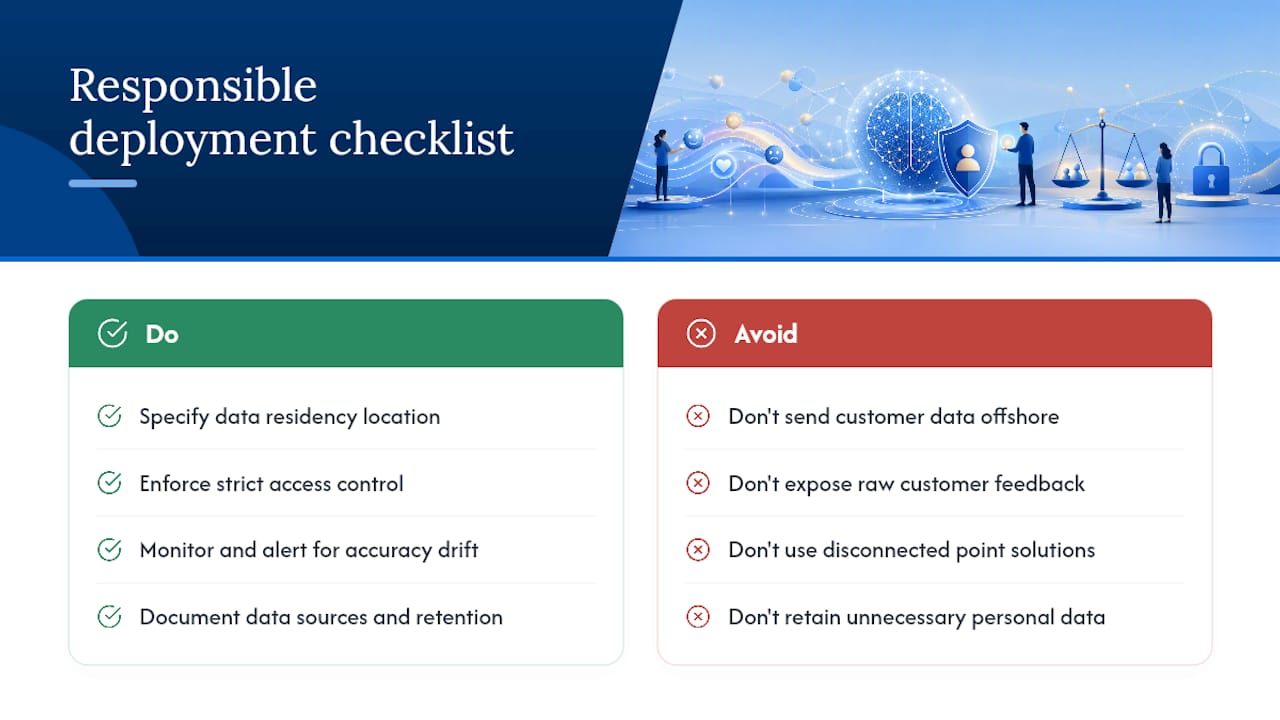
Getting a model to work in a notebook and getting it to work safely in production are two different problems. A deployment checklist worth following includes data residency (knowing exactly where text is processed and stored), strict access control over who can view raw customer feedback, ongoing monitoring and alerting for accuracy drift, explainability logs that record why a given prediction was made, and a fallback path to human review whenever model confidence sits below an agreed threshold.
Privacy and compliance deserve equal weight. Minimise the personal information a pipeline ever touches, anonymise wherever the analysis doesn’t genuinely require identity, and keep clear documentation of where every training and inference data source came from along with how long it’s retained. For sectors like healthcare, finance and professional services, this documentation isn’t optional paperwork, it’s what a regulator or client audit will ask for first.
Conversational AI builds its platform around exactly these constraints. It hosts entirely within Australia on a private cloud, which matters directly to the data residency point above, and its multi-channel agents apply sentiment signals across voice, SMS, email and live chat while staying integrated with existing CRM systems rather than operating as a disconnected side tool. Real-time analytics and contextual memory mean a sentiment signal captured on one channel can inform how the next interaction on a different channel gets handled, which is the kind of continuity that isolated point solutions rarely manage.
If you’re weighing up whether to build a sentiment pipeline in-house or deploy a platform that already handles the preprocessing, model selection and compliance layers together, it’s worth exploring what Conversational AI’s platform offers for Australian enterprises that need sentiment-aware automation without sending customer data offshore.
What should you actually expect from a first sentiment analysis pilot?
Most first pilots underdeliver not because the model is wrong, but because the preprocessing and validation set were rushed to get to the “interesting” modelling work faster. A pilot that spends its initial period focusing on clean data ingestion, proper negation handling and a genuinely representative labelled validation set will consistently outperform one that jumps straight to fine-tuning a transformer on messy, unvalidated text.
Realistic expectations matter here. A useful pilot typically runs for several weeks, involves subject-matter experts reviewing labelled examples alongside the technical team, and should define success as a specific, measurable outcome, such as reducing missed urgent complaints, rather than a vague target like “better sentiment accuracy.” Chasing marginal gains from a fancier model before the basics are solid is the single most common way pilots stall. Get the unglamorous preprocessing and evaluation groundwork right first, and the model choice becomes a much smaller decision than most teams initially assume.
Where can you learn more about how sentiment analysis works?
A handful of sources cover the technical ground this article has walked through in far more depth for readers who want to go further.
- Stanford NLP resources cover transformer architectures and canonical benchmark tasks like SemEval and SST in academic depth.
- The Cornell CS survey on opinion mining gives a structured overview of the three core methodological groups and where emotion detection research is heading.
- The Hugging Face model hub style repositories host pretrained sentiment models ready for fine-tuning, useful for anyone building a pipeline rather than researching one.
- The PMC article on sentiment analysis explains where generative AI fits into current sentiment analysis practice.
- Elastic’s sentiment analysis explainer offers a clear, vendor-neutral walk-through of tokenisation, feature extraction and classification stages.
What is sentiment analysis AI: frequently asked questions
What is sentiment analysis AI in one sentence? It’s an NLP process that reads unstructured text and outputs a sentiment label plus a numeric confidence score, using rule-based, classical ML, transformer or hybrid methods.
How does sentiment analysis work without a data scientist on staff? Cloud APIs like AWS Comprehend or Google Cloud Natural Language handle the modelling internally, so a team can call an API endpoint and receive a score without building or training anything themselves.
What are the main benefits of sentiment analysis for a business? The clearest benefits are faster customer service triage, earlier detection of brand reputation issues, and structured feedback that informs product decisions instead of relying on gut feel.
Which sentiment analysis technique is most accurate? Fine-tuned transformer models like RoBERTa generally outperform classical ML and rule-based systems on context-heavy text, but they cost more to run and need more labelled data to fine-tune properly.
Can sentiment analysis detect sarcasm reliably? Not reliably. Sarcasm remains one of the hardest problems in the field, and even transformer models miss it regularly, which is why human-in-the-loop review still matters for ambiguous or high-stakes cases.
Is sentiment analysis the same as emotion detection? No. Sentiment analysis classifies text as positive, negative or neutral, while emotion detection identifies specific emotions like anger, joy or frustration, a more fine-grained task that typically needs its own labelled dataset.
Sources
- PMC article on sentiment analysis
- Stanford NLP resources
- Elastic — what is sentiment analysis
- TechTarget — what is sentiment analysis