What is outbound voice automation? A guide for professionals
Discover what is outbound voice automation and how it enhances phone conversations. Learn to qualify leads, remind appointments, and more!

Outbound voice automation is an AI-driven system that initiates and manages goal-directed phone conversations to qualify, remind, collect or convert at scale. Unlike a simple robocall that plays a recorded message and hangs up, a modern outbound voice AI agent uses automatic speech recognition (ASR), large language model (LLM) reasoning, and text-to-speech (TTS) synthesis to hold a genuine multi-turn conversation, capture data, and hand off to a human when the situation calls for it. Australian deployments add a further layer: every call list must be scrubbed against the ACMA Do Not Call Register before dialling, and timezone-aware scheduling is a non-negotiable operational requirement, not a nice feature.
The most common applications are:
- Lead qualification — the agent asks discovery questions, scores the lead, and books a callback for a human rep
- Appointment reminders — automated calls confirm, reschedule or cancel bookings without tying up reception staff
- Debt collection and payment nudges — compliant, consistent outreach at volume
- Customer surveys and feedback — post-interaction calls that capture structured responses directly into a CRM
- Recruitment and onboarding — screening calls that filter candidates before a human interview
Stat to know: Gartner predicts that agentic AI will autonomously resolve 80% of common customer service issues without human intervention by 2029, a trajectory that makes outbound voice automation one of the most consequential investments an operations team can make right now.
Table of Contents
- How does outbound voice automation differ from IVR and dialers?
- What are the core components that power outbound voice automation?
- What are the primary benefits of outbound voice automation?
- What are the most common outbound voice use cases?
- How do you implement outbound voice automation in Australia legally?
- Should you build or buy? Pilot timelines and cost drivers
- How do you measure success in outbound voice automation?
- How Conversational AI supports Australian outbound voice deployments
- Key takeaways
- The case for outbound voice automation, and where it goes wrong
- Conversational AI: Australian-hosted outbound voice, ready to pilot
- Further reading and useful sources
How does outbound voice automation differ from IVR and dialers?
The terminology in this space is genuinely confusing, and the confusion is expensive. Buying a predictive dialer when you need a conversational AI agent, or vice versa, wastes budget and frustrates customers.
| Technology | Who initiates the call | Conversation style | AI reasoning | Typical use |
|---|---|---|---|---|
| Predictive / progressive dialer | System | None — connects human agent | No | High-volume agent-assisted calling |
| IVR (inbound or outbound) | System | Menu-driven, DTMF or basic ASR | No | Notifications, simple self-service |
| Robocall / pre-recorded message | System | One-way broadcast | No | Mass alerts, political campaigns |
| Outbound voice AI agent | System | Multi-turn, natural language | Yes (LLM) | Qualification, collections, reminders with dynamic responses |
The key distinction is goal-directed reasoning. An outbound voice AI agent combines telephony orchestration, streaming inference, and policy logic to pursue a defined outcome across multiple conversational turns, adapting its responses to what the contact actually says. A predictive dialer simply connects a ringing line to the next available human. An IVR follows a fixed decision tree.
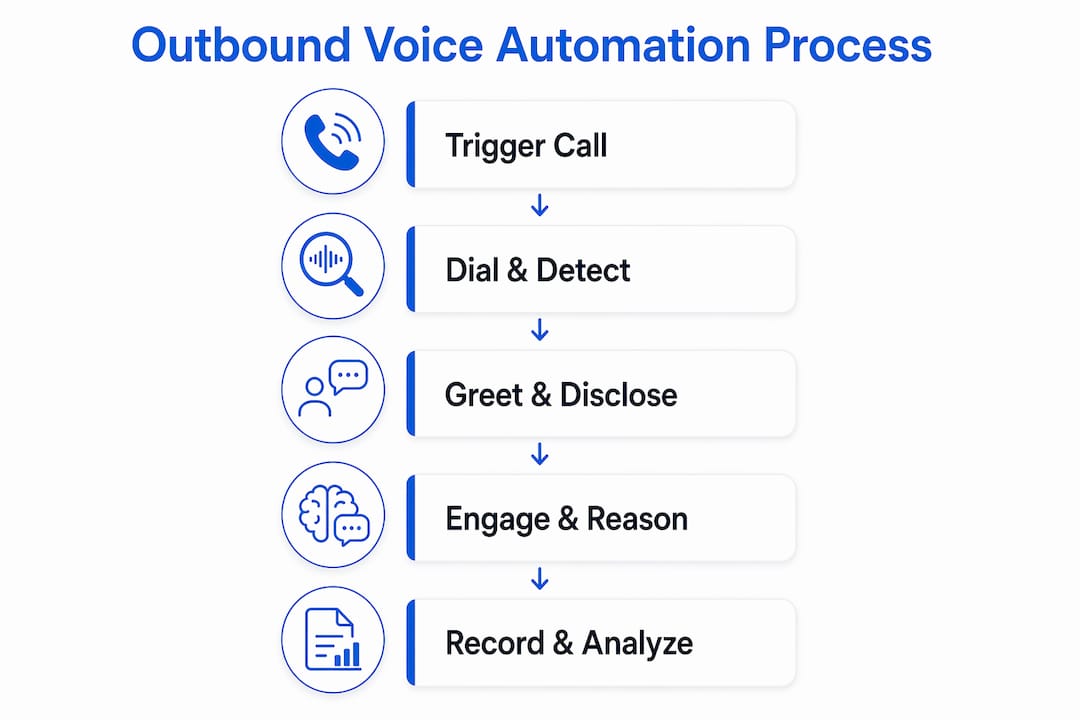
Where conversational flexibility matters, an LLM supplies it. Where compliance precision is required — identity verification, mandatory disclosures, consent capture — deterministic workflow logic handles it. The best architectures use both, with the LLM operating inside strict guardrails rather than free-ranging across the entire call.
A typical call flow looks like this:
Trigger (CRM event or scheduled campaign) → Dial (telephony layer, AMD check) → Greet and disclose (deterministic script) → Listen and transcribe (ASR) → Reason and respond (NLU + LLM) → Capture data (CRM write-back) → Escalate or close (handoff to human or end call)
What are the core components that power outbound voice automation?

Understanding the architecture helps you evaluate platforms honestly and avoid being sold a demo that hides latency or integration gaps.
| Component | Role | Key technical consideration |
|---|---|---|
| Telephony layer | Dials, routes, records, manages carrier failover | SIP trunk quality, number pool size, per-second billing |
| ASR (speech recognition) | Converts spoken audio to text in real time | Accuracy on Australian accents, streaming vs batch |
| NLU / dialogue manager | Interprets intent, tracks conversation state | Entity extraction, slot-filling, fallback handling |
| LLM reasoning layer | Generates contextually appropriate responses | Latency, guardrail enforcement, hallucination controls |
| TTS (text-to-speech) | Converts text responses to natural-sounding audio | Voice quality, prosody, latency contribution |
| AMD (answering machine detection) | Identifies voicemail vs live answer | Accuracy rate; missed AMD wastes per-second billing budget |
| Analytics and logging | Stores transcripts, scores calls, feeds dashboards | Data residency, encryption at rest and in transit |
| CRM / webhook integration | Syncs contact data, writes outcomes, triggers follow-ups | Bi-directional sync, suppression list propagation |
Latency is the hidden performance variable. Delays beyond roughly 400–600ms make interactions feel unnatural and prompt contacts to suspect they are talking to a bot, which collapses engagement. Platforms that use stream-to-stream architectures, where audio is processed and responded to in overlapping chunks rather than sequentially, consistently hit the lower end of that range.
OpenAI’s developer guidance distinguishes two design approaches: speech-to-speech live audio sessions (lower latency, less control over intermediate steps) versus chained pipelines that transcribe first, then reason, then synthesise (higher control, easier compliance auditing). For regulated Australian industries, the chained pipeline is usually preferable because every intermediate step is logged and auditable.
Integration checklist before go-live:
- Bi-directional CRM sync (contact data in, call outcomes out)
- Suppression list integration (DNC Register + internal opt-outs)
- Webhook triggers for post-call actions (SMS follow-up, calendar booking)
- Call recording storage with defined retention and access controls
- Carrier failover configuration for redundancy
- AMD tuned and tested against your specific call list profile
Pro Tip: During the first two to four weeks of any rollout, assign a team member to review a random sample of call transcripts daily. This human-in-the-loop (HITL) monitoring catches prompt drift, unexpected objection handling, and compliance gaps before they become systemic problems.
What are the primary benefits of outbound voice automation?
The business case for outbound call automation rests on three pillars: scale, consistency, and speed. A human team dialling manually might complete 60–80 calls per agent per day. An automated voice system can run thousands of concurrent conversations, 24 hours a day, without fatigue or variance in tone.
For the organisation:
- Scale without headcount — campaign volume is limited by telephony capacity, not staffing
- Consistent compliance — every call follows the same disclosure script, consent capture, and DNC check; no agent skips a step under pressure
- Audit trails — full transcripts and recordings are available for regulatory review, a critical advantage in finance, healthcare, and debt collection
- Speed-to-contact — automated systems can call a new lead within seconds of a web form submission, a window where conversion rates are significantly higher than calling hours later
- Cost per contact — once a system is configured and tested, the marginal cost per call drops substantially compared to agent-assisted dialling
For the customer:
- Calls arrive at a scheduled, timezone-appropriate time
- Responses are contextual, not scripted in a way that ignores what the customer just said
- Urgent matters can be escalated to a human immediately, without hold music
The limits are real, though. Voice automation handles structured conversations well. It struggles with highly emotional interactions, complex multi-party negotiations, and situations where the contact’s needs fall entirely outside the defined call flow. Treating automation as a replacement for every human call is where deployments fail. The role of AI in customer service is best understood as handling the predictable volume so human agents can focus on the conversations that genuinely need them.

What are the most common outbound voice use cases?
Automated outbound calls are campaign-driven and replace manual dialling for volume use cases. The five scenarios below cover the majority of Australian enterprise deployments.
-
Lead qualification — A prospect submits a form. An AI agent calls soon after a prospect submits a form, asks multiple qualification questions, scores the lead, and either books a sales appointment or marks the contact as unqualified in the CRM. The human sales rep receives only warm, pre-qualified leads.
-
Appointment reminders — A healthcare provider or service business triggers a reminder call a few days before a booking. The agent confirms attendance, offers a reschedule option, and updates the calendar system automatically. No-show rates drop without any reception staff involvement.
-
Debt collection and payment nudges — A financial services firm runs a compliant outbound campaign to contacts with overdue accounts. The agent states the amount, offers a payment link via SMS, and logs the outcome. Every call follows the same legally reviewed script, with no deviation.
-
Post-interaction surveys — After a service call or delivery, an automated agent contacts the customer and asks several structured questions, and writes responses directly to the analytics platform. Response rates for voice surveys typically exceed those for email surveys because the interaction is immediate and conversational.
-
Recruitment screening — An HR team triggers outbound calls to job applicants. The agent asks availability, role-fit questions, and salary expectations, then routes qualified candidates to a human recruiter for a second-stage interview. This compresses the early screening stage from days to hours.
For teams considering omnichannel outreach, voice works best as the primary contact channel, with SMS as a fallback when a call goes unanswered.
How do you implement outbound voice automation in Australia legally?
Australian deployments carry specific regulatory obligations that differ from US or UK implementations. Getting this wrong is not a minor compliance issue. The ACMA can issue infringement notices and civil penalties for unsolicited telemarketing calls to numbers on the Do Not Call Register.
Regulatory checklist:
- DNC Register scrubbing — every call list must be checked against the ACMA Do Not Call Register before each campaign run, not just at list import
- Consent — for telemarketing calls, you need express or inferred consent; document how and when consent was obtained in your CRM
- Time-of-day restrictions — telemarketing calls are restricted to 9 AM–8 PM Monday to Friday, 9 AM–5 PM Saturday, and prohibited on Sundays and public holidays (verify current ACMA guidance for your specific call type)
- Caller ID — you must not present a false or misleading caller ID; use a number the contact can call back
- Spam Act — automated calls with a commercial purpose may also engage the Spam Act 2003; seek legal advice if your campaign includes a promotional element
- Industry-specific rules — financial services calls are subject to ASIC guidance; healthcare calls may engage the Privacy Act 1988 and state health records legislation
| Governance area | What to implement | Why it matters |
|---|---|---|
| DNC scrubbing | Automated pre-campaign check against ACMA register | Regulatory penalty avoidance |
| Consent logging | CRM field capturing consent type, date, and source | Evidence in case of complaint |
| Timezone scheduling | Carrier-level or platform-level enforcement | Prevents out-of-hours calls across state boundaries |
| AMD configuration | Tuned to your carrier and call list profile | Cost control and compliance (no silent calls) |
| HITL audit | Weekly transcript review during live campaigns | Catches script drift and non-compliant responses |
| Data residency | Recordings and transcripts stored in Australia | Privacy Act compliance and sovereignty |
| Suppression propagation | Opt-outs applied across all channels within 24 hours | Spam Act and DNC obligations |
Telephony hygiene — retry limits, DNC flags, and timezone-aware scheduling — is as important as the AI layer. A technically excellent voice agent running on a poorly configured dialer will still generate complaints and regulatory exposure.
Pro Tip: Log consent in a dedicated CRM field with a timestamp and source URL or interaction ID. If a contact disputes receiving a call, you need to produce that record quickly. A free-text notes field is not sufficient for a regulated environment.
For healthcare, financial services, or debt collection deployments, engage a solicitor with telecommunications law experience before your first live campaign. The general checklist above is a starting framework, not legal advice.
Should you build or buy? Pilot timelines and cost drivers
The build-vs-buy decision comes down to three variables: internal engineering capacity, time-to-market pressure, and data sovereignty requirements.
When building in-house makes sense:
- You have a dedicated ML engineering team with telephony and LLM integration experience
- Your use case is highly proprietary and cannot be described to a vendor
- You need full control over every layer of the stack, including the LLM and ASR models
When buying a platform is the better call:
- You need to be live within 8–12 weeks
- Your team lacks telephony or voice AI expertise
- Data sovereignty is a requirement and a vendor offers Australian-hosted infrastructure
- You want HITL tooling, compliance dashboards, and carrier integrations pre-built
A realistic pilot-to-production timeline looks like this:
- Weeks 1–2: Define call flows, success criteria, and compliance requirements; select carrier and number pool
- Weeks 3–4: Configure platform, integrate CRM, build suppression list pipeline, set up HITL monitoring
- Weeks 5–6: Pilot with a small, controlled call list (500–1,000 contacts); review transcripts daily
- Weeks 7–8: Iterate on script, AMD tuning, and escalation triggers based on pilot data
- Weeks 9–12: Gradual scale-up with weekly KPI reviews; hand off HITL to a defined ops owner
Primary cost drivers to budget for:
- Telephony spend (per-minute or per-second carrier rates, number rental)
- LLM inference costs (scales with call volume and conversation length)
- ASR and TTS API costs (if not bundled with the platform)
- Engineering effort for CRM integration and custom call flow logic
- Compliance tooling (DNC scrubbing service, consent management)
- HITL staffing during the pilot phase
Omnichannel workflow automation that blends voice with SMS and email can increase contact rates meaningfully, but it also adds integration complexity and cost. Budget for it from the start rather than retrofitting it later.
How do you measure success in outbound voice automation?
Without a defined KPI set, it is impossible to distinguish a well-performing campaign from one that is quietly generating complaints or burning budget on unanswered calls.
| KPI | What it measures | Target signal |
|---|---|---|
| Connection rate | % of dialled numbers that result in a live conversation | Benchmark against your manual dialling baseline |
| Conversation completion rate | % of connected calls that reach the intended end state | Low completion signals script or AMD issues |
| Qualification / conversion rate | % of completed calls that achieve the campaign goal | Primary ROI metric |
| Cost per contact | Total campaign cost divided by live conversations | Compare to agent-assisted cost per contact |
| Average handling time saved | Reduction in human agent time per campaign unit | Quantifies labour efficiency gain |
| Escalation rate | % of calls handed to a human agent | High rate may indicate script gaps; very low rate may indicate missed escalation triggers |
| Opt-out / complaint rate | % of contacts who opt out or lodge a complaint | Leading indicator of compliance or tone issues |
Dashboard ownership:
- Operations: connection rate, completion rate, AMD accuracy, cost per contact
- Compliance: opt-out rate, DNC scrubbing logs, consent records, HITL audit findings
- Sales / revenue: qualification rate, conversion to next action, pipeline value generated
Measure at statistically meaningful sample sizes. A 200-call pilot will show directional trends, but you need at least 1,000–2,000 completed conversations before making major script changes based on conversion data. Weekly reviews during scale-up, moving to fortnightly once the campaign is stable, is a practical cadence for most Australian enterprise teams.
How Conversational AI supports Australian outbound voice deployments
Conversational AI is an Australian-hosted enterprise platform built specifically for organisations that cannot afford to send sensitive call data offshore. Every recording, transcript, and CRM interaction stays within Australian infrastructure, which directly addresses Privacy Act 1988 obligations and the data sovereignty requirements common in healthcare, finance, and government.
The platform’s outbound voice capability includes:
- Multi-turn AI agents with natural language understanding and contextual memory across a conversation
- Native CRM integration with bi-directional data sync and post-call webhook triggers
- Built-in HITL monitoring dashboards so compliance teams can review transcripts and flag issues without accessing raw recordings
- Multi-channel follow-up (voice → SMS → email) within a single campaign workflow, managed from one interface
- Real-time analytics covering connection rates, conversation completion, and escalation triggers
For teams evaluating AI agents for Australian businesses, the platform’s modular design means you can start with a single use case, such as appointment reminders or lead qualification, and expand to collections or recruitment screening without rebuilding the integration layer.
Pro Tip: Ask any vendor you evaluate to demonstrate their DNC scrubbing integration and show you where call recordings are physically stored. If they cannot answer both questions in under two minutes, that is a red flag for an Australian deployment.
Key takeaways
Outbound voice automation delivers measurable scale and compliance advantages for Australian organisations, but only when deployed with the right architecture, regulatory hygiene, and measurement framework from day one.
| Point | Details |
|---|---|
| Core definition | Outbound voice automation uses ASR, LLM reasoning, and TTS to hold goal-directed, multi-turn phone conversations at scale. |
| Australian compliance is non-negotiable | Every campaign must scrub against the ACMA Do Not Call Register, respect time-of-day restrictions, and log consent in your CRM. |
| Start with HITL monitoring | Human-in-the-loop transcript review during the pilot phase catches script drift and compliance gaps before they scale. |
| Measure the right KPIs | Connection rate, conversation completion, qualification rate, and cost per contact are the four metrics that prove ROI. |
| Conversational AI for Australian deployments | Conversational AI offers Australian-hosted infrastructure, built-in HITL dashboards, and multi-channel campaign support for compliant outbound voice. |
The case for outbound voice automation, and where it goes wrong
There is a version of this technology that genuinely transforms operations, and a version that generates complaints, regulatory notices, and customer churn. The difference is almost never the AI model. It is the governance layer around it.
The organisations I see getting real value from outbound voice automation share a few characteristics. They have a clearly defined, high-volume use case with a measurable outcome. They treat the first eight weeks as a learning exercise, not a cost-saving exercise. And they keep a human in the loop long enough to understand what the system is actually saying to their customers, not just what the script says it should say.
The failure pattern is equally consistent. A team deploys quickly, skips the HITL phase because it feels like overhead, and discovers three months later that the agent has been handling objections in ways that were never reviewed, some of which are non-compliant. In a regulated sector, that is not a minor embarrassment.
My honest recommendation: do not automate a call you would not be comfortable having a regulator listen to. If the conversation requires nuance, emotional intelligence, or discretion that your current script cannot encode, keep a human on it. Automation earns its place on the predictable, high-volume interactions where consistency is the point.
The market is shifting from simple if/then automation toward autonomous outbound agents that are goal-driven and permitted to navigate conversations within constraints. That is a significant capability jump. It also means the guardrails matter more, not less, as the system’s autonomy increases.
Conversational AI: Australian-hosted outbound voice, ready to pilot
Most Australian businesses evaluating outbound voice automation face the same friction: offshore platforms that cannot guarantee data residency, compliance tooling that was designed for US telemarketing law, and integration timelines that stretch well past the original budget.
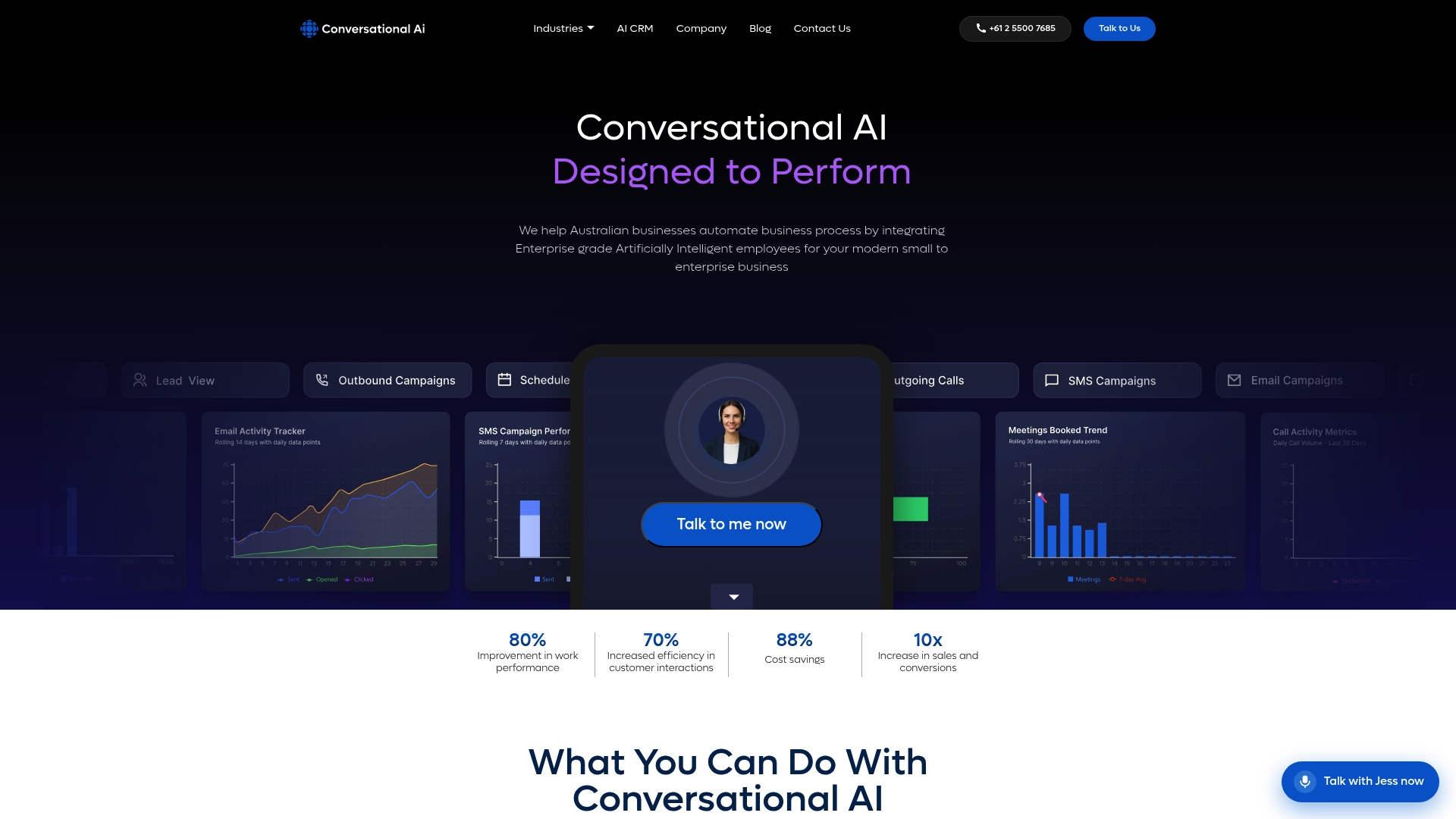
Conversational AI is built for the Australian context. Your call recordings, transcripts, and CRM data stay on Australian infrastructure. The platform includes HITL monitoring dashboards, native DNC scrubbing support, and multi-channel campaign management across voice, SMS, and email from a single interface. You can run a controlled pilot on a defined use case, review the results with your compliance team, and scale only when the numbers justify it. No long-term commitment required to start.
To see how the platform handles your specific use case, book a demo with the Conversational AI team.
Further reading and useful sources
These resources are selected for Australian implementers who need authoritative guidance on regulation, architecture, and telephony practice.
| Resource | What it covers | Why it is useful |
|---|---|---|
| ACMA Do Not Call Register | DNC scrubbing requirements and retry/scheduling best practice | Operational necessity for every Australian outbound campaign |
| OpenAI Voice Agents developer guide | Speech-to-speech vs chained pipeline architecture trade-offs | Helps architects choose the right design for latency and compliance needs |
| Microsoft Azure Voice Live SDK | Low-latency speech-to-speech SDK with ASR, generative AI, and TTS in one interface | Useful for teams building custom voice agents on Azure infrastructure |
| AGIX outbound AI calling guide | Agentic outbound system architecture, latency targets, and policy logic | Comprehensive technical reference for platform evaluation |
| Vobiz AMD documentation | Answering machine detection configuration and voicemail-drop flows | Cost optimisation for campaigns with high voicemail rates |
| Gartner agentic AI prediction | Analyst forecast on autonomous AI resolution rates by 2029 | Useful for internal business cases and stakeholder briefings |
| Conversational AI: AI communication orchestration | Orchestration patterns for voice, SMS, and email in Australian enterprise | Practical reference for multi-channel campaign design |
| Conversational AI: after-hours voice and AI | 24/7 outreach use cases and always-on agent configuration | Relevant for teams running time-sensitive outbound campaigns |