ISO 27001 for AI systems: what it covers and how to apply it
Learn how ISO 27001 applies to AI systems and discover steps to enhance your information security management for AI assets.

ISO/IEC 27001 already applies to your AI systems. The moment an AI tool processes company information, that tool falls inside your Information Security Management System (ISMS) scope. You do not need a separate programme. What you need is a deliberate extension of your existing ISMS to cover AI-specific assets, risks, and controls.
Here is what to do first, before reading any further:
- Scope your AI assets. Add every AI model, training dataset, inference endpoint, and AI-connected API to your asset inventory. Assign an owner and a sensitivity classification to each.
- Update your risk register. Run a focused risk assessment on AI data flows, covering training data leakage, prompt injection, model inversion, and supply-chain risks from AI vendors.
- Record supplier relationships. Every AI vendor or cloud-hosted model your organisation uses is a supplier under Annex A. Capture them in your supplier register and confirm data processing agreements (DPAs) are in place.
- Enforce point-of-use controls. Detect and redact sensitive data before it reaches any AI model. Do not rely on the model itself to refuse sensitive inputs.
- Document what you cannot cover. ISO/IEC 27001 addresses confidentiality, integrity, and availability. It does not address AI bias, explainability, or human oversight obligations. Note those gaps explicitly and plan for ISO/IEC 42001 or the NIST AI Risk Management Framework (NIST AI RMF) as complements.
Pro Tip: If you already hold ISO/IEC 27001 certification, extending it to AI is an ISMS scope amendment, not a new certification project. Brief your certification body early so your next surveillance audit can cover the AI scope additions.
Key takeaways
ISO/IEC 27001 applies to AI systems the moment they process organisational information, and extending an existing ISMS to cover AI assets and risks is the most efficient path to ISO 27001 certification for AI in Australia.
| Point | Details |
|---|---|
| Scope AI assets immediately | Add every model, dataset, endpoint, and agent account to your asset inventory with an owner and classification before your next audit. |
| Map AI risks to Annex A | Prompt injection, data poisoning, model inversion, and supply-chain risks each map to specific Annex A control families — document these in your risk register. |
| ISO 27001 has governance gaps | It covers confidentiality, integrity, and availability; add ISO/IEC 42001 or NIST AI RMF when bias, explainability, or human oversight obligations apply. |
| Australian law adds specific obligations | Privacy Act 1988, OAIC Notifiable Data Breaches, and ASD ISM requirements shape the controls and evidence Australian auditors expect for AI systems. |
| Conversational AI simplifies evidence collection | Australia-hosted, with built-in logging, redaction, and role separation, Conversational AI reduces audit preparation time for ISO 27001 surveillance visits. |
Table of Contents
- What is ISO/IEC 27001 and how does an ISMS work?
- How does ISO 27001 apply to AI systems?
- How do you incorporate AI into your ISMS step by step?
- Which Annex A controls matter most for AI?
- What testing and monitoring does ISO 27001 require for AI?
- What are the gaps in ISO 27001 for AI, and when do you need ISO/IEC 42001 or NIST AI RMF?
- What Australian laws and guidance affect ISO 27001 for AI?
- How does this apply to enterprise conversational AI platforms?
- What do auditors ask for, and what are the common pitfalls?
- The case for treating security and responsible AI as one programme
- How an Australia-hosted conversational AI platform reduces your audit burden
- Sources
What is ISO/IEC 27001 and how does an ISMS work?
ISO/IEC 27001 is the international standard for an Information Security Management System. It defines a risk-based management framework that organisations implement, certify, and continually improve to protect the confidentiality, integrity, and availability of information. Certification is granted by an accredited third-party certification body following a formal audit, and it operates on a three-year cycle with annual surveillance audits in between.
The ISMS is not a checklist of technical controls. It is a management system built around a repeating cycle: define scope, identify assets, assess risks, select and implement controls, monitor effectiveness, and improve. Annex A of the standard provides a reference set of controls, organised into control families covering areas such as access management, cryptography, supplier relationships, incident management, and physical security. Organisations select controls from Annex A based on the risks they have identified, document their rationale in a Statement of Applicability (SoA), and provide auditors with evidence that selected controls are operating effectively.
The core ISMS elements relevant to AI are:
- Scope definition — what systems, processes, and locations are covered.
- Asset inventory — every information asset, including its owner and classification.
- Risk assessment — threat identification, likelihood and impact scoring, and risk treatment decisions.
- Control selection — choosing Annex A controls (and supplementary controls) proportionate to identified risks.
- Documentation and evidence — policies, procedures, logs, and records that demonstrate controls are operating.
- Monitoring and review — ongoing measurement, internal audits, and management review.
- Continual improvement — corrective actions and updates driven by findings.
How does ISO 27001 apply to AI systems?
The governing principle is straightforward: any processing of organisational information by an AI system brings that system inside your ISMS scope. Treating models, training datasets, and inference endpoints as information assets and mapping AI risks to existing ISMS controls is the practical mechanism for ISO 27001 compliance for AI systems.
AI introduces a specific set of threat types that map cleanly onto existing ISMS clauses and Annex A control families. The table below gives you a working risk register template you can adapt directly.
| AI risk | ISMS clause | Annex A control family | Example mitigation |
|---|---|---|---|
| Training data leakage | Clause 8 (operational planning) | Classification of information; Information deletion | Classify training datasets; enforce data retention and deletion policies; restrict dataset access by role |
| Model inversion / extraction | Risk assessment | Information access restriction; Use of cryptography | Limit query rates on inference APIs; encrypt model weights at rest; log all inference requests |
| Data poisoning | Operational controls | Configuration management; Change management | Validate training data provenance; enforce integrity checks on datasets before retraining |
| Prompt injection | Risk assessment | Secure coding; Protection against malware | Input validation and sanitisation at the API layer; red-team testing of prompt boundaries |
| Inference leakage (output exposure) | Operational controls | Information transfer; Data masking | Output filtering and redaction before delivery to end users; DLP controls on API responses |
| Pipeline supply-chain compromise | Operational controls; Risk assessment | Information security in supplier relationships; Addressing security within supplier agreements | Supplier security assessments; contractual security requirements in AI vendor agreements |
A practical example: a model repository holding fine-tuned weights is an information asset under Clause 5.9 (asset inventory). It receives a classification label (typically confidential or restricted), an assigned owner, and protection under A.8 (technological controls). Access is restricted to authorised roles, changes are logged, and deletion follows a documented retention schedule. That is the same treatment you would give a sensitive database. The difference is that the asset is a model artefact rather than a data file, and the risk profile includes model extraction as well as data exfiltration.
For AI system integration in Australian enterprises, the most commonly overlooked assets are agent service accounts (the identities AI agents use to call internal APIs), inference logs, and the CI/CD pipelines that build and deploy models. All three need to be in scope.
How do you incorporate AI into your ISMS step by step?
A structured implementation roadmap prevents the most common failure mode: treating AI as a special case outside the ISMS rather than extending the ISMS to cover it. Scoping the ISMS correctly for AI development means explicitly including training environments, datasets, CI/CD pipelines, model repositories, and inference endpoints so those assets receive classification, ownership, and Annex A protection.
-
Define AI scope boundaries. Document which AI systems, tools, and environments are in scope. Include: training environments (cloud or on-premises), labelled datasets and data pipelines, model repositories (version control for model weights and configs), CI/CD pipelines that build or deploy models, inference endpoints and APIs, agent service accounts and API keys, and any third-party AI services your organisation calls.
-
Build an AI asset inventory. For each asset, record: asset name and type (model, dataset, endpoint, pipeline), owner (a named individual, not a team), classification (public, internal, confidential, restricted), location (where it is stored and processed), and dependencies (what systems it connects to). Australian enterprises should flag assets where training data or inference logs contain personal information under the Privacy Act 1988.
-
Run a focused AI risk assessment. Use your existing risk methodology. For each AI asset, identify threat sources (external attackers, insiders, supply-chain, accidental misuse), assess likelihood and impact on confidentiality, integrity, and availability, and record risk treatment decisions. AI-specific likelihood drivers include: public-facing inference APIs, use of third-party foundation models, and employee use of consumer AI tools with company data.
-
Select and document controls. Map each accepted risk to one or more Annex A controls. Update your Statement of Applicability to include AI-specific control applications. Document the rationale for any controls you exclude.
-
Implement supplier management for AI vendors. Every AI-as-a-service provider is a supplier. Conduct a security assessment, confirm a DPA is in place, and record the supplier in your supplier register. This applies to foundation model APIs, cloud AI services, and any vendor whose model processes your data.
-
Deploy operational controls. Enforce access control on model repositories and inference endpoints. Implement logging for all AI interactions (who used the model, what data classes were processed, what outputs were returned). Apply data handling rules: classify inputs before they reach a model, redact personal information at the point of use.
-
Establish change control for model lifecycle. Treat model retraining as a change event. Require documented approval, testing evidence, and rollback procedures before a retrained model enters production. This is the same change management process you apply to software releases.
-
Collect and retain audit evidence. Auditors will ask for: asset inventory entries for AI models and datasets, risk register entries with treatment decisions, supplier assessment records and DPAs, access control lists and logs, change records for model deployments, and test results from security assessments.
Suggested timeline for an Australian mid-size enterprise (200–2,000 staff):
- Months 1–2: Scope definition, AI asset discovery, and inventory update. Requires: ISMS manager (0.5 FTE), input from IT and data science leads.
- Months 2–3: AI risk assessment and control gap analysis. Requires: ISMS manager plus one risk analyst.
- Months 3–5: Control implementation (supplier assessments, logging, access controls, change management). Requires: IT security engineer plus ISMS manager.
- Month 6: Internal audit of AI scope additions. Requires: internal auditor (can be external on contract).
- Month 7: Management review and SoA update. Requires: ISMS manager and executive sponsor.
- Month 8 onward: Notify certification body of scope change; schedule surveillance audit to cover AI additions.
Pro Tip: Do not wait for the next scheduled surveillance audit to notify your certification body. Contact them when you complete the scope amendment. Most bodies can incorporate AI scope additions into a planned surveillance visit rather than requiring a separate audit, which saves time and cost.
Which Annex A controls matter most for AI?
The controls below appear most frequently in AI-related audit findings and risk registers. For each, the table shows how it applies to AI artefacts and what good evidence looks like.
| Annex A control | How it applies to AI | Example implementation | Audit evidence |
|---|---|---|---|
| A.5.9 Inventory of information and other associated assets | Models, datasets, endpoints, and agent accounts are information assets | Asset register with owner, classification, location, and review date for each AI asset | Current asset register extract; review log |
| Information security in supplier relationships | AI-as-a-service vendors and foundation model providers are suppliers | Supplier register entry; completed security questionnaire; signed DPA | Supplier register; DPA copies; assessment records |
| Addressing security within supplier agreements | Contractual security requirements for AI vendors | Contract clauses covering data handling, breach notification, audit rights, and deletion | Signed contracts with security schedules |
| Information access restriction | Restrict access to model weights, training data, and inference APIs | Role-based access control (RBAC) on model repositories; API key management policy | Access control lists; provisioning records; key rotation logs |
| Configuration management | Model versions and hyperparameter configs are configurations | Version control (e.g., Git-based model registry) with change history | Repository commit logs; configuration baseline records |
| Logging | Log all inference requests: user identity, data class, timestamp, output summary | Centralised logging platform capturing AI API calls with structured fields | Log samples; retention policy; SIEM alert rules |
| Use of cryptography | Encrypt model weights and training datasets at rest and in transit | AES-256 encryption at rest; TLS in transit; key management policy | Encryption configuration records; key management procedure |
| Secure coding | Prompt injection and input validation are secure development concerns | Input sanitisation at the API gateway; secure code review checklist covering AI inputs | Code review records; pen test results; remediation log |
| Change management | Model retraining and version promotion are change events | Change request, test evidence, and approval record required before production deployment | Change records; test reports; approval audit trail |
| Response to information security incidents | AI-specific incidents (data poisoning detected, model extraction attempt) need defined response procedures | AI incident classification added to incident response procedure; tabletop exercise covering AI scenarios | Incident procedure document; exercise records; incident log |
A few practical notes on implementation. Agent service accounts, the identities your AI agents use to call internal APIs, are frequently left out of access control reviews. Treat them as privileged accounts: rotate credentials on a defined schedule, restrict permissions to the minimum required, and log every call they make. For CI/CD pipelines that build and deploy models, apply the same change management controls you use for application code. A model deployment without a change record is a nonconformity waiting to happen.
For secure conversational AI deployments specifically, inference logs need to capture enough context for an incident investigation without retaining the full content of sensitive conversations. Structured log fields (session ID, user role, data classification of input, output category) give auditors what they need without creating a secondary data exposure risk.

What testing and monitoring does ISO 27001 require for AI?
ISO/IEC 27001 does not prescribe specific testing methods, but it does require organisations to verify that controls are operating effectively. For AI systems, that verification needs to go beyond standard vulnerability scanning. Practical implementation guidance covers supplier security, data validation, anomaly detection in training pipelines, and monitoring model behaviour as part of continuous improvement.
-
Model validation testing. Before any model enters production, test its outputs against known-good baselines. Validate that the model behaves as expected on out-of-distribution inputs and that its outputs do not expose training data. Document the test plan, results, and sign-off.
-
Adversarial testing (AI penetration testing). Conduct structured adversarial testing to probe for prompt injection vulnerabilities, model inversion, and output manipulation. This is the AI equivalent of application penetration testing. For production conversational AI systems, red-team exercises should include attempts to extract system prompts, bypass content filters, and elicit sensitive data through indirect prompting.
-
Data integrity checks. Verify training data provenance and integrity before each retraining cycle. Hash-check datasets against their registered baseline. Flag and investigate any unexpected changes to training data before they reach the model.
-
Drift detection and performance monitoring. Monitor production models for statistical drift in input distributions and output quality. Significant drift can indicate data poisoning, changed user behaviour, or model degradation. Set alert thresholds and define a response procedure for drift events.
-
Inference logging review. Periodically review inference logs for anomalies: unusual query volumes, queries from unexpected user accounts, or outputs that suggest the model is returning sensitive information. This review feeds directly into your management review inputs under Clause 9.3.
-
Supplier assurance reviews. For AI vendors, annual security reviews are the minimum. For critical AI services (those processing personal information or supporting regulated decisions), consider requiring SOC 2 Type II reports or equivalent assurance from vendors, and review those reports as part of your supplier management process.
Frequency guidance by AI system class:
- Critical production models (processing personal information, supporting regulated decisions, customer-facing): adversarial testing at least annually; drift monitoring continuously; log review monthly; supplier review annually.
- Internal productivity AI tools (staff-facing, low data sensitivity): adversarial testing at initial deployment and after major updates; log review quarterly; supplier review annually.
- Research and development prototypes (not in production, limited data access): security review before any promotion to production; no continuous monitoring required until production entry.
What are the gaps in ISO 27001 for AI, and when do you need ISO/IEC 42001 or NIST AI RMF?
ISO/IEC 27001 is a security standard. It addresses confidentiality, integrity, and availability of information. It does not address whether an AI system is fair, whether its decisions are explainable, whether humans can meaningfully override it, or whether its outputs are transparent. Those are governance obligations, and they sit outside the ISMS scope.
ISO/IEC 42001, published in December 2023, is the first international AI management system standard. It covers AI-specific governance topics: bias and fairness, explainability, accountability, lifecycle governance, human oversight, and transparency. It is designed to complement ISO/IEC 27001, not replace it. An organisation can hold both certifications, and the two standards share enough structural DNA (both are ISO management system standards following the Annex SL structure) that evidence collected for one often satisfies requirements of the other.
The NIST AI RMF, published by the US National Institute of Standards and Technology, provides a detailed technical risk taxonomy and test methodology for AI systems. It is not a certification standard, but its GOVERN, MAP, MEASURE, and MANAGE functions supply practical guidance that fills gaps in both ISO standards, particularly around model evaluation methods, bias metrics, and red-teaming approaches.
Where ISO/IEC 27001 alone is sufficient:
- Your AI use is limited to internal productivity tools (summarisation, drafting, search) with no automated decision-making.
- No personal information is processed by AI systems.
- AI outputs are always reviewed by a human before any consequential action is taken.
- Your customers and procurement partners require only security assurance, not AI governance assurance.
When to add ISO/IEC 42001:
- Your AI systems make or influence consequential decisions (credit, hiring, clinical triage, fraud detection).
- You supply AI products or services to EU customers or regulated industries where AI governance requirements are explicit.
- Your organisation’s AI Ethics policy creates obligations around fairness, explainability, or human oversight that need a management system to evidence.
- Enterprise buyers are asking for AI governance assurance beyond ISO 27001 in procurement questionnaires.
Where NIST AI RMF adds practical value:
- You need a structured method for categorising AI risks by impact and likelihood that goes beyond the ISMS risk register.
- Your security team needs test methods and metrics for evaluating model robustness, bias, and reliability.
- You are building an AI red-teaming capability and need a reference framework for scope and methodology.
Practical integration approach: Start with your ISMS. Extend it to cover AI assets and risks as described in this guide. Run your first surveillance audit with AI in scope. Then assess whether your AI use cases create governance obligations that ISO/IEC 42001 needs to address. A phased approach is more manageable than attempting joint certification from the outset, and the ISMS work you do first directly reduces the effort required for ISO/IEC 42001 implementation.
Pro Tip: When planning a joint ISO 27001 and ISO 42001 implementation, map your evidence once and reference it in both management systems. Risk assessment records, supplier assessments, and incident logs can satisfy requirements in both standards without duplication.
What Australian laws and guidance affect ISO 27001 for AI?
Australian organisations implementing ISO 27001 for AI operate within a specific legal and regulatory context that shapes both the controls you need and the evidence auditors will expect.
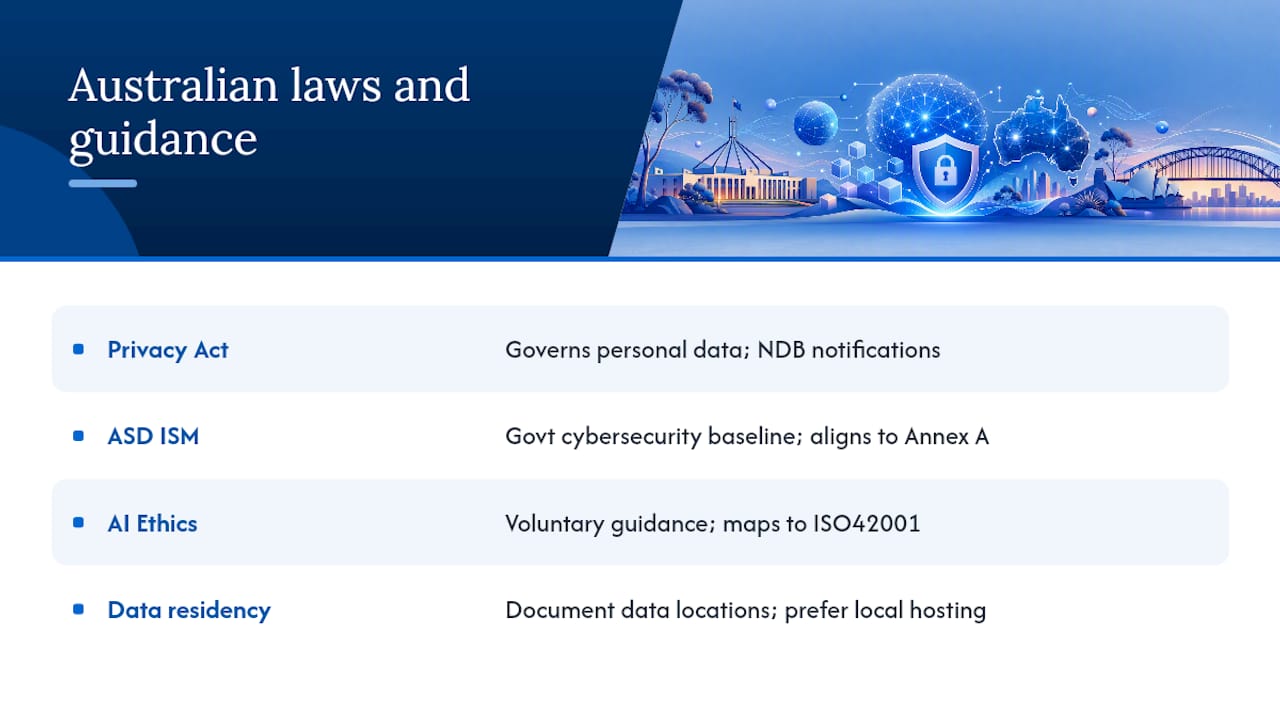
Privacy Act 1988 and the Notifiable Data Breaches scheme. The Privacy Act 1988 governs how Australian organisations collect, use, and disclose personal information. The Notifiable Data Breaches (NDB) scheme, administered by the Office of the Australian Information Commissioner (OAIC), requires eligible organisations to notify the OAIC and affected individuals when a data breach is likely to result in serious harm. AI systems that process personal information, including training on customer data or generating outputs containing personal details, are subject to these obligations. Your ISMS incident response procedure must include a pathway for assessing whether an AI-related incident triggers NDB notification obligations.
ASD Information Security Manual (ISM). The Australian Signals Directorate’s Information Security Manual is the primary cybersecurity framework for Australian government agencies and is increasingly referenced by enterprise procurement teams as a baseline. The ISM’s controls for system monitoring, access management, and software security align closely with ISO 27001 Annex A. For organisations supplying AI services to government, demonstrating ISM alignment alongside ISO 27001 certification strengthens your security posture in procurement evaluations.
Australian AI Ethics principles. The Australian Government’s AI Ethics Framework, developed through the Department of Industry, Science and Resources, sets out eight principles covering fairness, accountability, transparency, and human-centred values. These principles are voluntary guidance, not law, but they are referenced in government procurement and increasingly in enterprise supplier questionnaires. They map to the governance obligations that ISO/IEC 42001 addresses, reinforcing the case for treating ISO 42001 as a near-term complement to your ISMS.
Data residency and sovereign hosting. Australian privacy law does not prohibit cross-border data transfers, but Australian Privacy Principle 8 (APP 8) requires organisations to take reasonable steps to ensure overseas recipients handle personal information in accordance with the APPs. For AI systems, this means: documenting where training data is stored and processed, assessing the privacy protections in place in any overseas jurisdiction, and recording that assessment in your risk register. Organisations in regulated sectors (health, finance, government) face additional constraints. The practical response is to prefer Australia-hosted infrastructure for AI systems that process personal information, and to document the data residency position for every AI vendor in your supplier register.
What local auditors probe. Australian ISO 27001 auditors conducting surveillance visits on organisations with AI in scope typically focus on: whether AI tools used by staff are in the asset inventory (shadow AI is a common finding), whether supplier assessments cover AI vendors, whether logging captures AI interactions with personal information, and whether the incident response procedure addresses AI-specific scenarios. Procurement teams in Australian enterprises, particularly in financial services and healthcare, treat ISO 27001 certification as the minimum security floor for AI vendors, with ISO 42001 readiness becoming a differentiator in competitive tenders.
How does this apply to enterprise conversational AI platforms?
Deploying a conversational AI platform, whether for customer service, collections, appointment booking, or lead qualification, creates a specific set of ISMS obligations that go beyond generic AI risk management. Private AI deployment and data residency considerations are central to how Australian enterprises structure their ISO 27001 controls for conversational AI.
The controls that matter most for conversational AI deployments:
- Data zoning and input vaulting. Conversational AI systems receive user inputs that frequently contain personal information: names, account numbers, health details, financial data. Controls must classify and vault those inputs before they are processed or stored. Redaction at the point of ingestion, before the input reaches the model, is the most defensible approach under both ISO 27001 and the Privacy Act.
- Local hosting and data sovereignty. Hosting the platform within Australia means training data, conversation logs, and model artefacts remain subject to Australian law. This simplifies APP 8 compliance and removes the need to assess overseas privacy protections for the core platform. It also gives auditors a clean answer to the data residency question.
- Encryption in transit and at rest. Conversation transcripts and call recordings are typically classified as confidential or restricted. AES-256 encryption at rest and TLS 1.3 in transit are the expected baseline. Key management procedures need to be documented and key rotation scheduled.
- API key rotation and agent identity management. Conversational AI agents use service accounts and API keys to integrate with CRM systems, telephony platforms, and back-end databases. These credentials are privileged. Rotate them on a defined schedule (quarterly at minimum for production systems), restrict permissions to the minimum required, and log every API call made by agent identities.
- Role separation. Separate the roles of platform administrator, model trainer, conversation reviewer, and data analyst. No single individual should have unrestricted access to both conversation logs and model training pipelines.
- Multi-channel storage and retention. Voice, SMS, email, and live chat channels each generate different artefact types (call recordings, message threads, email bodies, chat transcripts). Your data classification and retention policy needs to cover each channel explicitly, with defined retention periods and deletion procedures.
Shared responsibility with vendors. When a conversational AI platform is vendor-hosted, the vendor controls the underlying infrastructure and the platform software. You control the data you send to it, the integrations you configure, and the policies you enforce. Your ISMS needs to document this shared responsibility clearly: what the vendor is responsible for (infrastructure security, platform patching, availability), what you are responsible for (data classification, access management, acceptable use policy), and how you verify the vendor’s controls (through their ISO 27001 certificate, SOC 2 report, or security questionnaire responses).
Pro Tip: Request your conversational AI vendor’s ISO 27001 certificate and scope statement before your next surveillance audit. Auditors will ask for evidence of supplier security assessment, and a current certificate from an accredited body is the most efficient form of assurance you can provide.
What do auditors ask for, and what are the common pitfalls?
The most common ISO 27001 nonconformities for AI systems are predictable and preventable. Knowing them in advance lets you close gaps before a surveillance visit rather than during one.
Top pitfalls:
- Unscoped AI usage. Staff are using AI tools (consumer chatbots, AI writing assistants, AI-powered search) that are not in the asset inventory and have not been risk-assessed. This is the single most common finding. Shadow AI and lack of logging are the most frequent audit failures for organisations that have not explicitly extended their ISMS to cover AI.
- Missing supplier assessments for AI vendors. An AI-as-a-service provider is a supplier. If it is not in your supplier register with a completed security assessment and a signed DPA, that is a nonconformity under A.5.19 and A.5.20.
- No logging of AI interactions. If you cannot show who used an AI system, when, and what data was processed, you cannot demonstrate that access controls are operating or that an incident would be detectable. Logging is non-negotiable for audit readiness.
- Acceptable use policy does not cover AI. Many organisations have an acceptable use policy for IT systems that predates AI adoption. If it does not explicitly address what staff may and may not do with AI tools (including which tools are approved, what data may be input, and what outputs may be shared), it is a gap.
- No change control for model updates. Retraining a model and deploying the new version without a change record is a change management nonconformity. Auditors treat model deployments the same as software releases.
Audit preparation checklist:
- Pull your asset inventory and confirm every AI model, dataset, endpoint, and agent account is listed with an owner and classification.
- Review your supplier register and confirm every AI vendor has a completed security assessment, a current DPA, and a contract with security requirements.
- Pull a sample of inference logs and confirm they capture user identity, data class, timestamp, and output category.
- Review your acceptable use policy and confirm it explicitly covers AI tools.
- Pull change records for the last three model deployments and confirm each has a test record and approval sign-off.
- Review your incident response procedure and confirm it includes AI-specific scenarios and an NDB assessment pathway.
- Confirm your risk register has entries for AI-specific threats (prompt injection, data poisoning, model inversion, supply-chain compromise) with documented treatment decisions.
Suggested owners for rapid remediation:
- Asset inventory gaps: ISMS Manager
- Supplier assessment gaps: Procurement / ISMS Manager
- Logging gaps: IT Security Engineer
- Policy gaps: ISMS Manager / Legal
- Change control gaps: IT Operations / DevOps Lead
- Incident procedure gaps: ISMS Manager / Legal
The case for treating security and responsible AI as one programme
There is a tendency in Australian enterprises to treat ISO 27001 as the IT security team’s problem and AI governance as something the data science or ethics team handles separately. That split creates real risk. A model that leaks training data is a security incident and a governance failure simultaneously. An AI vendor that processes personal information without adequate controls is a supplier management gap and a privacy breach waiting to happen.
The more useful framing is this: ISO/IEC 27001 gives you the security foundation and the audit discipline. It forces you to identify assets, assess risks, implement controls, and produce evidence. That discipline is exactly what responsible AI governance needs, and it is what most AI ethics frameworks lack. ISO/IEC 42001 and the NIST AI RMF add the governance layer on top: the bias assessments, the explainability requirements, the human oversight procedures. But without the ISMS foundation, those governance frameworks have no operational home. They become policy documents without controls.
Australian organisations that are serious about AI procurement, particularly those supplying to government or regulated industries, will increasingly need to demonstrate both. ISO 27001 certification is the floor. ISO 42001 readiness is becoming the differentiator. The organisations that get ahead of this are the ones that treat the two as a single integrated programme rather than two separate projects competing for the same limited security team bandwidth.
The practical encouragement here is to start where you are. If you have an ISMS, extend it to cover AI now. Do not wait for ISO 42001 to be on the roadmap before you address AI security. The ISMS extension is achievable in six to eight months for a mid-size enterprise. The governance layer can follow once the security foundation is solid.
How an Australia-hosted conversational AI platform reduces your audit burden
Achieving ISO 27001 compliance for AI systems is significantly more manageable when your platform is built with audit evidence in mind from the outset. For Australian enterprises in healthcare, finance, and professional services, the difference between a platform that generates evidence automatically and one that requires manual evidence collection is measured in weeks of preparation time before each surveillance audit.
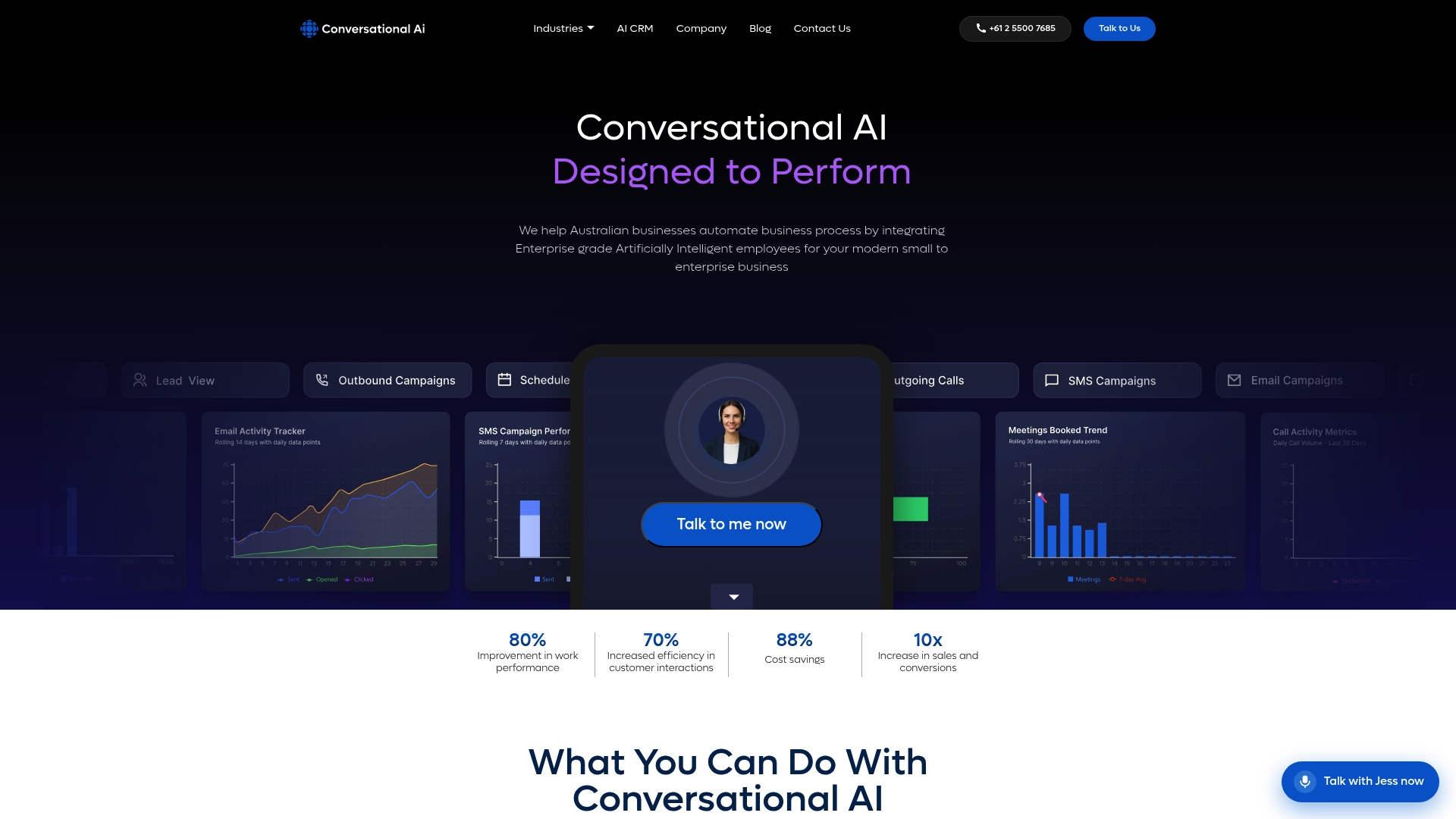
Conversational AI is an Australia-hosted, private cloud conversational AI platform designed specifically for enterprises that need data sovereignty, built-in compliance controls, and the kind of audit trail that satisfies both ISO 27001 auditors and Australian privacy regulators. Every conversation, every API call, and every agent action is logged within Australian borders. Role separation, input redaction, and encryption are platform defaults, not add-ons. When your auditor asks for inference logs, access control records, or supplier security documentation, the evidence is already there.
For enterprises preparing for a surveillance audit or responding to a procurement security questionnaire, Conversational AI reduces the time-to-evidence for the controls that matter most: logging, access management, data sovereignty, and supplier assurance. The platform’s enterprise AI capabilities are built to meet the expectations of Australian enterprise IT and compliance teams, not retrofitted for them.
To discuss your ISO 27001 compliance requirements or arrange a platform demonstration, contact the Conversational AI team directly.
Sources
The following authoritative sources are referenced throughout this guide. Each is worth bookmarking for ongoing ISMS and AI governance work.
- ISO/IEC 27001
- ISO 27001 and AI Security: The Complete Guide - Mimecast
- ISO 27001 AI Compliance: Securing AI Under Your ISMS (2026)