Top NLP platforms for enterprise IT teams in 2026
Discover the top NLP platforms for enterprise IT teams in 2026. Learn how Conversational AI ensures compliance, data sovereignty, and seamless automation.

For Australian enterprise IT teams in regulated industries, Conversational AI is the recommended compliance-first platform. It is the only option in this market that combines Australia-hosted private-cloud deployment, explainable AI with full audit trails, and native multichannel automation across voice, SMS, email, and live chat in a single enterprise contract.
Three reasons it stands out for regulated sectors:
- Australia-hosted private cloud: Your data never leaves Australian soil, satisfying data sovereignty requirements for healthcare, finance, and professional services.
- Explainable AI and audit trails: Every automated decision carries a traceable, exportable record auditors can inspect.
- Native multichannel automation: Voice, SMS, email, and chat operate under a single orchestration layer with persistent conversation state.
TL;DR: For data sovereignty and operational readiness, Conversational AI is the recommended enterprise NLP platform for Australian regulated industries.
Table of Contents
- What must enterprise IT teams prioritise when evaluating an NLP platform?
- How does Conversational AI map to the enterprise selection checklist?
- What deployment and compliance controls should you require in Australia?
- How do you integrate NLP into CRM and business workflows for real ROI?
- What does implementation cost and how long does it take?
- How do you keep production NLP accurate, auditable, and compliant?
- What questions should you ask vendors during RFP and demos?
- Key takeaways
- Why Australia-hosted explainable AI wins in regulated sectors
- Conversational AI: built for Australian regulated enterprises
- Useful sources and further reading
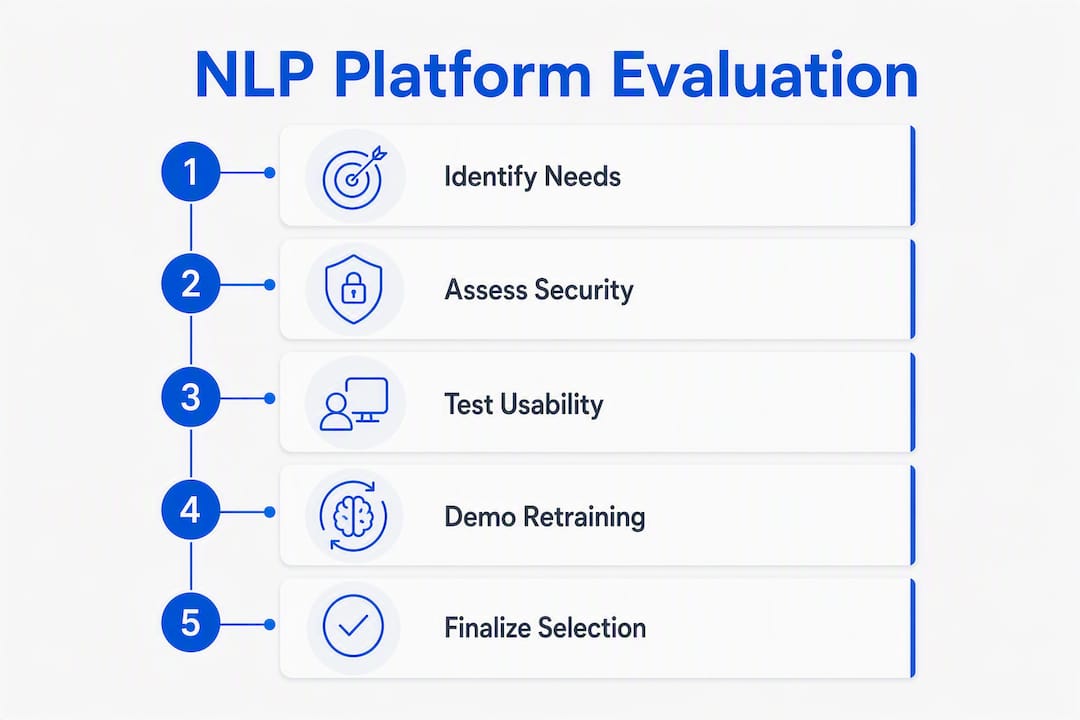
What must enterprise IT teams prioritise when evaluating an NLP platform?
Selecting the right enterprise NLP tools for a regulated Australian environment is not a feature-matching exercise. It is a risk-management decision. The checklist below is ordered by consequence: getting the top items wrong can trigger a compliance breach; getting the bottom items wrong costs time and money.
- Data residency and hosting location. Confirm that data is processed and stored within Australia. Offshore processing, even temporarily, can breach the Privacy Act 1988 and sector-specific obligations under APRA’s CPS 234.
- Deployment model. Require private-cloud or on-premises options. Public multi-tenant SaaS is rarely acceptable for sensitive patient or financial data.
- Explainability and auditability. XAI features are a compliance requirement in regulated sectors, not a nice-to-have. Auditors need clear provenance and reasoning for automated decisions.
- CRM and backend integration depth. End-to-end process automation delivers the real ROI. Standalone chatbots that do not connect to your CRM, billing system, or case management platform rarely justify the investment.
- Multichannel support. Voice, SMS, email, and chat must share a persistent conversation state. Siloed channels create compliance gaps and poor customer experience.
- Model lifecycle and retraining tools. The most common enterprise pitfall is treating NLP as set-and-forget. Require a documented retraining pipeline with drift-mitigation tooling.
- Security certifications. ISO 27001 or SOC 2 (or equivalent) are the baseline. Demand contractual data controls and clear data ownership clauses.
- Enterprise SLAs and support. Uptime commitments, incident response times, and a named technical account manager matter more in production than they do in a demo.
- Extensibility and customisation. Your workflows are not generic. Require API access, white-label options, and domain-specific tuning capabilities.
Pro Tip: When reviewing model lifecycle tooling, ask vendors to walk you through a full retraining cycle live, including rollback. A vendor who cannot demonstrate this in a demo almost certainly cannot deliver it in production.

How does Conversational AI map to the enterprise selection checklist?
| Dimension | Conversational AI capability |
|---|---|
| Data residency / hosting | Australia-hosted private cloud; data never leaves Australian jurisdiction |
| Channels supported | Voice, SMS, email, live chat with unified conversation state |
| CRM / backend integration | Native API connectors, event-driven webhooks, agentic automation for legacy systems |
| Explainability / audit logs | Exportable audit logs, deterministic decision-path records, explainable AI tooling |
| Model lifecycle and retraining | Dynamic agent training, labelled-data ingestion, staged deployment, rollback support |
| Deployment and scalability | Private cloud, on-premises, and hybrid options; modular and horizontally scalable |
| Security certifications | Enterprise-grade security controls; contractual data processing agreements |
| Pricing / licensing | Subscription SaaS with enterprise contracts; optional white-label and implementation fees |
| Enterprise SLAs / support | Defined uptime commitments, implementation methodology, and ongoing support tiers |
Beyond the table, a few capabilities set Conversational AI apart for regulated sectors:
-
On-premises deployment is available for organisations where even a managed private cloud is insufficient for their risk profile.
-
Dynamic agent training means the platform learns from production interactions in a controlled, auditable way, not through opaque background updates.
-
Agentic automation handles outbound campaigns, follow-ups, and scheduling across all channels from a single orchestration layer.
-
White-label capability lets professional services firms and health networks deploy branded AI agents without exposing vendor relationships.
What deployment and compliance controls should you require in Australia?
Choosing the right deployment model
Three models are in play for Australian enterprises:
- Pure on-premises: Maximum control, highest infrastructure cost. Appropriate for defence, intelligence-adjacent, or highly sensitive financial environments.
- Australia-hosted private cloud: The most practical choice for most regulated enterprises. You get dedicated infrastructure within Australian borders with managed operations.
- Hybrid: On-premises for the most sensitive data processing, private cloud for scalable customer-facing channels.
Contractual and technical controls to demand
Data sovereignty expectations for Australian healthcare and finance go beyond a hosting address. Require all of the following in writing:
- Explicit data residency clauses naming Australian jurisdiction
- Contractual data processing controls specifying permitted uses
- Encryption at rest and in transit with customer-managed key options
- Segregation of duties and access controls with audit evidence
- Exportable audit logs covering all data access and model decisions
- Clear data ownership clauses confirming you retain ownership of all processed data
ISO 27001 or SOC 2 certification (or equivalent) is the minimum security baseline. Ask for the most recent certification report, not just a badge on a website.
How do you integrate NLP into CRM and business workflows for real ROI?
Deploying a chatbot on your website is not enterprise NLP. The measurable ROI comes from connecting AI system integration to your core business processes.
Three integration patterns matter most:
- API-first connectors for CRM platforms, case management, and billing systems. Every conversation should write back to the system of record in real time.
- Event-driven webhooks for triggering downstream workflows: a completed triage call that auto-creates a case, or an SMS confirmation that updates an appointment calendar.
- Agentic automation for legacy portals and Citrix-style interfaces where no API exists. The agent navigates the UI on behalf of the user, with full logging.
For multichannel orchestration, durable conversation context is non-negotiable. A patient who starts on SMS and escalates to voice should not repeat themselves. Unified conversation state across all channels is what separates genuine omnichannel platforms from bolted-together point solutions.
During demos, validate these specifically:
- Live demonstration of context handoff between two channels
- Outbound campaign execution with real-time status reporting
- CRM write-back confirmation with a test record
Pro Tip: If a vendor claims agentic automation for legacy systems, ask them to demonstrate self-healing behaviour when the UI changes. A brittle automation that breaks on a screen update is a support liability, not a capability.
What does implementation cost and how long does it take?
Phased timeline
| Phase | Typical duration | Key milestone |
|---|---|---|
| Pilot / proof of concept | Weeks 1–6 | Defined use case live, acceptance criteria met |
| Production pilot | Weeks 7–14 | Integration to CRM confirmed, SLAs active |
| Scale roll-out | Months 4–6 | Full channel coverage, monitoring in place |
| Continuous operations | Ongoing | Retraining cycles, drift monitoring, quarterly reviews |
Phased implementation with explicit acceptance criteria at each gate protects your budget and gives you a clean exit point if the vendor underdelivers.
Cost components to budget
- Licence / subscription fees
- Implementation and integration services
- Ongoing model retraining and annotation
- Hosting and high-availability infrastructure
- Support and technical account management fees
- White-label or custom engineering (if required)
Enterprise NLP project costs vary considerably: a small proof-of-concept project typically costs US$10,000–40,000, mid-scale solutions often fall between US$30,000–100,000, and enterprise-grade systems usually start at US$100,000 and can exceed US$300,000 depending on scope and compliance requirements. Budget for recurring OPEX beyond licences: retraining, annotation, monitoring, and security operations are ongoing cost drivers that belong in your total cost of ownership model.
How do you keep production NLP accurate, auditable, and compliant?
A production NLP system in a regulated sector needs an operating model, not just a deployment plan.
The continuous model lifecycle runs in four steps: monitor production intent accuracy and flag drift; capture and label new training examples from live conversations; retrain on a scheduled cadence with staged deployment to a test cohort; and maintain a rollback plan for every model version. Vendor operational maturity is demonstrated by MLOps tooling, retraining pipelines, and domain-specific tuning workflows, not by accuracy scores on a generic benchmark.
For audits, you need three things from your platform: provenance tracking that records which training data influenced a decision, deterministic decision-path records that a compliance officer can read without a data science degree, and exportable audit logs in a format your existing GRC tooling can ingest.
Pro Tip: In your vendor demo, bring an anonymised scenario from your own domain, such as a de-identified patient triage query or a redacted loan application note, and ask the vendor to show you the XAI output for that specific input. Generic demos hide gaps that domain-specific tests expose.
What questions should you ask vendors during RFP and demos?
Deployment and data residency
- Where exactly is data processed and stored? Can you provide contractual confirmation of Australian jurisdiction?
- Do you offer on-premises deployment? What does the architecture look like?
Security and certifications
- Can you provide your current ISO 27001 or SOC 2 certification report?
- Who owns the data we process through your platform?
Explainability and auditability
- Show me the audit log for a specific automated decision. What format is the export?
- How does your platform support human-in-the-loop review for edge cases?
Integrations and orchestration
- Demonstrate a live CRM write-back from a completed conversation.
- How does context persist when a customer moves from SMS to voice mid-conversation?
Model lifecycle and MLOps
- Walk me through a full retraining cycle, including rollback, using a domain-specific example.
- How do you detect and alert on data drift or concept drift in production?
SLAs and support
- What is your uptime commitment and how is downtime measured and compensated?
- Who is our named technical contact during implementation and in production?
Pricing and TCO
- What recurring costs sit outside the licence fee (retraining, annotation, monitoring)?
- How is pricing structured as we scale from pilot to full enterprise roll-out?
Scoring guide: A confident, specific answer with a live demonstration is a pass. A vague answer with a promise to “follow up” is borderline. An inability to demonstrate a claimed capability live is a fail.
Key takeaways
Australia-hosted, explainable, multichannel NLP platforms give regulated enterprises the only defensible path to production-grade conversational AI without compromising data sovereignty or audit readiness.
| Point | Details |
|---|---|
| Data residency is non-negotiable | Require contractual confirmation of Australian hosting and data ownership before signing. |
| XAI and audit logs protect you | Exportable, deterministic decision records are what auditors need; verify them in the demo. |
| TCO includes ongoing OPEX | Budget for retraining, annotation, monitoring, and support beyond the licence fee. |
| Phased implementation reduces risk | A several-week proof of concept with defined acceptance criteria protects budget and gives a clean exit point. |
| Conversational AI covers the checklist | Australia-hosted private cloud, multichannel agents, CRM integration, XAI, and enterprise SLAs in one platform. |
Why Australia-hosted explainable AI wins in regulated sectors
The conventional wisdom in enterprise AI procurement is to start with accuracy benchmarks. That instinct is understandable, but it is the wrong starting point for regulated sectors. An NLP model that scores well on a public benchmark but cannot explain its decisions to an APRA auditor, or that processes data through an offshore data centre, is not deployable in Australian healthcare or financial services regardless of its accuracy.
The practical lesson is this: prioritise auditability, integration depth, and continuous retraining over initial accuracy scores. A platform that scores 85% on a domain-specific intent set but has a documented retraining pipeline, exportable audit logs, and Australia-hosted infrastructure will outperform a 95%-accurate model that cannot satisfy your compliance team. The gap closes quickly with retraining; the compliance gap does not close at all.
Conversational AI: built for Australian regulated enterprises
If the checklist in this article describes your requirements, Conversational AI was built specifically for this situation. It gives Australian enterprises a private-cloud NLP platform with multichannel AI agents across voice, SMS, email, and live chat, all hosted within Australia and backed by enterprise SLAs, CRM integrations, and exportable audit logs.
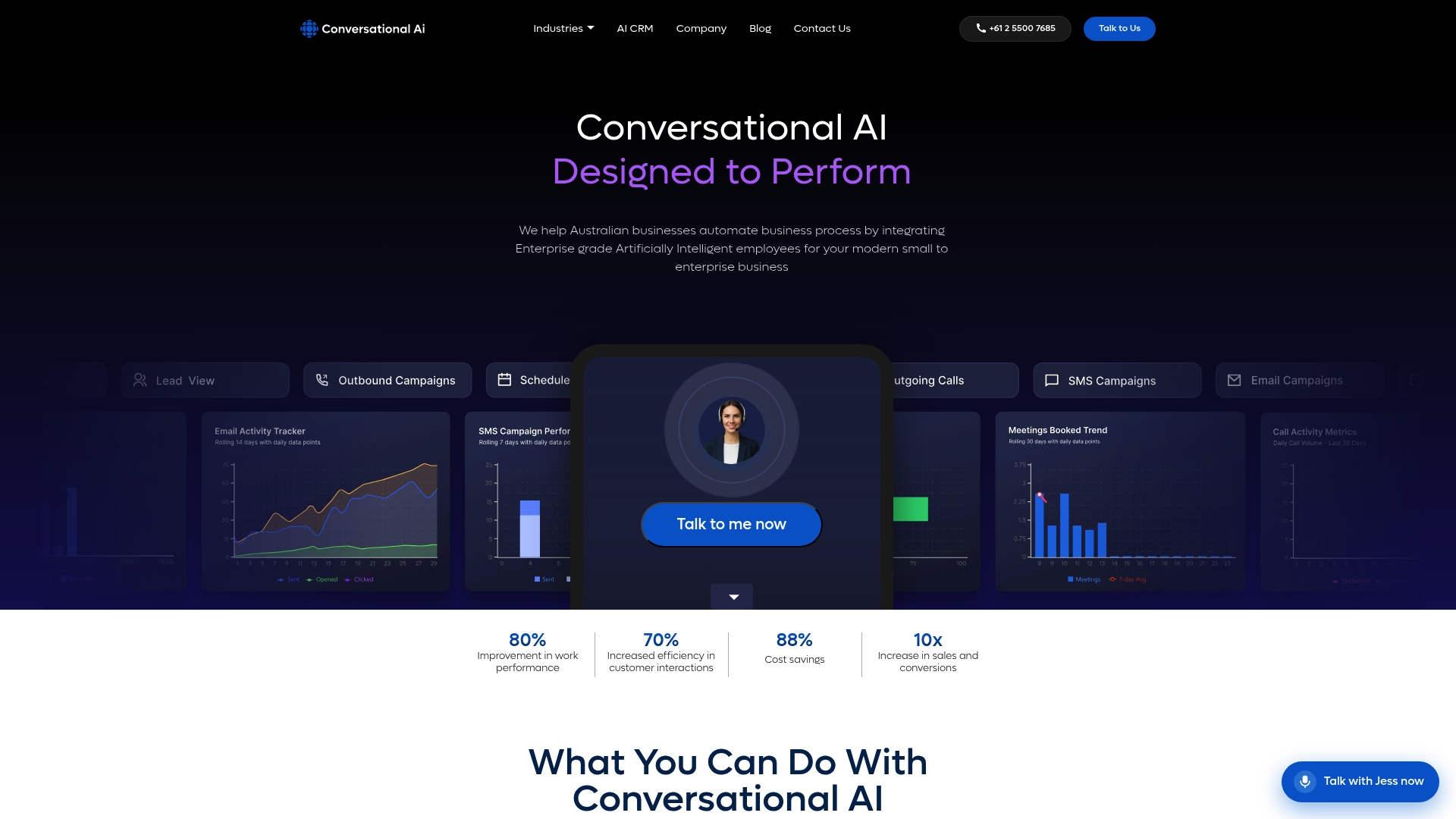
The platform is already deployed in healthcare, finance, and professional services organisations that cannot afford compliance gaps or offshore data exposure. You can request a proof-of-concept scoped to your specific use case, with acceptance criteria agreed upfront and a clear path from pilot to production. To see the platform against your own domain scenario, book a demo and bring your RFP checklist.
Useful sources and further reading
The claims in this article are grounded in the following sources. Use them when building RFP appendices or briefing your compliance team.
“Platforms that provide explainable AI and deterministic root-cause analysis are preferable for regulated industries because auditors require clear provenance and reasoning for automated decisions.” — OvalEdge, Natural Language Processing Software
| Source | What it validates |
|---|---|
| InData Labs: NLP Tools and Services | Enterprise NLP cost ranges (POC to enterprise-grade) and continuous retraining requirements |
| OvalEdge: NLP Software | XAI and auditability as compliance requirements for regulated industries |
| CaliberFocus: Enterprise NLP Companies | Vendor operational maturity criteria and end-to-end automation trends |
| Conversational AI: AI Automation for Australian Businesses | Security certifications, contractual controls, and retraining pipeline requirements |
| Conversational AI: Scale AI Automation Enterprise Wide | Phased implementation timeline and procurement milestone guidance |
For client proof points and regulated-sector case studies, contact Conversational AI directly. When building your RFP appendix, the cost ranges from InData Labs and the XAI criteria from OvalEdge are the most citable independent sources for procurement justification.