Multichannel customer communication examples for Australian businesses
Discover effective multichannel customer communication examples to enhance engagement. Learn how diverse channels can boost your business today!

Businesses that reach customers across email, SMS, voice, and live chat consistently outperform those relying on a single channel. Multichannel customer communication means using several independent platforms, each playing a distinct role, to meet customers wherever they are most likely to engage. The channels operate separately rather than as one unified system, which distinguishes this approach from omnichannel. Done well, it improves convenience, speeds up response times, and builds trust across every touchpoint.
What are the best multichannel customer communication examples?
The most practical examples share one trait: each channel does a specific job rather than repeating the same message everywhere. Multichannel communication engages customers through independent platforms including email, SMS, live chat, voice calls, and social media, with each suited to a different communication need.
Common channels and their core roles:
- Email: Detailed content, newsletters, product launches, and soft-sell campaigns where space and visuals matter.
- SMS: Time-sensitive updates, appointment reminders, order confirmations, and urgent calls to action.
- Voice calls: Complex qualification, objection handling, high-value sales, and recovery from missed appointments.
- WhatsApp: Ongoing two-way conversations, international customers, and post-sale support.
- Live chat: Real-time website support, lead qualification, and quick transactional queries.
- Social media: Brand awareness, community engagement, and inbound customer service requests.
A retail business running a product launch might send a teaser email in week one, follow with an SMS reminder linking to the product page, then close with a review-focused email and an exclusive SMS discount for undecided customers. Each channel adds something the other did not.
How multichannel communication works in real business scenarios

The operational logic behind effective multichannel communication is routing: each message type gets assigned to the channel where it performs best, then fired on a deliberate schedule.
A practical product launch sequence looks like this:
- Week 1, email: A teaser with key details and the launch date, giving customers time to anticipate.
- Week 1, SMS: A short reminder with a link to learn more, reaching customers who missed the email.
- Week 2, email: The full launch announcement with pricing, features, and a clear call to action.
- Week 2, SMS: A direct purchase link sent to engaged contacts, capitalising on peak interest.
- Week 3, email: A follow-up highlighting customer reviews and building social proof.
- Week 3, SMS: An exclusive discount for contacts who opened but did not convert.
The same logic applies to a Black Friday campaign: pre-event emails build anticipation while SMS handles flash sale alerts during the event itself, and a post-event email closes the loop with a thank-you and last-chance offer.
The challenge in multichannel setups is that channels often operate in silos. A customer who replies to an SMS may not have their response visible to the team managing email follow-ups. A central dashboard that aggregates activity across channels addresses this directly, giving your team visibility without requiring them to toggle between separate tools. For enterprise teams, contact centre AI integration can unify these views at scale.

Pro Tip: Map each message type to a single primary channel before you build any campaign. If you cannot explain why a message belongs on a specific channel, it probably belongs somewhere else.
How do you build an effective multichannel communication strategy?
Strategy comes before channels. The businesses that get the most from multichannel communication strategies are not the ones with the most platforms turned on. They are the ones with clear rules governing which channel fires for which message.
- Build unified customer records. One contact, one record, with email, phone, and messaging preferences attached. Fragmented records across three tools produce fragmented experiences.
- Capture channel preference data. Know which customers opted into SMS, which prefer email, and which have explicitly opted out of a channel. Sending an SMS to someone who opted out damages trust faster than any single message can rebuild it.
- Define message-channel routing rules. Welcome series go to email. Appointment confirmations go to SMS and email. Shipping updates go to SMS. Cart abandonment goes to email first, then SMS. Support queries go to WhatsApp or live chat. Renewals go to email and voice.
- Focus on 3–4 core channels. High-performing operators orchestrate email, SMS, voice, and WhatsApp rather than spreading resources across every available platform. Governance beats volume.
- Use deliberate channel sequencing. Sending email at the 24-hour mark and SMS at the one-hour mark, where each channel adds distinct value, prevents message overlap and protects conversion rates.
- Set up cross-channel attribution. A customer who opens three emails, receives one SMS, and books from the SMS link still needed the email work. Measuring at the customer level rather than the message level gives you an accurate picture of what is actually driving results. Designing scalable SaaS workflows can help automate this attribution logic across your stack.
- Audit your current communications first. Rate yourself on channel-to-message matching, preference respect, cannibalism avoidance, and attribution. The lowest score is your first priority.
Pro Tip: If you do not yet have SMS in your mix, add it before anything else. For service businesses, appointment reminder lift alone typically covers the cost of the tool within weeks.
Which channels work best for customer engagement?
Choosing the right channel for the right message is where most businesses either win or waste budget. Each channel has a distinct strength, and deploying them according to those strengths is what separates a coordinated strategy from a noisy one.
- Email suits long-form content: newsletters, deep-dive education, case studies, and multi-day promotional campaigns. It scales cheaply to large lists and gives customers space to absorb detail before acting.
- SMS delivers the highest open rates for time-sensitive messages. Appointment reminders, order confirmations, and urgent updates belong here. The channel is frictionless for two-way replies, making it ideal for booking changes and quick confirmations.
- Voice calls resolve complex situations faster than any text-based channel. High-value sales, nuanced qualification, and recovery from no-shows all benefit from a real conversation. A call within a few hours of a missed appointment consistently outperforms an SMS follow-up for rebooking.
- WhatsApp is the default messaging channel for international customers across Southeast Asia, the Middle East, and Europe. Post-purchase support and B2B account management on WhatsApp tend to generate far stronger engagement than email for those segments.
- Live chat handles real-time website queries and captures leads at the moment of peak intent. It works best when backed by a human agent or an AI agent that can escalate appropriately.
- Social media drives inbound service requests and brand visibility. Response speed matters here: customers who message a brand on social media expect a reply within hours, not days.
In the Australian context, SMS remains the dominant channel for appointment-based businesses in healthcare, allied health, and professional services. WhatsApp is growing for businesses with international client bases, particularly in financial services and consulting.
Multichannel vs omnichannel: what is the actual difference?
The distinction matters because it shapes how you invest in technology and how your customers experience your brand.
Multichannel communication uses separate channels that operate independently, while omnichannel integrates those channels so that context and history travel with the customer across every interaction.
| Dimension | Multichannel | Omnichannel |
|---|---|---|
| Channel integration | Independent, siloed | Unified, shared data |
| Customer experience | Consistent messaging, separate journeys | Continuous, contextual journey |
| Data sharing | Limited between channels | Full context across all channels |
| Complexity | Lower to implement | Higher, requires integration |
| Best suited for | Businesses starting out or with distinct audiences per channel | Businesses with complex, multi-touchpoint customer journeys |
The practical implication: a customer who contacts you by email and then calls your support line will need to repeat their issue in a multichannel setup, because the two channels do not share state. In an omnichannel setup, the agent already sees the email thread. Multichannel is a solid foundation for most Australian businesses. Omnichannel is the goal for organisations where customer journey continuity directly affects retention, such as banking, insurance, and healthcare.
How AI is changing multichannel communication for Australian businesses
AI agents are doing something that manual multichannel management cannot: they maintain consistency across every channel simultaneously, at scale, without fatigue. For Australian businesses, this matters beyond efficiency. Data sovereignty requirements mean that AI-powered communication tools must host and process data within Australia, and Conversational AI’s platform is built specifically for that compliance requirement.
The practical benefits of AI in a multichannel setup include:
- Automated follow-ups triggered by customer behaviour across channels, so no lead or appointment falls through the gaps.
- Contextual memory that carries conversation history across SMS, voice, and chat, reducing the repetition customers find frustrating.
- Real-time analytics that surface which channel is driving conversions at the customer level, not just the message level.
- Natural language understanding that handles inbound queries on voice and chat without requiring a human agent for every interaction.
- Consistent brand voice across every channel, regardless of volume or time of day.
Industry-specific applications are where the gains become concrete. Healthcare providers use AI-powered SMS and voice agents to handle appointment booking, reminders, and follow-up calls, reducing no-show rates without adding reception staff. Financial services firms automate customer service operations including loan enquiry handling and payment reminders across voice and SMS. Professional services firms use AI agents for lead qualification via voice, with handoff to a human consultant only when the situation warrants it.
Pro Tip: For healthcare and finance businesses in Australia, verify that any AI communication platform hosts data within Australian borders. Offshore hosting creates compliance exposure under the Privacy Act 1988 that no efficiency gain justifies.
Advantages and challenges of multichannel communication
The core advantage is reach. Customers have different preferences, and a business that communicates only by email will miss the segment that responds to SMS, and vice versa. Meeting customers on their preferred channel reduces friction and improves satisfaction without requiring them to adapt to your processes.
Consistency is a second advantage. When each channel carries the same brand voice and accurate information, customers build confidence in the business regardless of how they make contact. Templates and communication guidelines enforced at the platform level make this achievable even across large teams.
The challenges are real, though. Siloed data is the most common problem: when channels do not share context, customers repeat themselves and teams duplicate effort. Channel cannibalism is another risk, where redundant messages across platforms compete rather than complement each other, eroding trust and increasing unsubscribe rates. Managing multiple tools also adds operational complexity, particularly for smaller teams without dedicated communications staff.
What KPIs should you track for multichannel communication?
Measuring effectiveness at the message level misses the point. The metrics that matter track customer-level outcomes across the full channel mix.
Key performance indicators worth tracking:
- Cross-channel conversion rate: Which combination of channel touchpoints precedes a booking, purchase, or enquiry? This tells you where to invest.
- Channel engagement rate: Open rates for email, click-through rates for SMS, answer rates for voice. Each channel has its own benchmark, and tracking trends over time reveals whether a channel is losing relevance for your audience.
- Response time per channel: Customers on live chat expect a reply in under a minute. Email allows more time. Tracking response time by channel identifies where your team is falling short of customer expectations.
- Opt-out and unsubscribe rates: A rising opt-out rate on SMS usually signals over-messaging or poor message relevance, not a problem with the channel itself.
- Customer satisfaction score (CSAT) by channel: Satisfaction often varies significantly between channels. Knowing which channel produces the lowest CSAT score tells you where to focus improvement effort.
A single analytics dashboard that aggregates these metrics across channels is the practical requirement. Without it, you are optimising each channel in isolation and missing the cross-channel patterns that drive real results.
Best practices for keeping the customer experience consistent across channels
Consistency does not happen by accident. It requires deliberate governance at the template, tone, and routing level.
Start with a single source of truth for customer data. Every channel should read from and write to the same contact record, so that a preference update in one channel is immediately respected everywhere else. This is the technical foundation that makes everything else possible.
Maintain a defined brand voice guide that covers tone, vocabulary, and escalation language for each channel. Email can afford a more explanatory tone. SMS must be brief and direct. Voice requires warmth and clarity. The underlying message should be consistent even when the format differs.
Assign clear ownership for each channel. When no one owns a channel, response times slip and quality degrades. Even in small teams, one person should be accountable for each platform’s performance metrics.
Test channel sequences before deploying them at scale. A sequence that looks logical on paper can produce a poor customer experience when the timing is off or the messages feel redundant. Running a small pilot group first surfaces these issues cheaply.
How Australian businesses are using multichannel communication effectively
Australian businesses across healthcare, financial services, and retail have moved beyond single-channel communication, and the patterns are consistent.
A mid-sized allied health group managing appointment volumes across multiple clinics uses SMS for 24-hour and one-hour reminders, email for monthly health newsletters and post-appointment care instructions, and voice AI for outbound rebooking calls when a patient cancels. The result is a reduction in no-shows without adding reception headcount.
A financial services firm handling collections uses a channel-routed approach: email for initial payment reminders, SMS for escalation when email goes unopened, and voice calls for accounts requiring direct conversation. Each channel is triggered by the customer’s response behaviour, not a fixed calendar schedule.
A professional services firm uses WhatsApp for ongoing client account management with international clients, email for formal deliverable updates, and voice for quarterly review calls. The WhatsApp channel alone has improved response rates for time-sensitive client requests compared to email threads that can sit unread for hours.
Common pitfalls to avoid when implementing multichannel communication
The most damaging mistake is treating channel volume as a proxy for strategy. Adding more channels without governance rules produces noise, not reach. Customers who receive the same message across three platforms in the same hour do not feel well-served. They feel spammed.
Ignoring opt-in and opt-out preferences is the second critical error. Sending SMS to a customer who opted out, even for a message you classify as transactional, damages trust and creates compliance risk under Australian spam legislation.
Failing to connect attribution across channels leads to poor investment decisions. Teams that measure email and SMS performance separately will consistently undervalue the channel that closes the deal, because the influence of earlier touchpoints is invisible.
Finally, launching too many channels simultaneously overwhelms both your team and your customers. Start with email and SMS, get the routing rules and attribution working, then add WhatsApp or voice when the foundation is solid.
Key takeaways
Effective multichannel communication depends on governed routing rules, unified customer records, and deliberate channel sequencing rather than simply being present on every platform.
| Point | Details |
|---|---|
| Channel roles matter | Assign each message type to the channel where it performs best, not the one that is easiest to use. |
| Governance beats volume | High-performing operators focus on 3–4 core channels with clear routing rules rather than spreading across every platform. |
| Sequencing prevents cannibalism | Staggering email and SMS touchpoints so each adds distinct value protects conversion rates and reduces opt-outs. |
| Measure at the customer level | Track cross-channel conversion by customer journey, not by individual message, to understand what is actually driving results. |
| AI enables scale and compliance | AI-powered agents maintain consistency across channels at volume while respecting Australian data sovereignty requirements. |
Ready to put this into practice?
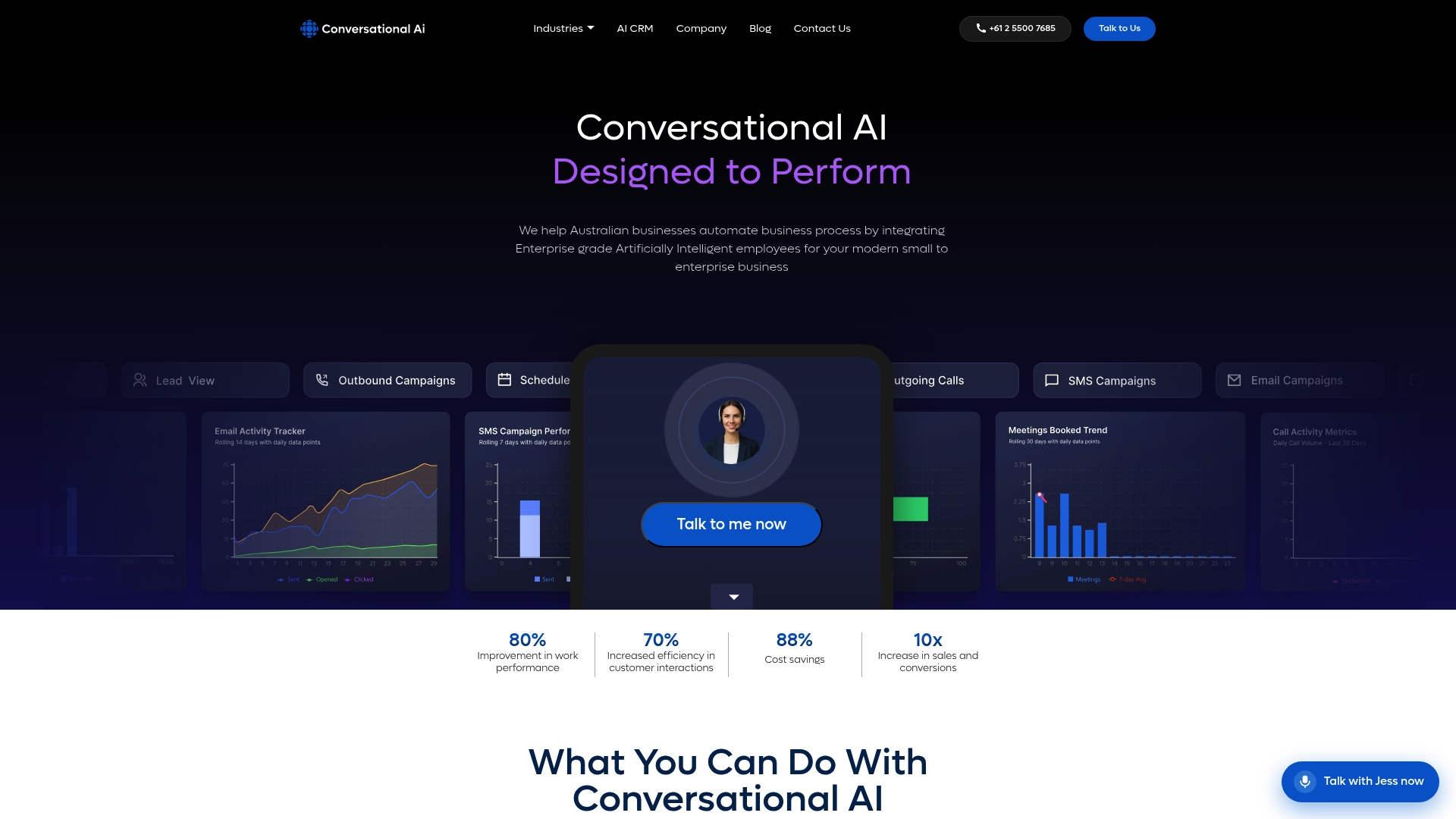
Conversational AI gives Australian businesses a private, locally hosted platform for voice, SMS, email, and live chat agents that work together from a single system. Whether you are in healthcare, finance, or professional services, the platform handles appointment booking, lead qualification, follow-ups, and customer service without the compliance risk of offshore data processing. Explore Conversational AI’s platform to see how it fits your communication mix.