AI Call Routing for Australia: Privacy Checks Before You Buy
See how AI call routing identifies intent, passes context, and handles unclear requests, with Australian privacy, procurement, testing, and KPI checks.

Intelligent call routing AI listens to what a caller actually says, works out the reason for the call, and sends them straight to the right team with context attached. The payoff is fewer transfers, shorter handle times and fewer repeat calls. None of that happens automatically though: it takes careful testing, clear fallback logic and proper human oversight to get right.
TL;DR:
- Keep intake to a few questions, simplify intent branches, and pass the caller’s name, reason, and relevant account context to the receiving agent.
- After one clarifying question, route a second unclear response to a general queue or receptionist; test frustrated callers and attempts to skip questions.
- A study found roughly 53% fewer transfers and 13% lower average handle time when complex contacts reached suitable agents, but results depend on call mix.
- Judge performance by resolution and repeat contact rates, not transfer counts alone, and log each call’s intake, handoff context, and outcome during the pilot.
- Before launch, check product testing, human review thresholds, vendor access to organizational data, and whether caller inferences count as personal information requiring lawful collection.
Table of Contents
- How AI call routing works: intake, intent and context handoff
- Key features to expect and why they matter
- Benefits and the KPIs that prove it’s working
- Implementation checklist and testing plan for pilots
- Privacy and procurement essentials for Australian organisations
- Monitoring and continuous optimisation for adaptive routing
- Publisher perspective: what sensible routing projects prioritise
- How our platform supports intelligent call routing
- FAQ
- Sources
How AI call routing works: intake, intent and context handoff
A typical call starts simply. The caller dials the main number, and instead of a maze of touch-tone menus, an AI voice agent asks a brief, natural question: what are you calling about, and who are you? Good implementations keep this intake short, with only a few questions, because every extra question adds friction and increases the chance a caller hangs up or mashes zero out of frustration (Aircall Help Center).
Behind that short conversation sits an intent classification layer, often built on a large language model, that maps what the caller said to a specific transfer branch. Research into LLM-driven routing has found that how intents are represented matters enormously: flattening complex IVR paths into simpler structures improved routing accuracy to around 89% in one study, compared with verbose, hierarchical menu descriptions that confused the model (Beyond IVR Touch-Tones). Adding too much extra training data without care can also introduce noise and hurt precision, so simplicity tends to win.
Once intent is classified, the system does not just dial a number. It passes context, the caller’s name, company and stated reason, so the receiving agent starts the conversation already briefed instead of asking the caller to repeat themselves (Aircall Help Center).
Good systems also plan for ambiguity:
- If intent is unclear, the system asks one clarifying question before giving up.
- A second unclear response triggers a defined fallback branch, usually a general queue or receptionist.
- A successful transfer is never assumed to mean the caller’s problem was solved.
That last point matters more than it sounds. Treating “the call transferred” as the finish line, rather than tracking what happened after, is one of the most common blind spots in routing projects (Aircall Help Center).
Key features to expect and why they matter
When comparing routing products, look past the demo and check for these operational capabilities:
- Skill-based routing with complexity prediction: some systems predict how complex a contact will be before it’s even answered, so harder issues go to senior agents instead of landing randomly (Arxiv).
- Omnichannel routing and CRM integration: the routing decision should use caller metadata already on file, and the receiving agent’s screen should populate automatically with history and context.
- Natural-language intake instead of rigid IVR menus: concise, well-structured prompts improve how accurately an LLM maps what a caller says to the right destination (Beyond IVR Touch-Tones).
- Plain-language trigger conditions: administrators should be able to write and adjust routing rules without needing a developer, and structured context fields should flow straight to agent desktops (Aircall Help Center).
- Confidence thresholds and human oversight: fallback branches and a human-in-the-loop check reduce the risk of a caller being misrouted with no safety net (OAIC).
Pro Tip: Ask any vendor to show you what happens when the system is unsure, not just what happens when it gets the intent right.
Benefits and the KPIs that prove it’s working
The case for AI call routing rests on measurable operational gains: fewer transfers, lower average handle time, better first-call resolution and, where appropriate, a higher IVR containment rate.
One experimental teacher-student complexity routing framework cut transfer rates by around 53% and reduced average handle time by roughly 13% when high-complexity contacts were directed to appropriately skilled agents from the outset (arxiv.org). That’s a meaningful signal of what well-tuned routing can achieve under the right conditions, though results from any pilot will depend on your call mix and existing processes.
To set targets and track progress, use consistent KPI definitions:
- IVR containment rate: the share of inbound calls resolved entirely within the IVR or voice response system, without needing a live agent (OpsDog).
- Transfer rate and multi-transfer rate: how often calls move between agents or teams, and how often they bounce more than once.
- Average handle time: total time spent per contact, from intake through resolution.
- Repeat contact rate: how often the same caller has to call back about the same issue.
Resolution and repeat contact rate matter more than transfer count alone. A call that transfers cleanly but doesn’t solve the caller’s problem is still a failure, even if it looks efficient on paper (Aircall Help Center).
Implementation checklist and testing plan for pilots
Before rolling AI routing out across every inbound number, run a structured pilot. The steps below keep risk low while you validate that the logic actually works for your callers.
- Map out distinct transfer branches and write trigger conditions in plain language, so non-technical staff can review and adjust them (Aircall Help Center).
- Keep intake to a few questions, and decide which fields, name, reason, account number, actually need to travel with the call (Aircall Help Center).
- Test three types of paths: happy paths where the caller answers clearly, fuzzy paths where intent is ambiguous, and unhappy paths where the caller tries to skip questions or sounds frustrated (Aircall Help Center).
- Launch outside peak hours first, and clone the routing agent per phone number if different lines need different logic (Aircall Help Center).
- Log every intake, transfer context and outcome so resolution and repeat contact rates can actually be measured, not assumed (Aircall Help Center).
- Document data handling before launch: what’s collected, how long it’s retained, who can access it, and what confidence threshold triggers human review, so privacy and procurement teams can sign off (OAIC).
If your pilot also involves reconfiguring inbound numbers or forwarding rules, it’s worth understanding how call forwarding behaves at the carrier level before you layer AI routing on top; guidance on setting up call forwarding covers the practical side of number configuration that often gets overlooked.
Privacy and procurement essentials for Australian organisations
Buying AI routing software is a governance decision as much as a technology one. The Office of the Australian Information Commissioner sets out what organisations should check before adopting a commercially available AI product: whether it’s been tested for its intended use, whether training data suits your actual customer base, and whether meaningful human oversight is built in rather than bolted on.
Two points deserve particular attention. First, vendor terms should be reviewed for whether the developer can access your organisational data, not just whether your staff can. Second, AI-generated inferences, including guesses about a caller’s identity, intent or state of mind, can themselves count as personal information, so collection needs to be reasonably necessary, lawful and fair (OAIC).
Plan for ongoing audits, staff training and ongoing monitoring, not just a one-off compliance check at launch. For a deeper look at data residency specifically, our guide to preventing offshore data transfers walks through the practical side of that assessment.

Monitoring and continuous optimisation for adaptive routing
Routing accuracy isn’t a set-and-forget outcome. Academic work on enterprise contact routing describes a shift from static rule sets toward adaptive systems that use outcome signals, resolution, transfer count, escalation, to retrain or retune routing decisions over time (International Journal of Computational and Experimental Science and Engineering).
In practice, that means watching for confusion patterns: intents the system consistently misclassifies, or routes that quietly underperform. As noted earlier, simpler path representations tend to improve mapping accuracy in LLM-driven systems, so revisiting how routes are described is often more useful than adding more training examples (Beyond IVR Touch-Tones). Some teams also track a Complexity AUC metric, which measures whether genuinely complex contacts are actually reaching appropriately skilled agents rather than being routed on intent alone (arxiv.org).
Whatever the sophistication of the model, keep human override and confidence thresholds in place as the system adapts, so nobody loses visibility into why a call went where it did (OAIC).

Publisher perspective: what sensible routing projects prioritise
We think the organisations getting real value from AI routing are the ones treating it as an enterprise system first and a convenience feature second. That means private hosting, tight CRM integration and enterprise-grade controls, especially for regulated customers in healthcare, finance or professional services, where a misrouted call carries more weight than a minor inconvenience. The implementation checklist above works well as a procurement readiness tool in its own right: if a vendor can’t answer every item on it clearly, that’s worth noting before contracts get signed. We’re always happy to talk through pilot scoping and integration questions, whatever stage your evaluation is at.
— Sowrabh
How our platform supports intelligent call routing
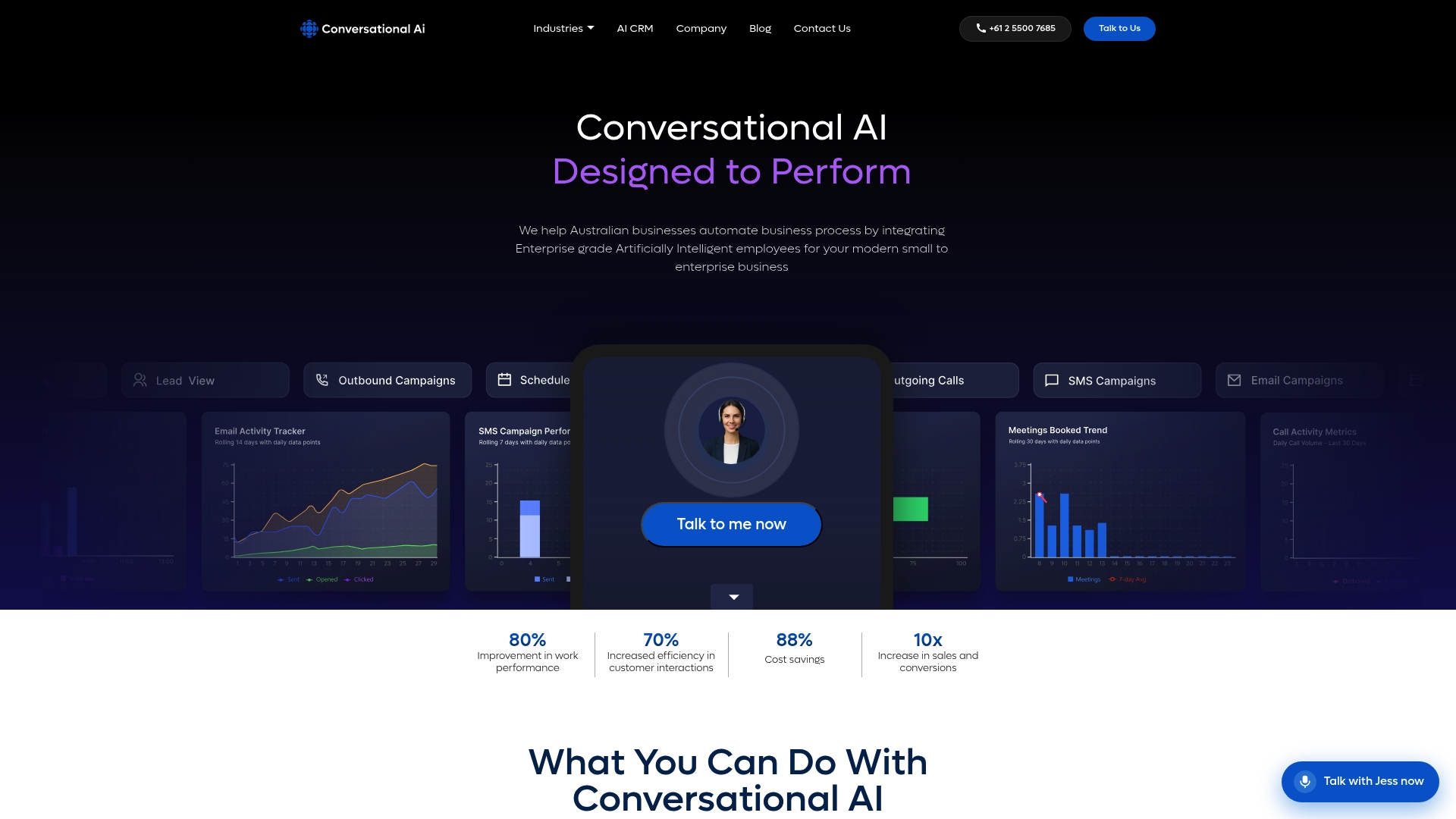
We built our platform as a private, Australia-hosted conversational AI system specifically because regulated organisations need routing decisions they can explain, audit and control end to end. Our Voice AI Agents support intent-based routing, so callers can be directed to the right team.
What that looks like in practice:
- Native integration with your existing Conversational AI CRM setup, so caller history travels with every transfer.
- Governance controls built for sectors like healthcare, banking and finance and professional services.
- Options including on-premises deployment for organisations with stricter infrastructure requirements.
If you’re scoping a pilot or want to see how routing and CRM context work together, we’d welcome the conversation.
FAQ
What is intelligent call routing AI?
Intelligent call routing AI uses natural language understanding to work out why a caller is ringing and sends them to the right team or agent automatically. Unlike traditional touch-tone IVR, it understands spoken or typed reasons for calling and can pass context like name and account details along with the transfer (Aircall Help Center).
How does AI call routing differ from traditional call routing?
Traditional routing relies on fixed menus and touch-tone selections that force callers into predefined categories. AI routing instead classifies intent from natural speech, which research shows can reach high accuracy when routing paths are kept simple rather than deeply hierarchical (Beyond IVR Touch-Tones).
What is a good IVR containment rate?
IVR containment rate measures the share of inbound calls fully resolved within the IVR system without needing a live agent, calculated as contained calls divided by total inbound calls (OpsDog). What counts as “good” depends heavily on call type and industry, so it’s best benchmarked against your own baseline rather than a single universal figure.
What privacy checks does an Australian business need before adopting AI call routing?
Organisations should confirm the product has been tested for its intended use, that meaningful human oversight exists, and that vendor terms don’t allow unexpected developer access to organisational data. The OAIC also notes that AI-generated inferences about callers can count as personal information, so collection must be reasonably necessary and lawful (OAIC).
How many intake questions should an AI routing system ask?
Documented production flows generally keep intake to a few questions before classifying intent and transferring the call. Asking more increases the risk of caller drop-off and adds unnecessary friction before the call even reaches an agent (Aircall Help Center).
Sources
- Aircall Help Center | Replacing your traditional IVR with a conversational routing AI Voice Agent
- Guidance on privacy and the use of commercially available AI products | OAIC
- Beyond IVR Touch-Tones: Customer Intent Routing using LLMs
- Arxiv